



logo
EverydayChaos
Everyday Chaos
Too Big to Know
Too Big to Know
Cluetrain 10th Anniversary edition
Cluetrain 10th Anniversary
Everything Is Miscellaneous
Small Pieces cover
Small Pieces Loosely Joined
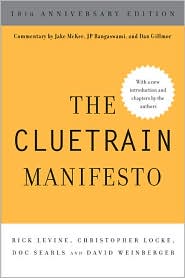
Cluetrain cover
Cluetrain Manifesto
My face
Speaker info
Who am I? (Blog Disclosure Form) Copy this link as RSS address Atom Feed

December 30, 2002

Mitch on Digital ID

Mitch Ratcliffe comments on the email thread about digital ID. Among other points:

… the basic problem with your debate [is] that it assumes the policy will be arrived at by companies bargaining with one another and, finally, once the dance of the giants is finished, offered to customers as a fait accompli. … People own their identities and should continue to own them as they migrate into electronic environments

I don’t think any of us disagree with Mitch that individuals should own their identity. I take that for granted. My concern has been more with: (1) The imposition of ID schemes top-down rather than continuing to grow bottom-up solutions to actual problems, and (2) What we would gain and lose with a strong digID system in place. The first concern sounds like it maps to Mitch’s imperative (“Thou Shalt Own Thy Identity”) but need not: it’s conceptually possible to impose a top-down identity scheme that enables us to own our identities. It’s just politically less likely since the people doing the imposing have an interest in taking custody of our IDs for us. How thoughtful of them.

Tweet
Follow me

Categories: Uncategorized Tagged with: web Date: December 30th, 2002 dw

Be the first to comment »

December 29, 2002

Digital ID Thread

In response to Eric’s
musings
,
Doc
, Bryan, AKMA, Kevin and
I
have been engaged in an email thread. With
their permission, I’ve bundled together the
messages, with some very minor cleanup (e.g.,
removing signoffs, etc.). You can read the loosely-raveled thread here.

Tweet
Follow me

Categories: Uncategorized Tagged with: uncat Date: December 29th, 2002 dw

3 Comments »

The Daypop Effect

Much as I love DayPop, I can see that I’m contributing to its inaccuracy. If I see a link that’s in the DayPop Top 40, I won’t blog it unless I have something particular to say about it for I figure it’s being blogged all over the place anyway.Thus, according to the Law of Inconspicuous Fame (“True fame extinguishes mentions”), height and persistence on the Top 40 tends to defeat itself.


Try out the Technorati Sidebar. Plunk in an URL and it will show you all the blogs that refer to it. (Well, all the blogs that Technorati tracks: 18,178 of ’em at last count.)

Tweet
Follow me

Categories: Uncategorized Tagged with: web Date: December 29th, 2002 dw

3 Comments »

December 28, 2002

Imperfecting Life

On page one of the Boston Globe this morning is the announcement that a crackhead religious group claims to have cloned a human, perfectly and flawlessly reproducing someone’s DNA. On page 9 of the Living/Arts section is an article by Randy Lewis that first appeared in the LA Times that says that Eminem, Toby Keith and the Transplants all have added analog-sounding crackles and pops to their CDs so that they’ll sound as good as the old vinyl LPs.

For millennia, the distinction between human beings and God was that we’re imperfect. In the age of digital machines, increasingly that’s the line between being human and being technology.

Q: How many human institutions exist to deal with our imperfections?
A: All of them.
Each is informed by the fact that not only are the participants imperfect, but the system itself is fallible. No wonder we flounder with our own perfect inventions.

Tweet
Follow me

Categories: Uncategorized Tagged with: philosophy Date: December 28th, 2002 dw

2 Comments »

December 27, 2002

More from Eric

Eric paints a plausible scenario of what the Net will look like once strong digital IDs are in place, and then he scares the crap out of us by pointing to Verisign’s new “consumer authentication system,” currently being tested by eBay, that checks “50 best of breed data sources (personal, credit, demographic and black list information) to cross verify and risk rank consumers.”

Blacklist???? Whose? How you get on? How do you get off? So, now Verisign’s automated credit check will evaluate whether you have the standing to buy cotton doilies from eBay based on blacklists that come from unspecified somewheres. Anyone who’s dealt with Verisign’s ability to handle exceptions when it comes to domain names knows that Kafka was being optimistic.

This by itself should count as an argument against instituting “strong” digital IDs.

Tweet
Follow me

Categories: Uncategorized Tagged with: web Date: December 27th, 2002 dw

4 Comments »

DigID and DRM

Lord bless Bryan Field-Elliot over at NetMeme. Bryan is a founder of PingID,

a member-owned, technology-neutral network that is facilitating the business framework necessary for the accelerated deployment of federated identity services.

He’s also a straightforward guy. In response to Doc‘s call for “full-power” digital IDs in order to give power back to “consumers,” Bryan writes:

There’s an important relationship here with DRM (Digital Rights Management), which I think has been danced around quite enough, and should be brought into the spotlight. The relationship is, quite simply, that “Strong Identity” (what Doc calls “full power”) is synomymous with Digital Rights Management. You can’t have one without the other.

Why not? Bryan explains:

In both cases, one party (individual, or content megaconglomerate) produces digital content (personal info, or a $100mln movie), and makes it available for consumption by other parties, but only with some assurance that the information won’t be copied or applied in undesired ways. The two problem patterns, and their range of solutions, appear pretty much identical to me.

…by the nature of information (which “wants to be free”, it’s said), we can never have Doc’s “full power” identity infrastructure without some enforcement teeth.

As far as I can see, only hardware enforcement, or legal enforcement, will provide such a bite, and in both cases, likely to be circumventable by the sufficiently determined.

It’s good to see the relationship of DRM and digID made explicit. Too often those pushing for digID avoid acknowleding the relationship.

So, let’s get yet more clear about the relationship of DRM and digID. Bryan is not saying (I assume) that the two can’t be distinguished the way you can’t separate “automobile” from “car” or “wet” from “liquid water.” Rather, he says, “you can’t have one without the other.”

And here I disagree. We could have digIDs that are used solely for enabling us prove we’re the one that sent an email, to enable online voting, and to prove that we are the holder of the credit cards we use to buy stuff online. And, as Bryan acknowledges, we can have DRM without digID; DRM just wouldn’t “have teeth.”

But it all depends on what you mean by teeth. Bryan says he accepts “legal enforcement” as a type of tooth. You don’t need digIDs to crack down on pirates who are taping movies on their first day of release and posting the files on the Net or to arrest the pirates who are mass producing bootleg CDs. You can even crack down on Kazaa “super nodes” or students at the Naval Academy who are downloading MP3s. You only need digIDs if you want to make it technologically nigh impossible to do what you want with the content you’ve downloaded. You only need digIDs if you want your ownership rights to be regulated at the bit level by the people from whom you’ve bought the content. You only need digIDs if your idea of DRM is CPPSROSE: “Content Providers’ Post-Sale Rigid and One-Sided Enforcement.” For more reasonable digital rights management we don’t need digIDs.

So, it’s good to surface the fact that when many people talk about digital IDs, they’re often really talking about DRM. But, IMO we need to be damn sure not to define DRM solely as the right of content providers to prevent us from using the content we’ve bought in the ways we see fit within the bounds of law.

Now Bryan, who understands this stuff 100x better than I, can set me straight…


Bryan’s posted a response. Here’s what he says (from an email to me):

I think we disagree mostly because I didn’t make clear enough in my original post, the difference between using DigID to “prove who you are” (what we do today), vs. using DigID to “control others’ use of your personal info” (which we don’t have today, and which Doc has variously named “Strong Identity” or “Sovereign Identity”). I believe, your response to me assumes I’m comparing the former to DRM, when actually I’m comparing the latter to DRM.

In his blog, Bryan says: “In classic security terms, we’re talking about taking authentication as a given, and moving up the chain to a flexible authorization system for access to personal information.” DRM gives the vendor the ability to authorize our use of the goods we buy, so I can see that formally digID and DRM are the same. Thanks for the clarification, Bryan (and did I get it right?).

Tweet
Follow me

Categories: Uncategorized Tagged with: uncat Date: December 27th, 2002 dw

Be the first to comment »

Adapation Review

I’ve reviewed Adapation, the Charlie Kaufman comedy, over at Blogcritics.

(There’s one howlingly incoherent sentence in the third paragraph where apparently I pressed the “Insert Gibberish” key instead of the “Delete” key. And since I’m temporarily locked out of the site, I can’t fix it. Sorry.)

Tweet
Follow me

Categories: misc Tagged with: misc Date: December 27th, 2002 dw

Be the first to comment »

University of Phonyx

The University of Phoenix spams me about once a day. For example:

We are closer to you than you might think. Go to http://oz.valueclick.com/r/hs0243102/a0070077/0 to check the location nearest you. University of Phoenix is the nation’s largest private university.

—————————

You are receiving this email because you have opted-in to receive email from publisher: swelldeals. To unsubscribe, click below:http://u2.%host%/?z=95-2047662-ByRumS

Ah, yes, the mark of a truly excellent institute of higher education is that it gets its spam list from swelldeals.com. (No, I never “opted-in.”) Well, that’s what happens when you hire carney folk to administer your college.

Tweet
Follow me

Categories: Uncategorized Tagged with: web Date: December 27th, 2002 dw

3 Comments »

December 26, 2002

The Net and Continuity Campaigns for … Oops, Gotta Go Retch

Cory Treffiletti in Online Spin writes about the possibility that the Internet has become a mature enough medium that it can provide “continuity” with a company’s mainstream broadcast campaign:

Maybe the Internet has actually become the best medium for running a continuity campaign, to sustain the message conveyed in Television and is clearly the second most important medium in conveying a message to the consumer?

After noting that 134M people in the US are online, he writes:

Given that the prices for Interactive media are so low, and that online ad spending has surpassed out-of-home and is quickly catching up on radio regardless of the cost cutting, it stands to reason that marketers are realizing this medium is indeed a great opportunity for reaching a mass audience effectively and generating a response.

You can’t argue with that! Well, except maybe to say: Noooooooo! Online marketing is almost always like handing out business cards at a wedding.

Will someone just send Treffiletti a copy of Gonzo Marketing already?

Tweet
Follow me

Categories: Uncategorized Tagged with: web Date: December 26th, 2002 dw

1 Comment »

I Am Not and Never Have Been a Hippie (Except 1968-1976 and weekends through the early ’00s)

Eric‘s posted more in his on-line writing project. It’s damn fun watching his essay evolve.

And now for my daily quibble with it. He writes that in our previous blog entries Akma and I point
toward the inefficiency of the Net not being a bad thing.” He replies: “I don’t think it is either, from the humanities perspective.” So let me be clearer: I am not presenting a hippie point of view when I say that the Net’s inefficiency at the packet level is the source of its strength. It has nothing to do with “bits just wanna be free, man.” It has everything to do with measurable, quantifiable decisions about how to build a network that is robust and insanely scalable. So don’t go tarring me with that hippie brush, man. Now, where’d I put my bong?

And how does this apply to economics? I don’t know nothing about economics, nevertheless the point I was trying to make was that the Internet’s greatest economic strength – and its strength in building markets – has been in ventures that are bottom-up, do the job well enough, and are highly specific to a problem. Many of the attempts to impose digital IDs fail all three criteria.

I agree with that old hippie, Akma:

But this returns me to my perpetual refrain that we need a new business model, not a new way of enforcing the old. RIAA and Hollywood might like to use DigID to ensure that one and only one person has the right to listen to my copy of Yankee Hotel Foxtrot—but if DigID is going to function as a weapon for enforcing the perpetuation of an obsolescent business model, than we’re much better off without it. Kevin knows this, and is touting Mediagora


And while I doth protest too much about not being a hippie, here’s a comment from Aaron Kinney’s year-end round-up of TV for Salon (for-pay edition).

… reminded us that television is the best medium for disseminating propaganda, as it served as the premiere for the Bush administration’s ad campaign claiming that anyone who purchases marijuana may be financing terrorists. I humbly submit that, rather than shifting blame for mass killing and a national security fiasco onto recreational pot smokers, the administration should maybe shut the fuck up and think about tracking down Osama bin Laden.

Don’t bogart that cultural revolution, muh friend.

Tweet
Follow me

Categories: Uncategorized Tagged with: web Date: December 26th, 2002 dw

9 Comments »

« Previous Page | Next Page »


Creative Commons License
This work is licensed under a Creative Commons Attribution-NonCommercial-ShareAlike 3.0 Unported License.
TL;DR: Share this post freely, but attribute it to me (name (David Weinberger) and link to it), and don't use it commercially without my permission.

Joho the Blog uses WordPress blogging software.
Thank you, WordPress!