


logo
EverydayChaos
Everyday Chaos
Too Big to Know
Too Big to Know
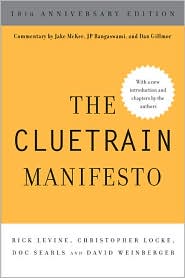
Cluetrain 10th Anniversary edition
Cluetrain 10th Anniversary
Everything Is Miscellaneous
Small Pieces cover
Small Pieces Loosely Joined
Cluetrain cover
Cluetrain Manifesto
My face
Speaker info
Who am I? (Blog Disclosure Form) Copy this link as RSS address Atom Feed

December 24, 2002

More to and fro Norlin

Eric is continuing his experiment in thinking out loud. He’s refined his original argument about the Net’s effect on the economy. It’s too rich a chunk to chew all at once, so I’ll just nibble at it. (Even though I’m about to disagree with him, this isn’t a “He’s Wrong!” sort of disagreement but an attempt to understand better by pushing back a bit.)

Eric begins by saying that the Internet is inefficient when it comes to managing reputations. Maybe, but so what? The Net’s strength is its inefficiency. A more efficient network would queue bits in order of importance, pre-compute routings, etc. So long as the bits are getting there, who cares if it’s the most efficient route? I worry that strong digital ID systems over-build in the name of efficiency and completeness.

The fact is that the Net has actually done an impressive job of building reputation management systems where they’re needed: eBay, Amazon, epinions all do a good enough job of it. Home pages and weblogs are another sort of reputation system. So, if there’s a market waiting to happen if only we had a reputation system, then why hasn’t someone already built one on the edge of the Net?

And the same goes for digital IDs themselves. If the need is that great, then why hasn’t it been solved? (I don’t mean this in a neener-neener way. I mean it as a real question.) Yes, we need strong digital IDs to enabling online voting. But I can already buy anything I want online by using my credit card. I have passwords at a zillion sites and a little password note pad that reminds me of what they are. My fear is that by trying to build systematic ID systems that don’t spring from particular applications, we’ll over-engineer a solution to a problem that doesn’t need that much solving.

And since over-solving this problem would benefit powers that would recentralize the network, there are additional reasons to aim for inefficient, minimal digital IDs.


Also, Eric makes a passing reference to an idea that sounds fascinating: “… property rights exist (at some economic level) to simplify the exchange.” He credits this to Frank Field. I hope Eric expands on it.


Doc is waxing wise in his response to Eric, although I think that in Doc’s terms I don’t want identity services to be “Net native.” I want them on the edge. I suspect Doc does, too, and we’re disagreeing only verbally.

Tweet
Follow me

Categories: Uncategorized Tagged with: web Date: December 24th, 2002 dw

Be the first to comment »

Nova Matrullo

A hearty virtual hug to Tom and Wendy, and a gentle embrace for Sawyer James. Congratulations!

Tweet
Follow me

Categories: misc Tagged with: misc Date: December 24th, 2002 dw

Be the first to comment »

Impenetrable Interview with Me

I wax incomprehensible in an interview at the SXSW site. Jon Lebkowsky asked good questions. I drove down the road into thickets every time.

I’ll be keynoting the SXSW Interactive conference in March. I’ll be using PowerPoints because, as is well known, PowerPoint prevents presentations from wandering into the deep end of the pool. That’s why we use ’em.

See you in Austin?

Tweet
Follow me

Categories: Uncategorized Tagged with: web Date: December 24th, 2002 dw

Be the first to comment »

Free History of Telecom

Bruce Kushnick’s book, “The Unauthorized Bio of the Baby Bells,” is available as a free download via the Teletruth organization. I haven’t read it yet, but I’m looking forward to it. Why, it even has an introduction by the redoubtable Bob Metcalfe!

Tweet
Follow me

Categories: Uncategorized Tagged with: tech Date: December 24th, 2002 dw

1 Comment »

The Closed Source of Open Source

Today’s Boston Globe has a history of the Open Source movement by Laurence Schorsch that’s quite positive, citing it as a threat “peering over the horizon … that just might topple Microsoft.” Appropriately, it begins with Richard Stallman’s contribution. Yet, although Linus Torvalds and Eric Raymond are interviewed, local-boy Stallman isn’t. The second to last paragraph explains why:

(Stallman declined to be interviewed for this article unless we promised to call the operating system “GNU/Linux” instead of the more common “Linux.”)

Every time Stallman interrupts a conversation to insist that people change the way they speak, the damage he does to the social values GNU was created to support are mitigated only by the impression that he’s nuts.

Language: The ultimate open source project.

Tweet
Follow me

Categories: Uncategorized Tagged with: web Date: December 24th, 2002 dw

Be the first to comment »

December 23, 2002

Norlin on Norlin

Eric gives a fast, breezy, and fascinating story of his life so far. and then responds to AKMA. Great framing of the current controversy Eric started by publishing the rough draft of his thoughts. Also, Eric makes the important point that as companies increasingly require us to have an in-house ID, we’re getting used to the notion of having one out on the big bad Web.

I do take exception to his saying that I’m among those insisting that digital ID can’t capture my soul, man. I’ve instead been insisting that the only thing “digital identity” has in common with “personal identity” is the use of the word “identity.” The problems I have with digital ID have to do with its importance (Eric thinks it’s the linchpin to the new economy), who will own it, and how easy it will be to abuse.

Tweet
Follow me

Categories: Uncategorized Tagged with: web Date: December 23rd, 2002 dw

2 Comments »

Two Towers, Much Fun

= saw “The Two Towers” yesterday with eight 12-year-olds who didn’t get up once in the 3 hours to go to the bathroom.

What more could you want in this type of movie? Adventure, bravery, characters with inner struggles, lots of story line, astounding scenery, amazing graphics…

Well, now that you mention it: Since I don’t care about fidelity to the source, I wish the movie were less sexist. And does it say anywhere in the books that the human characters are all white?

Tweet
Follow me

Categories: misc Tagged with: misc Date: December 23rd, 2002 dw

9 Comments »

POMO Programming

Dethe has found a very funny … well, here’s the relevant excerpt from the email he sent me:

…there’s a wonderful paper on Postmodern Programming. The authors presented this at OOPSLA last month, and it was one of the highlights of the conference for me. My favorite part is when they define the essence of the PoMo programming language: Languages get defined by the problems they solve. The first exercise for many programmers is to compute the first thousand prime numbers. Here’s their solution:

http://www.google.com/search?q=first%20thousand%20primes

I thought you’d enjoy that, seeing as how it combines PoMo, Google, and a wickedly funny smack on the head in one go.

My friend Paul English, when asked if he knows someone’s phone number, has been known to reply: “Yes. It’s 411.”

Tweet
Follow me

Categories: Uncategorized Tagged with: web Date: December 23rd, 2002 dw

Be the first to comment »

Prediction Marketing

Scott Kirsner’s always readworthy column in the Boston Globe (here today, gone tomorrow) has a table with predictions by seven leading Boston tech analyst companies. I’m assuming that these predictions were volunteered by the analysts and thus should be counted as marketing tools.

Analyst Prediction Comment
Aberdeen Group “Widespread rollout of WiFi high-speed Internet access in metropolitan areas will put telecom companies’ ‘dark fiber’ to use…” Safe but trendy: it got “WiFi” and “dark fiber” in a single sentence. (Won’t this be more like a sproutup than rollout?)
AMR Research “Companies will invest in ‘enterprise performance management’ software that supplies executives with real-time information…” Predicted every year for the past decade. Makes it sound like AMR has a big client in the “EPM” field.
Forrester “The DVD will be the last physical format for recorded entertainment. After that, it’s all delivered digitally…” Forrester gets the award for couching a provocative prediction in a mind-catching way.
Giga “PC and laptop market won’t recover until 2004 or 2005 despite revolutionary new chips from Intel and AMD” Ah, the “Courageously delivering bad news” approach. But loses marketing punch with the vague “2004 or 2005.” Giga might as well just say “Never.”
IDC “There will be a major cyber-terrorism event in 2003, perhaps in response to a war in Iraq.” Too Magic Eightball-y. Sounds like IDC is launching a Cyber-Security division. Besides, if there isn’t a cyber-attack in ’03, who’s going to go back to IDC to complain?
Patricia Seybold Group “Companies will use new technologies like Web services to become much more adaptive to customers’ changing needs.” Only if companies get forced brain transplants. Too transparently shilling for Seybold’s “Customer.com” brand.
Yankee Group “The advent of ‘portable’ cell-phone numbers which can be transferred from one carrier to another, will spark a price war in 2003, leading to unlimited voice-calling plans for $50 to $60 a month.” Solid, concrete prediction with numbers we can check in 2004. Since Congress mandated that portable numbers be available this year, it’s a fairly safe prediction.

Note: I have no predictions of my own to offer at this time. I wouldn’t dare.

Tweet
Follow me

Categories: Uncategorized Tagged with: web Date: December 23rd, 2002 dw

3 Comments »

December 22, 2002

AKMA’s ID

Akma, who is one of the funniest serious writers around, jumps into the Norlin Fray. He intuits, correctly in my view, that what’s motivating Eric more than anything is his interest in digital IDs.

Akma ably worries about one side of digital IDs: our persistent reputation on the Internet. What happens, he wonders, when we systematize that? What do we gain and what do we lose? The other side of digital ID, however, is the one that authenticates me in my online transaction. There’s little existential about such an ID. It’s really just a way of assuring that the money that’s about to transfer in fact comes from my real world wallet. Akma sees (or assumes?) a connection between these two:

If DigID is designed for users first, and only subsequently for commercial interests, then users won’t mind (much) sharing DigID with commerce. If DigID is designed for commerce first and thrust upon users, users will resist and evade.

I assume that these two IDs can be kept apart. But I wonder if I’m right.

Blogthread: These are the additional links Akma captures in the current Norlin blogthread: Doc Searls, Mitch Ratcliffe, Kevin Marks and me.


If it weren’t for the possessive, I could have had an all-caps title for this blog entry. Damn!

Tweet
Follow me

Categories: Uncategorized Tagged with: web Date: December 22nd, 2002 dw

9 Comments »

« Previous Page | Next Page »


Creative Commons License
This work is licensed under a Creative Commons Attribution-NonCommercial-ShareAlike 3.0 Unported License.
TL;DR: Share this post freely, but attribute it to me (name (David Weinberger) and link to it), and don't use it commercially without my permission.

Joho the Blog uses WordPress blogging software.
Thank you, WordPress!