


logo
EverydayChaos
Everyday Chaos
Too Big to Know
Too Big to Know
Cluetrain 10th Anniversary edition
Cluetrain 10th Anniversary
Everything Is Miscellaneous
Small Pieces cover
Small Pieces Loosely Joined
Cluetrain cover
Cluetrain Manifesto
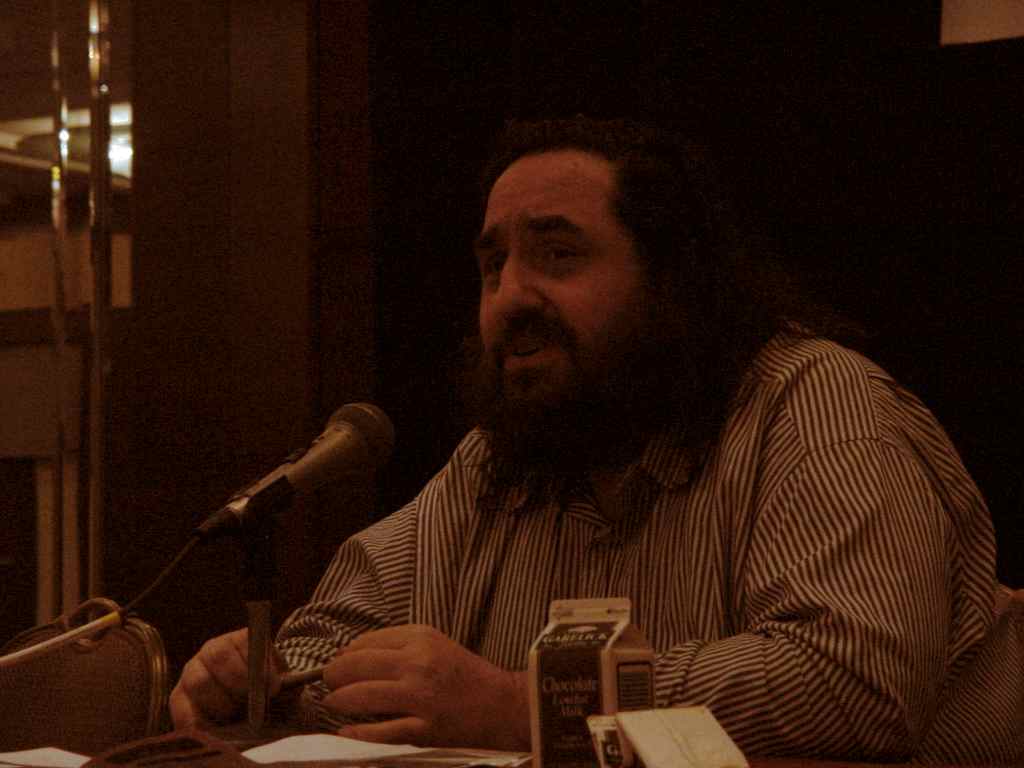
My face
Speaker info
Who am I? (Blog Disclosure Form) Copy this link as RSS address Atom Feed

May 25, 2002

Cherchez la French David Isenberg

Cherchez la French

David Isenberg has found an interesting French search site. It shows the results graphically, connecting the nodes to display, well, I have no idea what it’s displaying. But other people on the mailing list to which he sent the link seem to think that it’s quite helpful to those who didn’t sell their graphical lobes to artistically challenged millionaires in the early 70s. It’s called Kartoo.net and if it works for you, then I delight in your success.

Tweet
Follow me

Categories: Uncategorized Tagged with: uncat Date: May 25th, 2002 dw

Be the first to comment »

Another 2.5 Tools Ading to

Another 2.5 Tools

Ading to the list of simple tools for managing URLS and comments about URLs come two suggestions.

Phililp Webre recommends askSAM. But I’m a formerly happy user of surfsaver. It saves the entire page, not just the urls, which would be ok except that it does so in a proprietary format (or at least it used to) so that when it broke and askSAM couldn’t fix it, I lost all my data. I also got stuck in upgrade hell with them: couldn’t install the new, couldn’t get the old back…

Jonathan Peterson recommends Compass which looks pretty durn neat:

I love compass (), it can import/export opera, Netscape, IE bookmarks, you can do drag-n-drop and hotkey bookmarks, it autograbs meta tag info, but allows you to stick in your own comments as well. It works pretty well out of the box, but has a lot of customization features while still being pretty small and quick. I’ve got over 1500 bookmarks, in dozens of categories and subcats. One of the most powerful features is an HTML/XML export, which isn’t well documented, but lets you do stuff like: http://way.nu/bookmarks/, which I know I wouldn’t deal with otherwise.

The author is very responsive, I made a feature suggestion that he implemented with 2 months and I’ve managed to lose my serial number twice and he’s emailed it back to me.


James Sisk points us to a tool that he knows isn’t quite right but that looks interesting anyway. Hunter/Gatherer. In the words of the site: “Hunter Gatherer lets users select information of interest from within Web pages, and have those components collected automatically into a new web page.” It seems to be a research project and it is definitely not yet available.

Tweet
Follow me

Categories: Uncategorized Tagged with: uncat Date: May 25th, 2002 dw

Be the first to comment »

May 24, 2002

Link Reference Tools A few

Link Reference Tools

A few days ago, I asked people for suggestions for a simple tool that would let me save URLs and comments into folders. I heard from a few of you:

The ever-alert Chip recommends Treepad, a tool I had forgotten I’d downloaded a while ago. It’s small (470K zipped), it’s pretty friendly (the manual could use some work), and they have a workable version that’s free, as well as a more fully-featured versions you can pay for.

Gil Gilliam writes:

Have you looked at Zoot from www.zootsoftware.com ? It may be more than you want, but then again, you don’t have to use all of its features.

I had previous downloaded Zoot but it is a full featured “information processor” whereas I’m just looking for a place to stick some URLs.

Buzz Bruggeman at ActiveWords (and today the subject of an encomium by Doc) suggests:

Using ActiveWords simply name your URL’s according to a naming logic. For example all of the blogs’s I got to, I name “weblog”, then when I want to see them, I simply type, “weblog” trigger and see the list. Same for news, sports, research, travel, fun, etc. Real simple, real easy, and while only limited space for comments, they are only a word away, and also searchable inside ActiveWords.

ActiveWords has many things going for it, but it’s got too much if you just want to stick URLs into folders.

Doria Thodla (a name just dying to be anagrammed) of imorph recommends a service on her site:

It does not do all the stuff you want, but will let you put up a tool bar button, capture any URL you want, add a description, a set of keywords and will monitor the page for changes.

It is a service on our website (free for up to 10 pages)…

Please check it out at www.infominder.com

Kevin Marks comes in with a surprise suggestion: use the blogger bookmarklet tool. It doesn’t do exactly what I want, but it wins for Most Creative Suggestion.

So, for now it’s either Treepad or my home-brewed app. Thanks for the help, y’all!

Tweet
Follow me

Categories: Uncategorized Tagged with: uncat Date: May 24th, 2002 dw

Be the first to comment »

Epeus Takes Up the Telco

Epeus Takes Up the Telco Story

Kevin Marks thinks he’s disagreeing with my attempt to boil down the telecomm story. In particular, he thinks he’s disagreeing with “The Paradox of the Best Network,” the longer version David Isenberg and I wrote. But he’s not. I like a lot what Kevin says.

The supposed point of disagreement is that Kevin thinks Isenberg and I imply that “you can’t make money with a well-designed network.” Says Kevin: “It was a good soundbite, but wrong on a deeper level” because you can make good, steady money selling a commodity.

No argument! In fact, the heart of what we were saying is summed up in Roxann Googin’s phrase: “The best network [the “stupid” network that does nothing but move bits] is the hardest one to make money running.” Not impossible. Just hard. This is why the telco’s want to be in the added-value network business, not in the we-move-bits business.

So, Kevin and I are in agreement. And we also agree that Larry Lessig’s “The Future of Ideas” is really important; Kevin includes an extended quote from an article by Lessig in The American Prospect.

Sorry, Kevin, wish I could disagree…

Tweet
Follow me

Categories: Uncategorized Tagged with: uncat Date: May 24th, 2002 dw

Be the first to comment »

May 23, 2002

Doom III Not that I

Doom III

Not that I would waste my time playing violent games that glorify destruction and demean the human spirit while elevating a set of typically patriarchal values, but, damn, Doom III is looking good!

Tweet
Follow me

Categories: Uncategorized Tagged with: uncat Date: May 23rd, 2002 dw

1 Comment »

The Telecommunications Story At my

The Telecommunications Story

At my session at Connectivity 2002 yesterday (see my previous days’ blogs as well as Halley’s astute coverage including her pilloring of my presentation … and Dan Bricklin has just blogged his take on the conference), I asked the group to come up with ways of explaining to an intelligent layperson (well, a senator) what the technological argument is for fighting the incumbent telecommunication companies. The idea was to boil it down to the simplest possible story from the technological point of view. What’s the picture technologists should paint for the rest of us?

I’m nowhere near as up on this area as just about anyone you’ll meet, but it’s good to know that ignorance doesn’t deter me from making large-scale pronouncements. So, here’s what I would say:

Let’s just agree that the Internet is the best way our species has ever come up with for spreading free speech and free markets on a global scale. Screwing this up would be an epochal mistake. And, we want to make sure that we Americans don’t lock ourselves out of this arena, repeating the mistakes we made in, say, the auto industry. So, what do we do?

The Internet has succeeded because it Keeps It Simple, Stupid: it just moves bits around. And we want to keep it as a simple bit conveyer belt. That way, any bright new ideas someone has for products and services that can be done with bits — a little thing we like to call “innovation” — can count on the Net for getting bits from A to B with incredible efficiency.

But there’s a danger. The old types of networks have assumed that it’s always good to be tuned for particular applications — for example, a network specifically for telephone calls. But tuning a network for one type of application means that it’s “de-tuned” for others, and the strength of the Internet has been precisely that it just moves bits without caring what type of applications are sending the bits. To keep the Internet open for innovation we have to keep it the simplest possible “de-tuned” bit conveyer belt.

The temptation to tune the network is inevitable if control of it is given to a group that has one particular type of service to provide. That’s why it’s vital that we keep the provision of the network separate from the provision of applications that use the network. This has to be enforced at the technical level but also at the application, business and regulatory levels.

Yes, this doesn’t cover other vital issues such as free speech and the need to remove municipal regulations that hinder smaller competitors, but the aim is to keep this simple.

Comments, criticisms, suggestions, humiliating exposures of the fact that I am merely a poseur? Most important: Other ways of telling the story?

PS: I helped David Isenberg draft a similar sort of story at NetParadox. And at that site you’ll find links to “The Rise of the Stupid Network” and David Reed’s work on the End-to-End network that are behind this simple, stupid re-telling.

Tweet
Follow me

Categories: Uncategorized Tagged with: uncat Date: May 23rd, 2002 dw

Be the first to comment »

Thank you, Marybeth Peters Marek,

Thank you, Marybeth Peters

Marek, referring to an article by Doc in Linux Journal, suggests we send our thanks to Marybeth Peters, Register of Copyrights, for rejecting the CARP recommendation that would have killed Internet Radio. I called the Copyright Office and got her contact info:

Email: [email protected]
Fax: 202 707 8366

Marybeth, our love is on its way!

Tweet
Follow me

Categories: Uncategorized Tagged with: uncat Date: May 23rd, 2002 dw

Be the first to comment »

May 22, 2002

Halley Blogs The Conference If

Halley Blogs The Conference

If you want to see the benefit of not doing realtime blogging at a conference, compare Halley’s coverage of Connectivity 2002 with mine. She’s actually reflecting, summarizing, and picking out the parts worth making fun of (e.g., my presentation). I’m just typing.

Tweet
Follow me

Categories: Uncategorized Tagged with: uncat Date: May 22nd, 2002 dw

Be the first to comment »

David Isenberg’s Underwear On Tuesday

David Isenberg’s Underwear

On Tuesday at the Connectivity 2002 Conference, David Isenberg opened his talk by waving his underwear around and listing the metaphorical similarities between jockey shorts and telecommunications. So, on Wednesday morning during my session, I waved David Isenberg’s underwear around as the prize for coming up with the best way of explaining the telco mess in the fewest words. Yes, I was blatantly trading on the laughs Isenberg earned.

It was only on the way home that I realized that about 20% of the audience on Wednesday hadn’t been there on Tuesday and thus must have their own theories about why I would give Isenberg’s underwear away as a prize.

It reminds me of the time my sister-in-law Sue, a serious and seriously published novelist, was teaching an English course to college freshman. They were reluctant to speak up, so over the course of weeks, Sue used every technique she could think of to get them to open up. Finally, one woman – call her Mary – actually contested something Sue said, and Sue replied: “Mary, you ignorant slut!” There was a shocked silence for, of course, the students were too young to understand that this was a reference to an old Saturday Night Live skit. They sat there wondering why their professor was calling them sluts.

Tweet
Follow me

Categories: Uncategorized Tagged with: uncat Date: May 22nd, 2002 dw

Be the first to comment »

Connectivity 2002 – Wednesday Afternoon

Connectivity 2002 – Wednesday Afternoon


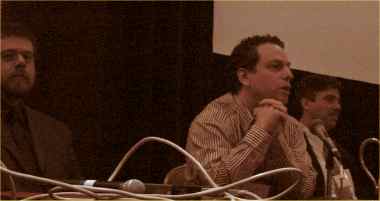
Keith, Joe and Lee

Panel: Open Communications Infrastructure: Cutting the Knot. Lee McKnight is talking, Prof. at Tufts. He says, there should be no regulatory distinctions local and national communications, wireline or wireless, narrowband or broadband, broadcast or switched. He’s presenting what he he thinks the new regulatory framework should be.

Keith Weiner, CEO of DiamondWare. He’s here to ruffle our feathers. Keith begins by stating the prevailing theory with which he’ll disagree: In theory we need to reign in the profit-hungry corporations, level the playing field and intervene to manage competition. People here would like to see hundreds of little companies competiting and would like to see the incumbents destroyed. But (now he’s stating his own views) there is no such thing as public interest because (on Ayn Randian grounds) there is no such thing as the public. But under the theory of “public interest,” the Bells are the ones who are delivering because they provide a universal service without tax money. (Fred from the audience says that the Bells don’t do rural delivery and it is subsidized by a tax.) Keith is trying to show equivocation on the word “power” that leads us to think that we need regulation to protect us. Microsoft doesn’t have the same sort of power as the Mafia; you can always go to a competitor. His point (as I understand it in response to a question from me) is that all regulation is bad and is only needed because of prior flaws in the system that prevent markets from being truly open and free; he would roll back the regulation and then attack the more fundamental problems (e.g., courts that favor incumbents with money). … Many ruffled feathers later, Keith wraps up: In a regulated environment, the richest gang wins, so fight against regulation.

[Must type louder to annoy Halley.]

Now Joe Plokin from Bway.net (a NYC ISP) and www.teletruth.org is up. He says we’re not looking at deregulation but demonopolilzation. TeleTruth is a consumer protection and advocacy group within telecommunications.


David Brustein looking more like Fidel
in the photo than he does in person.

Dave Burstein is leading a panel on “The Realities of the Local Access Bandwidth Bottleneck.” He’s reminding us of what’s at stake: our ability to decide what we want to put on the Net at prices we can afford, e.g., a broadcast of a church service. What is it that we want, he asks? The audience answers: Connectivity to be treated like a utility; as many people connected as quickly as possible (that was me).

How do we get there? In politics, you find allies and phrase the issues in their terms. Here are some potential allies:

  • Commissioner Kevin Martin at the FCC is a rigid conservative but he loves what the Net can do and doesn’t want parts of the country left out. He wants a better, faster Internet.
  • John Chambers and Andy Grove want to sell lots of equipment to do these great things on the Internet. Their TechNet initiative wants to deliver lots of bandwidth.

We can’t get there through a market full of small companies. .. [Damn, I have to duck out for a few minutes…] David is now suggesting various ways of getting cable to just about everyone, including a 30% investment tax credit to the Bells along with requirements that they open it up to other vendors. [Another phone call. I missed the ending. Too bad. It was interesting.]

Tweet
Follow me

Categories: Uncategorized Tagged with: uncat Date: May 22nd, 2002 dw

Be the first to comment »

« Previous Page | Next Page »


Creative Commons License
This work is licensed under a Creative Commons Attribution-NonCommercial-ShareAlike 3.0 Unported License.
TL;DR: Share this post freely, but attribute it to me (name (David Weinberger) and link to it), and don't use it commercially without my permission.

Joho the Blog uses WordPress blogging software.
Thank you, WordPress!