

logo
EverydayChaos
Everyday Chaos
Too Big to Know
Too Big to Know
Cluetrain 10th Anniversary edition
Cluetrain 10th Anniversary
Everything Is Miscellaneous
Small Pieces cover
Small Pieces Loosely Joined
Cluetrain cover
Cluetrain Manifesto
My face
Speaker info
Who am I? (Blog Disclosure Form) Copy this link as RSS address Atom Feed

May 22, 2002

Connectivity 2002 – Wednesday Morning

Connectivity 2002 – Wednesday Morning

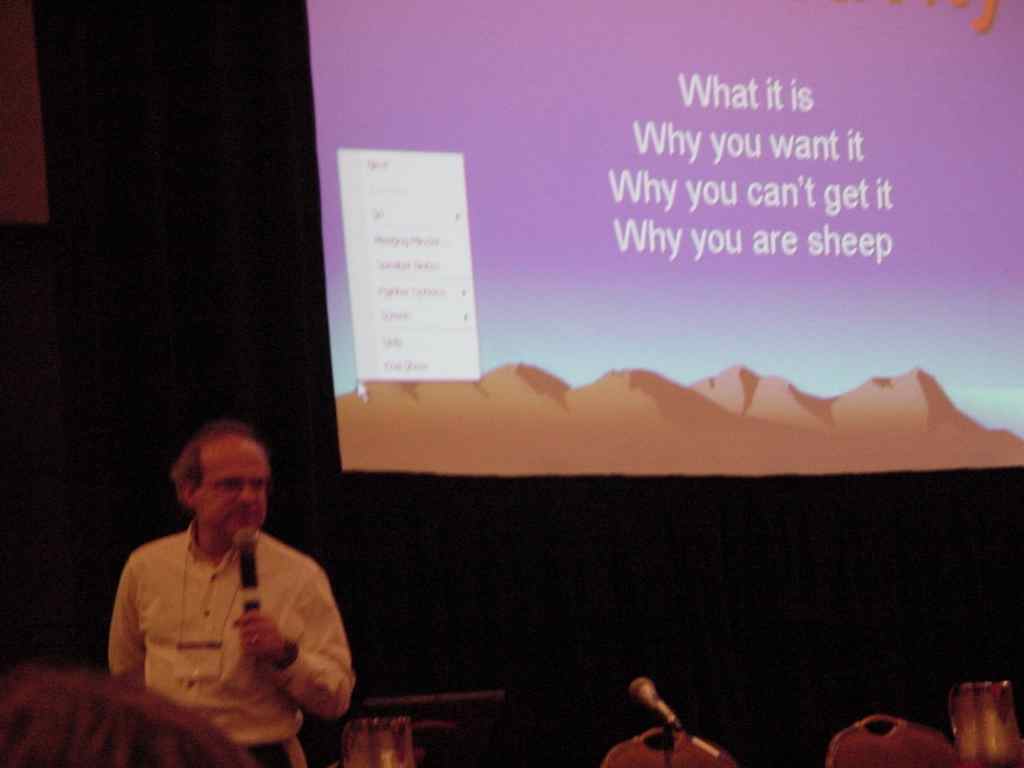
Back at the Connectivity 2002 conference. Bob Frankston is giving the morning’s introduction, boiling it all down. Here’s his slide:

Connectivity: The Concept

Separate transport from content
– Pack connectivity like the Internet
– Functions defined at the end point
Current situtation
– Inherent conflict of interest
– Egregious restrictions on free speech

Bob is pushing on his “More is More” (More’s Law) that says that you want to be in a situation where if you want more of something, you can buy more. This makes for a healthy market. But the current situation isn’t like that: if you buy more set-top boxes, you don’t get more channels or more choice. But it should be true for connectivity: if you buy more streams, you get more capacity. This puts connectivity into the market where market forces can work its magic. Currently, broadband, on the other hand, is a set capacity with no ability to buy more. That’s why Bob said yesterday that he considers broadband to be a distraction; we shouldn’t be worrying about delivering broadband but about building a market where capacity is subject to market forces.

We just broke slightly (as the projector reboots) to let newcomers introduce themselves. David Burstein from Vortex – a big time telecomm forum – just brought us greetings from Doc Searls and news that we may have allies in quarters such as Cisco that would benefit greatly from a rapid growth in connectivity.

Frankston: “The thing about companies is that it’s not against the law to kill them.” His slide says that we are not saying they should die, “only” that they should reinvent themselves.

Audience: How does this work in rural areas? And what about the expense of rights of way?

Me: Doesn’t the logic of “More’s Law” lead to paying by bit, which we agree would be a bad thing?
Frankston: No, that’d just be a bad business model. [So, More’s Law actually says that we should be able to buy more in increments that maximize the market. After all, we can buy “more” now by moving within the upload/download increments in cable, and moving from dial-up to cable to T1, etc.]
Frankston: Rights of way is part of the “nefarious conspiracy” to keep this so expensive that only the incumbents can win. And we should open up the problem of rural access through innovation.
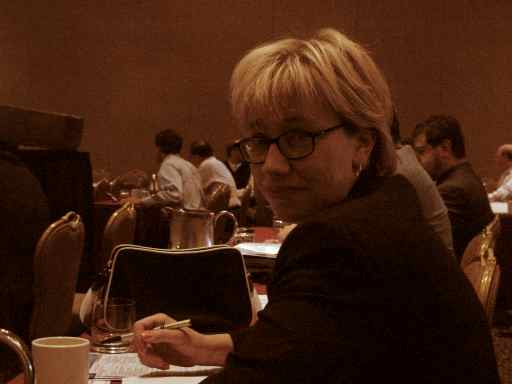

Halley Suitt takes a moment from blogging the conference…

Frankston: Content does have rights. And privileges. [I’m glad to see the conversation get down to the battle for the words that count.]

Bob is continuing to outline why breaking the hold of the “content providers” will open new business possibilities, e.g., aggregating content in flexible ways, etc. etc. I don’t need convincing on this point. But I’m also worried that we’re not seeing these new models already emerging. Some depend on greater access, but some – bands selling their own music over the Internet – could work now and yet haven’t caught on.

Frankston: “But it’s not all about entertainment. Some people have come to think that the purpose of the roof is to keep the rain off the television.”
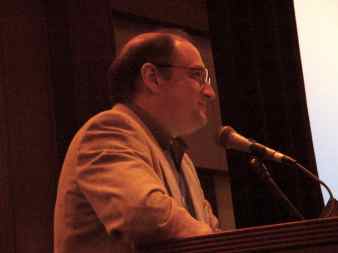


Bob DeRosa

Bob DeRosa, VP Mktg of American Fiber Systems, is up now. They design and develop metropolitan dark-fiber networks – fiber that can be used for whatever purposes the customer wants. (Thanks to David Isenberg for the explanation.) He’s explaining his competitive market: lots of groups (ILECs, CLECs, CATV, Gig-E players, utilities and more) are hooking wires up to your house. The “hidden competition” is the city itself: rights of ways, franchises and fees, permits, regulations and restoration demands. There’s some wiggle room, but “given the regulatory environment, competitors of any stripe are at a major disadvantage when competing against incumbents…”


I’m up supposedly up next leading a panel on “What the Fuck Do We Do about It?” Because this topic has come up pretty consistently in other panels, I instead, I want to have the entire group try to come up with the story by which we can explain the technological reasons for keeping the Net open. Divide into small groups, report back to the total group … the entire yechy, touchy-feely, marketing-offsite-meeting thing.

…Ok, I’m finished. We broke into groups and reported back. I can’t say that there were any tremendous breakthroughs, but it was – I hope – useful at least to begin talking with one another about this.

Here’s what the groups came up with:

1. Transport and connectivity are different
2. Infinite growth of imagine makes for infinite growth of potential…


Split between:” everyone can be an ISP vs. This is a natural monopology which we hate but we’re going to get our net from the post office


We were split between do we really need broadband and Broadband or Death. We’d send a politican back to look at national infrastructure projects, e.g., highway system.

It’s not so much the post office as we need the network.)


We sought a way to tie the self-itnerest of the legislator to the desire to achieve access to bb broadband. But what type of access? By facilitating universal access of any strength, you can induce the legislator to see it in his self-interest because the demographic can include new voters, by opening up access you open up particeipation in the electoral process.


A number of the goals the Telecomm Act advanced have not been met (e.g., education). We wwant to promote 100mb/sec broadband. Platform neutrality. Might be wireless in rural, fiber to the home. Maybe through taxx breaks. It will serve the economy globally and locally. Do we attack the IP rights of the entertainment industry, which becomes an issue when you have the higher connection speeds?


If we start talking about the RBOCs, we won’t get anywhere. So we have to frame this to meet the legislator’s self-interest by getting appropriations into the home district. We talk about the private road and the public road. The Internet is one of the greatest highway systems in the world but it’s being turned into a private road that serves private interests. Our country is rapidly losing employment to offshore competitors. How are enterpreneurs and people in disenfranchisede areas going to compete if they have worse access than, say, Korea and have to pay high prices? We’re shutting down the competition and our ability to be entrepreneurial in the global society.


We need to create an “innovation platform.” The next great boom, like the Net’s first great stimulus of creativity, will come from the breakthrough of an innovation platform.


Kevin Werbach

Kevin Werbach is speaking. He’s not only the editor of Esther Dyson’s “Release 1.0,” he’s also an ex-FCC person. (He has a paper on this topic here. Regulators are well-intentioned, he says. They want broadband access nationally. They just lack the right way of talking about the issues. The “regulatorium” (Frankston’s term) exists for reasons. The FCC is under tremendous constraints: when you’re inside the FCC, all you see are the limits on what you can do.

Michael Powell has been spending his time marshalling his forces. He’s started at lesast five seprate broadband-related proceedings. He’s trying to push through his agenda but not much has happened.

What’s missing is the right information. They rely on what they’re told and mainly what they’re told comes from the established players. There’s a woeful lack of engineers and economists for independent internal analysis…but this is beginning to change. This is the best thing Powell is trying to do. Before, the FCC had lawyers but no engineers.

But the real problem is that the FCC doesn’t have the right paradigm. Its communications policy is based on the 1934 Communications Act. Today we have horizontal categories: teleecomm, broadcast, cable, Internet. But connectivity doesn’t fit into this model because it isn’t a service, it’s a platform for delivering many different services, e.g., Voice Over IP. But the FCC has to stick it into one existing bin or another. So, the most important questions simply don’t compute.

Is there a better alternative? Sure: Look at how the network actually works (today, not in 1934). There are vertical layers, not horizontal categories: not separate networks for voice, for pictures, etc. This is old news for techies (OSI stack, etc.) but it’s news to the law. Reconfigure the law to recognize perhaps four layers: content, apps/services, logical, physical. [This is very close to Lessig’s argument, which is certainly an argument in its favor.] This would let you put constraints on physical networks that would lead to greater openness higher in the stack. Not all-or-nothing regulations. (There are always going to be regulations.)

So, how do we get there? It’d be nice if we had a creative and committed FCC, but even then the courts would be a problem. So, we need new legislation. It’ll take time and money. We should start writing the Telecom Act of 2010. We need to recognize that the time frame is longer than 6 months. But we also need short-term tactical actions. Kevin helped draft the Stevens Report issued four years ago to explain why Internet telephony shouldn’t be regulated, so the FCC does occasionally do the right thing. But we need more input from the public and tech industry by informal meetings with the staff and by formal filings. The FCC keeps asking “Where’s the other side? Where’s this big tech industry?”

[Chris Herot just passed me a pointer to Dan Gillmor‘s excellent article on David Reed‘s excellent article on spectrum.]

Realtime Blogging

I blogged the TED conference a couple of months ago by taking notes (pen and paper, how primitive!) during the sessions and then spending a couple of hours each morning writing up entries before breakfast. I’m blogging the Connectivity 2002 conference in real time because there’s a wireless net here. The result is not only that I’m distracted from what’s going on, but you’re getting something much more like a spotty, inadequate transcript than a reflection on what’s important about the conference. You’re getting notes. I personally think the reflective model is more useful. But, because this conference is in my home town, the blogging time would have to come out of time spent with my family. And last night was the excellent two-hour season finale of “Buffy.”
Tweet
Follow me

Categories: Uncategorized Tagged with: uncat Date: May 22nd, 2002 dw

Be the first to comment »

May 21, 2002

Connectivity 2002 – Tuesday Afternoon

Connectivity 2002 – Tuesday Afternoon


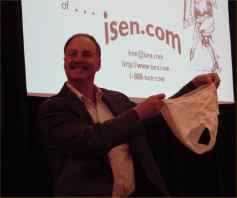
David Isenberg showing off
the latest in “fiber to the lap.”

David Isenberg, author of “The Rise of The Stupid Network” has begun his presentation. He’s explained how the telephone network arose as a “smart network” optimized for the services the telephone companies want to sell. The Internet is stupid in that it don’t know how to do nuthin’ but move them bits ’round. And, when you internetwork these networks, the control shifts from the network owner(s) to the end users; no longer can a network provider add features unilaterally, so the innovation has to come at the edges. That’s why the Internet disrupted the telecommunications industry.

[Eric Norlin has blogged about this blogging of the Connectivity conference. He thinks the question of digital IDs is underneath the spam and privacy issues discussed this morning.]

David is saying that the new end-to-end model puts the end-user in control and lets into the mix. Microsoft “gets this in spades”: Windows Messenger under XP lets two users open a voice channel or video channel integrated with the IM window. “SIP will change everything.”

Isenberg’s put up a 2×2 chart. X axis = kilobits to gigabites. Y axis = intelligent network to stupid network. Lower left is telephony, lower right is television, upper left are email and web browsing and internet telephony and games [this is the fun quadrant] and the upper right has “SIX BILLION CHANNELS” open to innovation. “The real important apps haven’t been discovered yet.”

[Kevin Marks has just blogged about this conference also. He proposes a 3-pronged attack on spam.]

Key point: The stupid network decouples connectivity from app building and it’s a mistake to try to be in both businesses. So, what’s the business model for connectivity? Not the phone company which likes vertical apps. Not the cable companies because they’re stuck on the old video paradigm and resist the new distributed model. So what’s left? Municipalities, utilities, customers, and/or something new … which David connects to David Reed’s “We Don’t Know,” fast becoming the conference’s mantra and theme.

Question from the audience: Should we come up with the apps first to drive the infrastructure? Reply from the audience: We did already and called it “Napster.” Isenberg: We have 100 megabits on our desktops but we use only a fraction of that usually, but we’d scream if someone tried to take our bandwidth away; bandwidth comes first.


ISP panel

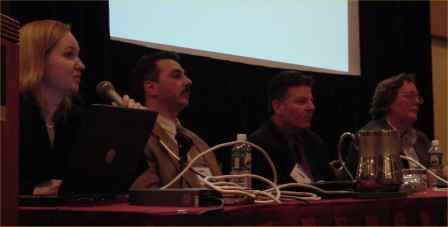
The ISPs. Chaired by Sue Ashdown of the American ISP Association. Panelists: Ira Kleiner, CEO of ProSpeed Networks. Colin King, co-founder of ProSpeed. Victoria White, CEO of Eclectechs in North Hampton.

Sue: “We’re beginning to see the death of the Internet service provider” because of the consolidation and now because ISPs need to obtain supply. [Artificial scarcity rears its ugly head again.] The actual title of this panel is “What happens if the ISPs don’t get what they want,” but Ashdown opens by asking when have ISPs ever gotten what they want? Now even the Patriot’s Act adds risk to the ISPs because they can’t afford attorneys to fight FBI requests for information about users.

The telephone companies have kept the ISPs out of the market by setting the price for lines to the house so high that the ISPs margins’ shrink pass the point of reason. And the telephone companies through “errors of omission” make it harder for customers to accept ISPs. As a result, the Bells have 86% of the DSL market.

Ira is about to talk. His company – a CLEC (Competitive Local Exchange Carrier) – delivers connectivity to underserved markets in NH and MA. [I have to duck out. See a man about a dog. And, unlike Doc, I’m not going to blog while balancing my laptop on the urinal.] Sue is now saying that she recommends against ISPs becoming CLECs because it brings them under so many regulations.

White began by building web sites; her company did 300 in about five years. “Sometimes running an ISP is like being in an MRI where you hear the field gradients, like someone shooting at you,” but you don’t know where it’s coming from or where the next one will come. They serve a lot of seniors and since they don’t require a credit card to sign up, people come into the office to pay the bill, to pay the dog, etc.

What’s the value of small ISPs? Ashdown says it’s in the ability to serve smaller and niche markets.

The guy from Bway.com, a NYC ISP, says that the only way for smaller ISPs to survive is by adding value rather than by competing on price.

Audience: What do the local congresspeople say when you lobby them? Colin: They don’t understand the technology. (Exceptions made for Markey and Hollings.)


Jeff Chester

Jeff Chester, Exec. Dir. of the Center for Digital Democracy, says that the advertising and entertainment industry’s vision of the new media is the old media. Their vision is to marry the branding power of TV with the interactivity of the Net, resulting in an “advertiser’s nirvana.”

He told about a meeting in the Chamber of Commerce early in the Clinton admionistration where, with the advertising lobby present, Clinton and Gore talked excitedly about the Information Highway. “You’re not really going to let people getheir content over the Internet,” said the advertisers, “That’ll kill our industry.” Jeff knew then that the government would work to restrict the Net to the benefit of those who own the content and sell the advertisements.

[BTW, blogger.com just ate some more paragraphs; it does a 404 when I hit the Post button and can’t get back the new content. Argh.]

[During the break, Jock Gill, former tech advisor to the Clinton White House and a fighter for What’s Right, said that we’re losing the battle because we can’t tell the story without dropping into deep techno-caves. We need a simple way to say what we mean. I may use this idea to structure the session I’m supposed to be leading tomorrow on What the !#$^% Do We Do About It?]

Jeff says that the cable companies have been successful in warding off any attempt to stop their near-explicit goal of controlling the network. He points us to a few sites that including his site: www.democraticmedia.org. “You have a handful of companies gobbling up control of old and new media. If all of the FCC rules go through, one company will be able to own the newspaper, several TV stations, several radios, the cable system, and de facto that town’s major ISP…all tied to a very very meaningless vision of just attracting eyeballs, engaging in what they call t-commerce, developing the branding…”

Jeff: “Go to FCC.gov and go to the Media Bureau and go to Media Mergers and go to the AOL/time Warner public interest statement. You’d think that the biggest media merger in American history…there will only be two benefits. #1 Just by the fact that we’re merging, more people will want more broadand. We’ll make a whole new generation of commercially sticky features.” No one in Congress is speaking out, only Hollings is speaking in the Senate.

Jeff would be happy simply with non-discriminatory access (opening the wires to the competitive market) but, he says, we won’t get that unless we form a movement. Now. “We’re not saying big companies can’t make lots of money. We’re saying they can’t monopolize the network. It should be win-win.”

Isenberg: We need to tell the story, as Jock Gill says. Here’s one way: “The US to be the best auto maker. Not any more. We used to be the best steel maker. Not any more. Do we want to lose the Internet business? We’re on the right track to do just that.”

Jeff: We lost the battle in DC. Now we need to take it local. Show our local reps that it’s win-win for business.

FLASH: Copyright office rejects CARP!! [By the way, I was able to blog this before Isenberg could get the chair’s attention to announce it at the conference. [… which proves what?]]

Tweet
Follow me

Categories: Uncategorized Tagged with: uncat Date: May 21st, 2002 dw

Be the first to comment »

Connectivity 2002 – Tuesday Morning

Connectivity 2002 – Tuesday Morning

The most visible initial fact about Connectivity 2002 is that there aren’t a lot of people here. The room is set up for about 150 people but there are only 30 of us here. [At 10am we’re up to about 50.] On the other hand, we just went around the room introducing ourselves and it seems like a really good group.

Bob Frankston is the conference chair and he’s giving his presentation as we wait for The Dave Farber to show up.

I’m now swapping notes — actually scribbles on 3D paper — with Halley Suitt, about what is and isn’t blogworthy. So, 10 minutes in and I’m already three levels of abstraction beyond where I am. Ack.

Bob Frankston’s explaining his version of Moore’s Law, More’s Law, which says if you want more, you can buy more. That’s what drives Moore’s Law. This argues against subsidizing the delivery of broadband because that destroys the dynamic of building more as the market needs it: if the cable company runs out of bandwidth, it builds more because people will pay more. [Yeah, but subsidizing may kickstart a market and, more important, can get over the inequities of a purely market-driven infrastructure.]


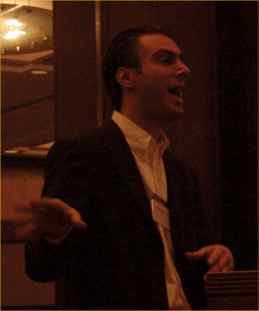
Bob Frankston

Bob’s second slide:

RAGE!
You are hostages!
You can’t choose what to watch
You pay the trolls for “phone calls”
You can’t be seen or heard
They must kill the Internet!

You are at the end of the last mile!

Bob, in response to a question, says that the incumbent business model pretends there’s a scarcity of bandwidth so that it can maintain control over access and over prices. But the users are the “unindicted co-conspirators” who go along with this.

Carl Ford, formerly from GTE but now with pulver.com, is standing in the aisle disputing the conspiracy theory. [Chris Herot IM’ed me with this info. He’s reading this blog as it develops. Thanks, Chris!]


Carl Ford protests!
Bob would like to see a decoupling of the network from the services built on it. He thinks the telco’s should actually want to be broken up, if only they were smart enough. The people here from the telco industry are shaking their heads at the idea that it’s stupidity that keeps them from seeing the wisdom of decoupling. If this conference can actually get to the common ground here — for surely it is anything but stupidity that drives this mess — it’ll be truly useful.


Dave Reed (right) – Icon … and Icon-Abuser

David Reed, of End-to-End fame, has announced that his point is that it’s time for us to admit that we don’t know what the business model is. The end-to-end argument says that the network itself should be “stupid” in Isenberg’s phrase in that it ought to do nothing but move bits, and the applications that make sense of those bits ought to be on the edges of the network. The alternative is to build special functionality into the network itself, but every time you do that, you actually make it harder to come up with innovative uses of the network. But that means that the network becomes commoditized which the telcos desperately don’t want to have happen. [This is my summary. Don’t blame Reed.]

Damn! Blogger just hiccoughed and ate two paragraphs of recapping of Reed’s economic model and why Bluetooth failed. Basically, Reed argues that the value in the network comes from the options at the edges where you make bets on innovation that may work. “Optimizing” the network itself for this or that app closes down other options. Reed pointed to Bluetooth and Universal Plug and Play as ways not to do this. Bluetooth came up with app-specific protocols rather than being a “stupid” protocol. Universal PnP tried to anticipate every conceivable app/decide that might come its way, an impossibility.

Reed is saying that pervasive computing will be wireless, so let’s look at it. All the wireless devices will have to be capable of highly flexible connectivity. The situtation is urgent already. It’s not so much about bandwidth…
[Damn. I have to go make a phone call that can’t be rescheduled…]

[Ok, I’m back. Which is as unnecessary as “If you lived here you’d be home now.”] Reed is saying that end users can afford gigabit broadband (currently $2,500-$3,500 and dropping, much less than remodeling a kitchen) as opposed to looking for a business to make that sort of investment. And now we’re all clapping for David… Sorry I missed the center. I am a huge admirer of David’s.


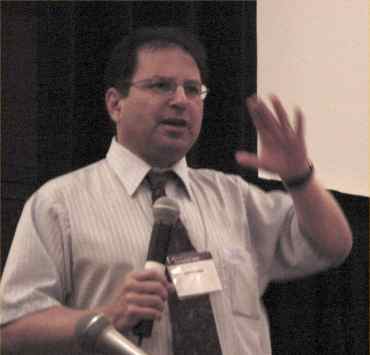
David Reed


Privacy and Spam panel. The connection between privacy and spam is, says the panel chair, Ray Everett-Church (ePrivacyGroup), is that many people assume that the spam they’re getting offering them photos of “barnyard frolics” is actually based on someone knowing something about them. The other two panelists: 1. John Levine, the author of “Internet for Dummies” among other books and a member of Coalition Against Unsolicited Commercial Email. 2. Rob Waters, a lawyer in DC who works on privacy issues.

John: People make two basic mistakes about the Net. 1. They don’t believe that it’s two-way all the time, unlike TV. But he doesn’t mean that The Web is a Conversation(tm). He means that web sites know you’ve been browsing. 2. People don’t believe that no one is in charge. They want police and they want rules.

Rob: Initially, Congress took a hands-off, libertarian attitude towards the Net. Then Ed Markey brought up some privacy rules out of his consumer advocacy. But we’ve confused security and privacy; people’s #1 concern is with identity theft, which is a security issue. Now let’s trash the Hollings bill. It segregates electronic transactions foolishly. It creates data collection with no restrictions on a class action suits. It does no harm…except to everything we do. [Rob has assumed I know more than I do so I’m a little at a loss here. Sorry. (This is the bad part of being in over my head.)]

John: [as if sensing my plight] The bill says spam has to have a return address, it has to have opt out, and there are penalties if they continue spamming you. But opt out is unworkable because there are too many lists and you have too many addresses.

Bob Frankston (who is on the panel as an emeritus): The problem is that we treat email addresses as physical objects. The return address is fictitious. Instead, you can create your own email addresses for each of your personae, from public to higher grade addresses for friends to a gibberish hash for commercial transactions; that’s what Bob does.

John: Yes, an email address is not like a physical address or a phone number; there’s no central, valid list. So, do-not-mail and do-not-call lists are workable because there’s a master database to work against. But not for email.

From the audience: A powerful industry coalition is against privacy safeguards because they want to use personalization software to own more of the customer.

[Isenberg just terminally distracted me from this panel, which is meandering down some paths I don’t find compelling, by taking a headline from today’s Globe — “Cancer Study Backs Ovary Removal” — and writing “Headlines You Won’t See: Cancer Study Backs Testicle Removal.”]

Panel is over. Lunch is around thetemporal corner…

Tweet
Follow me

Categories: Uncategorized Tagged with: uncat Date: May 21st, 2002 dw

Be the first to comment »

Stephen Jay Gould Had Stephen

Stephen Jay Gould

Had Stephen Jay Gould’s writings always taught us something — Dayenu! — that would have been enough. That he was an original contributor to his field just adds to his lustre. But the fact that everything he wrote was written from his heart with a passion to make the world fairer by making it clearer — what a faith in understanding! — made him, for me, one of the transcendent presences. I am sad to tears.


The Boston Globe this morning gives Gould a front page obituary. But in the fourth paragraph, the voices of envy are already being heard: “Critics occasionally grumbled that he was more focused on celebrity and commercialization than on rigorous science.” We really don’t need to hear this on the occasion of someone’s death. And that means we don’t need to hear it at all.

Tweet
Follow me

Categories: Uncategorized Tagged with: uncat Date: May 21st, 2002 dw

Be the first to comment »

Connectivity 2002 – Geek Woodstock?

Connectivity 2002 – Geek Woodstock?

I’m about to leave for Connectivity 2002, a conference technically only a few miles from my house but a major commute in terms of actual travel hours. It’s three days of confabulation about how The Bad Guys are trying to centralize control of the Internet, violating the end-to-end principle (about which see David Reed and David Isenberg and maybe even “The Paradox of the Best Network” that Isenberg and I wrote to try to boil the situation down a bit.).

I’m going because I recognize that it’s a big stinking problem but I expect the conference to be over my head. Actually, there’s no “but” about it: being in over my head is the best part. This is a topic about which I am smart only by association: I don’t understand it but I am fortunate enough to know people who are freaking geniuses about it, starting with Isenberg and Reed.

The organizer, Daniel Berninger, bills Connectivity 2002 as a telecommunications Woodstock. So, let me tell you about Woodstock. The real Woodstock, you young whippersnappers. I went because I had made a plan with Nancy Weeks, on whom I had a major crush, to “meet her there,” thinking that I’d spot her across a field, wave my arm in recognition, and we’d trot off to a secluded nook by a waterfall as The Airplane played “White Rabbit.” I had just finished my freshman year and was, of course, a moron.

Instead, I spent 4 hours in a traffic jam, parked about 5 miles away, got a ride on the hood of a car that crawled for another couple of hours, and arrived just as Melanie was a couple of songs into her set. It was raining. I hadn’t eaten in hours. And, yes, you are talking to the only person who couldn’t score drugs at Woodstock. Not a puff, much less a tainted acid tab.

Two hours later, drug- and Nancy-free, I made my way back to my car, curled up in the back seat for a few hours, and drove back to Mom and Dad’s house. So you can see how much I am looking forward to the Telecommunications Woodstock. (Nancy, if you’re coming to the conference, I’ll meet you by the geeky-looking guy trying to tweak the settings of his wireless connection. That ought to narrow it down.)

Tweet
Follow me

Categories: Uncategorized Tagged with: uncat Date: May 21st, 2002 dw

Be the first to comment »

May 20, 2002

Doc Bullish on Apple Doc

Doc Bullish on Apple

Doc is urging us all to buy Apple stock because “There is a sea-change happening, and it’s going down fast.” His evidence includes the movement of hard-core techies such as Scoble and Ev from Windows to the Mac OS X because they like Unix better than XP. (Imagine that! Something better than XP!) With the techies comes open source enhancements to the Mac, and Unix brings the Mac within the scientific and enterprise development communities. So, Doc sees a bright future for Apple. He says the people at Apple are even having fun.

If only Apple let other people build Mac machines so we’d get the sort of hardware openness that Unix is providing on the software side.

Tweet
Follow me

Categories: Uncategorized Tagged with: uncat Date: May 20th, 2002 dw

1 Comment »

Customer to Customer I just

Customer to Customer

I just gave a keynote this morning at the Transcentive annual user’s conference. (Transcentive provides software and services for managing 401K plans.) One of the main points of the talk was that B2B and B2C are both being shaped by “C2C,” customer-to-customer conversations; this matters because it means that businesses have lost their main way of controlling their markets: the selective release of information. So, I went through some sites that have lively C2C interchanges not knowing that the next speaker was announcing Transcentive’s own open-ended discussion boards. (I was really pleased to hear that the inspiration for putting up the boards came from The Cluetrain Manifesto and Chris Locke’s Gonzo Marketing.)

The Transcentive board is in its infancy. They’ve seeded it with a bunch of threads, which is a good start. But, I hope Transcentive understands that the success of a discussion board is subject to the same sort of randomness that turns a local diner into a citywide sensation for a month and then returns it to obscurity. So, I applaud Transcentive for having the guts to open up a space for unfettered discussion among customers and employees. It’s risky but it can be so worthwhile for everyone involved.

Tweet
Follow me

Categories: Uncategorized Tagged with: uncat Date: May 20th, 2002 dw

Be the first to comment »

Small Pieces Mambo Small Pieces

Small Pieces Mambo

Small Pieces gets a nice blog writeup by Martin Roell. It’s in German, but here’s the translation (checked and authorized by Martin himself):

I want to give an especially strong recommendation of the latter (= Small Pieces). This is a wonderful book about the Net, beautifully written, with many anecdotes, insights, analyses and philosophical thoughts …for dreaming, thinking ahead and developing new ideas. It’s an *important* book that you won’t give away and will always keep near your desk.

But now for the real reason for posting this: Here are pictures of Martin’s German Brazilian musical group.

Only on the Web, only on the Web.

Tweet
Follow me

Categories: Uncategorized Tagged with: uncat Date: May 20th, 2002 dw

Be the first to comment »

May 19, 2002

That Damn Naming Service [This

That Damn Naming Service

[This is awkward. I’d just finished writing about Dan Bricklin’s comments on the DNS problem and went to his page to grab the permalink when I discovered that he today blogs a generous review of Small Pieces. So, this will look like as gratuitous a case of blogrolling as we’re likely to encounter. To counter this impression, I’ve randomly introduced some negative comments, in gray, into the following.]

Dan Bricklin [that bastard!] has blogged comments about the Naming Problem in the wake of the back-and-forth between Clay Shirky and Bob Frankson (here and here) among others. The problem is that there are more sites than recognizable names and it’s only going to get worse — the fights over whether American Airlines, Alcoholic Anonymous or Alan Abrahamson gets “www.aa.com” are going to leave more and more unhappy site-holders. (I grabbed hyperorg.com to keep it from being taken by people greedier than I, but I also took nathanweinberger.com and leahweinberger.com so my children will be winners in the site name sweepstakes.)

Dan’s solution sounds right [even if he once sucker-punched Alvin Toffler]:

We need a way to experiment with different ways of naming things on the Internet in addition to the “unique text to IP address” bindings of the current use of DNS technology…Whatever we use should probably work in places that include the Address Bar (also known as the “Location Toolbar” to Netscape users) in browsers. We also know that to do such experimentation, we need to let all comers try their hands, using something like a plug-in architecture or other open API. The users and marketplace will choose the method (or methods) that work best for the various needs.

As Dan Gillmor has pointed out, many of us use Google as our name server: if we want to find an old friend who lives in Chicago who we think became a dentist, we look his name up in Google and then pick the entry that mentions Chicago and dentistry. Ultimately, however, we can imagine a more database-y approaches built to scale with the Net and history. It’d be great to get them working from the address bar without having to depend on the treacherous affections of Microsoft (cf. RealNames). But, we don’t have to wait for Microsoft to open up since we can already install additional widgets on the tool bar, and my google widget in fact already functions as my “fuzzy address bar,” the one I use when I’m not sure of the address I’m looking for.

In addition to full text searching and database lookups, there’s a third way this problem may be cracked. The first two approaches are bird’s eye views, but there’s also a surface-based approach. At some point we’re each going to have our own point of view looking across the Internet and what we’ll see are the groups we care about. These groups will be linked to other groups unto the sixth degree of separation. And that will narrow the focus of searches sufficiently that we’ll be able to resolve the ambiguity of names the way we do it among our acquaintances in the real world: “Do you mean Alan Abrahamson the dentist or the ex-boyfriend?”

If someone knows what I mean, would you please let me know? Thank you.

[PS: Dan Bricklin writes in library books.]

Tweet
Follow me

Categories: Uncategorized Tagged with: uncat Date: May 19th, 2002 dw

Be the first to comment »

What’s your tool? I’m looking

What’s your tool?

I’m looking for a shareware or freeware app that does one of the most basic of jobs: save and organize links into folders. I’ve tried a whole bunch, and even wrote one for myself, but none have stuck, often because they were over-featured (or, in the case of my home brew, screwed up too often). Here are my requirements:

  • Within the browser (tool bar or whatever) invoke the app and store an URL and a comment in folder
  • Arbitrarily create and nest folders
  • Be able to browse and search the archive
  • Doesn’t lock the info away in a way that makes me totally dependent on the app provider

Simplicity counts above all. If you have found something that has actually become a part of your working set, would you let me know?

And I am trapped in MSIE so don’t bother telling me that the if I get the Quake III mod of Mozilla it’ll do everything I want including letting me frag a John Ashcroft avatar.

Tweet
Follow me

Categories: Uncategorized Tagged with: uncat Date: May 19th, 2002 dw

Be the first to comment »

« Previous Page | Next Page »


Creative Commons License
This work is licensed under a Creative Commons Attribution-NonCommercial-ShareAlike 3.0 Unported License.
TL;DR: Share this post freely, but attribute it to me (name (David Weinberger) and link to it), and don't use it commercially without my permission.

Joho the Blog uses WordPress blogging software.
Thank you, WordPress!