



logo
EverydayChaos
Everyday Chaos
Too Big to Know
Too Big to Know
Cluetrain 10th Anniversary edition
Cluetrain 10th Anniversary
Everything Is Miscellaneous
Small Pieces cover
Small Pieces Loosely Joined
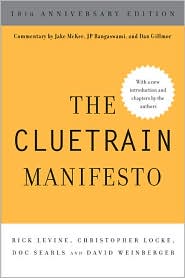
Cluetrain cover
Cluetrain Manifesto
My face
Speaker info
Who am I? (Blog Disclosure Form) Copy this link as RSS address Atom Feed

February 15, 2002

MiscLinks Mike O’Dell sends us

MiscLinks

Mike O’Dell sends us to a taxonomy of Flame Warriors, i.e., obnoxious Net types. Unfortunately, I recognized myself in over 75% of them.

Chip has found “more Google tales,” a provocative column by Eric Zorn that juxtaposes anecdotes about where the new line of privacy should be drawn given that we can find out ‘most anything about ‘most anybody by doing a search at Google.

Brad Bauer recommends Sidestep.com where you can download a free tool that lets you see various travel sites’ suggestions side by side. (I haven’t tried it, so if it eats your desktop and sends pornographic fonts to everyone in your address book, send your flames direct to Brad.)

Gary Unblinking Stock, Creator of the Googlewhack, points us to The Secret Life of Numbers, a fascinating (in the literal sense) site that does an amazing job of presenting its research into the frequency with which we use particular numbers. I assume that the fact that I can’t make heads nor tails of the shimmering graphics is my fault; I have trouble making sense of timelines.

Gilbert Cattoire has a pair of finds. First at the home of the Post-It Note, he writes, we learn that “refillable holders have a unique,very specific objective: Improve employee relations.”

Second, he points us to Annotis.com where you can get the tools to scribble on top of your email, highlighting passages, drawing little smiley faces, and putting horns on top of every instance of the phrase “my manager.”

Although I’m late blogging this, it’s sure important enough to repeat: Peter Kaminski recommends Lawrence Lessig’s Creative Commons where creators can get IP licenses that make sense. (Both Peter and Larry are Net treasures.)


Dave Rogers recommends a lecture by Brenda Laurel called “Creating Core Content in a Post-Convergence World.” She says:

… we are not experiencing convergence in the sense of media. We are experiencing a diaspora of displays and devices that will address even finer distinctions in situated context. … The opportunity here is to understand how to design what I would call “core content” that contains the potential to be shaped appropriately for myriad devices and contexts.

She proposes that we think “transmedia” to begin with, rather than rooting the content in one medium, and then talks about ways to think about this cross-device content, including a quote from Rob Tow that “narratives are the constitutions of new worlds.”

Tweet
Follow me

Categories: Uncategorized Tagged with: uncat Date: February 15th, 2002 dw

Be the first to comment »

February 14, 2002

NPR: Weblogs and Journalism Click

NPR: Weblogs and Journalism

Click here if you want to listen to my brief commentary last night on National Public Radio’s “All Things Considered” on weblogs’ effect on journalism. (You’ll need the Real player to listen.) If you’re a blogger, you’re not going to learn anything you don’t already know…

Tweet
Follow me

Categories: Uncategorized Tagged with: uncat Date: February 14th, 2002 dw

1 Comment »

The Real Blogger’s Manifesto Because

The Real Blogger’s Manifesto

Because parody is the sincerest form of flattery:

The
Real Blogger’s
Manifesto
Life
is uncensored.
Life
is uncensored, but my clients and my Mom may be reading my blog.
You
have no right to judge me.
You
have no right to judge me, but judging you is totally fun.
If
you don’t like what you see, look elsewhere.
If
you don’t like what you see, still link to me.
I
love talking about my life.
I
love talking about my life but, unfortunately, not to myself.
I
love writing about other people’s lives.
I
love writing about other people’s lives when it makes my life look
good.
I
will post whenever I feel like posting.
I
will post obsessively.
I
don’t have to blog every meme.
I
don’t have to blog every meme. But I will. Oh, and I count fantasies, insults
and grunts as memes.
You
don’t have to agree with everything I say.
You
don’t have to agree with everything I say so long as you link to me.
I
egosurf Daypop, Google, and Blogdex nightly.
I
egosurf Daypop, Google and Blogdex compulsively as if it gave meaning to
my life.
I
share what I want to share.
I
share what I want to share. But you have to ask first.
I
like linking to Dave, Doc, Evan, and Cam.
I
like linking to people who link to me.
Blogging
is theraputic.
Blogging
is a neurosis.
Pictures
of myself are not obligatory.
Pictures
of myself are highly edited.
I
visit every site in my blogroller regularly.
I
visit every site in my blogroller regularly to make sure they’re still linking
to me.
I
won’t post for the sake of posting.
I
won’t post for the sake of posting. I will post to get linked to.
I
have a life outside of blogging.
I
have a life outside of blogging, but when I blog about it, I lie.
I
have registered my blogging tool(s).
I
have registered my blogging tool under the name “B. S. Bogusboy”.
I
may criticize other bloggers, not harass them.
I
may criticize other bloggers, but I will only harrass them until they link
to me.
I
have the right to revise a post.
If
you criticize me, I will revise my post so that yours looks stupid.
When
blogging becomes a chore, I’ll quit doing it.
When
blogging becomes a chore, I’ll write about my cat. Again.
I’ve
given something back to the blogging community.
I’m
giving the blogging community a headache.
If
I want to complain about something, I will.
I
want to complain about everything.
If
I want to praise something, I will.
If
I praise you, you must link to me.
I
am not the best blogger on the planet.
I’m
the best motherfucking blogger on the planet.
I
don’t have to explain myself to you.
I
don’t have to explain myself to you. But I will. Endlessly. Until you link
to me.
– Chris
Pirillo
–
David
Weinberger
Chris’
original Blogger’s Manifesto is here.

Happy Valentine’s Day, Chris : )

Tweet
Follow me

Categories: Uncategorized Tagged with: uncat Date: February 14th, 2002 dw

Be the first to comment »

February 13, 2002

The Authenticity Complex There’s too

The Authenticity Complex

There’s too much to reply to in AKMA’s, Tom’s, and Dave’s blogthreading about authenticity. I feel like we’ve developed the topic well enough that blogging is no longer the right instrument of conversation. We should move this to a discussion board where the topics are more fragmented (shorter posts, faster replies) or even to a chat room. Nevertheless…

AKMA is right to remind us that selves are much more complex than my “inner self/outer self” explanation of sincerity and authenticity implies. In fact, “authenticity” impies a much more complex relationship whereby what is public is either “owned up to” or not … in an infinite variety of ways. Most of our great literary characters, from Hamlet to Madame Bovary to Zuckerman, are great because the complexity of the relation of who they are, who they seem and who they own up to being. (That this starts with Shakespeare lends credence to Bloom’s seemingly ridiculous claim that Shakespeare invented what we think of as a person.) This fact makes it much, much harder to think about what authenticity is.

AKMA’s main point in that particular blog entry, however, is that our Web personae are not extrinsic to our real selves. I wholeheartedly agree. That’s why our Web personae are interesting and important to us. That’s why we’re writing ourselves into existence on the Web. In fact, in a single blog I managed to say both that “As I understand the term, ‘authenticity’ assumes that there is a public outer self and an inner private self and that the two are intimately related” and “If your outer self doesn’t pretend to represent your inner self, you’re now in a politics of theatre or authorship, not one of personal identity.” (Emphasis added.) I meant the first to say exactly what AKMA says better: we are our public selves. The second overstates what I meant, for it implies there’s no relation between public and private selves. AKMA admirably spells out the complexity of that relationship. The point I was trying to make was that the relation of Web self to “real” self is different than, and looser than, the relation of RW public self and RW private self. It’d be useful to explore that relationship. Maybe it’ll take a Tolstoy or a Flaubert to do it successfully.

So, I like AKMA’s suggestion that “while ‘authenticity’ may be elusive as a positive quality, ‘inauthenticity’ may be easier to get hold of.” (I also like Dave’s idea that could reel in this discussion by talking about what it actually means for business.) John Austin, the British philosopher, once warned us not to be fooled by the existence of a word into assuming that it must denote some existing thing. For example, I may use the word “real” to distinguish a real gun from a toy gun, real money from counterfeit, real feelings from feigned feelings, real juice from reconstituted juice, etc. It would be a mistake, suggests Austin, to assume that there must be a thing called “reality.” Rather, the word “real” perhaps only has a use like the word “very.” Likewise, the word “authentic” when applied to people (as opposed to Louis XIV furniture) perhaps should be understood as meaning “not inauthentic.” (Well, I guess that wasn’t exactly Austin’s point, but I like Austin’s point so much I’m going to leave it here anyway. So there!) Perhaps “authentic” means nothing more than “Not a phony, not an ass-kisser, not a lying sack o’ shit.”

We got started on this because I blogged about whether the Corporate Voice could ever actually be authentic. (Actually, as I reread my post, I don’t use the term “authentic.” Dave Rogers introduces the term. So blame him! :) And I still think that neither “authentic” nor “inauthentic” can apply to an entity with neither body nor soul … nor, as RB always reminds us, sex organs.

(And I haven’t even replied to extraordinarily rich blog entries from Dave and Tom!)

Here’s a blogthread, not quite up to date, of the story so far.

Tweet
Follow me

Categories: Uncategorized Tagged with: uncat Date: February 13th, 2002 dw

Be the first to comment »

Learning from the WSJ One

Learning from the WSJ

One of my many failings (don’t get me started!) is an unreasonable antipathy to the Wall Street Journal. Yet, every time I read it, I learn something. I just don’t want to be the type of person who reads the WSJ. Adolescent? No, and now I’m going to go sit in my room, listen to OTown and eat an entire tube of Pringles.

Yesterday, for example, there were two interesting articles on the first page of the B section. Carol Hymowitz writes in the “In the Lead” column about a collaoration between the Orion String Quartet and Bill T. Jones’ dance troupe. The title of it implies that we’re supposed to be able to apply what we read to business: “Artistic Collaboration Offers Tips for Creating a Harmonious Merger.” It’s an interesting article, but the relevancy isn’t obvious. For example, it opens by telling of the quartet’s first meeting with Jones:

…they met a statuesque man wearing a long cape who immediately wanted to show them the dance he had choreographed to the third movement of Beethoven’s String Quarter in F, Op. 135.”

It may have gotten the collaboration off to a great start, but I’d really like to see how this applies to a business partnership:

…they met Jeff Bezos, an ordinary looking man wearing a long cape who immediately wanted to show them the investors’ dance he had choreographed to Amazon’s latest quarterly results.”

On the same page, there’s an article by Maureen Tkacik about Hot Topic, a suburban chain of clothing and accoutrement for teens. Unlike the Gap and Abercrombie & Fitch, Hot Topic doesn’t cater to “popular” teens. It’s clothing for the rest of us. In fact, Hot Topic sends scouts to rock concerts and other teen events to see what kids are wearing rather than trying to coerce kids into wearing what Hot Topic wants them to wear. Bottom up fashion design!

Of course, Hot Topic is stuck in its own teenage Hegelian contradictions. As the article notes, kids love it and hate it, no doubt in part because teenagers are determined not to like what they’re supposed to like. Similarly, “the chain strips dedicated nonconformists of a bit of their originality” by making it available to anyone whose Mom will give them a ride to the mall. Mainstream nonconformism is both an oxymoron and a way of life for a particular age group.

Given my own reaction to the WSJ, apparently I am in Hot Topic’s target demo.

Tweet
Follow me

Categories: Uncategorized Tagged with: uncat Date: February 13th, 2002 dw

Be the first to comment »

RW Collision and Rogue Agents

RW Collision and Rogue Agents

During the Q&A after my talk to the Customer Care 2002 conference, I was asked how the expectations being set by the Web show up concretely in customer call centers. Good question. Being fact-averse and reality-challenged, I claim no expertise, but it seems to me that there are two obvious effects.

First, there’s the nebulous effect of expecting to be treated like a live human being by another live human being. Hewing to the script is more annoying than ever after having been on the Web with employees who talk for and as themselves.

Second, when I call for customer support, I no longer assume that the person on the other end of the line is my only source of information. If I can’t find out from the cable company, for instance, how to hook up my home network through a Linksys router (“We don’t support home networks”), and if I can’t find out from Linksys (“We don’t know the details of your ISP”), I know for a fact that I can find someone on the Net who either already has a site up devoted to networking Linksys and my ISP, or I can find someone to ask. And the information I get from another user is more likely to be helpful — truthful, no BS — than what I get from the call center. I am no longer a supplicant when I call for help.

In fact, when talking with Sarah Kennedy, one of the conference conveners, we came up with an idea. If a customer support agent is uncomfortable giving me an off-script answer, send me to a “rogue agent” (Sarah’s phrase), someone explicitly positioned as a source of creative ideas and information that may not work but that may get me out of my predicament. A rogue agent would be permitted to say things like, “Yeah, I heard about that problem once before, and I saw on a Web site that if you uncheck PPPoE it should work, which makes sense to me. On the other hand, there’s a small chance it might fry your Linksys box, so don’t come crying to me, ok?” Obviously, rogue agents should be patrolling the Internet, to learn and to teach. Sounds like a cool job to me.

Tweet
Follow me

Categories: Uncategorized Tagged with: uncat Date: February 13th, 2002 dw

Be the first to comment »

February 12, 2002

Bush Abandons Universal Connectivity Forwarded

Bush Abandons Universal Connectivity

Forwarded by David Isenberg from Benton.org, a non-profit devoted to gaining social benefit from communications technology:

Bush abandons national strategy to bridge the digital divide.

After a year of public speculation over whether the White House was committed to expanding Internet access and skills to all of America’s citizens, the administration has finally broken its silence. In its FY 2003 budget, the White House stripped over $100 million in public investments previously available for community technology grants and IT training programs—programs that offer real payoffs to rural communities, the working poor, minorities and children.

So predictable.

(For more infopinion(tm), see my blog entry about Technet and a piece called “The Paradox of the Best Network” that Isenberg and I wrote.)

Tweet
Follow me

Categories: Uncategorized Tagged with: uncat Date: February 12th, 2002 dw

Be the first to comment »

February 11, 2002

Missing a Day of Blog

Missing a Day of Blog

I have to run to catch a plane. (Ottawa in February! Ah!) I’m speaking at a customer support conference and I’ve definitely decided to come out in favor of supporting customers. Sure it’s a controversial stand, but it’s what I believe.

This is the first time I’m going to be away from my blog. I barely have time to do an entry today, and tomorrow I expect to be blogless. I feel like the first time we went away for a night without our kids. Sniff sniff.

Mostly, I feel bad that some really interesting conversations are going to continue swirling and I’ll be left behind. Fortunately, I just finished reading the book “Thinking with the Left Side of Your Behind,” so maybe I’ll be able to catch up.

Here’s an example: AKMA has advanced the conversation about voice and authenticity that I’ve threaded here. Although I never thought I’d be using this as an analogy, I feel like I’m on a curling team. There’s this 42-pound stone that’s sliding its way down an alley, and AKMA, Dave Rogers, Tom Matrullo and I are walking along with it, adjusting its progress by sweeping the ice with brooms.

Gotta go…before I write any more bad analogies.

Tweet
Follow me

Categories: Uncategorized Tagged with: uncat Date: February 11th, 2002 dw

Be the first to comment »

Request for Product: International Searches

Request for Product: International Searches

Through an email conversation with Jeff Chapman, we have come up with a Request for Product for Google:

Suppose you could optionally say that you’d like your search terms translated into other languages and then get returns in those languages.

For example, suppose you were looking for information on what vegans eat and for some reason you want to find English and German pages. You enter “vegans eat” into the search box and click on the “Find German pages” box. Google returns the hits for that phrase, but behind the scenes it translates your search terms into German and returns the pages that contain the phrase “Vegans essen”. It optionally translates those pages into English for you. Or, search for “environmental politics” and click on the “All languages” box, and it will translate into however many languages Google has dictionaries for.

As the engineers used to say at Interleaf, how hard could it be? You just have to get the bits in the right order :)

Tweet
Follow me

Categories: Uncategorized Tagged with: uncat Date: February 11th, 2002 dw

1 Comment »

February 10, 2002

Blogthread: Voice, Authenticity and More…

Blogthread: Voice, Authenticity and More…

Continuing the blogthread among AKMA, Dave Rogers and AKMA (see the end of this entry) on authenticity, preaching, marketing and just about everything…

The latest entries are beautifully written, nuanced, thoughtful … everything I’ll mess up if I try to summarize them here. They have to do with whether authenticity for corporations is possible. But this has raised the question of what authenticity is for real individuals.

I’ve always been uncomfortable with the term “authenticity” but it names a concept that nevertheless we seem to need. I think this blogthread points to two places where the basic model of authenticity falls apart. As I understand the term, “authenticity” assumes that there is a public outer self and an inner private self and that the two are intimately related. “Sincerity” has to do with how accurately the outer self represents the inner self’s intentions, while “authenticity” has to do with how well the outer self represents the inner self’s self-understanding. Or maybe it just has to do with how well the inner self understands itself, which then gets reflected in the outer self.

If something like that is the case, here are two places where the term just doesn’t fit very well:

(1) Marketing. The problem isn’t a lack of sincerity, for marketing can reflect excellent intentions (although it’s rare because it has to fight the corporate entity’s inherent greed). The problem is that there’s no inner self to a corporation. It is an organization, not an individual. So the model within which “authenticity” makes sense breaks down.

(2) The Web. I’m less confident about this, but it seems to me that the Web frees us to create online selves that are personae. If your outer self doesn’t pretend to represent your inner self, you’re now in a politics of theatre or authorship, not one of personal identity. Asking “Is RageBoy authentic?” doesn’t make a lot of sense. If you were to discover, as per AMKA, that Ben & Jerry are polluting, right-wingers who have their ice cream made in Tunisian sweat shops, you would feel like you’d been lied to. If I were to tell you that Chris Locke is actually a sweet, kind man, you wouldn’t feel betrayed any more than if I were to tell you that Nabokov — despite Lolita — actually wasn’t a murderous pedophile.

This is why I’m so interested in the ways in which our Web selves are literary. (I’m sort of working on a sort of book proposal on this idea. Unlikely to succeed, so don’t hold me to it.)

Blogthreads (alphabetical order):

AKMA and AKMA
Tom Matrullo and Tom Matrullo
Dave Rogers, Dave Rogers, Dave Rogers
Me and me

Tweet
Follow me

Categories: Uncategorized Tagged with: uncat Date: February 10th, 2002 dw

Be the first to comment »

« Previous Page | Next Page »


Creative Commons License
This work is licensed under a Creative Commons Attribution-NonCommercial-ShareAlike 3.0 Unported License.
TL;DR: Share this post freely, but attribute it to me (name (David Weinberger) and link to it), and don't use it commercially without my permission.

Joho the Blog uses WordPress blogging software.
Thank you, WordPress!