


logo
EverydayChaos
Everyday Chaos
Too Big to Know
Too Big to Know
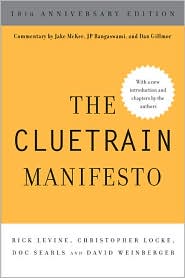
Cluetrain 10th Anniversary edition
Cluetrain 10th Anniversary
Everything Is Miscellaneous
Small Pieces cover
Small Pieces Loosely Joined
Cluetrain cover
Cluetrain Manifesto
My face
Speaker info
Who am I? (Blog Disclosure Form) Copy this link as RSS address Atom Feed

February 19, 2002

Domestic Life On Slashdot

Domestic Life
On Slashdot


Posted
by CmdrTaco
on Thursday February 14, @09:25AM

Kathleen Fent Read This Story

Kathleen,
I wanted to do this in the most potentially embarrassing way possible,
and I figured doing it here and now, in front of a quarter million strangers,
was as good a way as any. We’ve been together for many years now, and
I’ve known for most of that time that I wanted to spend my life with you.
Enough rambling. Will you marry me?”

From Kathleen
Yes

Dork. You
made me cry.


Yo,
InstaClair, It’s your turn to do the dishes

by Dogaroni
I cooked.
You clean.
Doggy howl
by Mackaroon
Arf! You tell
her, Dogman!
  RE: Doggy
howl
Posted by Jimba23
  Mark your
territory, man!
  RE: Doggy
howl
Posted by Tootertwist
  They ought
to make yellow scented markers smell like pee.
    RE: Doggy
howl

Posted by Scarrrly
    Another marketing
genius speaks.
    RE: Doggy
howl

Posted by GetOuttaFace
    Let me know
if you need a refill, moron.
Household
economy

Posted by Louisalot
Yeah, swing
your pathetic 4 inches of capitalist hegemony, Dogaroni. And pray that
no one sends her to a link to anything by Mahauser.
  Re: Household
economy

Posted by OnePureDork
  Oh, like Mahauser,
that Gramsci-wannabe dwarf, had anything to say about feminism that’s
worth the petrochemicals it took to print it. Wood pulp makes more sense
than Mahauser.
    Re: Household
economy

Posted by Happifat79
    And it tastes
better too. Mmmmmm, wood pulp.
      Re: Household
economy

Posted by EyePokemon
      Oooh, a Simpsons
reference! How clever!
        Re: Household
economy

Posted by Famisboyo
  D’oh!
YinYang
Posted by SweetWind
Cook/Clean.
The yin and yang.
  Re: YinYang
Posted by Alfalfamale
  Such typical
BS. Suppose he scorched 6 pots making bald eagle stew and she’s a vegan
monk who only wants a cup of basmati rice? Where’s your yin now? What
gives you the right to pontificate from your mountaintop? How about putting
down your yang for a while and coming to live in the real world.
    Re: YinYang
Posted by SweetWind
    You show the
pain of one still strugling in the world.
      Re: YinYang
Posted by TheMoe
      You show the
pain of one still "strugling" with touch typing.
And also
Posted by Acknoider
I looked.
You lean.
  Re: And
also

Posted by Dogaroni
  I booked.
You bean.
  Re: And
also

Posted by Minimerlin
  I croked.
You cream.
  Re: And
also

Posted by Oisybeois
  I choked.
You chinese.
  Re: And
also

Posted by MmmmenoR67
  Nookie nookie
nookie nookie nookie
No it’s
not

Posted by InstaClair
I did them
last night when I cooked so you could watch the "Mork and Mindy"
reunion. Remember?
  Re: No
it’s not

Posted by Dogaroni
  Oh yeah. I
forgot.
By the way, have you seen the remote?
    Re: No
it’s not

Posted by Smilgrezza
    You know,
we wouldn’t have this problem if remotes went Open Source.
      Re: No
it’s not

Posted by Arkwrong
      D’oh!

 
PS: Here’s Suck‘s
parody of Slashdot. (Thanks, Doc.)

Tweet
Follow me

Categories: Uncategorized Tagged with: uncat Date: February 19th, 2002 dw

Be the first to comment »

Both And Kevin Marks, inventor

Both And

Kevin Marks, inventor of the Marks marks of Googlewhacking, writes:

Thanks to Arts & Letters Daily, a couple of pieces that may throw some oblique light on lengthy meditations on how one’s personality is expressed and even formed though public writings.

One is an article by Constance Rosenblum about what it’s like to lose all your email. Having lost the past five months’ worth, I sympathize; I might as well have been told that a brain virus ate five months of memories.

The other is a review by the philosopher Thomas Nagel of a biography of Nietzsche. Writes Nagel:

This does not mean that greater self-knowledge is impossible: indeed, plunging beneath your own inner surface through both psychological and historical investigation is essential. But knowledge is not the main point. The point is to achieve a different kind of existence: to live one’s life in the full complexity of what one is, which is something much darker, more contradictory, more of a maelstrom of impulses and passions, of cruelty, ecstasy, and madness, than is apparent to the civilized being who glides on the surface and fits smoothly into the world. Because we are not animals, we are in a position to take conscious possession of ourselves in this way; but because we are socialized human beings, we tend instead to accept the superficial identities and the orderly system of beliefs that civilization has assigned to us.

You go, Nagel! The Web is an unparalleled realm for living the complexity of our social identities.

Which is a backwards way of getting at something that’s been bothering me. Remember Nietszsche’s Appolionian/Dionysian complementarity — the sedate, rational, respectful-of-limits Apollo and the wild, drunken, omni-mounting Dionysus? Having been involved in an Apollonian discourse on the nature of authenticity and self — the blogthread that’s been wending it’s way through many blogs over the past week — my inner Dionysius is getting antsy. All yin and no yang makes Jack a dull boy. Not that there’s been an overall shortage of Dionysian yang on the Web; we should be welcoming Apollo back and trying to make him feel at home. But, let’s face it, Apollo gets a bit tiresome (while Dionysus is just plain exhausting). We need to be able to say Yes to both the clear, insightful, patient and loving work of Apollo as well as the murky, felt, hasty, lusty, funny and loving work of Dionysius. Then they need to hit the road and star in a buddy movie together…

Tweet
Follow me

Categories: Uncategorized Tagged with: uncat Date: February 19th, 2002 dw

Be the first to comment »

Game Notes Scott McCloud, in

Game Notes

Scott McCloud, in his comic strip about games (“Discovering Games”) in the March Computer Gaming World, quotes game designer Doug Church:

Our desire to create traditional narratives and exercise authorial control over the gaming world often inhibits the players’ ability to involve themselves with the gaming world.

Exactly the same is true of businesses presenting themselves on the Web. The more they exercise control over their site, the less involving (or even useful) it is for visitors. All but a handful of business sites make this mistake. They view think their site is for them. Which is why we don’t care about them.


The “Shadows of Luclin” add-on to the online game
EverQuest requires 512MB of RAM for the graphics to
display properly.

This necessarily generates Geezer Stories such as: “Why, I remember when I was at Interleaf in 1988 and it was considered outrageous and even arrogant to require a Power Mac user to have 4MB of RAM. Why, today’s programmers are spoiled…”

Tweet
Follow me

Categories: Uncategorized Tagged with: uncat Date: February 19th, 2002 dw

Be the first to comment »

February 18, 2002

MiscLinks From Chris Pirillo’s Lockergnome

MiscLinks

From Chris Pirillo’s Lockergnome games discussion board comes a free game, called Crash!, that is surprisingly hypnotic in a Bejeweled sort of way. Thanks, Ernest! (The help files for this beta version aren’t very helpful. The object is to clear the board. Clicking on a square will clear it if it shares a border with two others of the same color; its border mates are also cleared. The bottom line of the screen shows you the next line of squares that will be added.)


Paul Graham, who is an acquaintance from a previous life at a software company, has written a really interesting explanation of why his start-up used Lisp to write their application, including an argument about what constitutes a higher level language. (Thanks to Bret Pettichord for pointing this out.)

Of course, this recalls the old joke that circulated via email about ten years ago. “I’ve managed to hack into the Defense Department’s Star Wars code,” it explained breathlessly. “Unfortunately, I was only able to get the last page.” What followed were 2,000 close-parentheses. Oh, the tears of laughter were like CDRs to the Lisp geeks’ eyes over that one!

My own book, The Adventurer’s Guide to Interleaf Lisp, continues to sell high into the single digits every year. I only wish I were kidding.

Tweet
Follow me

Categories: Uncategorized Tagged with: uncat Date: February 18th, 2002 dw

Be the first to comment »

February 17, 2002

A Day on the Blogstream

A Day on the Blogstream

Take Friday on the blogstream…

Read Mike Golby, Akma, Steve Himmer and Tom Matrullo, four brilliant writers with fast-beating hearts all writing on the same topic. Ten days ago, three were new to me.

Compare Akma’s and Steve’s careful precision that honors the topic to Tom’s inhabiting of history that enriches it to Mike’s jazz that invigorates it. Or don’t compare. Just delight in them all.

See if you can follow the threads which led to those posts. Reconstruct a dance from a snapshot. Here’s a salad, now rebuild the lettuce.

In the course of a week, they and others just as worthy have spun up a body of thought about an idea. Analysts have analyzed it. Artists have riffed on it. Practitioners have applied it. Ideas have been proposed and withdrawn. Certainty has been broached by a more useful indecision. A new type of focus has drawn an ever-widening horizon. Feelings have been hurt as we feel our way towards one another. There’s been at least one return to faithful roots. I have a handful of new friends I expect never to lose. We are writing a new book — distributed, contradictory, in process, unowned, right and wrong, loud and soft, angry and glad, inspired and dull, alone and together.

Don’t tell me this isn’t new. Don’t tell me that it’s “basically like” this or that.

This is what happens when you take the ownership out of the authorship and build a world out of conversation.

Tweet
Follow me

Categories: Uncategorized Tagged with: uncat Date: February 17th, 2002 dw

Be the first to comment »

Authenticity – Another perspective Vergil

Authenticity – Another perspective

Vergil Iliescu says it’s ok for me to blog email he sent me yesterday:

Just a comment on the authenticity issue in your blog. I’ve just started reading “The Psychology of the Internet” by Patricia Wallace. I don’t know whether you’ve heard of it, but it is quite interesting so far. Chapter 3 is called “Online Masks & Masquerades”, and includes the following comment : “When we alter the characteristics of ourselves on the Internet – even fundamental ones like age, race or gender – we might not think of ourselves as liars or con artists. … We might feel more like researchers, or experimenters. We are playing with our own identities and trying out different hats to see how they feel and how others will react to them. Though deception is a key ingredient, it may not seem quite the same as lying for personal gain.”

The Internet creates the opportunity to create a persona (mask), and this is generally acceptable. If you did that kind of thing in the office, you would likely be considered either a liar, not genuine or nuts. Yet we probably all are slightly different people at home to the person we are in the office. Too big a difference might be a problem. I think the Internet somehow creates a distance, a separation which allows you to be/play a different personality. I wonder why. Maybe it’s because you just don’t get the same visual and verbal clues, and it is easier to be consistent, since you are writing, for the most part. In Billy Connolly’s biography, written by his wife Pamela Stevenson, she notes that Billy doesn’t use the internet because the people who do are “the kind of people you wouldn’t talk to in a pub anyway” (or something like that, I’m quoting from memory). I don’t agree literally with that comment of course, but I think it illustrates that his perception is that the relationship, for him, would not be sufficiently authentic – can’t see the guy, can’t smell the guy, and worse, can’t share a drink.

As for corporations, I don’t know what to think –- authentic must basically mean consistency in behaviour, actions, and statements (more like the congruence you mentioned [And I was quoting Bill Seitz – dw]). If the Body Shop starts exploiting natives in South America, and testing only on unpleasant little animals like smelly sewer rats, then they would instantly lose their authenticity, since that is what they are on about. But there is no point in looking for a soul. Push past the vision statements and financial reports and you just find a bunch of people doing their job, or trying to.

Vergil pulls us back to the topic we started with: Can marketing be authentic? When the British Mini company creates an aw-shucks, witty site, should we trust it and them, or should we feel manipulated, or both, or neither? Yes, the Internet introduces (or exposes) a gap in our selves, a gap I think it’s useful to think of as like the gap between an author and her characters. Yes, “authenticity” seems not to apply to marketing campaigns and corporations, but congruence of statement and action seems helpful. Yes, the bodilessness of the Internet must have a deep effect on the nature of our self. Yes, Billy Connolly reminds us that one of parrhesia‘s greatest forms, at least in the modern world — from Lenny Bruce to mnftiu — is humor.

Thanks, Vergil.

Tweet
Follow me

Categories: Uncategorized Tagged with: uncat Date: February 17th, 2002 dw

Be the first to comment »

February 16, 2002

A Miss and a Link

A Miss and a Link

KateCoe writes:

I read your mention of Hot Topic and “bottom up” fashion design. This is nothing new. Six long years ago I worked as scout for Converse. I went out with a home video camera, talked to people in surf shops, movie lines, concerts, etc. Then, I turned over the tapes, and the kids’ opinions and reactions were endlessly analyzed. And I was at the tail end of the action, as they’d been doing it for about 3 years before I got the gig.

A & F [Abercrombie & Fitch] no doubt does just the same thing. All the companies use forecasting services who scout around for coming trends that some brave soul is already wearing, and then revamp it for mass market. If you wanted to give a plug to Hot Topic, that’s nice. But this technique isn’t anything revolutionary.

Yeah, I can see that. I wouldn’t even have mentioned it except I wanted to get to the inherent contradiction in Hot Topic’s mass marketing to non-conformists. Thanks for the info.


Marek says that b!X‘s mom’s blog is “the coolest.” No argument here.

Tweet
Follow me

Categories: Uncategorized Tagged with: uncat Date: February 16th, 2002 dw

Be the first to comment »

The Clued and the Clueless

The Clued and the Clueless

Mark Justman, from the Institute for Alternative Futures (leading one to ask: aren’t all futures alternatives?) recommends Zoot as a product and a company:

Zoot is a ECCO/Agenda-like PIM that is coded and
sold by a one-man operation. What can be rather
interesting is that bug fixes and suggested new
features can (and do) get added in a matter of
days…not months or never.

Also, the Zoot faithful do a fair share of user
support on the Zoot discussion group, which also
contains sample databases and instructional files
created by Zoot users. Several of these users have
even begun to construct a collaborative guide and
help manual for Zoot:

It’s also a very nifty tool for personal Knowledge
Management.

I haven’t installed the demo version yet, but James Fallows, in a 1997 review in The Atlantic Monthly, praises it. The site has a sense of humor, and the fact that it was built by one person (a recovering ad man) makes me trust its voice more. (Could I have fallen for a fiendish attempt to sound friendly? Absolutely!)


Jonathan Peterson writes:

… I think it’s a
really nicely put together view of how NOT to grow a
Cluetrained company. I’ve long been hoping that
someone would write down what happened at arsDigita
and Philip Greenspun can’t because of his legal
settlement.

The drift from open, active profitable (What Joel
calls the Ben and Jerry’s model) to big, closed (and finally unprofitable is
sad and painful even to the detached reader. The
quotes from employees are the voices that pull the
whole story together.

Tweet
Follow me

Categories: Uncategorized Tagged with: uncat Date: February 16th, 2002 dw

Be the first to comment »

AutoGoogleWhacker 2 Ken Walton has

AutoGoogleWhacker 2

Ken Walton has put up a site that lets you googlewhack painlessly. It also tracks high
scores. You should also check this site, although the name of the person who created
it got lost in my disk
crash
. Sorry!

Tweet
Follow me

Categories: Uncategorized Tagged with: uncat Date: February 16th, 2002 dw

Be the first to comment »

February 15, 2002

Authentic Miscellany The blogthread (hmm,

Authentic Miscellany

The blogthread (hmm, does the fact that it’s multi-site meant that it’s a blogyarn, not a blogthread?) about authenticity, marketing and the world has some excellent comments and additions.

Bill Seitz writes:

… in addition to authenticity and voice, perhaps the term Congruence has some play here. I’ve run across it mainly in a management context, but it’s a bigger/meatier/softer idea.

On Bill’s site congruence is defined as “Having action be congruent with thought. Doing what you know you should do.”

Oy, Bill, don’t go deepening this discussion on us! Authenticity has usually been taken to be within the realm of self-understanding, not action. But, of course, not only could you re-construe the entire discussion along the lines of the congruence of thought and action, but you would immediately plunge into a literally theological debate. E.g., faith versus works, to put it Christianly. For Jews, the faith/works model doesn’t work all that well. And now we’re off to the races…

Maybe congruence is all that we can or should demand of a business. I still believe that “authenticity” just doesn’t apply to organizations, but if we take corporate “thought” to mean not only the codified “vision” and “mission” but its external marketing, then, yes, if Monsanto is preaching “building a better world for all of us,” then I damn well want their actions to be congruent with that. In fact, I care much more about congruence than authenticity in this case.(By the way, I made up Monsanto’s motto.)


Andrew Ross writes:

I have been reading your recent thread about authenticity with great interest, as my own research [He’s at Oxford – dw] deals quite a bit with learners creating a sense of community (and with that, a sense of belonging) on the Internet.

I’ve come to believe that authenticity is where you find it — some people arrive at the person/ether interface with a well-established sense of self that carries through in toto into the Internet, and some others use the opportunity to lose the body as a change to renegotiate their selves. What results is a system that allows people either to import or to synthesize identity. It seems strange (and probably misleading) to discuss whether or not a projection of self is ‘true’ or ‘authentic’, mostly because doing so assumes a binary true/false duality of self. Perhaps we should speak in terms of two relative loci of being (‘In situation X, I am more/less like I am in Y’) rather than one fixed and one fluid locus, as we tend to do (‘In situation C, I am more/less like myself’). Authenticity therefore would be more a description of how acting/speech in a particular context is like that in contexts that a person believes are important to defining who s/he is.

I like the way this helps get us out of the trap of thinking (to put it in a purposefully loaded way) that not only do we have a single “inner self” but that that self is who we really are. It also provides a model that removes some of the traditional moral weight of authenticity — “Thou Shalt Be Authentic” — so that it’s more descriptive than prescriptive. This lets authenticity apply better to the Web where having a variety of selves and personae may be a sign of creativity, flexibility or playfulness rather than an indication that your moral core is flabby.

I think that Andrew’s view of authenticity makes it pretty irrelevant to corporations, which is fine with me. Or am I just thinking about this wrong?


Jonathan Peterson writes:

David Rogers‘ observations are pretty interesting, as is your response. It seems that the voice of the ideal cluetrained corporation is a gestaltic chorus, guided by a clear understanding of core corporate values and ideals. To become clue’d, a company has to have fundamental values that are clearly understood and shared by all employees (and partners/customers for that matter).

The problem is that all the vision statements in the world won’t actually tell you who a company IS, for that you must be there for a period of time. And the majority of companies are very different from who they say they are.

I worked with Earthlink in the very early web days, packaging an Earthlink sign up kit in our CD-ROM titles from CNN in ’95), and have been a customer since then. Perhaps apocryphal, but earthlink’s founders claim to have created this statement BEFORE deciding what their business was going to be: http://www.earthlink.net/about/ourvalues/cvb/

Interestingly http://www.earthlinksucks.net/ is a good example of how the internet can enable the voice of a single person. How these things inter-relate may be an interesting real-world lesson in corporate core values, voice and what happens when a company forgets where it came from through mergers, loss of founders, etc.

So, this would ground a company’s idea of itself in its actual history. I like that a lot. And it has an odd impact on the implications of Andrew’s and Bill’s ideas, for we don’t necessarily want congruence between a company’s history and its actions but this longer view of corporate identity maybe gives a way to identify an authentic (!) inner core of a company. (In The Cluetrain Manifesto, Doc and I wrote that positioning isn’t a matter of taking a blank piece of paper and jotting down some ideas. In fact, the market positions companies. And it can take generations before, say, Volkswagen is no longer “branded” as a Nazi car.)


Good heavens, is AKMA a masterful writer and the rare person who raises up all who meet him. His latest is brilliant along several axes. Unfortunately, I deleted the blog of mine to which he refers because I thought it was, well, crap. Had I known that it figures in AKMA’s latest authentico-blog, I might have left it up just so his links wouldn’t be dead. (I also was affected by the “hot ‘n heavy theological mash note” AKMA’s wife sent him yesterday.)


Dave Rogers, part of the original blogthread on this topic, has a terrific piece on whether Love is really the killer app. It’s very much on the same theme as the blogthread since it asks if businesses are capable of love. He also has blogged praise for Santa Cruz Bicycles as a company that perhaps deserves to be described as authentic. (I ran an interview with them in my ‘zine because I was similarly impressed with them.)


Jason Thompson is off to a great start with his new blog, including an entry about voice and marketing.


And, Jacob Shwirtz has entered the fray with a piece on trust. (“Fray” is the wrong word for this virulently civil discussion.) He includes a long quote from an entertaining rant from Dennis Miller.

Tweet
Follow me

Categories: Uncategorized Tagged with: uncat Date: February 15th, 2002 dw

Be the first to comment »

« Previous Page | Next Page »


Creative Commons License
This work is licensed under a Creative Commons Attribution-NonCommercial-ShareAlike 3.0 Unported License.
TL;DR: Share this post freely, but attribute it to me (name (David Weinberger) and link to it), and don't use it commercially without my permission.

Joho the Blog uses WordPress blogging software.
Thank you, WordPress!