


logo
EverydayChaos
Everyday Chaos
Too Big to Know
Too Big to Know
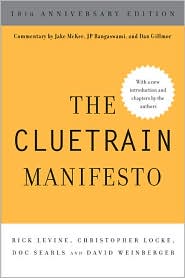
Cluetrain 10th Anniversary edition
Cluetrain 10th Anniversary
Everything Is Miscellaneous
Small Pieces cover
Small Pieces Loosely Joined
Cluetrain cover
Cluetrain Manifesto
My face
Speaker info
Who am I? (Blog Disclosure Form) Copy this link as RSS address Atom Feed

January 21, 2006

The $100,000 Bottom-Up Pyramid

Zephyr Teachout and Britt Blaser, both veterans of the Howard Dean Internet campaign, reflect on how to fix what’s going wrong at the well-intentioned Since Sliced Bread contest. The Service Employees International Union (SEIU) is sponsoring the contest, offering $100,000 to the person who comes up with the best idea for improving the lives of working women and men. 22,000 ideas were submitted which “a group of diverse experts” winnowed to 70, a process some felt was too top down.

This is a fascinating case in which a bottom-up process is supposed to squeeze out a single winner, the contest is intended to advance the social good, and the reward includes a hefty chunk of change. [Tags: seiu zephyrTeachout brittBlaser]

Tweet
Follow me

Categories: Uncategorized Tagged with: digital culture • politics • web Date: January 21st, 2006 dw

Be the first to comment »

January 18, 2006

Dan Bricklin’s wikiCalc

Yesterday, I saw Dan Bricklin demo his new project, wikiCalc. It’s a wiki spreadsheet. Like a spreadsheet, it does calculations on figures in a grid, and lets you enter formatted, cell-straddling text. Like a wiki, it lets anyone with permission make changes. It’s such a good idea that I thought we must already all be using it.

It’s in alpha, so it’s not yet a full-featured spreadsheet, but it’s getting there quickly. Because it’s AJAX-y, the cell editing is interactive. And it’s open source.

Great idea and looks like a cool implementation.

[Tags: wikicalc wikis danBricklin spreadsheets “web 2.0″]

Tweet
Follow me

Categories: Uncategorized Tagged with: web Date: January 18th, 2006 dw

1 Comment »

January 10, 2006

Conversation Network

Doug Kaye, founder of IT Conversations, has launched his new project, The Conversations Network, “a non-profit online publisher of recordings of spoken-word events.” IT Conversations is now officially one “channel” of The Conversations Network, which is transparent to users, so don’t worry. Doug will add more channels, and encourages people to submit high-quality recordings of spoken-word events.

I’m on its board of directors, so I’m totally not unbiased, but I’m on the board because I’ve been excited about this idea since Doug first broached it. [Tags: itconversations podcast dougKaye conversationnetwork media]

Tweet
Follow me

Categories: Uncategorized Tagged with: media • web Date: January 10th, 2006 dw

4 Comments »

January 5, 2006

Fast wifi in Boston

Steve
Garfield has a fascinating 3 minute report
at Rocketboom about "PulsePoints,"
a free fast wifi network, very local, that is separate from the Internet but
provides access to a bunch of content cached from the Internet. Oh, listen to
it and then you’ll see what I’m trying to say. [Tags: pulsePoints wifi boston SteveGarfield rocketboom]

Tweet
Follow me

Categories: Uncategorized Tagged with: web Date: January 5th, 2006 dw

4 Comments »

January 4, 2006

Hyperlinks v. Hierarchy

Here’s an excellent inter-blog thread on whether hyperlinks do in fact subvert hierarchy: Doc made that part of his new year wishes. Dave Rogers objected. Doc replied. Mark Bernstein calmly sorted through the claims.

I agree with Mark’s sorting-out. Nicely done.

When I wrote that “hyperlinks subvert hierarchies” phrase, I must have used the word “subvert” for a reason. I believe that I used it to hint at the effect of hyperlinks on power relationships. So, it seems the truth of the statement depends on whether existing hierarchies are in fact being subverted by the Web. And that’s hard to evaluate because it’s such a broad statement and because it’s still early days. In support of the claim I’d point to changes in how businesses behave and the role of the mainstream media. But you could counter that politics hasn’t changed much, and I would counter that that’s going to be one of the last hierarchies to change, and you could reply…etc. And you could point to the emergence of new hierarchies in various Web domains, and I’d point to ways in which they’re substantially different sorts of hierarchies, and I’d point to Web domains where non-hierarchical social forms dominate, and you could counter-claim…etc. And these are interesting conversations to have. But not to settle. Not yet.

I’d also add that I agree with Dave that humans compete. But – to state the obvious, with which Dave agrees – that’s not all we do. We also collaborate, sympathize, coordinate, love, give way, support, woo, encourage, cooperate, share, and surprise one another with “Hang in there, Baby!” cat posters. The fact that we compete does not necessarily mean that power hierarchies are inevitable or that they have to be the dominant institutional/social form.

PS: There’s a sense in which the book I’m working on is in fact an elaboration of the notion that hyperlinks subvert hierarchies, where the hierarchies are taxonomic but the effects are on institutions. [Tags: hyperlinks web docSearls daveRogers markBernstein EverythingIsMiscellaneous]

Tweet
Follow me

Categories: Uncategorized Tagged with: digital culture • web Date: January 4th, 2006 dw

39 Comments »

Wipo and the War against the Internet: Some resources

The remarkable Seth Johnson, corresponding secretary of New Yorkers for Fair Use, has put together a set of resources for people interested in how the US delegation to WIPO is leading one particular battle in the War against the Internet. Our representatives are pushing to create a new right, based on a right granted broadcasters 44 years ago. Before you could copy or reproduce in any form material that you found on the Web, you would have to get the permission not only of the copyright owners but of whomever published the content online. This would apply even if you were reproducing material in the public domain. “Webcasters” (i.e., anyone who posts anything on the Web) would be granted this control automatically for 50 years after they post any content. Creating this new right would require that digital rights management be installed everywhere. Yahoo is the most visible promoter of the proposal, according to an excellent article by James Love, which concludes:

Both the broadcasters and the webcasters claim that they are just trying to curb piracy. Well, if the works they broadcast or webcast are copyrighted, we already have lots of laws and treaties for that, including for the example the two 1996 WIPO Copyright treaties (the WCT and the WPPT)…
In the words of the treaty critics, the treaty proponents are guilty of piracy of the knowledge commons. They are seeking to claim ownership rights in works they did not create, and which today they do not own. They want something different from copyright, and different from the legal regime that exists in any country. They want to own what they simply transmit.

Here is Seth’s list of resources:
1) James Love: The UN/WIPO Plan to Regulate Distribution of Info
on the Net

2) Ernest Miller: The Broadcast Flag Treaty
3) James Boyle: More Rights are Wrong for Webcasters

Next Readings

Letter to Congress Seeking Public Consultation
National Association of Broadcasters Spokesperson on Public
Interest Considerations

Letter to Yahoo, the Foremost Sponsor of Webcasting Rights
Questions Posed by Civil Society Coalition to WIPO on
Broadcasting Treaty

Letter from Technology Businesses on Webcasting
IP Justice’s Top Ten Reasons to Reject the Broadcasting Treaty
Statement by NGOs on Signal Protection
2003 CPTech Analysis
James Love and Manon Ress Audio Overviews [1] [2]

Statements from Most Recent WIPO Meeting on Broadcasting Treaty

Chile Proposal
Brazil Proposal
Civil Society Coalition
Consumers International
Third World Network
IP Justice
Union for the Public Domain
Open Knowledge Foundation
Libraries:
European Digital Rights

Other Analyses

IP Justice [1] [2]
Electronic Frontier Foundation [1] [2] [3]:
Union for the Public Domain
News Articles
[1]
[2]
[3]
[4]

Link Pages

http://www.cptech.org/ip/wipo/bt/
http://www.ipjustice.org/WIPO/broadcasters.shtml
http://www.eff.org/IP/WIPO/broadcasting_treaty/
http://www.public-domain.org/?q=node/33

[Tags: digitalRights copyright warAgainstTheInternet SethJohnson wipo]

Tweet
Follow me

Categories: Uncategorized Tagged with: digital rights • media • web Date: January 4th, 2006 dw

Be the first to comment »

December 24, 2005

Does free software chill innovation?

Pito Salas wonders if the market’s expectation that broad classes of software just ought to be free is preventing some very cool apps from being developed. And before you jump all over Pito, keep in mind that he’s been working hard for over a year (or is it two years?) on an open source aggregator, BlogBridge that he provides, yes, for free. (Disclosure: I’m on BlogBridge’s board of advisors, without any expectation of compensation. I’m also a friend of Pito’s.) [Tags: PitoSalas blogbridge OpenSource]

Tweet
Follow me

Categories: Uncategorized Tagged with: web Date: December 24th, 2005 dw

2 Comments »

December 22, 2005

Three models of the Internet

Grant McCracken blogs about three ways of taking the depth and seriousness of the Net’s effect on culture. Here’s a distillation, but you should read the whole thing:

1. Disintermediation – “The Internet is an efficiency machine. It removes the friction…”

2. Long Tail – “The Internet is a profusion machine. It allows small cultural producers to find small cultural consumers, and as a result, all hell is breaking lose…”

3. Reformation – “It change the units of analysis and the relationships between them. This reformation model says, in other words, that the coming changes will deeply cultural…and not merely social (model 2) and economic (model 1).”

He concludes by offering a fourth. And, he notes that the first three are telescoping: If you believe 3, you also believe 2 and 1.

My view: Left free of large institutions trying to stifle the Net, it would become #3. Anyway, Grant offers us useful distinctions. [Tags: GrantMcCracken internet]


Shayne Bowman and Chris Willis have posted a piece they wrote for Nieman Reports, called “The Future Is Here, But Do News Media Companies See It?” The cutline gives away the surprise ending: “Traditional news media are not yet willing to adopt the principals of the environment in which they find themselves.” Good all-around survey of what’s going on.

Tweet
Follow me

Categories: Uncategorized Tagged with: web Date: December 22nd, 2005 dw

4 Comments »

December 20, 2005

Open source bounty

The Participatory Culture Foundation has started aggregating open source bounty projects at BountyCounty.org. For example, solve GNOME’s Addressbook’s LDAP configuration problem and earn yourself $250… [Tags: OpenSource]

Tweet
Follow me

Categories: Uncategorized Tagged with: web Date: December 20th, 2005 dw

5 Comments »

December 19, 2005

SiteAdvisor – Flagging the danger zones

When I was first introduced to Chris Dixon, a founder of SiteAdvisor.com, a few months ago, I was highly skeptical about his project. SiteAdvisor was going to tell people whether Web sites were safe. It struck me as over-ambitious, over-simplified and ripe for corruption. But after looking into it, I was impressed enough to join the board of advisors.

The SiteAdvisors.com site is still in stealth mode, but Ben Edelman — a security expert, Berkman fellow, and also on the board of advisors — has posted a long and thorough explanation of what SA is up to. So, the company is apparently no longer in full stealth mode.

Read Ben’s excellent post for the full story. Here’s my version:

SA has set up a slew of machines that crawl the Web, download whatever software they can find, and sign up for every email offer. They then run the downloaded software on virtual machines and note exactly what gets installed and how the registry is altered. They make up a unique email address for each site and note how many messages they get as a result. They also analyze the links to see if sites are part of nasty affiliate networks.

They then make all that information public via a Creative Commons license. You can go to the SA site and see exactly what will happen if you download software from an unknown Web site.

SA also sums up the results of this testing in a red, yellow, and green system of alerts. You can get a plug-in that will put those alerts next to every result on a Google results page. Hovering over the alert gives a summary. Clicking on it takes you to the full explanation. You can dive pretty deep into their analyses if you want. It evens build a mock inbox that shows you the subject lines of the spams you would have received had you signed up at a site.

So, I became a believer. First, I’ve spent a little time at the SA office and have gotten to know Chris fairly well, and I trust the SA team. Second, they answered all of my “Yeah, but” questions well: The data will be available through CC, there will be an API, there is room for users to comment on each site, the basic version will be provided for free and will be generously provisioned, their privacy policy looks good, they will accept zero advertising or other forms of vendor compensation. (Their business model includes offering a premium version at some point.)

I’ve been playing with the private beta, and I find it helpful and good-natured. And its database of empirical data, open via Creative Commons and an API, can become a very useful Web resource.

The site should be open for beta-business early next year…

[Tags: SiteAdvisor BenEdelman ChrisDixon security]

Tweet
Follow me

Categories: Uncategorized Tagged with: web Date: December 19th, 2005 dw

2 Comments »

« Previous Page | Next Page »


Creative Commons License
This work is licensed under a Creative Commons Attribution-NonCommercial-ShareAlike 3.0 Unported License.
TL;DR: Share this post freely, but attribute it to me (name (David Weinberger) and link to it), and don't use it commercially without my permission.

Joho the Blog uses WordPress blogging software.
Thank you, WordPress!