
logo
EverydayChaos
Everyday Chaos
Too Big to Know
Too Big to Know
Cluetrain 10th Anniversary edition
Cluetrain 10th Anniversary
Everything Is Miscellaneous
Small Pieces cover
Small Pieces Loosely Joined
Cluetrain cover
Cluetrain Manifesto
My face
Speaker info
Who am I? (Blog Disclosure Form) Copy this link as RSS address Atom Feed

January 27, 2025

Trump considering Tooth Fairy tariff


Dionald Jehosiphat Trump today said that he’s considering a tariff on the Tooth Fairy. “Why does she get to pull all those American teeth? We don’t even know where she offshores them!”

When asked for specifics about the tariff, Trump said, “Elon is working on an exact amount, but I told him it has to be high. So high that children keep up to 90% of their teeth.  Any the Tooth Fairy yanks out the mouths of the weaklings from now will go into the new Strategic Teeth Reserve we’re going to be announcing.”

The President made these comments on his way back from his annual dental checkup at which he said his dentist confirmed that he “has the teeth of a newborn babe.” “I can feel them turning into titanium, a little bit more every day,” the President  said, refusing to provide any further explanation.
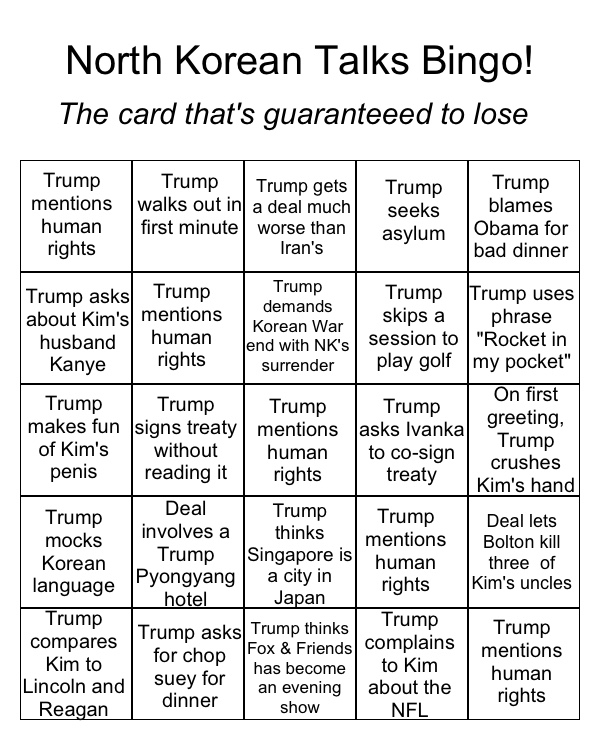
 

Image generated by Midjourney, prompt by me. CC-0
Tweet
Follow me

Categories: broadband, censorship, egov, humor, infohistory, libraries, net neutrality, politics, reviews, video Tagged with: humor • politics • trump Date: January 27th, 2025 dw

Be the first to comment »

August 1, 2024

The V.A.N.C.E. System of Voting

America is being run “by a bunch of childless cat ladies who are miserable at their own lives and the choices that they’ve made and so they want to make the rest of the country miserable, too.”  — J.D. Vance

I am truly excited, right down to my authentic work boots, by the tremendous response to my theory of voting rights. And despite what the lying radical left press says, I have even gotten strong messages of support from self-avowed cat-ladies who admit they are a waste of a womb. (Sorry, ladies. I’m a truth-teller.)

In response, I’ve decided to make public the full version of the Constitutional amendment I’ve been secretly working on for months. It’s, known as the V.A.N.C.E. System of Voting:

V stands for fair voting, in which the weight of your vote is determined by the stake you have in the future of this great country.

A is for “Advanced” because it is an advance over all other theories.

N is for “Nuanced” because it gets away from the simple-minded and unfair binary theory of voting according to which your vote either counts or it does not. Also, you see that I am open-minded about non-binary positions, although not when it comes to the sexuality of people or couches.

C is for “Counts” as in “How much does your vote count for?”

E is for “Equitable” because this is the only truly equitable voting system: If you have a family of, say, twelve then your vote deserves to count more than that of some self-centered cat-lady.

The Constitutional amendment that would make the V.A.N.C.E. System the law of the land spells this out in complete detail. Here’s an explanation that skips the fancy legal language so even you can understand it:

The key insight I’ve brought to the field of electoral philosophy is that the bigger stake you have in the outcome of an election, the more your vote ought to count. Simple and irrefutable!

But ideas of such crystalline purity still need mechanisms to make them real. The V.A.N.C.E. System provides one that is simple and, well, genius. It begins by saying that from now on, every voter’s vote has a weight calculated by the following considerations

Everyone starts out with a vote that weighs 1 pound.

Then we take the longest any American has lived, which is 119 years and 97 days. We call this the Knauss Max in honor of Sarah Knauss who passed away at this age in 1999. (The Knauss Max increases as Americans break her record.)

We subtract the voter’s age from the Knauss Max and add that to his (or her, at least until my next amendment) Vote Weight. So, if you’re 18, your Vote Weight starts off at 101. If you’re 75, its 44. That’s because you have a maximum of 44 years left to care about what the hell happens to this country.

Then we factor in the Child Care Bonus, which obviously has nothing to do with providing child care. No, it’s because, as any womb-using woman will tell you, if you have kids, you care more about what happens than if you only have a house full of cats or a couch with an oddly appealing indentation. So, for each child you have birthed and who still lives with you, you get 20 pounds of voting weight. Three kids at home? Your vote is sixty pounds heavier than your lonely next-door neighbor’s. (Meow.)

But there are a couple of complications necessary to keep this system completely fair.

First, if you’re raising children who never saw the inside of your womb, then you only get 5 more pounds per child. because, let’s face it, their futures don’t mean as much to you as someone who owes their life to your hubby’s Jesus seed.

Second, to be equitable ( see the “E” in V.A.N.C.E.), we have to factor in how many years each child has left. If you have two children, one 2 years old and the other 17 years old, then we apply the Knauss Max minus their ages to your Voting Weight. So, for the two year old the formula is (Knauss—age) – 2. That works out to an extra 177 pounds for you for the 2 year old and an extra 160 for the 18 year old.

I should have mentioned one other consideration earlier: the Loyalty Multiplier that gives 100 bonus pounds to each and every American citizen. If you are an immigrant, that number goes down by how old you were when you became a citizen, times 10. This reflects the fact that if you immigrated you have demonstrated that you lack the virtue of loyalty. Also, if you immigrated here, the chances are it was for any of three reasons. First, you love money more than your country. Second, it’s because you want to take a job away from a Black American. Third, it’s because you’re a kill-crazed drug dealer. Or all three.

Finally, there’s the E.L.O.N. (Economic Likelihood Of Nationalism) variable, which reflects the obvious truth that rich people have a much, much bigger stake in what happens to this country than poor people do: If you’ve got nothing, you have much less to lose than someone who could lose $20 or two hundred billion dollars.

So, the System says that we take a person’s Vote Weight as computed so far, and add to it the person’s annual income before tax breaks and deductions. So, if your Vote Weight comes to, say, 205, and your reported income is $22,000, your Vote Weight would be 22,205. And if you’re annual income is $100,000,000,000, your Vote Weight would be $100,000,022,205, which just makes intuitive sense.

Finally, as with any serious piece of research, I have to face some objections, no matter how dumb they are.

First, you — no, not you, but some anti-American radical leftist — might say that the poor have a bigger stake in their country than anyone since they depend on the government to help them out.

Shut up, stupid. There’s a difference between having a stake in America’s future and needing America to help you out. One is patriotic, the other is grifting.

The second objection is that if the V.A.N.C.E System makes sense for voting, why not for the economy? Clearly a poor person cares more about a dollar than a rich person does. So shouldn’t the poor person’s dollar count for more, and thus should buy more?

Hmm. I hadn’t thought about that. But it’s safe to say that it’s the sort of idea that cat-ladies find attractive since they’ve already created a communist, utopia for their lazyAF cats.

So, let’s go V.A.N.C.E system, and all hail the United States of America, the greatest shithole country in history!

Tweet
Follow me

Categories: humor, politics Tagged with: catladies • humor • politics • satire • trump • vance Date: August 1st, 2024 dw

1 Comment »

January 9, 2021

Beyond the author’s intent

Twitter’s reasons for permanent banning Donald Tr*mp acknowledge a way in which post-modernists (an attribution that virtually no post-modernist claims, so pardon my short hand) anticipated the Web’s effect on the relationship of author and reader. While the author’s intentions have not been erased, the reader’s understanding is becoming far more actionable.

Twitter’s lucid explanation of why it (finally) threw Tr*mp off its platform not only looks at the context of his tweets, it also considers how his tweets were being understood on Twitter and other platforms. For example:

“President Trump’s statement that he will not be attending the Inauguration is being received by a number of his supporters as further confirmation that the election was not legitimate…” 

and

The use of the words “American Patriots” to describe some of his supporters is also being interpreted as support for those committing violent acts at the US Capitol.

and

The mention of his supporters having a “GIANT VOICE long into the future” and that “They will not be disrespected or treated unfairly in any way, shape or form!!!” is being interpreted as further indication that President Trump does not plan to facilitate an “orderly transition” …

Now, Twitter cares about how his tweets are being received because that reception is, in Twitter’s judgment, likely to incite further violence. That violates Twitter’s Glorification of Violence policy, so I am not attributing any purist post-modern intentions (!) to Twitter.

But this is a pretty clear instance of the way in which the Web is changing the authority of the author to argue against misreadings as not their intention. The public may indeed be misinterpreting the author’s intended meaning, but it’s now clearer than ever that those intentions are not all we need to know. Published works are not subservient to authors.

I continue to think there’s value in trying to understand a work within the context of what we can gather about the author’s intentions. I’m a writer, so of course I would think that. But the point of publishing one’s writings is to put them out on their own where they have value only to the extent to which they are appropriated — absorbed and made one’s own — by readers.

The days of the Author as Monarch are long over because now how readers appropriate an author’s work is even more public than that work itself.

(Note: I put an asterisk into Tr*mp’s name because I cannot stand looking at his name, much less repeating it.)

Tweet
Follow me

Categories: censorship, culture, internet, philosophy, politics Tagged with: philosophy • politics • pomo • trump • twitter • writing Date: January 9th, 2021 dw

Be the first to comment »

August 17, 2019

Hillary-Trump Debates: The Audition Tapes

This is a re-play of something I wrote during the 2016 election. The premise is that the Clinton campaign is auditioning stand-ins for Trump to rehearse the 2016 debates with.

Note that Louis CK not yet disgraced, and in any case I the last paragraph of that one is really unclear. You see, he’s snapping back to the question, and talking about how Trump treats workers.

Also, the Anthony Wiener reference is, thankfully, dated now.

I have to say that I’m a little proud of the Quentin Tarantino story, though.

Louis CK


Clinton: Mr. Trump, not only have your businesses gone bankrupt, you’ve stiffed honest working people, refusing to pay them for their work. If you scam your own workers out of money, how can Americans trust you?

CK: I do that. I’m a terrible person. Really. I’m a rat bastard. I don’t mean to be. When I’m hiring someone, like a brick layer, I’m thinking: Wow, that guy works so hard. And you know something? He does something I couldn’t do in a million years. Give me a literal million years, and I’d still be laying bricks that looked like they were done by a two-year-old playing with her own poop. Uneven. Tilted. The cement between them would sometimes be the thickness of the chocolate in a Milano cookie, you know, so little it’s really there just so they can put on the package that it’s got chocolate. But it’s really like the fruit juice they add to a children’s drink so they can say “Made with real apples” when really it’s like they use apples in the paste on the labels. You can’t argue: it’s made with real apples. And then right next to that brick, the concrete would be like you split open two double-stuffed Oreos and stuck them together. Never in a million years could I do what a bricklayer does, and I’m in awe of them.

And next thing you know I’ve misjudged how many people want to get on a smelly bus to Atlantic City for four hours, and I’m like, “Hey, sorry, Mr. Bricklayer, but, go home and starve with your kids. But thanks, really.” I’m just such a rat bastard.

Malcolm Gladwell


Moderator: Mr. Trump, independent economists have estimated that your tax plan would cost the country as much as ten trillion dollars

in lost revenues. How would you pay for your ambitious new programs?

Gladwell: The best economists are with me. 100%. All of them support me. They’ve looked at my plan and they compare it to FDR. Franklin Delaney brought us out of the Great Depression. He was a cripple, you know? Still a great guy, though. Lot of brain. The world’s best economists look at my plan and what that tell me is that it’s like in 1875 when a peanut roaster by the name of Samuel Bridewell made a surprising discovery: the plants harvested from the western edge of his 30-acre farm in Virginia were slightly darker in color, slightly larger, and – this was the true revelation – when mashed at a temperature between 140 and 150 Fahrenheit, formed a glutinous mass that when cooled would hold whatever shape it was formed into. Bridewell began a lively, but local, business selling mashed peanuts in the form of farm animals, then Fathers of the Constitution, and then, as a wave of Irish immigrants spread the through the area, saints.

Bridewell’s Legume Figurines would today be forgotten if the nephews of a chemist named Robert Michelson had not been traveling through Virginia and came upon a box of the faded Figurines at a farm stand along a country path in Pebble Corners, eight miles south of Richmond. They opened one of the packages, but the youngest of the nephews, Chad Hemmings …

Moderator: Time is up, Mr. Trump.

Gladwell: … chipped a tooth on a desiccated miniature statue of St. Sebastian. He threw the statue down, where, by chance, it landed in a bowl of “lemon invigorator,” a punch being offered at the price of two drinks for a penny.

Moderator: Time, Mr. Trump.
Gladwell: The reaction of the peanut compound to the acidity of the lemons was immediate and startling …” John Podesta: Thank you.

Bryan Cranston


Moderator: Mr. Trump, you have said that you would consider withdrawing support for our NATO allies unless they made larger contributions to the financial cost of the treaty. Doesn’t that send a signal to Russia that it can invade countries with impunity?

Cranston: You’re worrying about Russia invading? You don’t understand. When invaders knock on the door of Crimea, I’m not Crimea and I’m sure as hell not its allies cowering in the dark. I am the one who knocks.

Clinton: I’m sorry, you’re now threatening to invade Crimea? I think we need to take this down a notch…

Cranston: Hey, lady, the screw only turns in one direction, and it you’re either the one doing the screwing or you’re on the pointy end…

John Podesta: Thank you Mr. Cranston. We’ll get back to you.

Terry Gross

Moderator: Mr. Trump, the next president may have the opportunity to fill up to three Supreme Court seats. Are there any litmus tests you would apply to candidates?

Gross: A litmus test? They’re completely unreliable. A hoax. Total hoax. You know who wants us to believe in litmus tests? The Chinese. [To the moderator] You should know that. Your father was a chemist, and your mother taught biology, right? And when you were fourteen, your father announced that he was gay. So how has growing up in a house full of scientists, one of who was a closeted gay man, influenced your sense of how reliable answers to any question can be, and the sort of follow-up you…

John Podesta: Thank you for your time, Ms. Gross.

Quentin Tarantino


Clinton: Politifact, the non-partisan fact checking site, says that you tell more untruths per hour than any candidate they’ve ever seen.

How can you lead the country when you have no problem knowingly telling outright lies?

Tarantino: You know who’s a liar? The biggest liar? God. I call him Lyin’ Jehovah. Lyin’ Jehovah. And you know the biggest lie Lyin’ Jehovah ever told, which makes it the the hugest lie in history? Huge. Really incredible.

You know Job, right? From the Old Testament. That Job. And it says right there that he’s the most righteous of his generation. He’s the guy. He does everything right. He prays. He sacrifices goats or whatever it says he has to sacrifice. He does it right. And it’s not easy. One little screw-up and you’re elbow deep in goat guts and it doesn’t count for anything. In fact, it shows God, who’s sitting there watching every detail just because He can, it shows God that you didn’t really mean it. If you meant it, you’d get it right. And Job gets it right. He totally does. God says so, flat out. And God rewards him with wives and children and goats and land. So Job is honoring God, all day, honoring, honoring, honoring.

And how does God respond? He basically gets into a drunken bet with Satan. Satan! Satan barely exists in the Old Testament, but he shows up just so God can have someone to bet with. Because who else is going to bet with God? God is always going to win. You know why? Because He’s God! The Creator. So, God bets the only schmuck arrogant enough to bet against Him that Job isn’t in it just for the wives and the goats. No, Job is righteous because he loves God. So what’s the test? Take away everything Job owns. Wives, children, land, goats. Give him boils, take away his HBO Go. Everything. Boom. Now instead of being the most righteous, he might as well be the town loser who takes a dump in the public swimming pool, you know what I mean? Job’s got nothing not because he was bad but because he was the most righteous. That’s why God picked on him.

So, Job asks God why this is happening to him, it’s so unfair. And asking God takes some Satan-size cojones because Job has seen what God can do. So, God replies with the greatest lie in the history of mankind. God — Jehovah, — to Job out of a freaking whirlwind and says, “Who are you to question me?” And God really rubs Job’s nose in it. Do you know about every freaking sparrow that falls? I didn’t think so. I couldn’t explain it to you if I wanted to, God says. And that’s it. That’s the lie. How do we know this? Because the Old Testament tells us exactly why it happened to Job: It was a bet. There’s nothing to understand except that God is being a total dick. But God can’t say that. So He lies. He lies!

But, I gotta say, Lyin’ Jehovah won the bet. He’s the ultimate winner.

John Podesta: Thank you, Mr. Tarantino.

Anthony Wiener

John Podesta: Next!

Tweet
Follow me

Categories: humor, politics Tagged with: humor • politics • tarantino • trump Date: August 17th, 2019 dw

Be the first to comment »

December 21, 2018

“I know tech better than anyone” isn’t a lie

The Democrats are trying to belittle the concept of a Wall, calling it old fashioned. The fact is there is nothing else’s that will work, and that has been true for thousands of years. It’s like the wheel, there is nothing better. I know tech better than anyone, & technology…..

— Donald J. Trump (@realDonaldTrump) December 21, 2018

This comes from a man who does not know how to close an umbrella.

Does Trump really believe that he knows more about tech than anyone? Even if we take away the hyperbole, does he think he’s an expert at technology? What could he mean by that? That he knows how to build a computer? What an Internet router does? That he can explain what an adversarial neural network is, or just the difference between machine learning and deep learning? That he can provide IT support when Jared can’t find the song he just downloaded to his iPhone? That he can program his VCR?

But I don’t think he means any of those things by his ridiculous claim.

I think it’s worse than that. The phrase is clearly intended to have an effect, not to mean anything. “Listen to me. Believe me.” is an assertion of authority intended to forestall questioning. A genuine expert might say something like that, and at least sometimes it’d be reasonable and acceptable; it’s also sometimes obnoxious. Either way, “I know more about x than anyone” is a conversational tool.

So, Trump has picked up a hammer. His hand is clasped around its handle. He swings his arm and brings the hammer squarely down on the nail. He hears the bang. He has wielded this hammer successfully.

Except the rest of us can see there is nothing — nothing — in his hand. We all know that. Only he does not.

Trump is not lying. He is insane.

Tweet
Follow me

Categories: politics, too big to know Tagged with: 2b2k • politics • trump Date: December 21st, 2018 dw

8 Comments »

June 10, 2018

North Korean Bingo!

Why is this card guaranteed to lose? You might notice a pattern in it…

north korean talks bingo card

…

Tweet
Follow me

Categories: humor, politics Tagged with: human rights • humor • politics • trump Date: June 10th, 2018 dw

2 Comments »

August 18, 2017

Journalism, mistrust, transparency

Ethan Zuckerman brilliantly frames the public’s distrust of institutional journal in a whitepaper he is writing for Knight. (He’s posted it both on his blog and at Medium. Choose wisely.)
As he said at an Aspen event where he led a discussion of it:

…I think mistrust in civic institutions is much broader than mistrust in the press. Because mistrust is broad-based, press-centric solutions to mistrust are likely to fail. This is a broad civic problem, not a problem of fake news,

The whitepaper explores the roots of that broad civic problem and suggests ways to ameliorate it. The essay is deeply thought, carefully laid out, and vividly expressed. It is, in short, peak Ethanz.

The best news is that Ethan notes that he’s writing a book on civic mistrust.


In the early 2000’s, some of us thought that journalists would blog and we would thereby get to know who they are and what they value. This would help transparency become the new objectivity. Blogging has not become the norm for reporters, although it does occur. But it turns out that Twitter is doing that transparency job for us. Jake Tapper (@jaketapper) at CNN is one particularly good example of this; he tweets with a fierce decency. Margie Haberman (@maggieNYT) and Glenn Thrush (@glennThrush) from the NY Times, too. And many more.

This, I think is a good thing. For one thing, it increases trust in at least some news media, while confirming our distrust of news media we already didn’t trust. But we are well past the point where we are ever going to trust the news media as a generalization. The challenge is to build public trust in news media that report as truthfully and fairly as they can.

Tweet
Follow me

Categories: blogs, journalism Tagged with: 2b2k • blogging • journalism • trump Date: August 18th, 2017 dw

1 Comment »

June 30, 2017

Hallucinating, not lying?

If we listen to what Donald Trump is telling us in plain and strong language, we should conclude that he is suffering from hallucinations — hallucinations of women bleeding.

Twice now he has claimed that blood was pouring out of women he feels were antagonistic of him: Megyn Kelly and Mika Brzezinski. We all saw that Kelly in fact was not bleeding. Brzezinski flat out denies her face was bleeding and says there are photos to prove it.

Then there’s this new story about Trump telling twenty Congressmen about seeing blood coming out of Brzezinski’s eyes and ears on another occasion.

These comments are so weird that the best explanation the media has put forward is that they are metaphors that illuminate Trump’s dark, dark reaction to being challenged by strong women.

But I think we should seriously consider that he was not talking metaphorically. He saw blood coming out of their faces.

At least the question needs to be asked of him. And then we need to re-read the 25th Amendment.

Tweet
Follow me

Categories: politics Tagged with: trump Date: June 30th, 2017 dw

2 Comments »

April 6, 2017

Not everything broken is in beta


CC-BY Kevin Gessner https://www.flickr.com/
photos/kevingessner/3379877300

A White House official has blamed the bumpiness of the ride so far on the White House being in “beta.” This has provoked Jennifer Pahlka — the founder and Executive Director of Code for America and a US Deputy Chief Technology under President Obama — to respond with heartfelt despair, worried that the tools she and her cohort brought to the Obama White House are now being used against all that that cohort accomplished.

It pains me to think that Pahlka, who is a hero of mine, has any regrets or fears about the after-effects what she has done for this country. For the foreseeable future, I think she need not worry about how the Trump administration is using the tools and mindset her cohort introduced to the White House. “This new administration lacks the understanding, competency, and value system to use those tools.”This new administration lacks the understanding, competency, and value system to use those tools.

Here’s the passage she cites from a New Yorker article
:

But, on Friday morning, Mike Allen, Axios’s editor-in-chief, reported that one of the officials in the meeting “views the Trump White House in terms that could be applied to the iterative process of designing software. It’s a beta White House.”

Allen went on, “The senior official . . . said the White House was operating on similar principles to the Trump campaign: ‘We rode something until it didn’t work any more,’ the official said. ‘We recognized it didn’t work, we changed it, we adjusted it and then we kind of got better . . . [T]his was much more entrepreneurial.’ In the White House, he said, ‘we’re going to keep adjusting until we get it right.’ ”
— John Cassidy, “The Keystone Kops in the White House” The New Yorker

“Beta” means “We rode something until it didn’t work any more”?? No, this official is describing what happens when you wake up one day and find out that your DVD burner is no longer supported by the latest upgrade to your operating system. That’s the opposite of “beta.”

The White House isn’t in beta. It’s in freefall.

Nevertheless, this passage bothers Jen because she and her colleagues used to say the same things about making incremental improvements when they were in the White House working to fix Healthcare.gov, the student loan process, and so much more. She writes:

Trump’s team is using the language of agile development to describe how they will strand millions of Americans without healthcare and ban Muslims from entering the country….

What are agile methods without the moral core of the movement for 21st century government, a commitment to users, aka the American people? My heart hurts so much I’m not sure my head is working quite right, and I don’t know if this bizarre application of agile methodologies is a farce or frighteningly effective.

Yes, agile programming can be used for evil purposes, but I don’t think Jen’s cohort should feel they carelessly left a weapon lying around the White House. The Trump administration lacks agile programming’s implicit understanding of how the future works, its theory or change, and its implied values. That’s why, at least so far, “the Trump White House is so non-agile that it’s not even the opposite of agile”the Trump White House is so non-agile that it’s not even the opposite of agile.

Agile software development is characterized by at least two relevant ideas: First, big projects can be chopped into smaller units that can be developed independently and often simultaneously. Second, agile projects are iterative, proceeding by small steps forward, with occasional small steps backwards. Both of these points stand in opposition to the prior “waterfall” approach?—?so-called because he project diagram looks like a series of cascading waterfalls?—?in which the steps for the entire project are carefully mapped out in advance.

To paint the differences too starkly, waterfall development is about command and control. Somebody maps out the flow, dates are assigned to the major phases, and managers make sure the project is “on track.” An agile project is instead about trust and collaboration. It breaks the software product into functional units — modules — each with an owner. The owner is trusted to build a module that takes in data in an agreed-upon format, operates on it, and outputs the result in an agreed-upon format. These independent module developers have to work closely with all the others who are relying upon their work, whether a module figures out what permissions a user has, determines if an arrow has hit its target in a game, or confirms that landing gear have been fully extended.

Agile development therefore cedes control from the Big Boss to the people most directly responsible for what they’re building. It needs a team — more exactly, a collaborative community?—?in which each person:

  • Understands precisely she needs to do

  • Understands how what she produces will serve everyone else’s input and output requirements

  • Can be trusted to get the job done well?—?which means getting it right for everyone else

  • Is in close communication with everyone relying upon her module and upon which hers relies

  • Understands the overall goal of the project

As far as anyone can tell from the outside, exactly none of this applies to the current White House.

Second, agile development is iterative?—?a series of small changes because it assumes that you cannot fully predict how exactly the end product will work, or even what exact functionality it’s going to provide. That is, agile development assumes that life, the universe, and all that are so complex that precisely planning a project from beginning to end requires an act of arrogance that borders on stupidity. And measuring the success of a project by its micro-adherence to a fixed schedule in a world that is changing around it rewards stubbornness over serving end-users as well as possible.

Now, Donald Trump’s preference for deal-making over policy
aligns with iteration’s acceptance that “the future is not the next card in the deck but is what we make of our hand”the future is not the next card in the deck but is what we make of our hand. But Trump’s style of deal-making is based on the superior skill of the individual (Donald), a ruthless commitment to “winning,” and is all about one big step?—?the end result?—?not a series of small changes. Ultimatums of the sort that Trump issued once he saw he was losing the health care battle are the opposite of the incrementalism of iteration. An iterative approach is exemplified by the Democrats’ approach: Let’s tinker with Obamacare to fix what needs fixing.

So, Trump’s White House is anything but agile.

But neither is it proceeding through a waterfall approach, for that requires a commitment to an end result, a rational and realistic understanding of the steps necessary to get there, and well-coordinated managers who are all on the same page. The Trump White House does have a commitment to end results, expressed as mob-inciting campaign promises that are often at the sweet spot where delusion and heartlessness intersect on the Venn diagram of policy-making. Beyond that, this White House exhibits none of the processes, commitments, or accountability that are the hallmark of waterfall development.

Jen’s cohort left tools the White House can’t use because it lacks agile development’s understanding of how change happens and agile’s fundamental trust in its community of practitioners. In short, Jen’s cohort brought a community to a knife fight.

Posted also at Medium.

Tweet
Follow me

Categories: misc Tagged with: agile • obama • pahlka • trump Date: April 6th, 2017 dw

1 Comment »

January 23, 2017

Trump's conspirators

For too long, a small group in our nation’s capital has reaped the rewards of government while the people have bore the cost. Washington flourished, but the people did not share in its wealth. Politicians prospered but the jobs left and the factories closed.

So said Pres. Trump in his inaugural address, identifying the perpetrators of the Bladerunner-esque hellscape he depicted.

It’s not clear who he means. That’s worrisome.

The “rewards of government” Trump has in mind seem to be monetary, since in the next sentence he talks about wealth, and in the one after that he contrasts prospering politicians with factory workers who have lost their jobs.

So, who does Trump thinks is this shadowy group that has controlled our nation for their own personal monetary profit? Obama and his administration? Especially in terms of personal enrichment, the Obama years were the cleanest in my lifetime. And, of course, Trump’s poised to be the most corrupt in terms of self-enrichment.

It makes me nervous when politicians blame a small unnamed group that controls the country and does so for personal monetary benefit. Sounds like a dogwhistle to me, especially when an anti-Semitic white racist is the president’s chief strategic adviser.

I’m struggling to make sense of this particular paranoid conspiracy theory. I’m only coming up with one answer.

Tweet
Follow me

Categories: misc Tagged with: trump Date: January 23rd, 2017 dw

Be the first to comment »

Next Page »


Creative Commons License
This work is licensed under a Creative Commons Attribution-NonCommercial-ShareAlike 3.0 Unported License.
TL;DR: Share this post freely, but attribute it to me (name (David Weinberger) and link to it), and don't use it commercially without my permission.

Joho the Blog uses WordPress blogging software.
Thank you, WordPress!