logo
EverydayChaos
Everyday Chaos
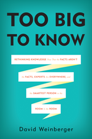
Too Big to Know
Too Big to Know
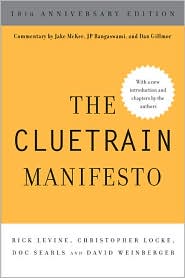
Cluetrain 10th Anniversary edition
Cluetrain 10th Anniversary
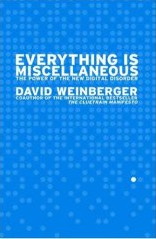
Everything Is Miscellaneous
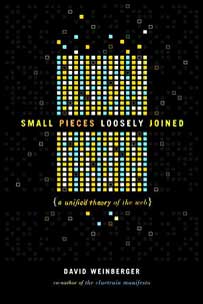
Small Pieces cover
Small Pieces Loosely Joined
Cluetrain cover
Cluetrain Manifesto
My face
Speaker info
Who am I? (Blog Disclosure Form) Copy this link as RSS address Atom Feed

November 19, 2007

Kindle, e-books, libraries…

I just published a new issue of my free newsletter. The main article is, entirely by coincidence, about ebooks and libraries — a coincidence because Amazon just announced Kindle, its ebook hardware.

November 19, 2007

The future of book nostalgia:
Anthony Grafton’s New Yorker article on why libraries will always be with us shows the power of book nostalgia.

What we owe:
As parents we need to fight to let the Internet we love be a settled part of our children’s lives.

By the way, Everything Is Miscellaneous is available for Kindle. Cluetrain is not.
Also by the way, I just got a link from Urs Gasser to his contribution to a recent conference on the future of books.

[Tags: books ebooks kindle amazon libraries everything_is_miscellaneous ]

Tweet
Follow me

Categories: Uncategorized Tagged with: culture • digital culture • everythingIsMiscellaneous • taxonomy Date: November 19th, 2007 dw

4 Comments »

October 21, 2007

Aaron Swartz on the Open Library project

If you’re interested in the future of books and libraries, and if you’re in Cambridge MA on Tuesday, you should come to the Berkman Center at 12:30 to hear Aaron Swartz talk about the Open Library project, which is gathering a global, open and free list of every book it can find out about. It’s also attempting to help with the problem that books exist at multiple levels of abstraction: There’s Hamlet, editions of Hamlet, Hamlet in anthologies, Hamlet in translation, books based on Hamlet, etc. This is an important and fascinating project.

We serve lunch. Please RSVP. See you there…or on the webcast. (Details) [Tags: open_library aaron_swartz libraries books_everything_is_miscellaneous ]

Tweet
Follow me

Categories: Uncategorized Tagged with: culture • digital culture • education • everythingIsMiscellaneous • philosophy • taxonomy Date: October 21st, 2007 dw

2 Comments »

October 20, 2007

Alan Watts lives

Here’s Alan Watts talking to IBM (1 2), probably in the early 1970s, although I’m just guessing. Very Alan Wattsian, very Sixties yet contemporary, and very enjoyable. Here’s a bite:

“But nature itself is clouds, is water, is the outline of continents, is mountains, is bilogical existences. And all of them wiggle. And wiggly things are to human consciousness a little bit of a nuisance, because we want to figure it out.”

(Thanks to Steven Kruyswijk for the link.) [Tags: alan_watts everything_is_miscellaneous ]

Tweet
Follow me

Categories: Uncategorized Tagged with: culture • digital culture • everythingIsMiscellaneous • philosophy • taxonomy Date: October 20th, 2007 dw

3 Comments »

October 18, 2007

A river runs through it

Dave Winer has come up with a clever way of reslicing the NY Times. Not only does it group articles by keyword, the layout creates a histogram of the topics. [Tags: dave_winer ny_times nytimes everything_is_miscellaneous media metadata ]

Tweet
Follow me

Categories: Uncategorized Tagged with: everythingIsMiscellaneous • media • taxonomy Date: October 18th, 2007 dw

4 Comments »

October 17, 2007

Everything is miscellaneous explained in a 5 and a half minute YouTube

Michael Wesch, who did the incredible info-visualization YouTube, The Machine Is Us/ing Us, has now done the same to explain the change from paper-based information to digital information. In just a few minutes, he explains the thesis of Everything Is Miscellaneous (which he credits, thank you). It is a brilliant piece of work. And totally delightful. [Tags: wesch everything_is_miscellaneous ]

Tweet
Follow me

Categories: Uncategorized Tagged with: digital culture • everythingIsMiscellaneous • taxonomy Date: October 17th, 2007 dw

5 Comments »

October 15, 2007

Peer review review

I have a friend who is in charge of managing the peer review process at some serious scientific journals. It’s a tough job requiring a set of skills that includes dealing with sometimes ornery people, managing multiple schedules, and expertise in the fields in which she works. She makes a good case for peer review, and for the journals that rely on it. Peer review has value and costs money, she says. So, journals have to charge fees to support the peer review process, and they have to hold onto the rights at least long enough to recover their costs.

I recognize the value of peer review. It not only directs our attention to worthwhile research, it is part of an editorial process that improves articles before they’re published. But peer review doesn’t scale. There’s so much research being done. A lot of it is good work but isn’t important enough to merit the investment in a traditional peer review process (including the failed hypotheses that we were taught in school were not failures at all). Peer review is valuable, but it’s a choke point required because traditional publishing’s neck is so thin. And it may — may! — turn out that the combination of crowds and quirky individuals can replace peer review’s value. Of course, we’d want the crowd to consist of people with some standing for evaluating the research. And we’d want to be sure that the quirky individuals who buck the crowd are not delusional psychotics. I of course don’t know what the world will look like (or what it does look like, when you come down to it), but I suspect that we’re going to have a mixed research ecology, with peer reviewed journals making recommendations we trust highly, and a wide variety of other ways of finding the research that matters to us. With PLoS and PLoS, and arXiv, and Nature’s version of arXiv, and all the rest of it, we’re already well on the way to filling the important niches in this new knowledge ecology.

In fact, peer review generally establishes two characteristics of a piece of work: It was performed properly and it is important enough to merit throwing some ink at it. Those are important criteria, but hardly the only ones. “This hastily performed work uses a flawed methodology but turns up an interesting fact worth considering” is the type of criterion researchers use when recommending articles to one another. There’s value there, and with research that has good data that it misanalyzes, research that is promising but incomplete, research that inadvertently demonstrates a flaw in some lab equipment, etc. etc. etc. And, as always, the value is in the long tail of et ceteras. [Tags: peer_review open_access science publishing everything_is_miscellaneous ]

Tweet
Follow me

Categories: Uncategorized Tagged with: culture • digital culture • everythingIsMiscellaneous • media • taxonomy Date: October 15th, 2007 dw

6 Comments »

October 12, 2007

Auto-tag your blog

Jeremy Wagstaff on Jiglu for auto-tagging your blog and its archive…

Tweet
Follow me

Categories: blogs Tagged with: blogs • everythingIsMiscellaneous • taxonomy Date: October 12th, 2007 dw

Be the first to comment »

October 8, 2007

Tags needed

Why oh why aren’t there tags in Google Calendar? Oh my sweet Jeebus, I want tags for events! I get so tired ot trying to find every birthday, every speech, every “maybe” event. In fact, I try to use those terms — embedded tags! — in the content itself just so I can find the events again. Please, oh great Google, give us, your unworthy supplicants, calendar tags!


Wordie started out as a joke – a site that was all tags and no content. Now it’s added tags. I have to run for a train, so I don’t have time to step into its infinite loop of metareference, but John McGrath explains it all here. [Tags: tags tagging folksonomy google_calendar wordie ]

Tweet
Follow me

Categories: Uncategorized Tagged with: everythingIsMiscellaneous • taxonomy Date: October 8th, 2007 dw

3 Comments »

October 2, 2007

Karen Schneider moves on from ALA blog

Karen Schneider (the Free Range Librarian) is one of those strong-voiced writers who makes a real difference in her domain. Now she is leaving the American Library Association’s TechSource blog — which she was instrumental in beginning — in order to follow her writerly instincts. Her last post is a message to librarians that usefully points them toward their fears. [Tags: karen_schneider libraries ala everything_is_miscellaneous]

Tweet
Follow me

Categories: Uncategorized Tagged with: culture • digital culture • education • everythingIsMiscellaneous • taxonomy Date: October 2nd, 2007 dw

1 Comment »

October 1, 2007

The front page is dead, but not yet quite reborn

I like what Michael Wolff says in his Vanity Fair piece about his new news site:

The metaphor, for 150 years — from print to radio to network to cable — has been the front page: important stuff first. “It should have to do now with falling through something, or floating through the totality of information or of intersecting worlds and interests,” offers [Patrick] Spain, not a man wild with his metaphors. [VF, October, p. 126]

I’ve been saying for a while, and I think in Everything Is Miscellaneous, that the new front page is distributed across our day and our network. Much of it comes through our inbox. It consists of people we know and people we don’t know recommending items for our interest.

So, I was disappointed by Wolff’s new site, Newser.com. It presents a view of the news that’s much less hierarchical than a typical front page, and it’s well-designed for quickly finding what matters to you, but: (1) It assumes its nine top-level categories reflect how every reader views the world; (2) Where are our voices? Comments? Blogs? (3) I couldn’t let it arise from my social network (where that network includes people I don’t know but whose views interest me). It competes with Google News, not with the intersection of Digg and FaceBook, which is what I’m waiting for. [Tags: everything_is_miscellaneous news media michael_wolff ]

Tweet
Follow me

Categories: Uncategorized Tagged with: digital culture • everythingIsMiscellaneous • media • taxonomy Date: October 1st, 2007 dw

1 Comment »

« Previous Page | Next Page »


Creative Commons License
This work is licensed under a Creative Commons Attribution-NonCommercial-ShareAlike 3.0 Unported License.
TL;DR: Share this post freely, but attribute it to me (name (David Weinberger) and link to it), and don't use it commercially without my permission.

Joho the Blog uses WordPress blogging software.
Thank you, WordPress!