


logo
EverydayChaos
Everyday Chaos
Too Big to Know
Too Big to Know
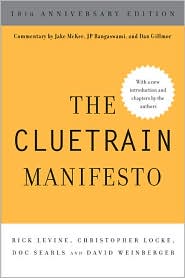
Cluetrain 10th Anniversary edition
Cluetrain 10th Anniversary
Everything Is Miscellaneous
Small Pieces cover
Small Pieces Loosely Joined
Cluetrain cover
Cluetrain Manifesto
My face
Speaker info
Who am I? (Blog Disclosure Form) Copy this link as RSS address Atom Feed

October 10, 2011

Erik Martin on what makes Reddit special

Erik Martin, the general manager of Reddit, explains what’s so special about the discussion site. I’m particularly interested in the nature of authority on the site, and its introduction of new journalistic rhetorical forms.

Tweet
Follow me

Categories: journalism, media, social media, too big to know Tagged with: 2b2k • journalism • media • reddit • social media Date: October 10th, 2011 dw

2 Comments »

September 28, 2011

The coffee-shopping of everything

David Strom at ReadWriteWeb notes a trend at hotels to re-jigger lobbies as social spaces in which you can plug in your laptop and hang out, instead of sitting in your disinfected Rectangle of Solitude.

I’d give it a try, especially if free or cheap coffee were involved. I think I might enjoy the company, although if someone actually tried to talk with me, I’d undoubtedly give him the stink eye so I could get back to work. Hey, just because I want to be near other human beings doesn’t mean I want to be your friend.

So, yes, I would want to achieve that refined balance of social and impersonal that is of increasing importance in today’s ever-more-public world, and that is at the heart of Starbucks’ value proposition.

Tweet
Follow me

Categories: culture, libraries, social media Tagged with: coffeeshops • hotels • libraries • social media • sociality • starbucks Date: September 28th, 2011 dw

5 Comments »

September 26, 2011

Profile Photo

Just for fun:

Profile Photo

JonJGman has updated his profile photo.

JonJGman thinks his profile photo makes him look boring.

JonJGman has put a yellow background in his profile photo.

JonJGman thinks the yellow background makes his skin look waxy, almost cadaverous.

JonJGman has superimposed “Madame Toussault’s” on his background photo so maybe you’ll think he looks waxy because they’ve made a statue of him.

JonJGman has run the spell checker on “Madam Toussault’s.”

JonJGman has changed the background so he’s now standing in front of the Grand Canyon.

JonJGman can’t figure out how to get “Madam Tossaud’s” erased from the sky over the Grand Canyon.

JonJGman has run the spellchecker on “Madam Tossaud’s” and definitely thinks he’s getting closer.

JonJGman has never been to the Grand Canyon and besides it looks like’s standing in front of a photo of the Grand Canyon with the words “Madam Tussauds” mysteriously in the sky, so he’s thinking about going back to his original photo.

JonJGman can’t find his original profile photo.

JonJGman has accidentally deleted his Trash folder.

JonJGman has downloaded a copy of his Waxy Dead Person Standing in Front of a Picture of the Grand Canyon with “Madame Tussault’s” Still Misspelled in the Skies photo.

JonJGman has decided to brighten his teeth in his profile photo.

JonJGman now has a bright pink, waxy nose in his profile photo.

JonJGman wishes to inform his friends that it’s only due to an incompetent attempt to darken the bright tip of his waxy nose that he now looks like suffers from stage 3 leprosy.

JonJGman has accidentally uploaded a photo of Anthony Weiner’s tumescent underpants that he honestly didn’t even know that he had, as his profile photo.

JonJGman’s new profile photo is Default Avatar #23.

JonJGman randomly chose Default Avatar #23 without realizing that it depicts a pink kitty that is at best age-inappropriate and, as a replacement for the Weiner Party in His Pants photo, is actually pretty creepy.

JonJGman wishes to apologize to his friends for not realizing that they were being notified about every step in this personal odyssey.

JonJGman has now changed his name to JakeTheBear325 and hopes to begin again fresh.

JakeTheBear325 has changed his profile photo.

Tweet
Follow me

Categories: humor, social media Tagged with: humor • profiles • social media Date: September 26th, 2011 dw

6 Comments »

July 31, 2011

The mystery of Public and Incoming at Google Circles: An Explainer (unless I’m getting it wrong)

I thought I understood Google Circles until I tried explaining it to someone. So, let me see if I have this straight.And if I do, then I have a suggestion for Google Plus: Instead of saying that we post to “Public,” tell us we’re posting “To Followers.” And instead of letting us look at our “Incoming” stream, tell us we’re looking at “From Followers.”

Let’s say I have two circles: Friends and Coworkers. Into Friends I put Fred, Fanny, and Felicia. Into Coworkers I put Carol, Carl, and Cathy.

I now post something to Friends. Assume all members of my Friends circle have put me in one of their own circles. My Friends now see my posts whenever they check the stream from the circle they’ve put me into.

Now, it turns out that my coworker Carol hates my guts and hates hearing from me, so she hasn’t put me in any of her circles. Does she see my posts to my Coworkers circle anyway? If not, then either (a) I have the illusory sense that I’m posting to her when I post to my Coworkers circle, or (b) Carol is seeing my posts even though she does not want me in any of her circles.

Google Plus solves this dilemma through the Incoming stream and the Public circle. By putting Carol into one of my circles, two things happen:

(1) When I check my Coworker stream, I now see what Carol posts to Public. Since Carol doesn’t have me in any of her circles, she doesn’t want me to see what she posts exclusively to those circles. But, if Carol posts to Public, it is visible to anyone who has encircled her…even people like me whom she hates. If Carol didn’t want me to see it, she shouldn’t have posted it to Public. (Think of posting to Public as posting “To Followers.”) [Note about an hour later: Thanks to useful discussion of this post over at G+, I realize I should have added that posting to Public means also that your post has a publicly accessible URL.]

(2) My posts now show up in Carol’s Incoming stream. That stream shows all posts from people who have encircled Carol. If she doesn’t want to see my posts in her Incoming stream, she can mute me. (Think of Incoming as “From Followers.”)

The asymmetry of Circles is their genius, but, just as with Twitter, they lead our mortal brains astray. We think that because we’re posting to a circle, everyone in that circle will receive our post. Not exactly. If they have encircled me, it will show up within that circle’s stream. If they have not encircled me, it will be visible to them in their Incoming stream.

So, if you are an Internet Celebrity who has been encircled by 100,000 people, but who has encircled only ten close friends, your posts to your circle of ten will be visible only to those ten. (If they haven’t encircled you, your posts will show up in their Incoming stream.) If you post to Public, all 100,000 people will see your post within whatever circle they’ve placed you in.

I understand this as I write it. But, wait a second…yeah, it’s gone. :(

Tweet
Follow me

Categories: social media Tagged with: google • google plus • social media Date: July 31st, 2011 dw

7 Comments »

February 4, 2011

Gladwell proves too much

Malcolm Gladwell is going further out on his cranky branch. His reading of the role of social media in Tunisia and Egypt actually seems to lead to conclusions that I think he would acknowledge are extreme and extremely unlikely. (I look at his new post in some detail after the big box below.)

Gladwell is in the unfortunate position of having published a New Yorker article dismissive of the effect of social media on social protest movements just weeks before the Tunisian and Egyptian revolts. Now Gladwell has posted a 200-word commentary that maintains his position without emendation. (Mathew Ingram has an excellent response to Gladwell’s latest post.)

I was among the many who replied to Gladwell’s initial article. I began that piece by trying to outline Gladwell’s argument, in a neutral and fair way. This is what I came up with:

In 1960, four college students staged a sit-in in NC. Within a week, sit-ins had started to spread like “a fever.”

Gladwell now states the claim he is going debunk: “The world, we are told, is in the midst of a revolution. The new tools of social media have reinvented social activism.” He then points to world events that have been claimed to support that view.

But, (he continues) those events were not really brought about by social media. Why would we think they were? It’s not due just to over-enthusiasm for social media. Fifty years after the civil rights movement, “we seem to have forgotten what activism is.” It is really our understanding of activism that is at issue.

Now, back to the sit-ins. They were dangerous. Civil rights activism took courage. That courage required strong ties to other activists. This was true not just of the civil rights movement in the US, but is a general characteristic of activism.

But, “The kind of activism associated with social media isn’t like this at all.” Social media (Twitter, Facebook) are all about weak ties. Weak ties are “in many ways a wonderful thing…But weak ties seldom lead to high-risk activism.” Social media activism works when little is asked of people.

Activism requires not just strong ties, but also strong, centralized, hierarchical organization. Not networks. You need a hierarchy “if you’re taking on a powerful and organized establishment…”

As an example, Gladwell ridicules the opening story in Clay Shirky’s Here Comes Everybody, about how “the crowd” got a smart phone returned to its rightful owner. “A networked, weak-tie world is good at things like helping Wall Streeters get phones back from teen-age girls.”

Now apply that to Tunisia and Egypt. You would think that these were pretty dramatic counter-examples. Gladwell does not think so. In fact, his recent post reads as if he’s exasperated that anyone is still bothering to disagree with him:

But surely the least interesting fact about them is that some of the protesters may (or may not) have at one point or another employed some of the tools of the new media to communicate with one another. Please. People protested and brought down governments before Facebook was invented.

Even the fact the post is only 200 words long gives the impression that the two Mideast upheavals are barely worth his time.

Let’s look at each of the post’s two paragraphs.

Paragraph #1. This is a paragraph of ridicule: Paying attention to social media is like hearing a famous revolutionary statement from Mao Zedong, paying scant attention to its content and import, and instead getting all excited because of the medium he used.

Yes, it is possible to pay too much attention to the medium as opposed to the message. But, as with so many arguments by ridicule, this one doesn’t advance our thought at all. We can counter by trying to make the analogy more exact: If in 1935 Mao had said “Power springs from the barrel of a gun,” and it had spread through, say, a new-fangled telephone tree so that it reached beyond the boundaries of government-controlled radio, and if that statement had signaled a turn to violent uprising, it would be irresponsible to ignore the role of the medium in the dissemination of the message. Or, if government printers had in the 1960s refused to publish the Little Red Book that spread that quote, the lack of a medium for it would surely be worth discussing. Media play an important role. When the medium is new, it is right to examine that role. That is not to say that the medium is a sufficient cause, or is the only thing worth discussing. But who has attributed the Tunisian and Egyptian uprisings solely to the existence of social media?

Gladwell’s argument in this first paragraph therefore seems to me to be: (1) Ultimately an argument against media having any role or significance in political movements; (2) An argument against a strawman; (3) Less an argument at all than a “Hey you kids, get off my lawn” statement of alignment.

Paragraph #2. Gladwell reiterates his point that political activism requires strong ties, and social media only provides weak ties. He defends these contentions by using the word “surely,” which almost always indicates that the speaker has no evidence to present that could in fact make us sure: “But surely the least interesting fact about them is that some of the protesters may (or may not) have at one point or another employed some of the tools of the new media to communicate with one another.”

It is not at all obvious that this is the least interesting fact. Social media are a new variable. Because history is so damn particular, contingent, and emergent, we can never be entirely sure which new variables matter. The anti-Mubarak demonstrations have been (apparently) heavily supported by Egypt’s trade unions, for example; perhaps that’s worth exploring. Declaring the possible role of social media the “least interesting fact” seems based either on an a priori belief that (a) media never have an important role in social movements, or (b) our new social media can have no role because of Gladwell’s theory that they can’t supply the strong ties necessary for activism. The first alternative seems too silly to defend. If it’s the second, then I would have thought a reasonable response from Gladwell would have been along these lines: “I’ve put forward a bold hypothesis about the ineffectiveness of social media. That hypothesis is based primarily on some historical examples. We have some new examples before us. Let us examine them to see if they indeed support my hypothesis — especially since so many have claimed that this new evidence refutes that hypothesis.” Instead we get all the power a confidently rendered “surely” can bring.

But the second paragraph is not over. Gladwell now gives examples of historical revolutions that succeeded before the development of the Net. The conclusion warranted from this evidence is that no particular medium is necessary for a revolution: We know you can have a revolution without, say, telephones because we’ve had many such revolutions. But this is a really bad way to argue about historical explanations. Many wars have ended without any atomic bombs being used, so we might as well say that historians ought not to consider the effect dropping a-bombs had on ending WWII. No, if we want to understand an event, we have to understand it within its history. The events in Tunisia and Egypt are occurring within a history in which social media are being used for among the first times. That makes the question of the role of social media interesting, and, under most theories of history — ones in which the nature of the contemporary media plays a contributing part — important.

Gladwell’s second paragraph therefore “proves” too much. But he backs off the obvious silliness of where his arguments lead by concluding: “People with a grievance will always find ways to communicate with each other. How they choose to do it is less interesting, in the end, than why they were driven to do it in the first place.” He thus proposes a sort of historical determinism: No matter what the means of communication, those who want a revolution will have a revolution. But: (1) How do we know this is true? (2) The means of communication may well affect (a) when it happens, (b) how it happens, (c) who participates, (d) its success, (e) how the world reacts, and (f) how the participants view themselves as a social group. That last point I acknowledge is the squishiest of them, but it may have the most lasting effect, helping to shape the governmental structure that emerges post-revolution: “We are a mob inspired by the incredible leaders who have the megaphones” might tend toward differences in governance than “We are a connected, empowered network.” In any case, it seems to me that investigating the role of social media is not an activity beneath contempt.

And that’s why I’ve written a post ten times longer than the one it’s discussing. Gladwell — with his amazing ability to illuminate difficult matters — is not merely splashing cold water on an overheated subject, but is trying to drown the subject entirely. Because we don’t yet understand the effect social media are having on social movements, it is unhelpful to have such a powerful voice ridiculing the effort to trace their effects. Gladwell’s attempt to undo unwarranted enthusiasm comes across instead as an argument for diminished nuance. That is exactly what Gladwell is decrying in our discourse, and is not what his body of writing has exemplified.

So, I come out of his brief post wondering how Gladwell would answer the following questions:

http://ramfarms.com/sites/blog/index.php?=cialis-20-mg-directions

1. Does Gladwell believe that the means of communication never has any effect on any social protest movement? (“…in the French Revolution the crowd in the streets spoke to one another with that strange, today largely unknown instrument known as the human voice.”)

2. If he believes that the means of communication can have some effect, then does he believe that some media that do not create strong ties — radio, newspapers, tv, etc. — are worth considering when trying to understand social protest movements? If so, then why are networked social media not worth considering?

3. If social media are worth considering as playing some role in social protests, exactly what role and how important? A role so trivial that it is literally the least interesting factor historians and analysts should be looking at? Or is it of more importance than that, but just not anywhere near worth the amount of attention it’s been getting?

4. On what does he base these views? A theory about how social protest movements have worked and must work? Does he hold this theory as so obviously true that all events must now be interpreted within it, or is he willing to examine events to see if they support or contradict his theory?

Tweet
Follow me

Categories: media, social media, too big to know Tagged with: egypt • gladwell • history • social media • tunisia Date: February 4th, 2011 dw

41 Comments »

« Previous Page


Creative Commons License
This work is licensed under a Creative Commons Attribution-NonCommercial-ShareAlike 3.0 Unported License.
TL;DR: Share this post freely, but attribute it to me (name (David Weinberger) and link to it), and don't use it commercially without my permission.

Joho the Blog uses WordPress blogging software.
Thank you, WordPress!