logo
EverydayChaos
Everyday Chaos
Too Big to Know
Too Big to Know
Cluetrain 10th Anniversary edition
Cluetrain 10th Anniversary
Everything Is Miscellaneous
Small Pieces cover
Small Pieces Loosely Joined
Cluetrain cover
Cluetrain Manifesto
My face
Speaker info
Who am I? (Blog Disclosure Form) Copy this link as RSS address Atom Feed

October 17, 2011

[2b2k] Why this article?

An possible explanation of the observation of neutrinos traveling faster than light has been posted at Arxiv.org by Ronald van Elburg. I of course don’t have any of the conceptual apparatus to be able to judge that explanation, but I’m curious about why, among all the explanations, this is one I’ve now heard about it.

In a properly working knowledge ecology, the most plausible explanations would garner the most attention, because to come to light an article would have to pass through competent filters. In the new ecology, it may well be that what gets the most attention are articles that appeal to our lizard brains in various ways: they make overly-bold claims, they over-simplify, they confirm prior beliefs, they are more comprehensible to lay people than are ideas that require more training to understand, they have an interesting backstory (“Ashton Kutcher tweets a new neutrino explanation!”)…

By now we are all familiar with the critique of the old idea of a “properly working knowledge ecology”: Its filters were too narrow and were prone to preferring that which was intellectually and culturally familiar. There is a strong case to be made that a more robust ecology is wilder in its differences and disagreements. Nevertheless, it seems to me to be clearly true (i.e., I’m not going to present any evidence to support the following) that to our lizard brains the Internet is a flat rock warmed by a bright sun.

But that is hardly the end of the story. The Internet isn’t one ecology. It’s a messy cascade of intersecting environents. Indeed, the ecology metaphor doesn’t suffice, because each of us pins together our own Net environments by choosing which links to click on, which to bookmark, and which to pass along to our friends. So, I came across the possible neutrino explanation at Metafilter, which I was reading embedded within Netvibes, a feed aggregator that I use as my morning newspaper. A comment at Metafilter pointed to the top comment at Reddit’s AskScience forum on the article, which I turned to because on this sort of question I often find Reddit comment threads helpful. (I also had a meta-interest in how articles circulate.) If you despise Reddit, you would have skipped the Metafilter comment’s referral to that site, but you might well hae pursued a different trail of links.

If we take the circulation of Ronald van Elburg’s article as an example, what do we learn? Well, not much because it’s only one example. Nevertheless, I think it at least helps make clear just how complex our “media environment” has become, and some of the effects it has on knowledge and authority.

First, we don’t yet know how ideas achieve status as centers of mainstream contention. Is von Elburg’s article attaining the sort of reliable, referenceable position that provides a common ground for science? It was published at Arxiv, which lets any scientist with an academic affiliation post articles at any stage of readiness. On the other hand, among the thousands of articles posted every day, the Physics Arxiv blog at Technology Review blogged about this one. (Even who’s blogging about what where is complex!) If over time von Elburg’s article is cited in mainstream journals, then, yes, it will count as having vaulted the wall that separates the wannabes from the contenders. But, to what extent are articles not published in the prestigious journals capable of being established as touchpoints within a discipline? More important, to what extent does the ecology still center around controversies about which every competent expert is supposed to be informed? How many tentpoles are there in the Big Tent? Is there a Big Tent any more?

Second, as far as I know, we don’t yet have a reliable understanding of the mechanics of the spread of ideas, much less an understanding of how those mechanics relate to the worth of ideas. So, we know that high-traffic sites boost awareness of the ideas they publish, and we know that the mainstream media remain quite influential in either the creation or the amplification of ideas. We know that some community-driven sites (Reddit, 4chan) are extraordinarily effective at creating and driving memes. We also know that a word from Oprah used to move truckloads of books. But if you look past the ability of big sites to set bonfires, we don’t yet understand how the smoke insinuates its way through the forest. And there’s a good chance we will never understand it very fully because the Net’s ecology is chaotic.

Third, I would like to say that it’s all too complex and imbued with value beliefs to be able to decide if the new knowledge ecology is a good thing. I’d like to be perceived as fair and balanced. But the truth is that every time I try to balance the scales, I realize I’ve put my thumb on the side of traditional knowledge to give it heft it doesn’t deserve. Yes, the new chaotic ecology contains more untruths and lies than ever, and they can form a self-referential web that leaves no room for truth or light. At the same time, I’m sitting at breakfast deciding to explore some discussions of relativity by wiping the butter off my finger and clicking a mouse button. The discussions include some raging morons, but also some incredibly smart and insightful strangers, some with credentials and some who prefer not to say. That’s what happens when a population actually engages with its culture. To me, that engagement itself is more valuable than the aggregate sum of stupidity it allows.

—


(Yes, I know I’m having some metaphor problems. Take that as an indication of the unsettled nature of our thought. Or of bad writing.)
Tweet
Follow me

Categories: copyright, culture, education, social media, too big to know Tagged with: 2b2k • culture • relativity • science Date: October 17th, 2011 dw

1 Comment »

October 11, 2011

[2b2k] Retraction system creaking under the load

According to a post at Nature by Richard Van Noorden, the rate of retracted scientific articles is growing far faster than the rate of published or posted articles. No one is sure why, but it is exposing inconsistencies in policies for dealing with retracted articles.

Suggested reforms include better systems for linking papers to their retraction notices or revisions, more responsibility on the part of journal editors and, most of all, greater transparency and clarity about mistakes in research.

It’s encouraging that it’s taken as obvious that the proper response is links and transparency. Gotta love science.

Tweet
Follow me

Categories: too big to know Tagged with: 2b2k • science Date: October 11th, 2011 dw

3 Comments »

August 3, 2011

[2b2k] Open bench science

Carl Zimmer at The Loom points to Rosie Redfield’s blogging of her lab work investigating a claim of arsenic-based life forms. It’s a good example of networked science : science that is based on the network model, rather than on a publishing model.

I find open notebook science overall to be fascinating and promising.

Tweet
Follow me

Categories: open access, science, too big to know Tagged with: 2b2k • blogging • open notebook science • science Date: August 3rd, 2011 dw

Be the first to comment »

July 13, 2011

New flavor of open

Randy Scheckman, the new editor of the Proceedings of the National Academy of Sciences — online and free — explains how the a new journal will work: scientists will edit for scientists, there will be rapid turnaround, and the journal’s acceptance rate for submissions will go way up. He positions it as more scientist-friendly than Public Library of Science.

The fact that this interview was (admirably) published in Science magazine has some significance as well.

(By the way, the authors of a report on obstacles to open access have left a hefty and useful comment on my post.)


In my continued pursuit of never getting anything entirely right, here’s a comment from Michael Jensen: “Not quite right — the new editor of what I think is a still-unnamed OA biomedical journal was announced, but Randy Schekman currently edits the PNAS, as I read it.” I have edited the above to get it righter. Thanks, Michael!

Tweet
Follow me

Categories: copyright, open access, science, too big to know Tagged with: 2b2k • open access • science Date: July 13th, 2011 dw

Be the first to comment »

July 7, 2011

1888 talking doll speaks again…by Science!

The National Park Service site has a fascinating article about the discovery of a very early talking doll made by Thomas Alva Edison. This was apparently the first commercially-available phonograph recording ever.

The artifact is a ring-shaped cylinder phonograph record made of solid metal, preserved by the National Park Service at Thomas Edison National Historical Park. Phonograph inventor Thomas Edison made the record during the fall or winter of 1888 in West Orange, New Jersey. On the recording, an unidentified woman recites one verse of the nursery rhyme “Twinkle, twinkle, little star”. The voice captured on the 123-year-old record had been unheard since Edison’s lifetime. The recording represents a significant milestone in the early history of recorded sound technology.

To “play” the recording, scientists at the Lawrence Berkeley National Laboratory did a 3D scan of the grooves and reproduced the sound without having to touch the physical material.

Each phonograph was made live, rather than reproduced from a master, which adds just a little more of thrill to listening to it. You can hear the recording here.

[Tip of the hat to my brother Andy for the link. And see the excellent article in Science magazine.]

Tweet
Follow me

Categories: misc, science Tagged with: archives • edison • phonograph • science Date: July 7th, 2011 dw

3 Comments »

June 25, 2011

Interesting reading abounds

Ever since I ended my paper-based relationship with the Boston Globe, I’ve done my breakfast reading in front of a monitor on our kitchen table. Today, I spent a little longer, and read some excellent articles:

  • Stephen Metcalf writes about Robert Nozick’s legitimizing effect on Libertarianism, and the philosophical weakness of the case he made for it. I have not heard anyone else make Metcalf’s critique of the Wilt Chamberlain argument (so far as I recall).

  • In Scientific American, John Horgan defends Stephen Jay Gould from the charge that his brilliant example of personal bias affecting scientific outcomes was itself based on Gould’s own biases. It’s actually a weak defense, with Horgan instead defending a related point SJG was making: “Maybe Gould was wrong that Morton misrepresented his data, but he was absolutely right that biological determinism was and continues to be a dangerous pseudoscientific ideology.” By coincidence, a couple of days ago I came across my old copy of an anthology titled “The Sociobiology Debate” that was compiled in 1978 when the idea that evolution shape ours our social behavior was not just controversial, but to many of us (including me) seemed quite threatening: it implied a lack of free will (which I no longer care about) and it was sometimes used to give a sheen of inevitability to the most conservative and even oppressive of social behaviors. Unfortunately, Horgan’s argument against sociobiology consists of the following single paragraph:

    “Biological determinism is a blight on science. It implies that the way things are is the way they must be. We have less choice in how we live our lives than we think we do. This position is wrong, both empirically and morally. If you doubt me on this point, read [Gould’s] Mismeasure [of Man], which, even discounting the chapter on Morton, abounds in evidence of how science can become an instrument of malignant ideologies.”

  • Also in Slate, I disagree so sharply with Jack Shafer’s criticism of Jose Antonio Vargas that I think I must be missing something obvious. Jose is the former Washington Post and Huffington Post journalist (and Pulitzer-prize winner, by the way) who came out as an undocumented immigrant in an article in tomorrow’s NY Times Magazine. Shafer declares himself to be an “immigration dove”: “I believe in open borders and detest our current laws and their enforcement.” If you hate the law’s enforcement, how can you also get in a snit about someone who lies to evade that enforcement? Or perhaps it’s only journalists who shouldn’t lie to their employers about their immigration status because there needs to be a special bond of trust between the editor and the journalist. So, which jobs does Shafer think do not require trust? Or is this just journalism dealing with its self-esteem issues again? Jose didn’t lie about his credentials, and he didn’t lie in his stories. He lied about the thing the bad laws Shafer “detests” made him lie about, just as forty years ago he likely would have had to lie about his sexual preferences. If Shafer thinks Jose’s admission makes him unreliable, then go through his work and find where this lack of reliablity manifests itself. If it doesn’t, then salute Jose for his honesty and courage. (Disclosure: Although I haven’t talked with him in a year or two, I count Jose as a friend, beginning in his pre-Pulitzer WaPo days. He has struck me as an honest, open-minded, and impassioned inquirer. I like him a lot.)

Tweet
Follow me

Categories: culture, journalism, media, philosophy, politics, science Tagged with: jose anotion vargas • libertarianism • nozick • philosophy • science • sociobiology • stepohen jay gould Date: June 25th, 2011 dw

3 Comments »

March 4, 2011

[2b2k] Tagging big data

According to an article in Science Insider by Dennis Normile, a group formed at a symposium sponsored by the Board on Global Science and Technology, of the National Research Council, an arm of the U.S. National Academies [that’s all they’ve got??] is proposing making it easier to find big scientific data sets by using a standard tag, along with a standard way of conveying the basic info about the nature of the set, and its terms of use. “The group hopes to come up with a protocol within a year that researchers creating large data sets will voluntarily adopt. The group may also seek the endorsement of the Internet Engineering Task Force…”

Tweet
Follow me

Categories: everythingIsMiscellaneous, science, too big to know Tagged with: 2b2k • big data • everythingIsMiscellaneous • science • standards Date: March 4th, 2011 dw

2 Comments »

February 2, 2011

Open access welcomes Nature

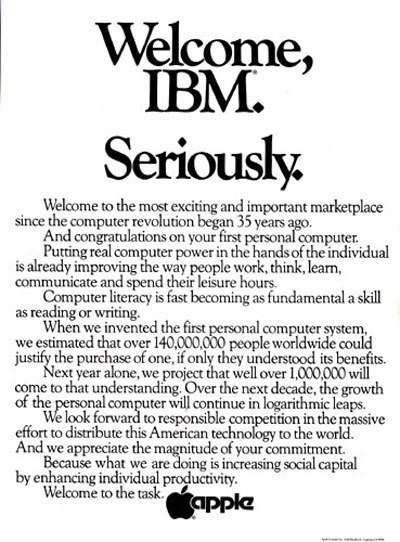
A couple of weeks ago, when Nature magazine announced it was starting a peer-reviewed open access journal, PLoS One (a peer reviewed open access journal) welcomed them the way Apple welcomed IBM into the personal computing market:

On January 6, 2011, Nature announced a new Open Access (OA) publication called Scientific Reports. Nature’s news underscores the growing acceptance of OA, as reflected in recent OA journal launches from other traditional publishers such as the BMJ, Sage,  AIP (American Institute of Physics) and APS (American Physical Society). Please spread the word either via this blog post or download this PDF.


Inspired by Apple
.

The Nature entry into the open access field is a big deal. So is Nature’s support of Creative Commons. I’ve had a chance to spend some little time with folks at Nature, and know them to be passionate about making the work of science more accessible. So, this is good news all around.

Tweet
Follow me

Categories: open access, science, too big to know Tagged with: 2b2k • nature • npg • open access • plos • science Date: February 2nd, 2011 dw

2 Comments »

January 21, 2011

Open access continues to catch on

Science Magazine reports on a study sponsored by the EU that found that 89% of the 50,000 researchers surveyed think open access is good for their field. On the other hand, the reporter, Gretchen Vogel, points out that while 53% said they had published at least one open access article, only 10% of papers are published in open access journals. What’s holding them back from doing more open access publishing? About 40% said it was because there wasn’t enough funding to cover the publication fees, and 30% said there weren’t high-quality open access journals in their field.

The data and analysis is supposed to become available this week at The SOAP Project. Unfortunately, the Science Magazine article covering the report is only available to members of the AAAS or to those willing to pay $15 for 24 hours of access. (Hat tip to Andrew “Yes he is my brother” Weinberger.)

Tweet
Follow me

Categories: open access, science Tagged with: cheap irony • open access • science Date: January 21st, 2011 dw

1 Comment »

January 5, 2011

[2b2k] Amateur astronomers, and science as a network

I met today with Aaron Price, who’s with the American Association of Variable Star Observers, a group celebrating a hundred years of gathering data from amateurs and professionals about variable stars. AAVSO has an archive of over 19 million variable star observations. Aaron is particularly interested in enabling and encouraging amateurs to become increasingly involved in the scientific process, ultimately collaboratively writing publishable articles. (I’m putting this my way, not his, so don’t blame him for my infelicities.)

We talked a bit about who should be called a scientist. My own view is that if you have this discussion without any context, then you look to paradigmatic scientists — works in a lab (perhaps), designs and runs experiments, formulates hypotheses, has academic credentials, wears a lab coat. In such cases, when there is no actual need driving the question, arguments about edge cases can’t be resolved. On the other hand, if something hangs on the question — does the person get funding, get invited to address a conference, is allowed access to equipment, get to claim a particular standing in an argument, etc. — then the question is more likely to be settle-able. For that reason, most discussions about whether citizen scientists are scientists (or, are “citizen journalists” journalists, etc.) should be addressed (in my opinion) first by asking, “Why do you ask?”

This seems to me to be an illustration of the way everything (well, almost) is becoming a network. In the old days, when science was a lot like publishing, the line between scientist and layperson was fairly well (but certainly imperfectly) drawn. In a networked world, it’s not simply a matter of redrawing lines, so that now citizen scientists are inside the Circle of Science. Rather, the nature of the lines is different. All members of a network are connected. The question is the nature of the connection, and that can change instantly based on interests, skills, credentials, and the project underway. The old lines disconnected; the new ones connect. And that makes it far more difficult to come up with persistent answers to questions like “Who is a scientist?” or “Who is a journalist?”

Often, in a networked world, it’s better not to insist on an answer. More important than deciding exactly who is inside the charmed circle is figuring out how to make the network smarter — which almost always means extending the network as far as it can possibly go.

Tweet
Follow me

Categories: science, too big to know Tagged with: 2b2k • amateurs • citizen journalists • citizen scientists • science Date: January 5th, 2011 dw

8 Comments »

« Previous Page | Next Page »


Creative Commons License
This work is licensed under a Creative Commons Attribution-NonCommercial-ShareAlike 3.0 Unported License.
TL;DR: Share this post freely, but attribute it to me (name (David Weinberger) and link to it), and don't use it commercially without my permission.

Joho the Blog uses WordPress blogging software.
Thank you, WordPress!