



March 29, 2011


Speaker info
 Atom Feed
February 22, 2011
Eszter Hargittai and Aaron Shaw are giving a Berkman lunchtime talk titled “The Internet Young Adults, and Political Engagement around the 2008 Elections.” It’s a collaborative work between Northwestern U (where Eszter is) and Berkman (where Aaron is). What did the Obama campaign mean for the Internet’s effect on engagement of young people?
|
NOTE: Live-blogging. Getting things wrong. Missing points. Omitting key information. Introducing artificial choppiness. Over-emphasizing small matters. Paraphrasing badly. Not running a spellpchecker. Mangling other people’s ideas and words. You are warned, people. |
Research generally summarizes the story of youth’s engagement as a sad one: A downward trend over the past 50 years. Most of the previous research has suggested that the Net is a “weapon of the strong”: those from higher income levels and more social capital tend to make more and better use of the Net. But does the Net impact political engagement directly? Uniformly? What factors and processes matter more than others. There is little agreement on these questions in the literature so far.
They looked at four outcomes or models: 1. Online political cognitive engagement: How much info-seeking on the Net do you do about politics? 2. Civic engagement: Do you volunteer in the community. 3. Voting. 4. Political action more broadly defined.
Eszter gathered data from the U of Illinois in Chicago. It’s one of the more racially diverse campuses. She went to the only course required everyone on campus. (There are 86 different sections, so it was a lot of work to gather the data.) It was a paper-pencil survey, not online, because she did not want to worry about who has access to the Net and who is comfortable donig things on line. Of the 1,115 students, the research focused on the 1,000 who were eligible to vote in the 2008 election. About half are first generation college students, 11% African-American, 25% Hispanic. About 60% voted, compared to 62% nationally. Eszter and Aaron are not claiming this is representative of the nation. the controlled for partisanship, political interest, and political knowledge, using “pretty standard” ways of measuring this. She presents the data on the extent of their Net usage; everyone had already been online. [You’ll have to check the study for the actual data. I can’t possibly type that fast!]
1. Online political cognitive engagement. They looked at whether the kids are reading blogs, commenting on them, involved in online discussions, forwarding info, etc. About 40% visited blogs (etc.) on political topics, and 16% commented on them. Women were less likely to participate. Race and ethnicity and parental education didn’t seem to matter. Political capital (= interest in politics) and your Net skills are positively correlated.
2. Civic engagement. 81% had engaged in some form, 54% talked to friends or family about current events a few times a week or more, 33% have organized the event of a club or organization. [Again, I can’t keep up with all the data. I’m cherry-picking.] Gender doesn’t matter, but Asian Americans are more engaged, as are those who score higher on parental education, political capital, and online political engagement.
3. Voting. Race and ethnicity had a positive correlation with voting. Not parental education. Political capital and civic engagement both did. But online political cognitive measures did not. Neither did Net expertise/experience.
4. Political action, which includes everything from signing a petition to being a paid campaign worker. 65% had signed a petition. 22% had contacted a political official. 14% donated money. If you count any of those, 70% have engaged in political action. No correlation to gender, race/ethnicity, parental education But, there was a positive correlation with political capital, civic engagement, and Internet experiences (particularly the use of social networking sites, and skill).
Internet mattered for all of the outcomes, except for voting. Net skills seem to have enabled the social networking that is correlated with political action.
Conclusion: Simply being a Net user is not a direct factor; the relationships seems to be indirect and differential. And were there Obama effects? Only in the political action area, and there it was pretty minor and needs more investigation.
Q: Suppose you did a longitudinal study…?
A: That would be interesting. We actually have data on half of them about whether they voted in the gubernatorial election. I’d like to get funding to go back to the students.
Q: How can you get at what shifts in access have happened that might have spiked with the Obama effect providing an opportunity to engage? E.g., social media make it easier to send around petititions.
A: It’d be interesting to follow up on what’s going on at social network sites. We only asked if people checked other people’s status and updated their own.
Q: Net use doesn’t correlate to voting but not to political action?
A: Voting is a different type of political action. The people who vote tend to look slightly different than the people who engage in other forms of political action.
Q: How about people from out of state?
A: Almost all are from within Illinois.
Q: How active is the Deomcract Club at the U?
A: Good question.
Q: Did you look at local elections?
A: No.
Q: A study recently showed something like 85% of contributors to Wikipedia were male. Did you see anything similar with online political participation?
A: I (eszter) have been gathering nuanced data on Wikipedia participation, and it’s unbelievably gendered. Women are participating in political activity less, but the gap is much smaller than at Wikipedia. My research as shown that women contribute less content online [my phraseology — don’t blame Eszter!], even with fan fiction.
A: [me] Did you break this down by ideology, as well as by partisanship?
Q: We haven’t broken it out yet.
A: I would have thought that political engagement and voting would be on the same trajectory, with the same determinants. Do you have a theory about they they’re not?
A: I do think they’re qualitatively different in American society.
Q: What data do you wish you had?
A: We’re proud of this data. We have a ton of it. It’d be good to have more data about Internet engagement/behavior. We also don’t have media consumption data.
Q: What is more important for a vibrant democracy for these young people, voting or activism?
A: It’s not an either/or. The literature suggests both are important. Cf. Talking Together. Their data suggests there are lots of people who are talking together.
[I missed some questions. Sorry. Don’t forget these Tuesday lunch presentations are available online as webcasts.]
Categories: berkman, egov Tagged with: berkman • edemocracy • egov • online politics • politics
January 3, 2011
Fillibusters need to be the exception, not the rule
Joyce Appleby makes the case for returning fillibusters to their old role as a moral trump card played when a matter of real principle was at stake. The Senate was not intended to require a 60-vote majority, and conservatives ought to join with liberals in honoring the Constitution. (The “Coffee Party” has a link that’ll get you your Senator’s contact info.)
November 20, 2010
You’re welcome :)
When my wife and I spent a year in Portland Oregon in 1979 or so, we went house to house for Ron Wyden, who was running for his first term as a Congressional Representative. This was so early in his career that when my wife first called his headquarters to get his position on some issues (that’s what you did before the Internet, children), Wyden himself called back that evening and talked with her for half and hour.
So, now Senator Ron Wyden has put the kibosh on the awful bill that would have let the government censor the internet.
I understand that if I had stayed home instead of knocking on doors for a few afternoons, Wyden would still have won and history would have unfolded in exactly the same way. A volunteer could not do much less than I did for the Wyden campaign.
Nevertheless, I have three observations:
First, I have felt attached to Wyden (who obviously wouldn’t remember me) ever since pitching in three decades ago. Silly, but there you have it.
Second, a relative handful of people — there were maybe dozens of volunteers? scores? — did make some difference to the campaign, and those little actions have unrolled to much larger consequences. One might even say that history consists of disproportionate effects.
Put the first and second observations together and you get the fact that even though your individual action may have no decisive effect, it can contribute to a tiny nudge that ends up making a difference, and, in any case, you can feel connected to a cause and a narrative.
Third, thank you, Senator Wyden!
November 11, 2010
Lessig backs Tea Party
Now for the de-sensationalizing of that headline.
Lawrence Lessig is indeed finding common cause with the Tea Party, but only with one part of its agenda: fighting earmarks — a position that has put the Tea Party at odds with many members of the Republican Congressional delegation.
If any of the Tea Partiers want to back the end of gerrymandering, I’d be happy to tip my liberal hat at them.
November 9, 2010
Reading Obama
Here’s a short article (and semi-puff piece) about James Kloppenberg’s new book Reading Obama, that situates Obama within America’s intellectual history. Kloppenberg says (according to the article) that Obama’s two books lay out quite clearly how he thinks and how he approaches problems.
Kloppenberg says in the interview that Obama’s “commitment to bipartisanship is rooted, not just in a desire to be strategic, but instead in what I see as a really sophisticated and robust conception of deliberation — that you cannot have at the beginning of a process of debate the same understandings that you have at the end of that process.†And, says Kloppenberg, his books show that he is a pragmatic problem solver.
Exactly. Read Obama’s books and tell me why you’re surprised at how he has behaved in office.
November 3, 2010
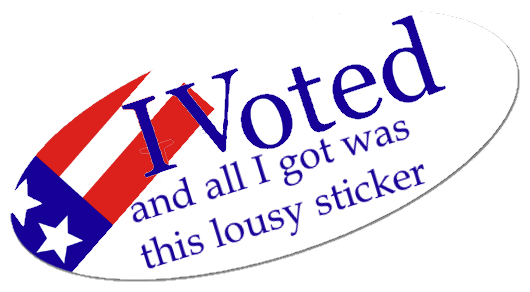
The morning after
Election Day + 1, 2010
August 13, 2009
8 ways health care reform helps
From my close, dear, intimate, personal, BFF, David Axelrod (Hi, David, you remember me, I was the one in row 32, on your left, that time you gave that talk…):
8 ways reform provides security and stability to those with or without coverage
1. Ends Discrimination for Pre-Existing Conditions: Insurance companies will be prohibited from refusing you coverage because of your medical history.
2. Ends Exorbitant Out-of-Pocket Expenses, Deductibles or Co-Pays: Insurance companies will have to abide by yearly caps on how much they can charge for out-of-pocket expenses.
3. Ends Cost-Sharing for Preventive Care: Insurance companies must fully cover, without charge, regular checkups and tests that help you prevent illness, such as mammograms or eye and foot exams for diabetics.
4. Ends Dropping of Coverage for Seriously Ill: Insurance companies will be prohibited from dropping or watering down insurance coverage for those who become seriously ill.
5. Ends Gender Discrimination: Insurance companies will be prohibited from charging you more because of your gender.
6. Ends Annual or Lifetime Caps on Coverage: Insurance companies will be prevented from placing annual or lifetime caps on the coverage you receive.
7. Extends Coverage for Young Adults: Children would continue to be eligible for family coverage through the age of 26.
8. Guarantees Insurance Renewal: Insurance companies will be required to renew any policy as long as the policyholder pays their premium in full. Insurance companies won’t be allowed to refuse renewal because someone became sick.
Learn more and get details: http://www.WhiteHouse.gov/health-insurance-consumer-protections/
Yes, I know you’re probably one of the millions of people who got this email also, but I think it’s important to say these things, given that some of those campaigning against health care reform have taken lying to a new level of ridiculousness.
Categories: Uncategorized Tagged with: hcr • health_care • obama • politics
July 26, 2009
Deval Patrick plummets, and responds with talking points
According to a Boston Globe poll, the popularity of Mass. Gov Deval Patrick has plummeted.
Too bad. I think he’s been doing a good job in an economic and political environment within which success can only be measured by degrees of failure. (Those who worry about one-party control turning into a tyranny have never met Massachusetts Democrats.)
But, I was disappointed to receive an email this morning from Doug Rubin, of the Deval Patrick Committee, containing “talking points” for his supporters, with a form that lets us forward it to ten people. The msg begins:
Friends,
In light of today’s Globe Poll, we know that many of you will be receiving many questions about the Governor and the Commonwealth. Below are some talking points to help with those conversations. We ask that you use these in conversation and distribute them to your friends and family. I’m proud of what we have accomplished, feel confident talking about our work, and I hope you are as well.
Sincerely,
Doug Rubin
Jeez, I really don’t want to be recruited as a spin agent.
Governor Patrick, I know this has to be a sucky day for you. There are lots of us in the Commonwealth who think you’re the right person for the job and that you’re an exceptional person in near impossible circumstances. We want to help. Don’t spin us. Fall back on us. We’ll rise to catch you. Trust us.
One more thing: The email msg and the DevalPatrick.com site it comes from do not explain who Doug Rubin is (Google reports he’s the Governor’s Chief of Staff [NOTE later that day: Doug Rubin says in the comments that he was Patrick’s Chief of Staff but is now part of the Governor’s campaign team] or Deval Patrick’s relationship to the site, other than noting that it is not an official government site. How about a little more transparency than that?
Categories: Uncategorized Tagged with: deval_patrick • e-gov • e-politics • egov • politics • pr • spin
July 22, 2009
My PDF talk on facts ‘n’ transparency
Link. (The video embeds my slides, but (1) they get more and more out of order in this YouTube; they were in the right order when I actually presented them. 2. My font got lost somewhere in the translations, and so there’s a fair bit of mis-sizing, text overflows, etc.) (I posted about one of the ideas in the talk (transparency as the new objectivity) here.)
Categories: misc Tagged with: e-democracy • e-gov • e-government • everything_is_miscellaneous • media • misc • newspapers • pdf09 • politics • transparency

This work is licensed under a Creative Commons Attribution-NonCommercial-ShareAlike 3.0 Unported License.
TL;DR: Share this post freely, but attribute it to me (name (David Weinberger) and link to it), and don't use it commercially without my permission.
Joho the Blog uses WordPress blogging software.
Thank you, WordPress!