




logo
EverydayChaos
Everyday Chaos
Too Big to Know
Too Big to Know
Cluetrain 10th Anniversary edition
Cluetrain 10th Anniversary
Everything Is Miscellaneous
Small Pieces cover
Small Pieces Loosely Joined
Cluetrain cover
Cluetrain Manifesto
My face
Speaker info
Who am I? (Blog Disclosure Form) Copy this link as RSS address Atom Feed

June 1, 2020

Rights vs. Dignity

Of course we need to accord people their rights and their dignity. But over time I have come to find dignity to be the more urgent demand.

Rights cover what a society will let people do. Dignity pertains to who a person is.

Rights are granted on the basis of theories. Dignity is enacted in the presence of another.

Rights are mediated by whatever institution grants the rights. Dignity is unmediated, immediate.

Rights are the same for all. Dignity is for the singular person before you.

You can grudgingly grant people their rights. The moment you grant someone their dignity, any resentment you had about doing so turns against yourself.

Grant people their dignity, and rights will follow. Grant people their rights and you may treat them like slaves who have been freed by law.

A world without dignity is not at peace.
Tweet
Follow me

Categories: culture, ethics, peace, politics Tagged with: culture • politics • rights Date: June 1st, 2020 dw

Be the first to comment »

March 12, 2020

For Biden to win

Because I have never even once been wrong about politics, I know you and the Biden campaign you’ve been waiting for my guidance about how the former VP can beat Trump. So here is the exact and precise plan from which I will permit not a single deviation.

Biden needs to hang on to his current base, expand it to include as much of Bernie’s as possible, and energize especially the young to campaign and vote.

Simple!

  1. Position Biden’s presidency as a four year return to normalcy that will position us for truly progressive change. Slogan: Make America America Again.
  2. Announce he will be a one-term president.
  3. Pick a truly exciting progressive VP, preferably a black woman. Stacy Abrams?
  4. Say that she will work even more closely with Biden than Biden with Obama. She will be fully prepared to become president.
  5. (Three years in, Biden should resign. Shhhh.)

I will leave for another post exactly the progressive positions he should aggressively adopt, how he should position them, and the colors of the binders he should use when presenting them.

Tweet
Follow me

Categories: politics Tagged with: biden • fantasy • politics Date: March 12th, 2020 dw

Be the first to comment »

February 16, 2020

Dutch national health insurance – probably not what you think

A Dutch friend wrote this up for a list I’m on, and kindly gave me permission to post it. It turns out that the Netherlands is to the left of Bernie and Warren when it comes to national health insurance.

Here are my friend’s comments.


The Netherlands has privatised all government health funds in 2006. They were regional organized and covered 65% of the population.

The remaining 35% had private health insurance. Partially coöps/non-profits and others for-profit.

Those 35% were higher incomes and/or self-employed and students without a (part-time) job.

The Netherlands doesn’t have Medicare. Elderly people have to purchase health insurance. We do have a mandate, and there are transfers to low income people, paid by a partial income related tax on the wages of working people.

In short, the Netherlands introduced the “Heritage Foundation Health Care System”. It was done by a center-right government who saw an opportunity to privatise the public health funds.

There are some interesting differences how The Netherlands implemented the “Heritage Foundation System” in comparison to RomneyCare and ObamaCare:

  1. Employer provided health insurance was grandfathered into an individual polis (you could keep it, but the employer went out of the system)
  2. There is a mandatory list called ‘basic insurance list’. Every insurer has to offer that list. It is the cheapest available.
  3. Contraceptive pills have been kicked off the ‘mandatory list’ by centre-right governments and put back on the list by centre-left. Currently they are off the mandatory list.
  4. Abortion is outside the mandatory list, except for medical necessity in hospitals
  5. There is a specialist ‘Pro Life Health Insurance’. No abortion, no euthanasia, no transgender operations, no in-vitro-fertilisation, no sterilisation and no morning after pill coverage etc. ample on palliative care and courses for natural family planning / counseling. When I drive on the highway through the Bible Belt, I see billboards for them. 
  6. Pro-Life Insurance is also the health insurer promoted by the PCOB and KBO. The Protestant Christian and the Catholic associations for the elderly, both are mainline protestant and catholic social organisations. They cover a lot of elderly people with the insurance they negotiated for their members.
  7. The Netherlands has a ‘conscience clause’. Those who don’t want health insurance for religious reasons or any other personal belief, can call it in. The government then opens a health account and fills it with your health-tax payments. The account can only be used for paying health care/cure. If it is empty, your on your own. If there is still an amount when you die, it becomes part of your estate and goes to your heirs.
  8. If you want insurance, you relinquish your health account to the insurer of choice, but you cannot go back from insurance to the tax-authority filled health account.

As far as I understand it, Switzerland also made reforms toward a “Heritage Foundation health care system” in the 2000s. 

And as a final note: keep in mind that the ‘hot button issues’ like contraception and inclusion/exclusion of abortion on the mandatory coverage list are political footballs here too.

There were 17 abortion clinics in the Netherlands. 7 went bankrupt in the early ’10s due to too low demand for their services. 4 were relaunched, so there are now 13 abortion clinics on a population of 17 million. California has ca. 150 clinics for ca. 40 million. I think only South-Carolina has a lower ratio in terms of Abortion Clinics per 1,000,000 women. Kansas and Missouri are more on par with the Netherlands.

In general, abortion policies are far stricter in Europe. The Netherlands isn’t much of an outlier in restrictive abortion policies, where restrictions kick-in after 13 weeks of gestation and a 5 working day “rethink period” with adoption counseling is mandatory. The big outlier in Europe is Great-Britain, which has abortion policies a lot like the USA. Northern-Ireland however is very strict, just like Ireland.

Off course this is far from China’s ‘one-child-policy’, where it was encouraged to have single-child families and abortion is easy accessible.

There are some intriguing points to make, about what went different.

  1. The USA didn’t grandfather private health insurance policies from employers to individuals and continued employer provided health insurance.
  2. As a result demand for the “ObamaCare exchanges” was much smaller
  3. Due to the existence of Medicare, untouched by ObamaCare, there wasn’t massive ‘insurance pool organisation’
  4. US Labor Unions still negotiate health benefits with employers instead of operating as the middleman towards health insurers c.q. owning a stake in a health insurance fund
  5. The absence of “Conscience Opt-Out” and “Pro Life Insurance”, combined with employer based health care, caused a Supreme Court case (Hobby Lobby) which forced a ridiculous decision that a corporate legal entity now can have a ‘religious conscience’
  6. This of course did extend to Catholic Nuns too, who were forced to pay for mandates that went against their beliefs.

It all smacked as incomplete design and as a result a set of flaws due to provisions not taken, probably because of political expediency.

Currently the Netherlands has 11 health insurance providers after a lot of M&A had happened. The interesting result is that the big winners have been 

a. A rather high-end private insurer, offering expensive “we cover everything” policies 

b. A former health fund which had worked in a blue-collar region (Delfland-Schieland-Westland), being the repeated price-breaker and as a result is now the darling of consumer organisations etc.

What is really different between the Dutch implementation and the USA, is the bargaining positions in the system. The collectives that sprang up (some spontaneously, around websites) and went shopping. It makes a difference when in a market of 17 million and 11 providers, someone shows up at your doorstep with ‘I have 200.000 signatories looking for a good insurance policy …’).

Tweet
Follow me

Categories: culture, politics Tagged with: bernie sanders • election2020 • elizabeth warren • healthcare • politics Date: February 16th, 2020 dw

Be the first to comment »

August 17, 2019

Hillary-Trump Debates: The Audition Tapes

This is a re-play of something I wrote during the 2016 election. The premise is that the Clinton campaign is auditioning stand-ins for Trump to rehearse the 2016 debates with.

Note that Louis CK not yet disgraced, and in any case I the last paragraph of that one is really unclear. You see, he’s snapping back to the question, and talking about how Trump treats workers.

Also, the Anthony Wiener reference is, thankfully, dated now.

I have to say that I’m a little proud of the Quentin Tarantino story, though.

Louis CK


Clinton: Mr. Trump, not only have your businesses gone bankrupt, you’ve stiffed honest working people, refusing to pay them for their work. If you scam your own workers out of money, how can Americans trust you?

CK: I do that. I’m a terrible person. Really. I’m a rat bastard. I don’t mean to be. When I’m hiring someone, like a brick layer, I’m thinking: Wow, that guy works so hard. And you know something? He does something I couldn’t do in a million years. Give me a literal million years, and I’d still be laying bricks that looked like they were done by a two-year-old playing with her own poop. Uneven. Tilted. The cement between them would sometimes be the thickness of the chocolate in a Milano cookie, you know, so little it’s really there just so they can put on the package that it’s got chocolate. But it’s really like the fruit juice they add to a children’s drink so they can say “Made with real apples” when really it’s like they use apples in the paste on the labels. You can’t argue: it’s made with real apples. And then right next to that brick, the concrete would be like you split open two double-stuffed Oreos and stuck them together. Never in a million years could I do what a bricklayer does, and I’m in awe of them.

And next thing you know I’ve misjudged how many people want to get on a smelly bus to Atlantic City for four hours, and I’m like, “Hey, sorry, Mr. Bricklayer, but, go home and starve with your kids. But thanks, really.” I’m just such a rat bastard.

Malcolm Gladwell


Moderator: Mr. Trump, independent economists have estimated that your tax plan would cost the country as much as ten trillion dollars

in lost revenues. How would you pay for your ambitious new programs?

Gladwell: The best economists are with me. 100%. All of them support me. They’ve looked at my plan and they compare it to FDR. Franklin Delaney brought us out of the Great Depression. He was a cripple, you know? Still a great guy, though. Lot of brain. The world’s best economists look at my plan and what that tell me is that it’s like in 1875 when a peanut roaster by the name of Samuel Bridewell made a surprising discovery: the plants harvested from the western edge of his 30-acre farm in Virginia were slightly darker in color, slightly larger, and – this was the true revelation – when mashed at a temperature between 140 and 150 Fahrenheit, formed a glutinous mass that when cooled would hold whatever shape it was formed into. Bridewell began a lively, but local, business selling mashed peanuts in the form of farm animals, then Fathers of the Constitution, and then, as a wave of Irish immigrants spread the through the area, saints.

Bridewell’s Legume Figurines would today be forgotten if the nephews of a chemist named Robert Michelson had not been traveling through Virginia and came upon a box of the faded Figurines at a farm stand along a country path in Pebble Corners, eight miles south of Richmond. They opened one of the packages, but the youngest of the nephews, Chad Hemmings …

Moderator: Time is up, Mr. Trump.

Gladwell: … chipped a tooth on a desiccated miniature statue of St. Sebastian. He threw the statue down, where, by chance, it landed in a bowl of “lemon invigorator,” a punch being offered at the price of two drinks for a penny.

Moderator: Time, Mr. Trump.
Gladwell: The reaction of the peanut compound to the acidity of the lemons was immediate and startling …” John Podesta: Thank you.

Bryan Cranston


Moderator: Mr. Trump, you have said that you would consider withdrawing support for our NATO allies unless they made larger contributions to the financial cost of the treaty. Doesn’t that send a signal to Russia that it can invade countries with impunity?

Cranston: You’re worrying about Russia invading? You don’t understand. When invaders knock on the door of Crimea, I’m not Crimea and I’m sure as hell not its allies cowering in the dark. I am the one who knocks.

Clinton: I’m sorry, you’re now threatening to invade Crimea? I think we need to take this down a notch…

Cranston: Hey, lady, the screw only turns in one direction, and it you’re either the one doing the screwing or you’re on the pointy end…

John Podesta: Thank you Mr. Cranston. We’ll get back to you.

Terry Gross

Moderator: Mr. Trump, the next president may have the opportunity to fill up to three Supreme Court seats. Are there any litmus tests you would apply to candidates?

Gross: A litmus test? They’re completely unreliable. A hoax. Total hoax. You know who wants us to believe in litmus tests? The Chinese. [To the moderator] You should know that. Your father was a chemist, and your mother taught biology, right? And when you were fourteen, your father announced that he was gay. So how has growing up in a house full of scientists, one of who was a closeted gay man, influenced your sense of how reliable answers to any question can be, and the sort of follow-up you…

John Podesta: Thank you for your time, Ms. Gross.

Quentin Tarantino


Clinton: Politifact, the non-partisan fact checking site, says that you tell more untruths per hour than any candidate they’ve ever seen.

How can you lead the country when you have no problem knowingly telling outright lies?

Tarantino: You know who’s a liar? The biggest liar? God. I call him Lyin’ Jehovah. Lyin’ Jehovah. And you know the biggest lie Lyin’ Jehovah ever told, which makes it the the hugest lie in history? Huge. Really incredible.

You know Job, right? From the Old Testament. That Job. And it says right there that he’s the most righteous of his generation. He’s the guy. He does everything right. He prays. He sacrifices goats or whatever it says he has to sacrifice. He does it right. And it’s not easy. One little screw-up and you’re elbow deep in goat guts and it doesn’t count for anything. In fact, it shows God, who’s sitting there watching every detail just because He can, it shows God that you didn’t really mean it. If you meant it, you’d get it right. And Job gets it right. He totally does. God says so, flat out. And God rewards him with wives and children and goats and land. So Job is honoring God, all day, honoring, honoring, honoring.

And how does God respond? He basically gets into a drunken bet with Satan. Satan! Satan barely exists in the Old Testament, but he shows up just so God can have someone to bet with. Because who else is going to bet with God? God is always going to win. You know why? Because He’s God! The Creator. So, God bets the only schmuck arrogant enough to bet against Him that Job isn’t in it just for the wives and the goats. No, Job is righteous because he loves God. So what’s the test? Take away everything Job owns. Wives, children, land, goats. Give him boils, take away his HBO Go. Everything. Boom. Now instead of being the most righteous, he might as well be the town loser who takes a dump in the public swimming pool, you know what I mean? Job’s got nothing not because he was bad but because he was the most righteous. That’s why God picked on him.

So, Job asks God why this is happening to him, it’s so unfair. And asking God takes some Satan-size cojones because Job has seen what God can do. So, God replies with the greatest lie in the history of mankind. God — Jehovah, — to Job out of a freaking whirlwind and says, “Who are you to question me?” And God really rubs Job’s nose in it. Do you know about every freaking sparrow that falls? I didn’t think so. I couldn’t explain it to you if I wanted to, God says. And that’s it. That’s the lie. How do we know this? Because the Old Testament tells us exactly why it happened to Job: It was a bet. There’s nothing to understand except that God is being a total dick. But God can’t say that. So He lies. He lies!

But, I gotta say, Lyin’ Jehovah won the bet. He’s the ultimate winner.

John Podesta: Thank you, Mr. Tarantino.

Anthony Wiener

John Podesta: Next!

Tweet
Follow me

Categories: humor, politics Tagged with: humor • politics • tarantino • trump Date: August 17th, 2019 dw

Be the first to comment »

December 21, 2018

“I know tech better than anyone” isn’t a lie

The Democrats are trying to belittle the concept of a Wall, calling it old fashioned. The fact is there is nothing else’s that will work, and that has been true for thousands of years. It’s like the wheel, there is nothing better. I know tech better than anyone, & technology…..

— Donald J. Trump (@realDonaldTrump) December 21, 2018

This comes from a man who does not know how to close an umbrella.

Does Trump really believe that he knows more about tech than anyone? Even if we take away the hyperbole, does he think he’s an expert at technology? What could he mean by that? That he knows how to build a computer? What an Internet router does? That he can explain what an adversarial neural network is, or just the difference between machine learning and deep learning? That he can provide IT support when Jared can’t find the song he just downloaded to his iPhone? That he can program his VCR?

But I don’t think he means any of those things by his ridiculous claim.

I think it’s worse than that. The phrase is clearly intended to have an effect, not to mean anything. “Listen to me. Believe me.” is an assertion of authority intended to forestall questioning. A genuine expert might say something like that, and at least sometimes it’d be reasonable and acceptable; it’s also sometimes obnoxious. Either way, “I know more about x than anyone” is a conversational tool.

So, Trump has picked up a hammer. His hand is clasped around its handle. He swings his arm and brings the hammer squarely down on the nail. He hears the bang. He has wielded this hammer successfully.

Except the rest of us can see there is nothing — nothing — in his hand. We all know that. Only he does not.

Trump is not lying. He is insane.

Tweet
Follow me

Categories: politics, too big to know Tagged with: 2b2k • politics • trump Date: December 21st, 2018 dw

8 Comments »

June 10, 2018

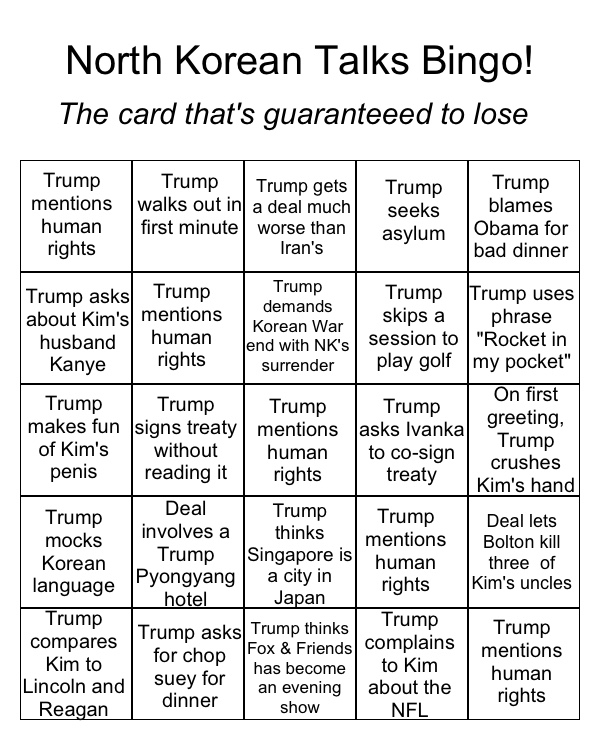
North Korean Bingo!

Why is this card guaranteed to lose? You might notice a pattern in it…

north korean talks bingo card

…

Tweet
Follow me

Categories: humor, politics Tagged with: human rights • humor • politics • trump Date: June 10th, 2018 dw

2 Comments »

February 18, 2018

High schoolers in the streets

despite having our hearts ripped out of our chests. Despite losing our friends and coaches. Despite living through a nightmare. As students of Douglas, we are the voice of this generation. And I’ll be damned if anyone thinks they can silence us.

— kyra (@longlivekcx) February 18, 2018

My generation was mobilized politically by the threat of being sent to kill and die in Vietnam.

The new generation is being mobilized by the threat of being killed in their classrooms.

It would of course be foolish to assume that the political path of the new generation will follow that of the 1960s generation. There are so many differences. Here are two that seem to me to matter:

First, the draft was an institutionalized, bureaucratic mechanism that every male faced, by law, on his eighteenth birthday. A choice was forced on each young man. But school shootings are random, unpredictable.

Second, because the draft and the war it served were caused by the government, we knew whom to protest against and what had to be done. The way to end mass murders in schools isn’t as conveniently obvious. Yet there are some steps that a high school movement can and will focus on, beginning with making it harder to get a gun than to hack your parents’ Netflix account.

But those differences will not matter if this movement is indeed an expression of the outrage the high school generation feels. They are facing so much that I can’t even begin to list the issues — not that I need to since they are the issues++ that my generation faced, addressed, and in some cases made worse. Our children’s fear of being murdered in their schools is, horrifyingly, simply the identifiable face of the unfair world we are leaving them.

Hearing these young people speak out even before they have buried their friends brings me the saddest hope imaginable. At such an age to stand so strong together…they are fierce and beautiful and I will laugh and cry with joy as they change the world.

Of course I stand with them. Or, more exactly, I stand a respectful and supportive distance behind them. And not just on March 24:

http://act.everytown.org/sign/march-for-our-lives/

Here’s the speech from Marjory Stoneman Douglas High School student Emma Gonzalez at an anti-gun rally happening today in Fort Lauderdale https://t.co/CyfMnPDAvW // https://t.co/hgewZy4Cxf https://t.co/gssAmGczuH

— Joshua Chavers (@JoshuaChavers) February 17, 2018

Tweet
Follow me

Categories: politics Tagged with: boomers • politics • youth Date: February 18th, 2018 dw

1 Comment »

September 26, 2017

[liveblog][pair] Golan Levin

At the PAIR Symposium, Golan Levin of CMU is talking about ML and art.

NOTE: Live-blogging. Getting things wrong. Missing points. Omitting key information. Introducing artificial choppiness. Over-emphasizing small matters. Paraphrasing badly. Not running a spellpchecker. Mangling other people’s ideas and words. You are warned, people.

The use of computers for serendipitous creativity has been a theme of computer science since its beginning, Golan says. The job of AI should be serendipity and creativity. He gives examples of his projects.

Put your hand up to a scanner and it shows you hand with an extra finger. Or with extra hands at the end of your fingers.

Augmented Hand Series (v.2), Live Screen Recordings from Golan Levin on Vimeo.

[He talks very very quickly. I’ll have to let the project videos talk for themselves. Sorry.]

Terrapattern provides orbital info about us. It’s an open source neural network tool which offers similar-image search for satellite imagery. It’s especially good at finding “soft” structures often not noted on maps. E.g., click on a tennis court and it will find you all of them in the area. Click on crossroads, same thing.

Terrapattern (Overview & Demo) from STUDIO for Creative Inquiry on Vimeo.

This is, he says, an absurdist tool of serendipity. But it also democratizes satellite intelligence. His favorite example: finding all the rusty boats floating in NYC harbor.

Next he talks about our obsession with “masterpieces.” Will a computer ever be able to create masterpiece, he keeps getting asked. But artworks are not in-themselves. They exist in relationship to their audience. (He recommends When the Machine Made Art by Grant D. Taylor.)

Optical illusions get us to see things that aren’t there. “Print on paper beats brain.” We see faces in faucets and life in tree trunks. “This is us deep dreaming.” The people who understand this best are animators. See The illusion of Life, a Disney book about how to make things seem alive.

The observer is not separate from the object observed. Artificial intelligence occurs in the mind as well as in the machine.

He announces a digression: “Some of the best AI-enabled art is being made by engineers,” as computer art was made by early computer engineers.

He points to the color names ML-generated by Janelle Shane. And Gabriel Goh’s synthetic porn. It uses Yahoo’s porn detector and basically runs it in reverse starting with white noise. “This is conceptual art of the highest order.”

“I’m frankly worried, y’all,” he says. People use awful things using imaging technology. E.g., face tracking can be abused by governments and others. These apps are developed to make decisions. And those are the thoughtless explicit abuses, not to mention implicit biases like HP’s face scanning software that doesn’t recognize black faces. He references Zeynep Tufecki’s warnings.

A partial, tiny, and cost-effective solution: integrate artists into your research community. [He lists sensible reasons too fast for me to type.]

Tweet
Follow me

Categories: ai, liveblog Tagged with: art • machine learning • politics Date: September 26th, 2017 dw

Be the first to comment »

January 23, 2016

Guns, Sarah Palin, and other hilarious stuff

My brother Andy points to a New Yorker humor post by John Quaintance about the original intent of the Second Amendment. It’s simultaneously hilarious and sad.

Then, in the righthand column there’s a link to an Andy Borowitz post with an Onion-esque title that I enjoyed:

Palin Blames Obama for Her Defeat in 2008 Election

And while we’re on the subject of terribly sad mirth, here’s Colbert’s hilarious impersonation of the First Hockey Mom’s rhetorical style / way of thinking:

Tweet
Follow me

Categories: humor, politics Tagged with: palin • politics • trump Date: January 23rd, 2016 dw

2 Comments »

May 19, 2015

John Kerry on the importance of an open-ish Internet

Secretary of State John Kerry gave a speech in Seoul yesterday about the Internet, setting out five principles of cybersecurity.

The talk is quite enthusiastic and progressive about the Net. Sort of. For example, he says, “[t]he United States considers the promotion of an open and secure internet to be a key component of our foreign policy,” but he says this in support of his idea that it’s crucial to govern the Internet. On the third hand, the governance he has in mind is designed to keep the Net open to all people and all ideas. On the fourth hand, predictably, we don’t know how much structural freedom he’s willing to give up to stop the very Worst People on Earth: those who share content they do not own.

Overall, it’s a speech that we can be pretty proud of.

Here’s why he thinks the Net is important:

…to begin with, America believes – as I know you do – that the internet should be open and accessible to everyone. We believe it should be interoperable, so it can connect seamlessly across international borders. We believe people are entitled to the same rights of free expression online as they possess offline. We believe countries should work together to deter and respond effectively to online threats. And we believe digital policy should seek to fulfill the technology’s potential as a vehicle for global stability and sustained economic development; as an innovative way to enhance the transparency of governments and hold governments accountable; and also as a means for social empowerment that is also the most democratic form of public expression ever invented.

At its best, the internet is an equal-opportunity platform from which the voice of a student can have as much reach as that of a billionaire; a chief executive may be able to be out-debated by an entry-level employee – and there’s nothing wrong with that.

Great, although why he needed to add a Seinfeldian “Not that there’s anything wrong with that” is a bit concerning.

He then goes on to say that everyone’s human rights extend to online behavior, which is an important position, although it falls short of Hillary Clinton’s claim while Secretary of State that there is a universal “freedom to connect.”

He then in an odd way absolves the Internet from blame for the disruption it seems to cause:

The internet is, among many other things, an instrument of freedom. It’s a tool people resort to in response to the absence and failure or abuse of government…Anyone who blames the internet for the disorder or turmoil in today’s world is just not using their head to connect the dots correctly. And banning the internet in a misguided attempt to impose order will never succeed in quashing the universal desire for freedom.

This separates him from those who think that the Net actually gives people an idea of freedom, encourages them to speak their minds, or is anything except a passive medium. But that’s fine since in this section he’s explaining why dictators shouldn’t shut down the Net. So we can just keep the “inspires an ambition for political freedom” part quiet for now.

“The remedy for the speech that we do not like is more speech,” he says, always a good trope. But he follows it up with an emphasis on bottom-up conversation, which is refreshing: “It’s the credible voices of real people that must not only be enabled, but they need to be amplified.”

To make the point that the Net empowers all sectors of society, and thus it would be disastrous if it were disrupted globally, he suggests that we watch The Day the Earth Stood Still, which makes me think Secretary Kerry has not watched either version of that movie lately. Klaatu barada nikto, Mr. Kerry.

To enable international commerce, he opposes data localization standards, in the course of which he uses “google” as a verb. Time to up your campaign contributions, Bing.

Kerry pre-announces an international initiative to address the digital divide, “in combination with partner countries, development banks, engineers, and industry leaders.” Details to follow.

Kerry tries to position the NSA’s data collection as an enlightened policy:

Further, unlike many, we have taken steps to respect and safeguard the privacy of the citizens of other countries and to use the information that we do collect solely to address the very specific threat to the United States and to our allies. We don’t use security concerns as an excuse to suppress criticisms of our policies or to give a competitive advantage to an American company and any commercial interests at all.

You have our word on that. So, we’re good? Moving on.

Kerry acknowledges that the Telecomm Act of 1996 is obsolete, noting that “Barely anybody in 1996 was talking about data, and data transformation, and data management. It was all about telephony – the telephone.”

Finally, he gets to governance:

So this brings me to another issue that should concern us all, and that is governance – because even a technology founded on freedom needs rules to be able to flourish and work properly. We understand that. Unlike many models of government that are basically top-down, the internet allows all stakeholders – the private sector, civil society, academics, engineers, and governments – to all have seats at the table. And this multi-stakeholder approach is embodied in a myriad of institutions that each day address internet issues and help digital technology to be able to function.

“Stakeholders” get a “seat at the table”? It’s our goddamned table. And it’s more like a blanket on the ground than polished rare wood in a board room. Here’s an idea for you, World Leaders: How about if you take your stakes and get off our blanket?

Well, that felt good. Back to governing the Internet into the ground. And to be fair, Kerry seems aware of the dangers of top-down control, even if he doesn’t appreciate the benefits of bottom-up self-organization:

That’s why we have to be wary of those who claim that the system is broken or who advocate replacing it with a more centralized arrangement – where governments would have a monopoly on the decision-making. That’s dangerous. Now, I don’t know what you think, but I am confident that if we were to ask any large group of internet users anywhere in the world what their preferences are, the option “leave everything to the government” would be at the absolute bottom of the list.

Kerry now enunciates his five principles.

  1. First, no country should conduct or knowingly support online activity that intentionally damages or impedes the use of another country’s critical infrastructure.

  2. Second, no country should seek either to prevent emergency teams from responding to a cybersecurity incident, or allow its own teams to cause harm.

  3. Third, no country should conduct or support cyber-enabled theft of intellectual property, trade secrets, or other confidential business information for commercial gain.

  4. Fourth, every country should mitigate malicious cyber activity emanating from its soil, and they should do so in a transparent, accountable and cooperative way.

  5. And fifth, every country should do what it can to help states that are victimized by a cyberattack.

Two particular points:

First, #2 establishes Internet repair teams as the medical support people in the modern battleground: you don’t fire on them.

Second, #3 gets my goat. Earlier in the talk, Sect’y Kerry said: “We understand that freedom of expression is not a license to incite imminent violence. It’s not a license to commit fraud. It’s not a license to indulge in libel, or sexually exploit children.” But the one crime that gets called out in his five principles is violating copyright or patent laws. And it’s not even aimed at other governments doing so, for it explicitly limits the prohibition to acts committed “for commercial gain.” Why the hell is protecting “IP” more important than preventing cross-border libel, doxxing or other privacy violations, organizing human trafficking, or censorship?

Oh, right. Disney. Hollywood. A completely corrupt electoral process. Got it.

Now, it’s easy to be snarky and dismissive about this speech — or any speech — by a Secretary of State about the Internet, but just consider how bad it could have been. Imagine a speech by a Secretary of State in an administration that sees the Internet primarily as a threat to security, to morals, to business as usual. There’s actually a lot to like in this talk, given its assumptions that the Net needs governments to govern it and that it’s ok to spy on everyone so long as we don’t do Bad Things with that information that we gather.

So, before you vote Republican, re-read Hillary Clinton’s two speeches [2010 2011] on Internet freedom.

Tweet
Follow me

Categories: copyright, peace, policy Tagged with: copyleft • copyright • kerry • politics • rights Date: May 19th, 2015 dw

1 Comment »

« Previous Page | Next Page »


Creative Commons License
This work is licensed under a Creative Commons Attribution-NonCommercial-ShareAlike 3.0 Unported License.
TL;DR: Share this post freely, but attribute it to me (name (David Weinberger) and link to it), and don't use it commercially without my permission.

Joho the Blog uses WordPress blogging software.
Thank you, WordPress!