


logo
EverydayChaos
Everyday Chaos
Too Big to Know
Too Big to Know
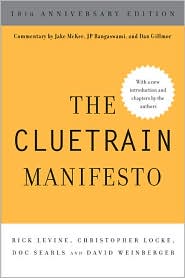
Cluetrain 10th Anniversary edition
Cluetrain 10th Anniversary
Everything Is Miscellaneous
Small Pieces cover
Small Pieces Loosely Joined
Cluetrain cover
Cluetrain Manifesto
My face
Speaker info
Who am I? (Blog Disclosure Form) Copy this link as RSS address Atom Feed

December 26, 2007

Rheingold on Habermas

I’m 2 months behind, but I finally got to Howard Rheingold’s post on his brief encounter with Habermas, because I’m trying to understand Habermas without having to actually read his Big Books. When Habermas chose not to answer Howard’s question about how the rise of the Internet affects the public sphere, Howard was disappointed the way only a mentor can disappoint us.

I think some of the commenters on Howard’s post are reasonable when they try to let Habermas off the hook for not responding then and there. OTOH, I wasn’t there and thus don’t know just how dismissive Habermas was. In any case, Howard is right that if you’re interested in democracy and the public sphere — as Habermas obviously is — you need to pay attention to the rise of the Net. (Howard and the commenters list sources I am now about to read.)

But mainly I was so happy to see philosophy engaged via Howard’s demand that it address the important issues of the day and the commenters’ pokings, pullings and elaborations. [Tags: howard_rheingold habermas philosophy ]

Tweet
Follow me

Categories: Uncategorized Tagged with: digital culture • philosophy • politics Date: December 26th, 2007 dw

1 Comment »

December 13, 2007

Dreyfus on Heidegger

Hubert Dreyfus’ lectures on Heidegger’s Being and Time are available for one and all. I haven’t heard them, but back when I was studying (and eventually teaching about) Heidegger, I found Dreyfus to be exceptionally clear and helpful. (Don’t ask me about Dreyfus’ Internet theories, though.) (Thanks to Tom Morris for the link, and for the fun on the LeWeb back channel) [Tags: hubert_dreyfus martin_heidegger being_and_time philosophy ]

Tweet
Follow me

Categories: Uncategorized Tagged with: philosophy Date: December 13th, 2007 dw

8 Comments »

December 1, 2007

The value of the implicit – Defrag

I’ve posted the video of my talk at Defrag about the value of the implicit. It’s about four or five links down on this page. The original is here.

The talk is 30 minutes long and mainly incoherent.

[Tags: defrag implicit language rilke everything_is_miscellaneous ]


And while I’m being self-centered, HearsayCulture just posted a podcast interview with me.

Tweet
Follow me

Categories: Uncategorized Tagged with: conference coverage • digital culture • everythingIsMiscellaneous • philosophy • poetry Date: December 1st, 2007 dw

Be the first to comment »

October 23, 2007

Debatepedia launches

Debatepedia wants to collect the best arguments pro and con for issues that matter. It’s not a place for people to shout at each other. On the contrary, it aims at assembling reasoned arguments.

It’s a noble idea. I don’t know if it’ll catch on, of course, but I do like the way the Web is shortening the MTBNI (mean time between noble ideas). [Tags: debatepedia wikis debates reasoning everything_is_miscellaneous ]

Tweet
Follow me

Categories: Uncategorized Tagged with: digital culture • everythingIsMiscellaneous • philosophy • politics Date: October 23rd, 2007 dw

Be the first to comment »

October 22, 2007

From data to presence

There’s a good article by Ivar Ekman in the NY Times about the meaning of Google’s purchase of Jaiku. Relying heavily on Tim O’Reilly and Chris Messina (two good people to rely heavily on), the article says it’s all about expanding the services Google can provide for one’s presence.

So, here’s the story so far. Computers are invented. They’re all about bits, data and information that reduce experience to what can be managed by digital processors. PC’s are invented. They are about making us big-brained. The Web is invented to make the Internet usable. The Web is about creating a new type of public in which we can connect with one another in ways we’re still inventing. Our presence thus goes from being a reduction to holes in punch cards to being rich, open-ended and fully socially shaped and defined. But, so long as we access the connected net through a computer, it is a place we visit. As it becomes something we carry with us everywhere, it swallows us whole. Our presence in this world becomes constant, intertwingled with the real world, and connected in ways that will emerge from constancy and intertwingling.

From data to connected, ubiquitous presence. Quite a trip. [Tags: jaiku google presence mobiles ]

Tweet
Follow me

Categories: Uncategorized Tagged with: digital culture • philosophy Date: October 22nd, 2007 dw

3 Comments »

October 21, 2007

Aaron Swartz on the Open Library project

If you’re interested in the future of books and libraries, and if you’re in Cambridge MA on Tuesday, you should come to the Berkman Center at 12:30 to hear Aaron Swartz talk about the Open Library project, which is gathering a global, open and free list of every book it can find out about. It’s also attempting to help with the problem that books exist at multiple levels of abstraction: There’s Hamlet, editions of Hamlet, Hamlet in anthologies, Hamlet in translation, books based on Hamlet, etc. This is an important and fascinating project.

We serve lunch. Please RSVP. See you there…or on the webcast. (Details) [Tags: open_library aaron_swartz libraries books_everything_is_miscellaneous ]

Tweet
Follow me

Categories: Uncategorized Tagged with: culture • digital culture • education • everythingIsMiscellaneous • philosophy • taxonomy Date: October 21st, 2007 dw

2 Comments »

October 20, 2007

Alan Watts lives

Here’s Alan Watts talking to IBM (1 2), probably in the early 1970s, although I’m just guessing. Very Alan Wattsian, very Sixties yet contemporary, and very enjoyable. Here’s a bite:

“But nature itself is clouds, is water, is the outline of continents, is mountains, is bilogical existences. And all of them wiggle. And wiggly things are to human consciousness a little bit of a nuisance, because we want to figure it out.”

(Thanks to Steven Kruyswijk for the link.) [Tags: alan_watts everything_is_miscellaneous ]

Tweet
Follow me

Categories: Uncategorized Tagged with: culture • digital culture • everythingIsMiscellaneous • philosophy • taxonomy Date: October 20th, 2007 dw

3 Comments »

October 18, 2007

When satisficing is good enough

After years to talking about our move to “good enough” information, I’m just a little late to learning that Herbert Simon coined a term for this phenomenon in 1957. Yes, it’s the fiftieth anniversary of “satisficing.”

I found this via a very interesting blog post at Just Communicate by a knowledge management grad student who, in the course of discussing the wisdom of Cory Doctorow’s Metacrap article, also points to a post by Steven Bell at the Association of College & Research Libraries blog, on using social sites to move good enough research beyond good enough. [Tags: satisfice herbert_simon everything_is_miscellaneous cory_doctorow just_communicate ]

Tweet
Follow me

Categories: Uncategorized Tagged with: education • everythingIsMiscellaneous • philosophy Date: October 18th, 2007 dw

2 Comments »

October 16, 2007

Berkman lunch: Oliver Goodenough on Modeling Cooperation

Oliver Goodenough, a fellow at the Berkman Center, is leading a lunchtime discussion on the topic “Modeling Cooperation for First and Second Lives: Suggesting a General Case.” [As always, I’m live blogging, typing quickly, missing some points, paraphrasing throughout, getting some things wrong. Sorry. But you can always see the presentation itself at Media Berkman. (This talk was particularly over my head, as you’ll see.)] [The paper is available here.]

Oliver says: Cooperation is “a key element of our existence.” Economically, biologically, we are cooperative. But we haven’t understood it well. And neoclassical economics assumes that cooperation is easy (e.g., contracts) and that it’s impossible (the “rational actor” model). And biology’s “selfish gene” assumes that we’re selfish.

“Outcomes that vary from Nash equilibriums have not been well studied.” “Many of the opportunities for cooperation come in defection-prone contributions.” E.g., I can offer to pay you, get the goods, and then not pay you. “Cooperation is likely to occur in circumstances where it is the dominant game strategy.” We’re not stuck in bad games. “We can choose and shape the games we want to play in.” The Mechanism Design approach (its creators just won the Nobel) lets us evolve the game. We can cooperate in the design of the mechanism we’re building. We can have deals and create institutions.

The mechanism design toolkit for constructing institutions and mechanisms includes reciprocity, hierarchy, partnership, contract, property, fairness… And these mechanisms can be located in various institutions and mechanisms, e.g., dual key lock box, genes, psychological values, law, culture, code…

Examples of mechanism design: A Coke machine in a college dormitory is made reliable to the Coke company via physical armor. It is made reliable to the buyer via Coke’s reputation, the big sign, the history of transactions. eBay has a different set of mechanisms. YouTube is making it possible for copyright owners to give permission for the posting of their material in return for advertising revenues from those postings. These are all mechanisms.

So, we are making progress in understand cooperation. Some of the progress is coming from outside of economics.

Q: How about non-monetized projects like Wikipedia?
A: There are lots of motivations other than money.
A: [andrew] There’s a literature on why people contribute to open source software.

Q:(wendy) What about DRM? It is an institution written in code to keep us from “misusing” copyright works. But we are not free to refuse it.
A: Individuality rationality says that we don’t accept the best deal we could design, but we take the deal that’s the best we can get. Between the quicksand and Nirvana of cooperation is a continuum. We could even look at politics as the renegotiation of distribution rules.

Q: (doc) What about generosity?
A: That would be in the realm of my psychology of values. One wants to avoid becoming mechanistic about human attributes. E.g., love plays a highly evolved biological role, but it’s also splendid. Generosity is either a gift from above, or it is the result of material processes that we can understand. If the latter, we should try to understand it.

Q: (corinna) The more close knit the network, the more likely you are to cooperate. How do you transfer this to the digital world where you’re unlikely to know the person directly, e.g., eBay.
A: When you’re designing digital mechanisms such as eBay, you’re combining a reputation system, a repeat transaction history, network reputation, access to Paypal, a trusted intermediary, etc. These are mechanisms.

(gene) If you were doing the mechanism design for record companies, what might be a mechanism that would work?
A: The record company was a mechanism. The technology is destroying their role as middle broker. They’re desperately hanging onto a IP position to maintain what was a market position?
Q: So, would your model suggest that Radiohead will succeed?
A: That asks what mechanisms a band can use…

Q: (me) What domain is this theory in? What do we have to stop believing to start believing this?
A: Economists will tell you they explore behavior. Biology and psychology also explore behavior. The most serious formalizations in economics and biology don’t get how this works. Now institutional and game theoretical economists have advanced this. People like Martin Nowack (sp?) are undoing the blockages in biology. My one contribution is perhaps to turn it around to mechanism design and see that there’s a general case there.

Q: How does your theory view law? Is it something that can bring about good outcomes for everyone? Or does it always involve hard political questions?
A: In a mechanism structure, there are people who getter better or worse deals. Is being part of that mechanism individually rational is a different question than “Would I redesign the game if given the opportunity.”

Q: You sound a bit like early Douglas North: Institutions fix the problem. I think the really new stuff in what you say has to do with the technology piece. Tech can constrain where you put the mechanism.
A: I have taken a bunch of ideas from North, but he doesn’t take the next step to mechanism design. The most I’m doing is putting the pieces together…

Q: (gene) Is it the monetization that undermines cooperative systems or the rational counting of it. E.g., at eBay, you can look beyond the numbers to see what kind of seller you are.
A: There’s a literature on impersonal vs. personal exchange. One of the problems in designing big markets is whether you want to strip away all the personal signals.

Q: (jp) You probably have most of us convinced of your critique of classical economics. We’ve all seen lots of motivations online. What is it about the digitally mediated environment that causes people to act differently? What are the strands you could pull together about what makes the digital world differently? Also, what is the institution you want to build? What problem are you trying to solve?
A: I take these as challenges. I’m working on the business instance. I’m trying to figure out how a constraint-space within which we could use the techniques of contracts combined with software to create a space where people can design something better. Can I help create a legal framework in a state that is friendly to virtual businesses?
Q: (jp) The contracts in the Web 2.0 space are a house of cards. E.g., 5,000 build FaceBook apps without good contracts underneath them. Your work could help in such cases.
A: Emergent is great when it works, but hierarchy has its place, too. [Tags: oliover+goodenough economics everything_is_miscellaneous ]

Tweet
Follow me

Categories: Uncategorized Tagged with: digital culture • philosophy Date: October 16th, 2007 dw

3 Comments »

October 10, 2007

My maybe-talk at Veerstichting

I’ve been working hard on a new presentation, to be given tomorrow at the Veerstichting conference in Leiden, in the Netherlands. After tonight’s speakers dinner, I’m thinking maybe the last half (including the Wikipedia portions) of my Everything is Miscellaneous talk would be more suitable. I don’t what I’ll decide.

Here’s the gist of the new talk. I’m going to be sketchy, because I have to go to sleep very soon, but mainly because there’s something missing at the talk’s core. The title is something like “The Challenge of the Implicit.” It’s a 20-minute talk.

The Web is best understood as a social realm. But groups (vs. mere groupings) become real when people know more about one another than they can say. For example, I can’t tell you much of what I know about my kids. And when you can express a character in just a phrase, the character’s been badly written. What makes a group a group is not the lines among the people, but what is unsaid and can’t ever be said fully

But computers are monsters of the explicit. That’s why in the 1950s they symbolized the mechanizing of relationships. From the beginning, information itself was invented to manage, and thus reduce, complex relationships. Now this poorly defined word (few use it in Shannon’s sense) has become an assumed part of how we know our world.We think we’re constantly emitting info. E.g., a street scene used to be a river with eddies of public and private. Now it’s all info. This has enabled a switch in how we think of privacy, from that which we exclude from the record, to what the authorities are not allowed to pay attention to in the record that now includes everything.

The Web is a disruption in this informationalization. It is built of links, which use language to contextualize relatioships. Links are the opposite of databased information: They enrich rather than reduce, are decentralized, personal, and fundamentally social in that they are written by one person for others to use.

Yet the Web is (in a sense) lousy at the social. It knows about links but not about people or groups. That’s why social networking sites are rising so quickly. They internalize the Web, providing the connective features we’re used to on the Net (email, IM, etc.).

While groups depend on the implicit, social networking sites start by asking for explicit info about our network and interests. But that’s ok because they so quickly transcend those sticks and twine. Real, messy social relations grow. Good!

But: (1) Making things explicit can be highly disruptive. Computers — and software designers — are not always good at this, especially since we don’t have good norms yet, and perhaps never will. (2) Much of what’s of value in the implicit was created without intending to. There are thus issues about how much we are entitled to make not just explicit but public. (3) The implicit is by its nature messy and connective. It always drags more into the light than it intended. It’s thus hard to keep the above issues separate and containable. (4) We have an obligation and an opportunity to increase and preserve the unspoken. Explicitly.

The end.

I’m thinking that this talk is not ready to be presented. Too bad. I’ve worked hard on it. I guess I’ll decide tomorrow morning. Sigh. [Tags: implicit sociality veerstichting ]

Tweet
Follow me

Categories: Uncategorized Tagged with: conference coverage • digital culture • everythingIsMiscellaneous • philosophy Date: October 10th, 2007 dw

2 Comments »

« Previous Page | Next Page »


Creative Commons License
This work is licensed under a Creative Commons Attribution-NonCommercial-ShareAlike 3.0 Unported License.
TL;DR: Share this post freely, but attribute it to me (name (David Weinberger) and link to it), and don't use it commercially without my permission.

Joho the Blog uses WordPress blogging software.
Thank you, WordPress!