logo
EverydayChaos
Everyday Chaos
Too Big to Know
Too Big to Know
Cluetrain 10th Anniversary edition
Cluetrain 10th Anniversary
Everything Is Miscellaneous
Small Pieces cover
Small Pieces Loosely Joined
Cluetrain cover
Cluetrain Manifesto
My face
Speaker info
Who am I? (Blog Disclosure Form) Copy this link as RSS address Atom Feed

June 8, 2011

MacKenzie Smith on open licenses for metadata

MacKenzie Smith of MIT and Creative Commons talks about the new 4-star rating system for open licenses for metadata from cultural institutions:

The draft is up on the LOD-LAM site.

Here are some comments on the system from open access guru Peter Suber.

Tweet
Follow me

Categories: copyright, culture, open access Tagged with: archives • copyright • libraries • lod-lam • lodlam • metadata • museums • open access • peter suber Date: June 8th, 2011 dw
5 Comments »

June 6, 2011

Peter Suber on the 4-star openness rating

One of the outcomes of the the LOD-LAM conference was a draft of an idea for a 4-star classification of openness of metadata from cultural institutions. The classification is nicely counter-intuitive, which is to say that it’s useful.

I asked Peter Suber, the Open Access guru, what he thought of it. He replied in an email:

First, I support the open knowledge definition and I support a star system to make it easy to refer to different degrees of openness.

* I’m not sure where this particular proposal comes from. But I recommend working with the Open Knowledge Foundation, which developed the open knowledge definition. The more key players who accept the resulting star system, the more widely it will be used.

* This draft overlooks some complexity in the 3-star entry and the 2-star entry. Currently it suggests that attribution through linking is always more open than attribution by other means (say, by naming without linking). But this is untrue. Sometimes one is more difficult than the other. In a given case, the easier one is more open by lowering the barrier to distribution.

If you or your software had both names and links for every datasource you wanted to attribute, then attribution by linking and attribution by naming would be about equal in difficulty and openness. But if you had names without links, then obtaining the links would be an extra burden that would delay or impede distribution.

The disparity in openness grows as the number of datasources increases. On this point, see the Protocol for Implementing Open Access Data (by John Wilbanks for Science Commons, December 2007).

Relevant excerpt: “[T]here is a problem of cascading attribution if attribution is required as part of a license approach. In a world of database integration and federation, attribution can easily cascade into a burden for scientists….Would a scientist need to attribute 40,000 data depositors in the event of a query across 40,000 data sets?” In the original context, Wilbanks uses this (cogently) as an argument for the public domain, or for shedding an attribution requirement. But in the present context, it complicates the ranking system. If you *did* have to attribute a result to 40,000 data sources, and if you had names but not links for many of those sources, then attribution by naming would be *much* easier than attribution by linking.

Solution? I wouldn’t use stars to distinguish methods of attribution. Make CC-BY (or the equivalent) the first entry after the public domain, and let it cover any and all methods of attribution. But then include an annotation explaining that some methods attribution increase the difficulty of distribution, and that increasing the difficulty will decrease openness. Unfortunately, however, we can’t generalize about which methods of attribution raise and lower this barrier, because it depends on what metadata the attributing scholar may already possess or have ready to hand.

* The overall implication is that anything less open than CC-BY-SA deserves zero stars. On the one hand, I don’t mind that, since I’d like to discourage anything less open than CC-BY-SA. On the other, while CC-BY-NC and CC-BY-ND are less open than CC-BY-SA, they’re more open than all-rights-reserved. If we wanted to recognize that in the star system, we’d need at least one more star to recognize more species.

I responded with a question: “WRT to your naming vs. linking comments: I assumed the idea was that it’s attribution-by-link vs. attribution-by-some-arbitrary-requirement. So, if I require you to attribute by sticking in a particular phrase or mark, I’m making it harder for you to just scoop up and republish my data: Your aggregating sw has to understand my rule, and you have to follow potentially 40,000 different rules if you’re aggregating from 40,000 different databases.

Peter responded:

You’re right that “if I require you to attribute by sticking in a particular phrase or mark, I’m making it harder for you to just scoop up and republish my data.” However, if I already have the phrases or marks, but not the URLs, then requiring me to attribute by linking would be the same sort of barrier. My point is that the easier path depends on which kinds of metadata we already have, or which kinds are easier for us to get. It’s not the case that one path is always easier than another.

But it might be the case that one path (attribution by linking) is *usually* easier than another. That raises a nice question: should that shifting, statistical difference be recognized with an extra star? I wouldn’t mind, provided we acknowledged the exceptions in an annotation.

Tweet
Follow me

Categories: everythingIsMiscellaneous, libraries, open access, too big to know Tagged with: lod-lam • lodlam • metadata • open access Date: June 6th, 2011 dw

1 Comment »

June 3, 2011

Open Access and libraries

I’ve posted the next in my series of library podcasts at the Library Innovation Lab blog. This one is with Peter Suber, the hub of the Open Access movement.

Tweet
Follow me

Categories: libraries, open access Tagged with: open access • peter suber Date: June 3rd, 2011 dw

Be the first to comment »

June 2, 2011

OCLC to release 1 million book records

At the LODLAM conference, Roy Tennant said that OCLC will be releasing the bibliographic info about the top million most popular books. It will be released in a linked data format, under an Open Database license. This is a very useful move, although we need to know what the license is. We can hope that it does not require attribution, and does not come with any further license restrictions. But Roy was talking in the course of a timed two-minute talk, so he didn’t have a lot of time for details.

This is at least a good step and maybe more than that.

Tweet
Follow me

Categories: everythingIsMiscellaneous, libraries, open access, too big to know Tagged with: library • metadata • oclc • open access Date: June 2nd, 2011 dw

2 Comments »

May 27, 2011

A Declaration of Metadata Openness

Discovery, the metadata ecology for UK education and research, invites stakeholders to join us in adopting a set of principles to enhance the impact of our knowledge resources for the furtherance of scholarship and innovation…

What follows are a set of principles that are hard to disagree with.

Tweet
Follow me

Categories: copyright, education, egov, everythingIsMiscellaneous, open access, too big to know Tagged with: 2b2k • everythingIsMiscellaneous • metadata • open access Date: May 27th, 2011 dw

1 Comment »

May 4, 2011

Open Access soars

Some facts and stats, compiled at PoeticEconomics:

# of open access journals : over 6,000. Growth rate: 4 per day.

# of freely available journals: over 28,000. Growth rate: 10 per day.

# of open access repositories: close to 2,000 . Growth rate: 1 per day.

# of documents freely available: 25 million. Growth rate: 6,000 per day.

# of open access mandate policies: 271. Growth rate: 1 per week or 5 per month.

% of world’s scholarly literature that is freely available: 20%

The sources are here.

Tweet
Follow me

Categories: copyright, open access Tagged with: copyright • oa • open access Date: May 4th, 2011 dw

1 Comment »

April 8, 2011

How-to guide for moving a journal to Open Access

The Association for Learning Technology has published a detailed and highly practical guide, based on its own experience, for journals moving toward an Open Access model. Indeed, the guide is of even broader utility than that, since it considers the practicalities of moving from an existing contract with publishers for any reason.

ALT’s journal has been renamed Research in Learning Technology, and it will be fully Open Access as of January 2012. (Thanks to Seb Schmoller for the tip.)

Tweet
Follow me

Categories: open access, too big to know Tagged with: 2b2k • copyright • open access Date: April 8th, 2011 dw

4 Comments »

March 7, 2011

Imperial College in showdown with closed-access journals

Felix Online, the online news of Imperial College in the UK, reports (in an article by Kadhim Shubber) that Deborah Shorley, Director of the Imperial College London Library, is threatening to end the library’s subscriptions to journals published by Elsevier and Wiley Blackwell, two of the major publishers in the UK. Rather than giving into the bundling of journals with 6% annual subscription prices (well above inflation, and in the face of a growth in profits at Elsevier from £1B to £1.6B from 2005 to 2009), she is demanding a 15% reduction in fees, as well as other concessions.

Says the article: “…if an agreement or an alternative delivery plan is not in place by January 2nd next year, researchers at Imperial and elsewhere will lose access to thousands of journals. But Deborah Shorley is determined to take it to the edge if necessary: ‘I will not blink.'”

As the article mentions, in 2010, after a 400% fee increase, the University of California threatened to boycott the Nature Publishing Group, including not engaging in peer review for NPG’s journals. (NPG claims that the rise in fees was due to the reduction of a discount from 88% to 50%. UC disputes this.) In August of 2010, NPG and UC made nice and announced “an agreement to work together to address the current licensing challenges as well as the larger issues of sustainability in the scholarly communication process.” [more and more]

Wow, we’re in a painful transition period. Open access will win.

Tweet
Follow me

Categories: copyright, libraries, open access Tagged with: 2b2k • copyright • libraries • open access Date: March 7th, 2011 dw

2 Comments »

March 1, 2011

Digital Public Library of America

I’m at the first workshop of the Digital Public Library of America, which is studying how we might build such a thing. Fascinating meeting so far. But it’s under Chatham House rules, which means that there’s no attribution of ideas and quotes. So, I’m tweeting it without attributions. Hashtag: #dpla. John Palfrey is liveblogging it.

Tweet
Follow me

Categories: libraries, open access, too big to know Tagged with: dpla • library • open access Date: March 1st, 2011 dw

1 Comment »

February 2, 2011

Open access welcomes Nature

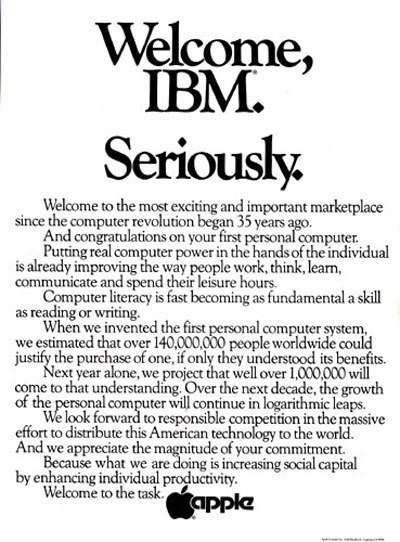
A couple of weeks ago, when Nature magazine announced it was starting a peer-reviewed open access journal, PLoS One (a peer reviewed open access journal) welcomed them the way Apple welcomed IBM into the personal computing market:

On January 6, 2011, Nature announced a new Open Access (OA) publication called Scientific Reports. Nature’s news underscores the growing acceptance of OA, as reflected in recent OA journal launches from other traditional publishers such as the BMJ, Sage,  AIP (American Institute of Physics) and APS (American Physical Society). Please spread the word either via this blog post or download this PDF.


Inspired by Apple
.

The Nature entry into the open access field is a big deal. So is Nature’s support of Creative Commons. I’ve had a chance to spend some little time with folks at Nature, and know them to be passionate about making the work of science more accessible. So, this is good news all around.

Tweet
Follow me

Categories: open access, science, too big to know Tagged with: 2b2k • nature • npg • open access • plos • science Date: February 2nd, 2011 dw

2 Comments »

« Previous Page | Next Page »


Creative Commons License
This work is licensed under a Creative Commons Attribution-NonCommercial-ShareAlike 3.0 Unported License.
TL;DR: Share this post freely, but attribute it to me (name (David Weinberger) and link to it), and don't use it commercially without my permission.

Joho the Blog uses WordPress blogging software.
Thank you, WordPress!