


logo
EverydayChaos
Everyday Chaos
Too Big to Know
Too Big to Know
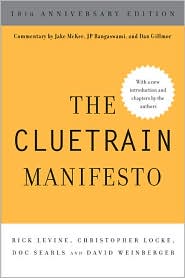
Cluetrain 10th Anniversary edition
Cluetrain 10th Anniversary
Everything Is Miscellaneous
Small Pieces cover
Small Pieces Loosely Joined
Cluetrain cover
Cluetrain Manifesto
My face
Speaker info
Who am I? (Blog Disclosure Form) Copy this link as RSS address Atom Feed

April 9, 2009

The future of the Boston Globe

The New York Times owns the Boston Globe and is asking the unions to come up with $20M in savings. According to a report on WBUR this morning, the Times isn’t even giving the unions enough time to go through their own legal processes for making such decisions. So, here are some possible outcomes:

The Globe folds.

The Globe is bought, presumably by someone with a drug problem.

The Globe becomes an insert in the New York Times. The insert covers not just local news but maintains some of the Globe’s identity, personality, and personalities. (Also, the comics.) If I were the NYT, I’d be running spreadsheets to see if folding the Globe into the NYT (quite literally) would increase local circulation and ads enough to make it worth the considerable operating expenses.

And, as an auxiliary idea, I wonder if people would be willing to pay for online access to the Globe if it did two things: 1. Continue to provide free access to individual articles, for we need to be able to link to them both to keep the Globe relevant and to grow our culture. 2. Enhance the current Globe site so that it has more of the unitary newspaper feel. That is, let us have more of a sense that we’re reading an object that has a start and a finish, so that we’re tempted to sit down with it once a day and go through it. Let us turn pages until we’re done. (Of course, the pages would be full of links.) Provide us with all the electronic reading tools we could ever want, but tempt us to treat it as a whole through which we take a walk every day. And charge us $100/ year for the privilege. Since we’d be able to get at any of the individual articles for free, the Globe would be charging us for the online equivalent of curling up with the paper in the morning.

I acknowledge that that may be the stupidest idea since unsliced bread, and perhaps it is merely an old fogey desire. But, heck, it’s not like I’m writing for a responsible newspaper!

[Tags: newspapers media boston boston_globe everything_is_miscellaneous ]

Tweet
Follow me

Categories: Uncategorized Tagged with: boston • everythingIsMiscellaneous • media • newspapers Date: April 9th, 2009 dw

2 Comments »

March 19, 2009

Transparency and noir journalism

David Eaves makes a crucial point in a post inspired by Clay Shirky‘s and Steven Johnson‘s recent brilliant postings about the future of journalism. Pardon me if I rephrase David’s point, and possibly shade it a little differently.

The mythic figure of the journalist is still that of the young Woodward and Bernstein. They are detectives in a noir world where everyone — and, most important, every institution — has a secret. The journalist is the lone truth teller, forcing the secrets out into the light. The institutions keep as much secret as they can because they have selfish interests to protect. The journalist, on the other hand, has no interests other than the truth. Thus he (and in the myth, the journalist is a man) is committed to and guided by objectivity: seeing things as they are, untainted by self-interest.

That’s a valuable myth so long as institutions are built on the assumption of secrecy. But imagine a world of perfect institutional transparency. If all is light, the noir journalist is a peeping tom at a nudist colony.

Now, we are not going to have a world of perfect transparency. But the defaults may be flipping from need-to-know to need-to-hide. Customers, clients and citizens already casually betray most of what institutions used to keep hidden, from the real-world mileage of cars to the spread of protests in totalitarian countries. Laws and norms are changing, bringing institutions to disclose more on their own.

Will this bring about a fundamental change in the practice of journalism? By itself, probably not. Much of traditional journalism already assumes transparency in business, government, and, yes, sports. Greater transparency will give current journalists more to report on. But there will always be people and institutions with dark secrets, so we will always need noir journalists.

But it’s certainly not yet settled what the new mythic journalist will be like or how we will support our old noir types.

[Tags: journalism media newspapers noir david_eaves ]

Tweet
Follow me

Categories: Uncategorized Tagged with: digital culture • journalism • media • newspapers • noir Date: March 19th, 2009 dw

6 Comments »

March 14, 2009

Shirky’s classic post on the fate of newspapers

This post by Clay Shirky will be at the center of future discussions about the newspaper revolution. It is itself a pivot point. And it’s beautifully written, with a pause-worthy insight in every paragraph.

[Tags: newspapers journalism media clay_shirky everything_is_miscellaneous ]

Tweet
Follow me

Categories: Uncategorized Tagged with: culture • digital culture • everythingIsMiscellaneous • journalism • media • newspapers Date: March 14th, 2009 dw

4 Comments »

March 4, 2009

Three from the Boston Globe: Conflict, amusement, and maddening missing of the point

Part One

The big page two story of today’s Boston Globe is an article by Lori Montgomery of the Washington Post. It begins:

Two of the administration’s top economic officials defended President Obama’s $3.6 trillion budget plan yesterday, arguing that the proposal would finance a historic investment in critical economic priorities while restoring balance to a tax code tipped in favor of the wealthy.

The first nine paragraphs are about the fierce conflict. Only in paragraph ten do we get the most important news:

Despite those and a few other contentious issues, Obama’s budget request was generally well-received yesterday, as lawmakers took their first opportunity to comment on an agenda that many have described as the most ambitious and transformative since the dawn of the Reagan era. Democratic budget leaders said they are likely to endorse most of Obama’s proposals sometime in April in the form of a nonbinding budget resolution.

If it bleeds, it leads. Sigh.


Part Two

Because I generally disagree on policy with the Globe’s conservative columnist Jeff Jacoby, I try to give him the benefit of the doubt in his reasoning. But this morning, he’s driven me officially nuts. Well done, sir!

Jacoby devotes his column to the philosopher Peter Singer. First, he lauds Singer for “his commitment to charity.” But the bulk of the column is given over to Singer’s controversial — too mild a word — argument for permitting infanticide under careful legal conditions.

Actually, I’ve misspoken. Jacoby doesn’t mention Singer’s argument. He only gives the conclusion. Jacoby’s own conclusion is that Singer’s stance shows what happens “if morality is merely a matter of opinion and preference — if there is no overarching ethical code that supersedes any value system we can contrive for ourselves…”

In fact, Singer’s most objectionable conclusions come from rigorously applying standards of morality against opinion and preference. For example, if we say it’s our superior intelligence that gives us certain rights, then we should be willing to accord those rights to other creatures that turn out to have the same intelligence, even in preference to humans who lack that intelligence by accidents of birth or personal history. Or, as Singer says in the conclusion of the brief column in Foreign Policy that Jacoby cites:

…a new ethic will … recognize that the concept of a person is distinct from that of a member of the species Homo sapiens, and that it is personhood, not species membership, that is most significant in determining when it is wrong to end a life. We will understand that even if the life of a human organism begins at conception, the life of a person—that is, at a minimum, a being with some level of self-awareness—does not begin so early. And we will respect the right of autonomous, competent people to choose when to live and when to die.

There are lots of ways to argue with Singer’s conclusions. (I found him so convincing on animal rights in the 1970s that I’ve been a vegetarian ever since. I find him less convincing on infanticide.) But saying that Singer is merely expressing personal opinion is not to argue with him at all. In short, Jacoby is merely expressing his own opinions and preferences, and thus is guilty of exactly what he criticizes Singer for.


Part Three

The headline over the continuation of an article from the front page says:

Amid Maine’s extremes, teams of dogs and humans vie

It’s mildly disappointing to learn that the article is about dog sled racing in Maine, rather than about a dogs vs. humans sports event. [Tags: media newspapers journalism ethics philosophy peter_singer jeff_jacoby stimulus ]

Tweet
Follow me

Categories: Uncategorized Tagged with: ethics • journalism • media • newspapers • philosophy • stimulus Date: March 4th, 2009 dw

4 Comments »

January 16, 2009

Ethanz: Are print ads crazy?

Ethan, in a long, careful, and superb speculative piece, wonders if newspapers have been propped up by the fact that advertisers couldn’t tell just how over-priced the ad space in newspapers has been:

Basically, there are two ways to explain the disparity in online and offline ad cost. One is to argue that paper ads are, for some combination of reasons, ten to a hundred times more effective than online ads. The other is to argue that advertisers are better at pricing online ads than offline ads.

So, if we lose the irrational pricing of offline ads, how are newspapers going to support expensive, investigative journalism? Or, as Ethan puts it.

What if the model that brought us Upton Sinclair and Woodward and Bernstein – impression advertising – can’t bring us into the future because it’s based on uneven distribution of information and bad math?

And Ethan’s answer is: We don’t know yet.

Great, provocative piece.

[Tags: ethan_zuckerman journalism newspapers media advertising ]

Tweet
Follow me

Categories: Uncategorized Tagged with: advertising • journalism • media • newspapers Date: January 16th, 2009 dw

4 Comments »

December 18, 2008

Media Re:Public from Berkman

The Berkman Center’s Media Re:Public project assessing the state of the media (old school and citizen/participatory) is now out. (The papers are here.)

The report points to six issues, which I’m paraphrasing rather crudely:

1. Traditional media are scaling back their reporting because they’re going broke.

2. Their webby equivalents are not replacing all their functions.

3. Online news sources are not uniformly reliable, and not everyone knows that.

4. Not everyone is online anyway.

5. Some of the functions not being replaced online are really important, but we don’t yet have good business models for them.

6. We don’t have good data about what’s really going on.

This status report tries to bring some empiricism to the cheerleading (guilt as charged). It also pairs up nicely with a 2005 report about a Berkman conference that brought bloggers and mainstream journalists together for 1.5 days of frank discussions.

[Tags: berkman media citizen_journalism blogging news newspapers participatory_journalism persephone_miel ]

Tweet
Follow me

Categories: blogs Tagged with: berkman • blogging • blogs • digital culture • everythingIsMiscellaneous • media • news • newspapers Date: December 18th, 2008 dw

Be the first to comment »

December 6, 2008

NY Times evolves lungs and stubby legs

NYTimes.com has come a looong way.

At first, all the links on the site pointed to more of its own content, except for ads, as if the NYT was the only place ever worth reading. Then the NYT took a big step backwards with the Times Select program, locking its most valuable content behind a pay wall. But the Times saw that, although they were making money, they were losing influence. So, they came up with Times Topics as a place where we could point our links, enabling the NYT to climb up the Google rankings. And they unlocked their oldest archives, which is a great social boon.

And now they’ve started Times Extra: Articles on the NYTimes.com site now are suffixed with links out to other newspapers and blogs that talk about the same topic. So, at the end of an article on, say, Obama’s economic pledge, there may be a link to a Washington Post story, a post at Crooks and Liars, and maybe even a comment section.

Consider how unlikely such a thing would have seemed ten or even give years ago. Well done, NYT

[Tags: nyt new_york_times ny_times times_extra everything_is_miscellaneous media journalism news newspapers ]

Tweet
Follow me

Categories: Uncategorized Tagged with: digital culture • everythingIsMiscellaneous • journalism • media • news • newspapers • nyt Date: December 6th, 2008 dw

7 Comments »

January 22, 2008

The NYTimesoverse

The New York Times has proclaimed Twitter a phenomenon in a piece redolent with all the smug, self-referential authority it can muster. Journalists are using it! One twittered something that made it into the NY Times! Twitter therefore matters!


Why is journalistic innovation happening last at the newspapers? [Tags: twitter media newspapers journalism nytimes citizens_media ]

Tweet
Follow me

Categories: blogs Tagged with: blogs • digital culture • journalism • media • newspapers • nytimes • twitter Date: January 22nd, 2008 dw

3 Comments »

« Previous Page


Creative Commons License
This work is licensed under a Creative Commons Attribution-NonCommercial-ShareAlike 3.0 Unported License.
TL;DR: Share this post freely, but attribute it to me (name (David Weinberger) and link to it), and don't use it commercially without my permission.

Joho the Blog uses WordPress blogging software.
Thank you, WordPress!