



logo
EverydayChaos
Everyday Chaos
Too Big to Know
Too Big to Know
Cluetrain 10th Anniversary edition
Cluetrain 10th Anniversary
Everything Is Miscellaneous
Small Pieces cover
Small Pieces Loosely Joined
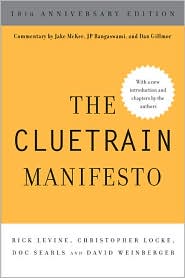
Cluetrain cover
Cluetrain Manifesto
My face
Speaker info
Who am I? (Blog Disclosure Form) Copy this link as RSS address Atom Feed

March 2, 2008

Susan Crawford: The Internet is not a medium

Susan Crawford comments on the Comcast FCC hearings, urging that we not view this simply as a matter of keeping net management neutral. Rather, she says, we should recognize that the Internet is not a medium but purely a transport system. The implication is that those who sell access to the Internet should not also be selling content and services over the Internet. (Delamination now!)

This is the crux of the matter. We’ve handed the implementation of our Internet over to companies that view themselves as providers of programming (in the TV, not the software, sense). That’s why they almost all think that giving you a fifth or a tenth of your download capacity for uploading makes obvious sense.

We could get a favorable (from my POV) ruling on Net neutrality from the FCC and still leave our Internet in the hands of those who are structured to treat it as a medium for passive viewers of high-def programming.

[Tags: susan_crawford net_neutrality comcast fcc ]

* * *

The Boston Globe has a pretty good editorial about the Comcast affair. My main concern with it is that it assumes this country’s failure to deliver a satisfactory Internet infrastructure shows that that infrastructure can’t come from a competitive market … as if the current situation is a competitive market. In my view, we need a mix of government steps to open the market (by rquiring access providers to act as wholesalers, for example), probably some direct government intervention (e.g., subsidies of some sort to reach areas quickly that the market won’t), and (I wish) government-enforced de-laminating of the industry. Something like that. But I have more faith in the power and efficiency of truly open markets than the Globe seems to have.

PS: I still wish we’d embrace the Open Spectrum idea. Lots of problems would be rapidly solved if and when it becomes practical technically and politically.

Tweet
Follow me

Categories: Uncategorized Tagged with: comcast • fcc • net neutrality • net_neutrality • susan_crawford Date: March 2nd, 2008 dw

4 Comments »

February 27, 2008

What a non-neutral Net could look like

Click here for a dystopic taste of the future. (This page will not harm your sensibilities, your computer, or your ability to procreate.)

[Tags: net_neutrality comcast ]

Tweet
Follow me

Categories: Uncategorized Tagged with: comcast • digital rights • humor • net neutrality Date: February 27th, 2008 dw

17 Comments »

February 26, 2008

Giving packets sirens

I want to pull on just one thread in the argument against Net neutrality: The claim that it’s obvious that some types of applications deserve priority. It’d be crazy not to give priority to Internet telephony packets or to heart monitoring packets. Right?


It seems crazy because it’s a fact that some application types are sensitive to delay and others are not. No denying that.

But given finite bandwidth and an indefinite number of jitter-sensitive, delay-sensitive app types, it’s not obvious that the ISPs are the ones who should make the decision about how to prioritize the packets. That is, it makes sense to give vehicles with sirens priority in the streets, but when an indefinite number of vehicles have sirens, who decides which vehicles get priority? If I’m not a VOIP user and if I don’t care about watching videos over the Net, why should my World of Warfare packets suffer? Why should your interest in high-def ESPN packets shoulder aside my SecondLife packets? Do my in-game chat VOIP packets deserve the same — or greater? — priority than your VOIP business calls? If I’m a Boston researcher who is engaged in some obscure (but important to me) delay-sensitive research with a lab in Japan, why should I have to hope the ISPs will decide to honor my packets’ sirens? Will my physician have to petition Comcast to let my kidney monitoring data have priority? Diabetes monitoring vs. thyroid info? Who decides if routine heart monitoring data should go at the same speed as critical care heart data?

And if I invent a new type of application that happens to be delay-sensitive, who has to approve it to get it onto the priority list?

If the only way to manage this were to rely upon the ISPs, then we’d just have to hope they’d make decisions that are genuinely in the public interest. But, if end-users can instead make those decisions, why not give them the power to say that they want their heart monitoring data to have a huge siren, and VOIP to be a Yugo that needs a valve job? And when their hearts stabilize, let them turn down those packets’ priority. in order to avoid an obvious gaming of the system, only let users change their designated siren vehicles once a month or so. And, I’d prefer that the ISPs not charge for this service — it’s simply a bit of network mgt — because I don’t want to give them an incentive for keeping the system sluggish.

There are some easy ways to present this to users, ways that never use the word “packet” or “jitter.” Let them designate some sites as high priority. Let them specify some application types (telephone calls, on-demand video). Even maybe let them choose “What type of user are you?” from a list.

It’s entirely possible that the solution I’m proposing is technically impossible or too expensive. IANAG (I am not a geek.) Nevertheless, thinking that some packets obviously should have priority doesn’t resolve the problem of figuring out how to prioritize packets. The more you look at it, the less obvious it becomes. [Tags: net_neutrality fcc comcast ]

Tweet
Follow me

Categories: Uncategorized Tagged with: comcast • fcc • net neutrality Date: February 26th, 2008 dw

10 Comments »

February 25, 2008

[fccboston08] FCC Hearing: Panel 2: Q&A

NOTE: I am live-blogging. Not re-reading for errors. There are guaranteed to be errors of substance, stand point and detail. Caveat reader.

McDowell: Does BitTorrent run differently on different types of network infrastructures?
BT: The engineers do take advantage of architectures. We rely on the basic structure of the Internet to handle congestion controls. The Internet has been doing that well.
McDowell: Is that what BitTorrent DNA does?
BT: It’s a competitive market, so we’ve worked on theability to run well in particular network envrionments.
McDowell: Should you be required to disclose that you don’t work well in particular types of networks?
BT: BT emerged as an open source protocol. We run it like an open standards process. We disclose it all. As issues materialize on particular networks, there’s demand for solutions, and we see a very open process.
Weitzner: The premise on the Internet is that there are standards that work, and the nodes and apps conform to those standards. If Comcast markets as Internet service, it ought to support Internet standards. Apps should be able to assume that they are operating in an Internet-compliant environment. Apps can’t conform when the carriers aren’t conforming and when they’re not given info.
Clark: In the beginning, we thought the apps should adapt to the underlying network. The user ought to decide what’s satisfactory not the app. E.g., a slow file transfer might seem unusable, but users find uses for it. In the end, it’s the user who should decide to hit the quit button. But crossing into paying for a service and expecting to get it requires adapting the net and the apps. We need tools for talking cross layer. There’s space for technical innovation.
Reed: Adapting to categories of networks traditionally have been the role of the IETF. E.g., 20 yrs ago there was a move to asymmetric networks. The community wanted to ban it. More pragmatic folks in the IETF said that it’s a reasonable technology an we have to be able to live with it. But that was the standard Internet, not the Comcast subclass of the Internet. If there are changes through the IETF, networks and apps will adapt. But it’s different when one vendor has a lock on one area and makes unilateral changes.

Now we see videos made by citizens today.

A retired fed lawyer says she needs the Net for her work playing music for cancer patients.

A worker for a small non-profit that makes a small TV app for participatory culture. Comcast’s filtering of BT harms his company and anyone who tries to post without going through a central authority. Comcast is “essentially ruining our system.”

A MIT computer science student sees it as a political issue. What will happen to MIT when it begins writing papers about the negative effects of this type of censorship. It affects the free flow of info.

The Maine Civil Liberties Union likes NN on First Amendment grounds.

Martin: David Clark, you want to change the business model…
Clark: Charging by the byte works poorly. But it might be worth exploring usage caps measured not in peaks but in gigabytes per month. [So, not $50/month for a max of 10Mb at any one time, but $50/month for a total of 5Gb (or whatever) of downloads.] The wireless guys are breaking the ice here. The current all-you-can-eat model has the advantage of encouraging people to try things, but it hides the cost and the value.
Martin: That could make sense in terms of business and maybe address some of the congestion problem. But with BT, it was their uploads that were being blocked, and they were below their limits anyway.
Clark: The ISPs haven’t characterized what acceptable use is. This is understandable because it’s very hard to know exactly what the conditions are going to be. But we can determine fairness of use among users without looking at the particular applications being used.
Martin: Do you think it’s important to distinguish among types of bits, not applications?
Clark: If there’s going to be any discrimination based on QoS, I’d rather have the user determine it. “This telephone call is really important!” Maybe 10% of your bits could be high priority, and you decide.
Martin: Was BitTorrent designed to get around some of the limitations of networks such as the cable network?
BT: The protocol was designed simply to manage large files. It doesn’t behave differently on different types of networks.

Reed explains a bit about how the IETF works. Locking in decisions around apps and QoS stops innovation in its tracks.
Bennett: It takes and months to get a solution through a standards body. Comcast has an obligation to solve it faster and to do the experiments.

Copps: Do we have enough info to proceed?
Clark: From the perspective of the academic the answer is simple: No.
Reed: My colleagues who try to collect data report a systematic shutting down of info.
Copps: Is this a serious problem?
Clark: Yes. E.g., we’re trying to find out if 10% of users generate 90% of the traffic. The only info I could get was from s. Korea. Not a single US ISP would give us the info even fully laundered. We don’t even know if there are consistently heavy users. They say it’s proprietary.
Copps: we really need to grapple with this.
Martin: Does that mean we shouldn’t take action, because we don’t have enough info?
Reed: No one has enough data to know whatt the current or projected traffic across the entire industry is.
Clark: The complaint before you does not require detailed traffic knowledge to make a decision.

Adelstein: How important network mgt practices for our ability to maintain our leadership in innovation?
BT: Incredibly important.
Reed: I spoke with the head of China’s largest portal. He’s got the rights to distribute the Olympics over their Net. That’s in competition with the state TV service. They may pass us with this new tech.
Bennett: If the FCC gets the decision right, you’ll increase the value of the carrier’s infrastructure. If you take the carrier out of it, the blocking will happen but it will be done by the guy down the street. The carrier is acting as a sheriff. If you add enough capacity so that there is no congestion, you’ll have to increase it 10- to100 times.
Clark: I disagree. The network does contain mechanisms to control traffic. The Comcast is a particular, nuanced response to what the Internet’s been doing for years, which is when too much traffic shows up everyone slows down. Being slowed down by our neighbor is right and it’s a good thing, because it means that when my neighbor isn’t there, I can go twice as fast. The question is whether the net is allocating in a way the user thinks is fair. (Should you be able to buy your way out, he asks) If you want to have nuances, you have to be clear about it or people won’t bother to innovate. No one wants to compete with Vonage because the carriers have done certain things.
Sony: Short term solutions should be recognized as having global implications.
Weitzner: The video innovation we’ve seen today is just the beginning. We ought to be working to get past the relatively mundane question of how to transport video in a civilized way.
Clark: There’s a world of innovation waiting to happen when there’s enough bandwidth.
Adelstein: Where is the line between sound network mgt and unsound? Between good discrimination an bad?
BT: I know it when I see it. Comcast is doing what [bac] hackers do to disrupt traffic. Forging data is outside the realm of reasonable.
Bennett: What I found lacking in the petitions against Comcast was any data about the condition of the network when the mgt practices were put into effect. They didn’t provide empirical data about how busy the Net was.
Clark: Using RST indicates that Comcast’s tools were inadequate for predicting and managing.
Bennett: The data is available.
Reed: I checked it out myself. They were indeed sending RST packets. They have to be carefully synthesized. And I discovered that to do that they had to use info from inside packet. I would view that as a pragmatic solution to the problem if someone had analyzed this technique and published a paper that says RST is a good way to solve congestion. But I can’t find anything. There is a bright line around hacking without public data. [Tags: fccboston08 net_neutrality ]

Tweet
Follow me

Categories: Uncategorized Tagged with: fccboston08 • net neutrality Date: February 25th, 2008 dw

2 Comments »

[fccboston08] FCC Hearing: Panel 2: Statements

NOTE: I am live-blogging. Not re-reading for errors. There are guaranteed to be errors of substance, stand point and detail. Caveat reader.


Daniel Weitzner of MIT says the entire Web is peer-to-peer, although not technically. People use the Net in a synchronous, P2P manner. E.g., pages are pulled together from info all over. We depend on the open nature of the Web to enable that.

Richard Bennett (network architect): Does free speech require abandoning the active mgt of net traffic? If so, then we have to shut down the Internet. Is it legit to manage the Net by discriminating by application? The Net and its constituent nets serve different apps. E.g., VOIP needs to avoid jitter. It makes sense to move apps that don’t care about jitter (e.g., email) to the back of the queue. BitTorrent is insensitive to jitter; you care about the time between first and last packet, but not jitter of individual packets….except for apps like Vuze, but RB doubts Vuze’s business viability. If we abandon app discriminatory we have to get rid of IP because it includes info about the app in the packets. Get rid of Wifi because QoS discriminates among apps. Get rid of difference between UDP and TCP. We have to get rid of discrimination within their own homes. Even on Ethernet we have to discriminate among apps, e.g., WoS for audio systems to avoid lipsynching issues If you add capacity to a network, you’ve only moved the bottleneck from the first hop to the second hop. NN would inhibit rural delivery since it depends on wifi. So, sit back. We’ll solve it with more bandwidth and with revisions of the apps that use it, like BitTorrent.

David Clark says that TV is central here because it increases the traffic and it’s a collision of pricing models. We should be partnering, not fighting. Let’s talk about business model. The usage cost to Comcast for a month of user usage might be around $0.50. TV usage is 40 times as much (taking reasonable estimates), i.e., $20/month to cover your user costs. What’s going to give is the all you can eat flat rate pricing. We have to find a way that will be acceptable to the user. David likes selling tiers of consumption.


David says he finds the blocking of particular apps “troubling.” The ISP should not be imposing a value judgment on the consumer. That makes the customer into an enemy.


He says that they put desired-QoS and app bits in the header is so that the user could decide what apps and QoS s/he wants. He says that discrminating in favor of VOIP bits is not a violation of NN but he’d rather let users decide. He’d rather decide where to draw the line through case law than by a policy. So, ultimately he’s against the FCC adopting a policy.


Eric Klinker of BitTorrent explains why BT was invented: To move large files. He lists legit users of BT. Why, even Hollywood studios! If Comcast is allowed to block this class of app, it would stamp out “the most promising technology we have to do to deliver a near infinite” set of content.


David Reed (MIT): Providing Net access implies adherence to protocols and standards essential to a world wide net. Variance damages the Net and all its uses. Industry standard processes exist for disclosure, etc. Comcast’s secretive attempt to provide non-standard mgt is a problem. Access do not create the Internet. They provide access as part of a much large system. The Net is a network of networks that results from voluntary compliance with standards and protocols. You just have to agree to play by the ground rules. These ground rules have been around or 30 years. You have to agree to send on Internet datagrams. [He has a prop!] The content is inside the packet “envelope.” The content is meaningful only to the sender and receiver. The participating networks agree not to alter the contents. When congestion becomes extreme, it’s normal to discard the envelope because the sender is responsible for re-transmitting it. The Net was designed from the beginning to manage congestion. The network cannot eliminate it. It requires the senders to cooperate and slow down. This requires acceptance of standards. This is all part of the standard Internet. But Comcast unilaterally and secretly used its own mgt techniques, doing deep packet inspection and sending RST packets. This violates the expectations of users that the content of envelope will not be read. If the standard methods aren’t adequate, the provider should bring the situation to the IETF. Otherwise, Comcast is not providing access to the Internet, but to a selected portion of the Internet.

Scott Smyers, Senior Vice President, Network & Systems Architecture Division, Sony Electronics Inc. Sony thinks the Net is the future of delivery of TV. He believes in competition. I can’t tell what he thinks about Net neutrality.

[Tags: fccboston08 net_neutrality ]

Tweet
Follow me

Categories: Uncategorized Tagged with: fccboston08 • net neutrality Date: February 25th, 2008 dw

2 Comments »

[fccboston08] FCC hearing: Panel 1 part c: Tim Wu

Tim Wu, Columbia Law and the coiner of the phrase “Net neutrality” (and, like Yochai, a personal hero of mine) says: Whatever we conclude about Net neutrality we should decide on a simple rule: NN should not include blocking lawful applications

He says the FCC should keep in mind that this discussion is also part of American foreign policy that the technology of censorship are being built into our technology (e.g., deep packet technology). We don’t want America to be known as the home of the filtered Internet. We’ve been presenting ourselves as the home of free speech, free markets, open Internet. We want to keep the Internet as a role model of freedom.

Christopher S. Yoo, Professor of Law and Director, Center for Technology, Innovation, and Competition, University of Pennsylvania Law School, says the industry is facing uncertainty. We don’t know how quickly traffic is growing. Quality of service depends on what your neighbors are doing on the net. We don’t know how downloads vs. P2P will work out. Network management has a role, he says. He talks about ow the NSF solved a traffic problem by preferring human-to-human sessions vs downloads. And the 700MHz auction allows some types of services to have priority. Conclusion: The FCC should not adopt a one size fits all policy… [Tags: fccboston08 net_neutrality ]

Tweet
Follow me

Categories: Uncategorized Tagged with: fccboston08 • net neutrality Date: February 25th, 2008 dw

2 Comments »

[fccboston08] FCC hearing: Panel 1 part b – Comcast and Verizon

Representative Dan Bosley talks about the need for broadband in western Mass., where he lives, because lack of it hurts the local economy. He compares stifling competition on the Net to stifling competition in grocery stores. He says aspects of the violation of NN remind him of slotting fees at groceries.

He says it’s about capacity, not content. Yes, there’s a lot of traffic. Competition will bring about capacity. Plus, we could use a national broadband plan, he says.

David L. Cohen, Executive Vice President, Comcast Corporation, tells us that Comcast is committed to giving its customers superior Internet access. 60M households get broadband. What is the secret of this remarkable “success” [Mission accomplished!]? The lack of regulation enables competition. we’ve risked huge amounts of money to Users can use whatever VOIP they want, use Vuze and BitTorrent.


ut we do manage our network to maximize the experience. Every network is managed. Our customers want us to fight spam and viruses, and they want us to fight network congestion.


Bandwidth consumption is a real concern. We manage minimally, barely noticeable. This has a huge benefit for our users. We use the least intrsuvie methods.


We inform our users. We have recently clarified our policy on our Web site.

Networks discriminate. A Harvard medical network does in order to ensure the delivery of important data. [But that’s the point: If we had competition, we’d have ISPs with different offers and the market could decide.]

Tom Tauke, Executive Vice President – Public Affairs Policy and Communications, Verizon Communications talks about short codes, which I think are SMS’s. He sees to be justifying why they blocked pro-choice text messages. He says they were spam. They’ve also blocked messages that advertised wallpaper with “inappropriate” content and ring tones with inappropriate, um, tones. [Wow. So much for freedom of speech. I think this guy is screwing his own pooch…a turn of phrase that probably wouldn’t make it past Verizon’s censors.] He acknowledges that blocking the pro-choice message was a mistake that Verizon connected.

He recommends “industry action” — self-policing — to get over these little censorship problems.

[Tags: fccboston08 net_neutrality ]

Tweet
Follow me

Categories: Uncategorized Tagged with: fccboston08 • net neutrality Date: February 25th, 2008 dw

Be the first to comment »

[fccboston08] FCC hearing: Panel 1 part a [Benkler rocks the house]

Marvin Ammori, General Counsel, Free Press, is first up on this panel. The panel is as long as a march of penguins. This is not about tech, he says. It’s about the future of the Net. Door #1: Open, fast broadband, innovative, etc. Door #2: Providers choose your sites for you [whoops, overstatement], etc. How can there even be a hearing to choose between these two doors, he asks. It’s because big companies are pushing open that door in DC.

Yochai Benkler of the Berkman Center. Two different issues. 1. Net is abut users connected to one another. 2. We need a restructuring of the basic decision to support a duopoly. [Go Yochai!]

1. The Net is about people connected to one another, at least once you stop looking throgh 20th Century business models. The carriers are based around delivering content and services. Only genuine competition will keep the Net open.

2. It was a mistake to enable the ISP consolidation. Net neutrality is important but it is only a partial solution to the failures of the market that is at beast only weakly competitive. We need to make the Net competitive all the way through.


BitTorrent brings together both points, he says. It is a decentralized structure to enable users to support one another, engage in peer collaborative. By myopia or malice, the last-mile firms are preventing competition. The way to ensure real competition is probably some form of unbundling and open access. This is a very American approach. But we abandoned them, instead handing access to two incumbent industries.

[Putting this in terms of the structural changes we need is, imo, exactly right.]

David Cohen [Tags: fccboston08 net_neutrality ]

Tweet
Follow me

Categories: Uncategorized Tagged with: fccboston08 • net neutrality Date: February 25th, 2008 dw

1 Comment »

[fccboston08] FCC hearing: BitTorrent demo

The head of Vuze, Gilles BianRosa, is showing a demo of his BitTorrent client. There have been 20M downloads of Vuze in the past 12 months. It delivers high-def TV. He says Vuze enables viewers to find producers and vice versa. He connects live to a science video with gorgeous astronomical videos, although he can’t show it in high-def beause of Harvard’s projector. He hits the play button on the PBS channel. He then drops down into advanced view (= the old Azureus client). He explains that because it’s peer-to-peer, throttling some of the peers clocks it (or lags it) for everyone else.


So, the basic argument is that Vuze is used for legitimate TV time shifting via Net delivery. It uses BitTorrent. Throttle BitTorrent keeps this new form of Net TV to function well. Great example of a insurgent competitor being hurt by packet discrimination, with the implication that the discrimination is coming from companies that should see Vuze as a threat.


“We are not against reasonable network management. We are against network mgt with no boundaries.” Comcast owns the racetrack but also has a horse running in the race, he says. “The market should determine which services should win,” but markets need ground rules.


[Well done.]

Martin: I want to make clear that you have relationships with media companies, so the programming you’re providing is legal.
A: We are an open platform so people can upload what they want, but we feature legal content.

Martin: Your tech doesn’t allow users to exceed the upload capacity they’ve bought, right?
A: No, they couldn’t. [I think Martin’s making a point, not really asking.] [Heck, we’re not even allowed to use all the bandwidth we’ve purchased!]

Adelstein: How much traffic does uploading by your users generate?
A: Generally, upload is 10-20% of download capacity.

McDowell: The 1996 Telecom Act is the backdrop for this. We’re talking here about cable companies. Did you try to work around the inefficiencies present with cable companies?
A: We are agnostic about the network. By cooperating we can be more intelligent in distributing the strain.
McDowell: Are you one size fits all even though the networks have different limitations?
A: Of course.

Martin reiterates that Vuze does not allow users to exceed their capacity. They can only use the capacity they’ve purchased. [Excellent. This says something very positive about Martin’s stance (imo)] [Tags: fccboston08 net_neutrality ]

Tweet
Follow me

Categories: Uncategorized Tagged with: fccboston08 • net neutrality Date: February 25th, 2008 dw

1 Comment »

[fccboston08] FCC hearing: Commissioner McDowell

Robert McDowell is one of the Rep commissioners. He talks about the Internet as a new medium and calls us consumers. Sigh.

He says the Net has been through transitions. Now we’re facing a new one. He says he likes competitive markets better than “bureaucrats” like him. Thus, broadband networks have to have incentives to deploy new tech. To give them the incentive to extend the Net, they need to be allowed to make money. They do have to give access to all devices.

This is one of the conceptual disjunctions. The carriers claim NN is gov’t regulation of the Internet. Supporters of NN (like me) think that NN regulation would regulate the carriers. The carriers think NN imposes a new regulation. Supporters of NN think that NN preserves the existing architecture of the Net. [Tags: fccboston08 net_neutrality ]

Tweet
Follow me

Categories: Uncategorized Tagged with: fccboston08 • net neutrality Date: February 25th, 2008 dw

1 Comment »

« Previous Page | Next Page »


Creative Commons License
This work is licensed under a Creative Commons Attribution-NonCommercial-ShareAlike 3.0 Unported License.
TL;DR: Share this post freely, but attribute it to me (name (David Weinberger) and link to it), and don't use it commercially without my permission.

Joho the Blog uses WordPress blogging software.
Thank you, WordPress!