



logo
EverydayChaos
Everyday Chaos
Too Big to Know
Too Big to Know
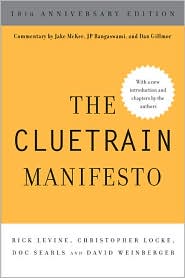
Cluetrain 10th Anniversary edition
Cluetrain 10th Anniversary
Everything Is Miscellaneous
Small Pieces cover
Small Pieces Loosely Joined
Cluetrain cover
Cluetrain Manifesto
My face
Speaker info
Who am I? (Blog Disclosure Form) Copy this link as RSS address Atom Feed

May 24, 2011

The Net Neutrality Bot

Juan Carlos de Martin is giving an informal talk to a few of us about the Neubot: a Net Neutrality bot, created by NEXA Center for Internet & Society
at Politecnico di Torino.

Neubot is a small piece of software that tests connection speeds, “assesses the quality and neutrality of Internet connections,” and makes the data publicly accessible. The agent runs in the background. It tests by sending and receiving random data. Each test emulates the syntax and behavior of an existing protocol, e.g. HTTP, RTP, or BitTorrent. During the test the agent measures quality of service indicators, such as jitter. The result of a test is a measure of the connection quality to a specific host, with time, day of month, and emulated protocol indicated. Each result also enables a coarse identification of the location, so the results can be organized by city. Before you install, you have to agree that your IP will be in a public database. [All that appears is that an IP address sent some random bits using a particular protocol, so I’m not seeing the privacy implications, but apparently Europe disagrees.] This enables the discerning of patterns that might (might!) indicate ISP discrimination against particular protocols, or hidden bandwidth caps, etc.

[And then I had another meeting and had to leave…]

Tweet
Follow me

Categories: net neutrality Tagged with: net neutrality Date: May 24th, 2011 dw

2 Comments »

April 25, 2011

8th graders make awesome Net neutrality explainer

Congratulations to eighth graders Melissa Yu, Katy Becker, and Sara Atkins for winning first prize in C-SPAN’s StudentCam contest. Their 7:45 minute video explainer of Net neutrality — the policy and the politics — is clear, fair, and smart.

Tweet
Follow me

Categories: journalism, media, net neutrality Tagged with: journalism • net neutrality Date: April 25th, 2011 dw

3 Comments »

April 18, 2011

Online Clomid Over the Counter | Canadian Pharmacy | Why you won’t care that the Net isn’t neutral

Online Clomid Over the Counter

It’s very simple. Once we have lost Buy Online Clomid over the counter Net neutrality and the access clomid pct providers are given a free hand to charge Internet companies for delivering their bits faster and more reliably than their competitors’ bits, we will experience this simply as how the Internet works, not as an artificial constraint put in to benefit the access providers.

With so little without prescription competition, the access providers will be able to jack up fast lane prices as high as the richest players in the market can bear. So, let’s say Google decides to pay the access providers for “fast lane” service, but Bing does not. You’ll notice that Google results fly in, while Bing seems to be having trouble digesting its oatmeal. You won’t know if that’s because Bing’s search engine is slower or because it didn’t pony up for fast lane service. All you’ll know is that you’re not going back to Bing.

So, what’s the problem? The first is that this raises the hurdle to innovation. You have a great clomid for women 50mg new search engine? You won’t be able to get started competing generic against Google and Bing without being able to afford the fast lane services they can buy. The big companies will always be able to buy faster service. This encourages the sort of consolidation that would have forestalled the most interesting success stories of the Net so far.

Second, the access providers are also providers of services and content that compete with the organizations they serve. So, Comcast will undoubtedly find how to take clomid economic advantage in making sure that Comcast-NBC content shoulders aside Netflix’s offerings … and your offerings on YouTube. You’ll prefer using the video service that doesn’t suck…not knowing that removing Net neutrality’s economic point is to introduce artifical suckage onto the Internet.

Market forces clomid for men won’t correct the loss of Net neutrality because the market won’t experience its bad consequences as consequences at all. This is a predictable market weakness. It is why we need to regulate the access providers. It is why we need Net neutrality.

Tweet
Follow me

Categories: net neutrality Tagged with: net neutrality Date: April 18th, 2011 dw

1 Comment »

March 9, 2011

Robin Chase tells Congress why we need an open, neutral Internet

Robin Chase, the founder of ZipCar, testified in front of Congress. She argued that Congress ought not remove the FCC’s authority to prevent access providers from deciding which information moves fast, slow, or not at all. [pdf]

Tweet
Follow me

Categories: net neutrality Tagged with: fcc • net neutrality • robin chase Date: March 9th, 2011 dw

6 Comments »

February 28, 2011

Am I blocked or Not: Wisconsin version

From the Berkman Center:

The Herdict team is looking for help testing the hypothesis that the Wisconsin Capitol building guest wireless blocks Websense’s “advocacy” category. (Background here, and see the various links in those posts).

If you have friends/family/contacts/colleagues who might be in a position to help Herdict with this testing, please share the links above or point them to Herdict’s “am I blocked or not?” testing queue for the US — Many thanks!

Tweet
Follow me

Categories: censorship, politics Tagged with: censorship • herdict • net neutrality Date: February 28th, 2011 dw

1 Comment »

February 18, 2011

National Broadband Map: What the incumbents hath failed to wrought (wring?)

The National Broadband Map is now available. We had wanted to bask in the sunlight provided by the incumbent access providers, but instead we just got freckles. Want to laugh like a broken-hearted clown? View only the places that have fiber to the home.

The map was controversial from its inception, since it at least initially was relying on data coming from parties interested in exaggerating the extent of coverage. (I interviewed Steve Rosenberg at the FCC about his agencies contribution to it, in November 2009.) It does not link to its sources. It did not list my access provider (RCN) as available where I live. Also, the map is very clunky to manipulate. (Hint: Turn off all overlays until you zoom into where you want to see.) (Harold Feld provides a balanced perspective.)

Now want to cry like a generation watching its future slip away? The Republicans seem set on throwing The Master Switch to turn the Internet into a corporate content delivery system. Let your Senators know that you want the Internet to remain the engine of innovation and a public square for free speech.

Tweet
Follow me

Categories: net neutrality, policy Tagged with: broadband • broadbandstrategyweek • fcc • net neutrality • ntia Date: February 18th, 2011 dw

1 Comment »

January 21, 2011

Two of the Internet’s parents explain its origins and future

Scott Bradner and Steve Crocker are two of the tech geniuses who built the Internet in an open way and built it to be open. Now they have both published instructive columns recounting the thinking behind the Net that has been responsible for its success . I highly recommend both.

From Scott‘s:

The IETF has interpreted the “End to End” paper to basically say that
the network should not be application aware. Unless told otherwise by
an application, the network should treat all Internet traffic the
same.

…this design philosophy has led the IETF to create
technologies that can be deployed without having to get permission
from network operators or having to modify the networks.

…Last year I was worried about what rules regulators and politicians
were going to impose on the Internet. This year, my pessimism is
focused at a lower level in the protocol stack: I’m worried about what
kind of network the network operators will provide for the IETF to
build on, for me and you to use, and for tomorrow’s enterprises to
depend on.

From Steve‘s:

…we always tried to design each new protocol to be
both useful in its own right and a building block available to others.
We did not think of protocols as finished products, and we
deliberately exposed the internal architecture to make it easy for
others to gain a foothold. This was the antithesis of the attitude of
the old telephone networks, which actively discouraged any additions
or uses they had not sanctioned.

As we rebuild our economy, I do hope we keep in mind the value of
openness, especially in industries that have rarely had it. Whether
it’s in health care reform or energy innovation, the largest payoffs
will come not from what the stimulus package pays for directly, but
from the huge vistas we open up for others to explore.

Tweet
Follow me

Categories: net neutrality Tagged with: internet • net neutrality Date: January 21st, 2011 dw

2 Comments »

December 21, 2010

FCC Fail — Providing incentives for scarcity

There are many ways to boil down today’s upcoming FCC rejection of Net neutrality (which they did in the guise of supporting Net neutrality). Here’s one:

The end of Net neutrality means that those who provide access to the Internet — to our Internet, for it is ours, not theirs — have every economic incentive to keep access scarce. By not providing enough bandwidth, they can claim justification for charging users per bit (or per page, service, download, etc.), and justification for charging Net application/data providers for the right to cut ahead in line.

This is ironic — in the not-funny sense — since the access providers’ stated justification for opposing Net neutrality is because to do otherwise would discourage investment. But, why are they going to invest in providing more bits when they make more money by throttling access? (Competition? Sure, that’d be great. Let’s require them to rent out their lines. Oh, I forgot.) Abundance would turn access provision into a profitable commodity business, which is exactly what users want, and what would stimulate innovation and economic growth.

So, now that Net neutrality is going to be overturned, the access providers will make money by preventing access. Anyone want to bet that the U.S. is now going to climb the charts of average national broadband rates and of lowest average cost? Does anyone think that we haven’t just moved back by decades when we’ll have, say, gigabit access common across the country?

For shame, FCC.


[Later that day] The FCC has clarified some of what it means. For example, they are not going to allow access providers to charge companies for fast lane access. It seems that Commissioners Copps and Mignon nudged the regulations in the right direction. Thank you for that. (Also, see Harold Feld’s take.)

Tweet
Follow me

Categories: net neutrality Tagged with: fcc • net neutrality Date: December 21st, 2010 dw

26 Comments »

December 18, 2010

David Reed on the neutrality of the Net’s code

Barbara van Schewick has posted two brilliant posts (1 2) about the practical effects removing Net neutrality would have on innovation. Now David Reed, one of the authors of the original argument for the Net’s neutral architecture, has responded, in agreement, but with a shading of emphasis.

David’s point (as I understand it) is that we should remember that Net neutrality isn’t something that we need the law to impose upon the Net. Rather, the Net was architected from the beginning to be neutral. The Internet as a protocol explicitly is designed to move packets of bits from source to destination without knowing what information they contain, what type of application they support, or who created them. All packets move equally in those regards.

So, David asks, “[W]hat do we need from the ‘law’ when the ‘code’ was designed to do most of the job?” After all, he writes, “merely requiring those who offer Internet service to implement the Internet design as it was intended – without trying to assign meaning to the data content of the packets – would automatically be application agnostic.”

In particular: We don’t need a complex rule defining “applications” in order to implement an application agnostic Internet. We have the basis of that rule – it’s in the “code” of the Internet. What we need from the “law” is merely a rule that says a network operator is not supposed to make routing decisions, packet delivery decisions, etc. based on contents of the packet.

David along with Barbara disputes the claim that the need to manage traffic to avoid congestion justifies application-specific discrimination. The Net, David says, was built with traffic management in mind:

… network congestion control is managed by having the routers merely detect and signal the existence of congestion back to the edges of the network, where the sources can decide to re-route traffic and the traffic engineers can decide to modify the network’s hardware connectivity. This decision means that the only function needed in the network transport itself is application-agnostic – congestion detection and signalling.

So, the only law we need, David is saying, is that which lets the Net be the Net.

Tweet
Follow me

Categories: net neutrality Tagged with: barbara van schewick • david reed • net neutrality Date: December 18th, 2010 dw

6 Comments »

December 13, 2010

FCC: Do Net Neutrality right

Brad Burnham, a well-known and thoughtful venture capitalist — I know him a bit, and like and respect him — has posted a letter to the FCC explaining why it ought to reject Chairman Genachowski’s compromised version of Net Neutrality (AKA “I can’t believe it’s not Net Neutrality”) in favor of something more clear and powerful.

Barbara van Schewick, an authority on Net Neutrality, has posted about a very specific example of the harm that would be done if the Chairman’s version becomes public policy: Zediva is a online DVD rental start-up that needs Net Neutrality to be viable. Zewdiva says in their own letter to the FCC:

By enabling users to watch new DVDs online, our service may be perceived to directly compete with the VideoLonLDemand service, PayPerView or other PayTV services offered by cable providers and, in some cases, the providers of fiber networks and wireless networks. At the same time, we depend on the broadband Internet access service offered by these providers to reach our users. In the absence of strong nonLdiscrimination rules and meaningful restrictions on what constitutes “reasonable network management”, these competitors will be able to exploit their control over the provision of broadband access to put us at a competitive disadvantage.

Here’s hoping that Chairman Genachowski can put on a pair of man pants and propose some real Net Neutrality (while maintaining his sense of humor).

Tweet
Follow me

Categories: net neutrality Tagged with: fcc • man pants • net neutrality Date: December 13th, 2010 dw

2 Comments »

« Previous Page | Next Page »


Creative Commons License
This work is licensed under a Creative Commons Attribution-NonCommercial-ShareAlike 3.0 Unported License.
TL;DR: Share this post freely, but attribute it to me (name (David Weinberger) and link to it), and don't use it commercially without my permission.

Joho the Blog uses WordPress blogging software.
Thank you, WordPress!