logo
EverydayChaos
Everyday Chaos
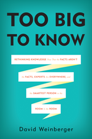
Too Big to Know
Too Big to Know
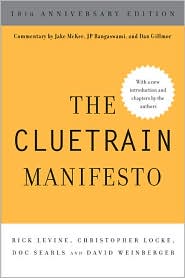
Cluetrain 10th Anniversary edition
Cluetrain 10th Anniversary
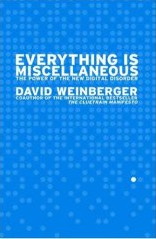
Everything Is Miscellaneous
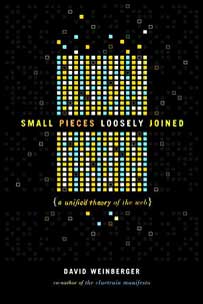
Small Pieces cover
Small Pieces Loosely Joined
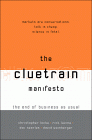
Cluetrain cover
Cluetrain Manifesto
My face
Speaker info
Who am I? (Blog Disclosure Form) Copy this link as RSS address Atom Feed

August 20, 2009

New issue of JOHO the Newsletter

I’ve just sent out the August 18, 2009 issue of JOHO, my newsletter. (It’s completely free, so feel free to subscribe.) It’s all new material (well, new-ish) except for one piece.

Cluetrain@10: Recently, the tenth anniversary edition of The Cluetrain Manifesto came out, a book I co-authored. Here’s some of what we got wrong in the original version.

In the new edition’s introduction, I list a bunch of ways the world has become cluetrain-y, many of which we take for granted. The fact is that I think Cluetrain was pretty much right. Of course, at the time we thought we were simply articulating things about the Web that were obvious to users but that many media and business folks needed to hear.

But Cluetrain also got some important things wrong…and I don’t mean just Thesis #74: “We are immune to advertising. Just forget it.”

Our kids’ Internet: 

Part 1: Will our kids appreciate the Internet?: Will the Net become just another medium that we take for granted? 

I love the Internet because even now, fifteen years into the Web, I remember what life used to be like. In fact, give me half a beer and I’ll regale you with tales of typing my dissertation on an IBM Model B electric, complete with carbon paper and Wite-Out. Let me finish my beer and I’ll explain microfiche to you, you young whippersnappers.

The coming generation, the one that’s been brought up on the Internet, aren’t going to love it the way that we do…

Part 2: The shared lessons of the Net: The Net teaches all its users (within a particular culture) some common lessons. And if that makes me a technodeterminist, then so be it.

In my network of friends and colleagues, there’s a schism. Some of us like to make generalizations about the Net. Others then mention that actual data shows that the Net is different to different people. Even within the US population, people’s experience of it varies widely. So, when middle class, educated, white men of a certain age talk as if what they’re excited about on the Net is what everyone is excited about, those white men are falling prey to the oldest fallacy in the book. 

Of course that’s right. My experience of the Web is not that of, say, a 14 year old Latina girl who’s on MySpace, doesn’t ever update Wikipedia articles, isn’t on Twitter, considers email to be a tool her parents use, and — gasp — hasn’t ever tagged a single page. The difference is real and really important. And yet …

Part 3: How to tell you’re in a culture gap: You’ll love or hate this link, which illustrates our non-uniform response to the Net.

The news’ old value:  

Part 1: Transparency is the new objectivity: Objectivity and credibility through authority were useful ways to come to reliable belief back when paper constrained ideas. In a linked world, though, transparency carries a lot of that burden.

Part 2: Driving Tom Friedman to the F Bomb: Traditional news media are being challenged at the most basic level by the fact that news has been a rectangular object, not a network.

Bogus Contest: Net PC-ness: What should we be politically correct about in the Age of the Web?

[Tags: joho newsletter technodeterminism news journalism media cluetrain ]

Tweet
Follow me

Categories: Uncategorized Tagged with: business • cluetrain • digital culture • digital rights • joho • journalism • marketing • media • news • newsletter • technodeterminism Date: August 20th, 2009 dw

2 Comments »

August 5, 2009

Media Cloud unclouds media

The NY Times has a terrific article about Media Cloud, a Berkman Center project (hats off to Ethan Zuckerman, Yochai Benkler, Hal Roberts, among others) that will let researchers track the actual movement of ideas through the mediasphere and blogosphere.

Data about concepts! What a concept!

[Tags: berkman media blogs memes research media_cloud ]

Tweet
Follow me

Categories: blogs Tagged with: berkman • blogs • everythingIsMiscellaneous • media • memes • research Date: August 5th, 2009 dw

Be the first to comment »

July 28, 2009

Annals of openness in peril

1. The court has rejected Charlie Nesson’s basic defense of Joel Tenenbaum’s sharing of music files. The case is going to jury which may levy the same sort of insanely excessive fines as in the Jammie Thomas-Rassert trial. I hope Charlie’s team can convince the jury that the fines and the entire process are so onerous and disproportionate that the RIAA has been abusing the court system. Of course, IANAL, and IANAOTJ (I am not on the jury).


2. Barnes and Noble has launched its e-book software. It runs on iPhones as well as on PC’s and Mac’s. I’m having trouble finding which formats it supports, but judging from its Open dialogue, not PDF, .doc, .html, .mobi, or text. It does support .PBD books.

After a very very quick session playing with it, it seems quite competitive with the Kindle, and because I’m running it on my Mac and not on the little piece of crippled hardware I bought from Amazon — the Kindle is just barely adequate as a reader, and is still overpriced by more than 100% in terms of its value, imo — having the use of a keyboard and a mouse is a big step up. And, unlike the Kindle, you can use whatever fonts you have on your machine. Still, it’s only incrementally better than the Kindle’s software (again, on a quick look), not a great leap forward for readers.

One of B&N’s big advantages is that it’s hooked into Google Books, enabling you to download public domain books that Google has scanned in. You do this by searching for a book on the B&N site and noticing the “free from Google Books” label. Be sure to sort by price; otherwise B&N lists the for-pay versions first. If B&N wants to be aggressive in this space (= succeed), it should create an easy-to-find section that lets you browse Google’s free books. Get us using the ereader and then sell us the copyrighted books. (If B&N has such a section, I couldn’t find it quickly enough.)

BTW, I presume (and thus may be wrong) that Google did a special deal with B&N to enable this. If so, I find it worrisome. If Google is going to be granted a special right to scan in books without fear of copyright reprisals, it will be the de facto national e-library, discouraging others from undertaking similarly scaled scanning projects, and thus should be making its public domain books equally and maximally freely available. IMO.

2a. [Later that evening:] B&N stores are now providing free Wifi. Yay!


3. Apple is not permitting the Google telephone service into the Apple App store, thus simultaneously and inadvertently making the case for Zittrainian generativity.


4. [Later that day]: On the happy front, Google has open-sourced an implementation of Wave.

[Tags: copyright copyleft books e-books google libraries everything_is_miscellaneous charles_nesson jonathan_zittrain law fair_use amazon kindle b&n ]

Tweet
Follow me

Categories: Uncategorized Tagged with: amazon • books • cluetrain • copyleft • copyright • digital rights • e-books • everythingIsMiscellaneous • google • kindle • law • libraries • media Date: July 28th, 2009 dw

8 Comments »

July 25, 2009

AP to digitally monitor copyright

The AP has announced it is going to use an automated system to monitor the use of AP content on the Web, looking for copyright violations. The empire is fighting back. From the press release:

The Associated Press Board of Directors today directed The Associated Press to create a news registry that will tag and track all AP content online to assure compliance with terms of use. The system will register key identifying information about each piece of content that AP distributes as well as the terms of use of that content, and employ a built-in beacon to notify AP about how the content is used.

I think there are three possible broad-stroke outcomes:

1. The AP takes an enlightened and generous view of copyright protection and its terms of use, encouraging people to link to and cite its stories, and saving its angry face for commercial thieves, wholesale infringers, and other scum. The AP remains a major source of news, fulfills the social mission of the newspapers who are its members, and our culture is better off for it.

2. The AP’s automated system is set on a hair trigger. The AP protects its copyright so well that no one ever hears from it again.

3. The AP acts inconsistently. It sends scary letters to teenagers who copy three paragraphs about the Jonas Brothers and sics lawyers on a professor teaching a course on media studies. No one understands what the AP is doing, so we all get scared and hate it.

To start with, it’d be great if the AP’s copyright warnings didn’t just tell people what they can’t do, but also told them what they can do, and encouraged us to re-use the material as much as possible. On the other hand, since one of the aims of the new system (according to the press release) is to facilitate the use of pay walls, I expect we’ll see more of the AP’s content making itself irrelevant.

[Tags: ap media journalism free copyright copyleft everything_is_miscellaneous ]

Tweet
Follow me

Categories: misc Tagged with: ap • copyleft • copyright • everything_is_miscellaneous • free • journalism • media • misc Date: July 25th, 2009 dw

4 Comments »

July 23, 2009

Accountable bloggers and journalists

[Note 1.5 hrs after posting this: Ethan Zuckerman has just put up a superb post on this topic. I suggest you read that instead of this.]

Jillian York of the Berkman Center explains the current confusion about the NY Times’ rather casual suggestion (in a blog post) , based on an accusation in a tweet from Omid Habibinia, that Hossein Derakhshan (aka Hoder) has been an agent for the Iranian government, basically ratting out pro-democracy bloggers. The NY Times has now gone meta on the accusation, saying it only reported it because it’s a sign of the discord and distrust, etc., etc. But it’s still a dangerous charge to propagate. Jillian wants to know why we’re blaming the NY Times blogger and not Habibinia.

I’ve got enough blame in my backpack for both. But I do think that since the NY Times trades on its credibility, it has a greater responsibility. When the NY Times reports a rumor, it not only amplifies the rumor, it inevitably adds credibility to it. That’s just the way it is, and, it’s also how the NY Times wants it.
Navigating fertility treatment? Let’s talk about clomid, a common medication in this journey.

clomid is typically taken orally once a day for 5 days, usually starting on day 3, 4, or 5 of your menstrual cycle. The dosage and timing can vary based on individual needs and doctor recommendations.

Key points to remember:

• Take it at the same time each day

• Follow your doctor’s instructions precisely

• Be aware of potential side effects

Tracking your cycle and ovulation is crucial when taking clomid. It’s not just about taking a pill – it’s about understanding your body’s response.

Are you considering or currently using clomid? Share your experience or questions below. Remember, always consult with your healthcare provider for personalized advice.

(I wish I could track down the article I read today about the difficult the human brain has in unlearning bad info even after it’s been shown to be bad. The article talked about the increase in the belief that Iraq had WMDs after it was shown that it did not.)

[Tags: iran nytimes journalism media hoder ]

Tweet
Follow me

Categories: misc Tagged with: hoder • iran • journalism • media • misc • nytimes Date: July 23rd, 2009 dw

4 Comments »

July 22, 2009

My PDF talk on facts ‘n’ transparency

Link. (The video embeds my slides, but (1) they get more and more out of order in this YouTube; they were in the right order when I actually presented them. 2. My font got lost somewhere in the translations, and so there’s a fair bit of mis-sizing, text overflows, etc.) (I posted about one of the ideas in the talk (transparency as the new objectivity) here.)

[Tags: pdf09 transparency media politics e-democracy e-government e-gov everything_is_miscellaneous newspapers media ]

Tweet
Follow me

Categories: misc Tagged with: e-democracy • e-gov • e-government • everything_is_miscellaneous • media • misc • newspapers • pdf09 • politics • transparency Date: July 22nd, 2009 dw

1 Comment »

July 19, 2009

Transparency is the new objectivity

A friend asked me to post an explanation of what I meant when I said at PDF09 that “transparency is the new objectivity.” First, I apologize for the cliché of “x is the new y.” Second, what I meant is that transparency is now fulfilling some of objectivity’s old role in the ecology of knowledge.

Outside of the realm of science, objectivity is discredited these days as anything but an aspiration, and even that aspiration is looking pretty sketchy. The problem with objectivity is that it tries to show what the world looks like from no particular point of view, which is like wondering what something looks like in the dark. Nevertheless, objectivity — even as an unattainable goal — served an important role in how we came to trust information, and in the economics of newspapers in the modern age.

You can see this in newspapers’ early push-back against blogging. We were told that bloggers have agendas, whereas journalists give us objective information. Of course, if you don’t think objectivity is possible, then you think that the claim of objectivity is actually hiding the biases that inevitably are there. That’s what I meant when, during a bloggers press conference at the 2004 Democratic National Convention, I asked Pulitzer-prize winning journalist Walter Mears whom he was supporting for president. He replied (paraphrasing!), “If I tell you, how can you trust what I write?,” to which I replied that if he doesn’t tell us, how can we trust what he blogs?

So, that’s one sense in which transparency is the new objectivity. What we used to believe because we thought the author was objective we now believe because we can see through the author’s writings to the sources and values that brought her to that position. Transparency gives the reader information by which she can undo some of the unintended effects of the ever-present biases. Transparency brings us to reliability the way objectivity used to.

This change is, well, epochal.

Objectivity used be presented as a stopping point for belief: If the source is objective and well-informed, you have sufficient reason to believe. The objectivity of the reporter is a stopping point for reader’s inquiry. That was part of high-end newspapers’ claimed value: You can’t believe what you read in a slanted tabloid, but our news is objective, so your inquiry can come to rest here. Credentialing systems had the same basic rhythm: You can stop your quest once you come to a credentialed authority who says, “I got this. You can believe it.” End of story.


We thought that that was how knowledge works, but it turns out that it’s really just how paper works. Transparency prospers in a linked medium, for you can literally see the connections between the final draft’s claims and the ideas that informed it. Paper, on the other hand, sucks at links. You can look up the footnote, but that’s an expensive, time-consuming activity more likely to result in failure than success. So, during the Age of Paper, we got used to the idea that authority comes in the form of a stop sign: You’ve reached a source whose reliability requires no further inquiry.

In the Age of Links, we still use credentials and rely on authorities. Those are indispensible ways of scaling knowledge, that is, letting us know more than any one of us could authenticate on our own. But, increasingly, credentials and authority work best for vouchsafing commoditized knowledge, the stuff that’s settled and not worth arguing about. At the edges of knowledge — in the analysis and contextualization that journalists nowadays tell us is their real value — we want, need, can have, and expect transparency. Transparency puts within the report itself a way for us to see what assumptions and values may have shaped it, and lets us see the arguments that the report resolved one way and not another. Transparency — the embedded ability to see through the published draft — often gives us more reason to believe a report than the claim of objectivity did.

In fact, transparency subsumes objectivity. Anyone who claims objectivity should be willing to back that assertion up by letting us look at sources, disagreements, and the personal assumptions and values supposedly bracketed out of the report.


Objectivity without transparency increasingly will look like arrogance. And then foolishness. Why should we trust what one person — with the best of intentions — insists is true when we instead could have a web of evidence, ideas, and argument?


viagra online new york

In short: Objectivity is a trust mechanism you rely on when your medium can’t do links. Now our medium can. [Tags: objectivity transparency journalism media knowledge epistemology jay_rosen science everything_is_miscellaneous ]

Tweet
Follow me

Categories: misc Tagged with: digital culture • education • epistemology • everythingIsMiscellaneous • expertise • journalism • knowledge • media • objectivity • philosophy • science • transparency Date: July 19th, 2009 dw

4 Comments »

July 16, 2009

Two interviews

I was live on the Jeff Farias show on Monday. You can hear it here. (I start at around the 88th minute.)


Powered by Podbean.com

We talked for half an hour, at first about Cluetrain and then about some of the stuff in Everything Is Miscellaneous. I haven’t listened to it, but I enjoyed it.

Also, this week a Swiss newspaper, Sonntags Zeitung, ran an interview with me about cloud computing. That one is a bit more problematic. It’s a brief Q&A, boiled down from 20-30 minutes of talk, although it does not mention that. Inevitably, there are some places where I disagree a bit with the impression my abridged answers leave. That’s what happens. But it also has me saying some things that I’m quite sure I didn’t say. One in particular I feel a need to correct. The interview has me stating that it takes 4-5 times more computing power to deal with encrypted traffic (such as email) than with unencrypted. Not only don’t I know how much more computing power it takes, I know that I don’t know. So, I want to here put on “the record” that that estimate is unsubstantiated, and that I’m quite sure that that’s not what I said.

The journalist did offer to let me see the interview before he ran it, but I declined, primarily because, through a mutual misunderstanding, I thought I was only contributing an idea or two to an article — not a dedicated Q&A — about cloud computing.

[Tags: media cloud_computing ]

Tweet
Follow me

Categories: Uncategorized Tagged with: cloud_computing • media Date: July 16th, 2009 dw

3 Comments »

Techcrunch’s RT of @Ev email

Sam Bayard of the Berkman Center’s Citizen Media Law Center has posted an explanation of the legal issues around TechCrunch posting some of the content of the email stolen from Twitter’s founders background.

It seems different to me than when people posted internal messages from Diebold, because there was a clear public interest in the reliability of voting machines. I’m trying to bracket out the sense that Twitter is one of us, but I’m failing. The whole thing makes me feel icky.

Tags: twitter techcrunch diebold privacy media

Tweet
Follow me

Categories: Uncategorized Tagged with: diebold • digital culture • media • privacy • techcrunch • twitter Date: July 16th, 2009 dw

1 Comment »

July 9, 2009

Brad Sucks latest album for free — and Brad still gets paid!

NOTE: The 50 copies are gone. Took about an hour.

I’m trying an experiment with a business model I like to call a reverse referral fee. Here’s how it works…

You click on a link that lets you download a copy of Brad Sucks’ latest album, Out of It. The album of wonderful music is yours for free in every sense. (Share it! Please!) But, I’m going to pay Brad for each copy downloaded, at a bulk rate he and I have agreed on.

This offer is good for the first fifty people who download it. After that, you can buy a copy on your own. Of course, Brad also makes his music available for free (in every sense), but don’t you want to support a truly webby, big-hearted musician who’s giving us his talent free of copyright, studios, and DRM? Doncha?

So, if you want to be one of the fifty, click here for your free-to-you-but-not-to-me copy of Brad Sucks’ Out of It.

[Tags: bradsucks music drm copyright copyleft business_models everything_is_miscellaneous ]free ]

Tweet
Follow me

Categories: Uncategorized Tagged with: bradsucks • business_models • copyleft • copyright • digital culture • drm • entertainment • everythingIsMiscellaneous • everything_is_miscellaneous • free • marketing • media • music Date: July 9th, 2009 dw

14 Comments »

« Previous Page | Next Page »


Creative Commons License
This work is licensed under a Creative Commons Attribution-NonCommercial-ShareAlike 3.0 Unported License.
TL;DR: Share this post freely, but attribute it to me (name (David Weinberger) and link to it), and don't use it commercially without my permission.

Joho the Blog uses WordPress blogging software.
Thank you, WordPress!