


logo
EverydayChaos
Everyday Chaos
Too Big to Know
Too Big to Know
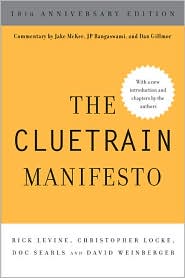
Cluetrain 10th Anniversary edition
Cluetrain 10th Anniversary
Everything Is Miscellaneous
Small Pieces cover
Small Pieces Loosely Joined
Cluetrain cover
Cluetrain Manifesto
My face
Speaker info
Who am I? (Blog Disclosure Form) Copy this link as RSS address Atom Feed

October 3, 2007

Harvard moves towards Open Harvard moves towards Open Access scholarship

According to the Harvard Crimson, the Harvard Faculty of Arts & Sciences’ governing body has proposed an open access policy according to which faculty members would make their research available for free either on a university site or on their own site. This would be in addition to publishing in academic journals, some of which charge $20,000 a year for a subscription. It’d be an opt-out program. The Harvard Crimson has a good editorial supporting it.

Yay! Locking research up in for-pay journals slows the pace of knowledge. The peer review system — one important way ideas are vetted — does not require the existing print publication system. Harvard’s move will not only make more information more widely available, it may help nudge the system itself into a form that better serves our species’ interests: As more schools adopt open access programs, researchers will have an increasing disincentive not to lock their work up.

I’m actually not sure how this will work, especially with regard to its being opt-out. If I’ve just had an article accepted by The Journal of Hydroponic Pediatrics. do I then also submit it to the Harvard open access server? If so, in what sense is that opt out?

Obviously, I’m also interested in what sort of metadata and aggregation facilities Harvard will supply to make these articles easily findable.

But what pleasant questions to contemplate! [Tags: open_access harvard publishing copyright a2k everything_is_miscellaneous ]

Tweet
Follow me

Categories: Uncategorized Tagged with: digital rights • education • everythingIsMiscellaneous • media Date: October 3rd, 2007 dw

1 Comment »

October 2, 2007

Meta-radio

James Vasile, who just gave a Berkman lunch-time talk, distributed a copy of a brief paper, “Unlock the Rock,” which is not yet up on the Web. In it, James suggests that we separate radio into its two functions: DJs who figure out what to play, and the delivery mechanism. Someone should create a plug-in (or sump’in) that lets everyone create playlists using simple HTML, and lets everyone listen to those playlists by scouring multiple sources for the music. So, if you have a copy on your disk, it’ll play that. If there’s an online distributor that has it available, great. If you have to buy it from iTunes, then it’ll let you. Or maybe you have a small p2p network of friends who are sharing music.

Interesting. It’d at least make it difficult to find someone to sue. And the publishers might make some money out of it. And, from my provincial point of view, it’d be a nice case of separating the metadata from the data…. [Tags: james_vasile internet_radio everything_is_miscellaneous ]

Tweet
Follow me

Categories: Uncategorized Tagged with: culture • digital culture • digital rights • everythingIsMiscellaneous • media Date: October 2nd, 2007 dw

3 Comments »

New innovation blog

Soctt Kirsner has started a as the online side of his Boston Globe “Innovation Economy” column. He says:

My goal with both the column and the blog is to cover the most interesting people and companies involved in the tech, VC, and life sciences scene here in New England…ideally before they’re written about elsewhere.

So, New England innovators, start your PR engines! :) [Tags: scott_kirsner innovation ]

Tweet
Follow me

Categories: blogs Tagged with: blogs • business • media Date: October 2nd, 2007 dw

1 Comment »

October 1, 2007

The front page is dead, but not yet quite reborn

I like what Michael Wolff says in his Vanity Fair piece about his new news site:

The metaphor, for 150 years — from print to radio to network to cable — has been the front page: important stuff first. “It should have to do now with falling through something, or floating through the totality of information or of intersecting worlds and interests,” offers [Patrick] Spain, not a man wild with his metaphors. [VF, October, p. 126]

I’ve been saying for a while, and I think in Everything Is Miscellaneous, that the new front page is distributed across our day and our network. Much of it comes through our inbox. It consists of people we know and people we don’t know recommending items for our interest.

So, I was disappointed by Wolff’s new site, Newser.com. It presents a view of the news that’s much less hierarchical than a typical front page, and it’s well-designed for quickly finding what matters to you, but: (1) It assumes its nine top-level categories reflect how every reader views the world; (2) Where are our voices? Comments? Blogs? (3) I couldn’t let it arise from my social network (where that network includes people I don’t know but whose views interest me). It competes with Google News, not with the intersection of Digg and FaceBook, which is what I’m waiting for. [Tags: everything_is_miscellaneous news media michael_wolff ]

Tweet
Follow me

Categories: Uncategorized Tagged with: digital culture • everythingIsMiscellaneous • media • taxonomy Date: October 1st, 2007 dw

1 Comment »

September 29, 2007

Picnic O7 presentation and (sort of) debate

Here’s a video of the full session I was at at Picnic ’07. It includes Walt Mossberg’s introduction, my 40 minute keynote (very similar to the presentation that I did at Google, although with a short section on the importance and difficulty of the implicit added, and some references in anticipation of the debate to follow), and then the half hour or so of my debate with Andrew Keen, moderated by Walt M.

I haven’t watched the video beyond the first few minutes — the production quality is high — but my sense of the debate was that Andrew was on an oddly anti-intellectual track, attacking me as a “professional philosopher,” which I’m not (I was an assistant professor of philosophy 22 years ago), and even if I were, why would that be a criticism, especially coming from a guy who is out arguing for the importance of credentialed authorities? Not helpful to discussing the actual topic. Frustrating. My feeling coming out of the discussion over all was indeed frustration. I didn’t think we were able to pursue points sufficiently.

BTW, somewhere in my presentation you can see me very carefully get left and right confused. Also, I’m going to plug again my more coherent attempt to explain and evaluate Keen’s argument: Andrew Keen’s Best Case. [Tags: everything_is_miscellaneous picnic2007 taxonomy folksonomyk ]

Tweet
Follow me

Categories: Uncategorized Tagged with: conference coverage • culture • digital culture • everythingIsMiscellaneous • for_everythingismisc • media • philosophy • taxonomy Date: September 29th, 2007 dw

Be the first to comment »

September 25, 2007

The future of content

Martin Weller has an excellent article on the future of content, presenting an economic and a quality argument for why it’s bound to be (in my terms) miscellanized.

This is the first in a “distributed blogging” experiment that will have three other bloggers responding. [Tags: content publishing books clay_shirky martin_weller long_tail chris_anderson everything_is_miscellaneous ]

Tweet
Follow me

Categories: Uncategorized Tagged with: business • digital culture • everythingIsMiscellaneous • for_everythingismisc • media Date: September 25th, 2007 dw

2 Comments »

September 17, 2007

Amazon and small presses

My sister-in-law, Meredith Sue Willis, the novelist and writing teacher, ran a piece in her newsletter about how small presses see Amazon. It’s by Jonathan Greene of the Gnomon Press. I thought it was interesting. Here it is, in its entirety:

Just back from the [Kentucky] State House chambers and the uphill
useless fight against legislation to give Peabody Coal millions in
incentives which may very well result in more mountaintop removal
devastation in the eastern coalfields.

But back to Amazon, this from the view of a small publisher (with over
40 years experience): The way the book world is set up is less than
ideal for a small publisher. Amazon is not Evil in that in many
instances it gives access to readers who want small press books that are
not otherwise easily available. Certainly I agree with my friend Gordon
Simmons: first support your local independent bookstore if you are lucky
enough to have a good one in your neighborhood; they are a dying breed.

But not all such bookstores will go to the trouble to order a book that
is not distributed by the near-monopoly of Ingram Book Co. Ingram takes
the same deep discount (55% off of list price) that Amazon takes, but
(unlike Amazon) Ingram often returns much of what it buys in beat-up
condition which the publisher has to eat plus pay the UPS cost back to
its door. I once got a hardback book returned by Ingram with a razor cut
the length of its spine through both the jacket and the cloth. And had
to pay for its trip back to my warehouse. As far as Amazon being
non-union, I doubt many bookstores are union or pay what many would
consider decent wages. Not right, but friends who work in stores
complain to me about this fact without telling me their specific
salaries.

Readers can also try to support publishers directly if their local store
will not bother to order a book that Ingram does not carry. Research
on-line and contact or buy from the publisher directly. Not all
publishers take credit cards, a reason some would prefer to deal with
Amazon. Barnes & Noble often will not order from small publishers
directly, but often seem to give out their telephone numbers to those
that want books from those publishers. Small Press Distribution and
Consortium that distribute books for many small presses return even less
to small presses that Amazon: they normally sell books to stores or
chains at 40% – 55% then take half of the gross receipts of any payment
and put the amount due the publisher in escrow for three months. And
Consortium charges the publisher a re-stocking fee for any books stores
or distributors return. In other words, it is almost impossible for a
small literary publisher to survive without massive infusions of grants
from NEA and foundations. Or increasingly asking for author subsidies.
And this affects writers who want to be published by small publishers.
The health of these publishers helps the writers they publish. The
worsening condition is also caused by big publishers deciding to kill of
their mid-list authors, authors who do not sell books at or above the
10,000 range. They would rather publish fewer authors selling more
product (a ubiquitous hateful word now in the book trade).

Print-on-demand vendors are a new avenue for authors and publishers. Or
in many instances now the author is the self-publisher. A complicated
situation. Bashing Amazon is not really helpful. Bash Ingram, bash the
fact that mainstream literary publishing is now dominated by
multi-nationals. Knopf, Random House, Farrar Straus, etc. are now owned
by German companies. Or lament the fact that just released figures state
that 27% of Americans do not even read one book a year. One was quoted:
reading made them sleepy. Well, then tout reading for insomniacs as much
healthier than sleeping pills. That should boost book sales.

BTW, Gnomon is no longer accepting manuscripts for publication. [Tags: amazon books publishing gnomon_press jonathan_greene meredith_sue_willis media bookstores ]

Tweet
Follow me

Categories: Uncategorized Tagged with: business • culture • digital culture • media Date: September 17th, 2007 dw

1 Comment »

September 15, 2007

NYTimes continues its slow climb to consciousness

My Times is in beta. I’m not sure how much of it I’m getting for free because Times Select comps people at universities. And I haven’t played with it extensively. But what I’m seeing I’m liking.

my.nytimes.com lets you choose your feeds. Of course, NY Times material is available, but you could make a page that shows the feeds from the Washington Post, Slate, and BBC and not the NY Times. The site lets you see suggested feeds from various NY Times celebrities. You can add widgets like a Flickr photo browser. You can lay out the page you want. You can add tabs to organize your many feeds. You can even add your own feeds. Plus there’s a meta-tab that will take you to Times Topics, taking them from their undeserved obscurity.

It’s not perfect, even at first glance. The feeds only show headlines, not any of the text. It doesn’t input or output OPML. The feed of the NYTimes columnists only shows the title of their posts, not the names of the authors. There’s still no way to comment on the articles, not even a thumbs up or down. The articles don’t link to blog posts about them.

Nevertheless, the decision to allow us to aggregate other sources on a page at the nytimes.com domain is a big symbolic deal. [Tags: nytimes media blogs newspapers journalism everything_is_miscellaneous ]

Tweet
Follow me

Categories: Uncategorized Tagged with: digital culture • everythingIsMiscellaneous • media Date: September 15th, 2007 dw

1 Comment »

September 12, 2007

Non-mashuppable debates, no thanks to Yahoo

From TechPresident’s indispensible Daily Digest, compiled by Joshua Levy:

…Wired’s ever-diligent Sarah Lai Stirland reports that “Yahoo has decided not to support citizen remixing of the footage — reducing the once-bold experiment to little more than a fancy online version of an on-demand cable television offering.” Yahoo had originally planned to upload the raw footage from the debate to its Jumpcut service for citizens to use in their mashups. But now a spokesman told Stirland that Yahoo will only let participants choose what candidates they want to hear from, without the ability to mashup actual footage. “Bloggers will be able to embed the video into their sites, YouTube-style, but will have no easy way to repurpose it,” writes Stirland. Those who want to create mashups won’t be able to use the simple Jumpcut service, and will instead be forced to download individual videos and use desktop video-editing software. Not nearly as fun.

[Tags: politics yahoo mashups everything_is_miscellaneous ]

Tweet
Follow me

Categories: Uncategorized Tagged with: digital rights • everythingIsMiscellaneous • for_everythingismisc • media • politics Date: September 12th, 2007 dw

Be the first to comment »

September 11, 2007

Now that we’re in the majority, could you please stop calling us consumers?

From the Center for Media Research:

Half of All Web Viewers Watching What The Other Half Has To Say

According to the just released Deloitte’s study on Media & Entertainment practice, looking at how American consumers between 13 and 75 years of age are using media and technology today, Millennials (13-24) are leading the way, embracing new technologies, games, entertainment platforms, user-generated content and communication tools. Data from the survey show that user-generated content is in tremendous demand across the generations, with 51% of all consumers watching and/or reading content created by others.

[Tags: web2.0 millennials user-generated-content media everything_is_miscellaneous]

Tweet
Follow me

Categories: Uncategorized Tagged with: digital culture • everythingIsMiscellaneous • for_everythingismisc • media Date: September 11th, 2007 dw

2 Comments »

« Previous Page | Next Page »


Creative Commons License
This work is licensed under a Creative Commons Attribution-NonCommercial-ShareAlike 3.0 Unported License.
TL;DR: Share this post freely, but attribute it to me (name (David Weinberger) and link to it), and don't use it commercially without my permission.

Joho the Blog uses WordPress blogging software.
Thank you, WordPress!