


logo
EverydayChaos
Everyday Chaos
Too Big to Know
Too Big to Know
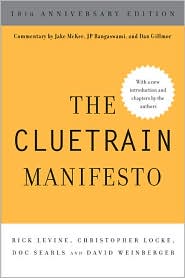
Cluetrain 10th Anniversary edition
Cluetrain 10th Anniversary
Everything Is Miscellaneous
Small Pieces cover
Small Pieces Loosely Joined
Cluetrain cover
Cluetrain Manifesto
My face
Speaker info
Who am I? (Blog Disclosure Form) Copy this link as RSS address Atom Feed

June 9, 2008

AllVoices

AllVoices is a new site that lets anyone upload an “event,” which in other circumstances might be called a “news story.” The site enables the clustering of bloggage and msm coverage of the event in what looks like a useful way.

I like a lot about it. I just hope it doesn’t become the preserve of yet another homogeneous group, which is exactly what the site doesn’t want to happen.

(It could use tags. [LATER that day: A helpful person from AllVoices tells me that there are tags for user-contributed items but not for ones that the system susses out.] And, at the moment the registration process is broken.)

Tags: allvoices global_voices media news social_tools everything_is_miscellaneous

Tweet
Follow me

Categories: Uncategorized Tagged with: allvoices • digital culture • everythingIsMiscellaneous • everything_is_miscellaneous • global_voices • media • news • social networks • social_tools Date: June 9th, 2008 dw

Be the first to comment »

June 6, 2008

Flyp’s balloon

Flyp’s new issue is another example of how mainstream media production values can find a more interesting home on the Web. And in terms of raw content goodness, take a look at the bursting balloon high-speed imagery in the “Maximum Definition” article. [Tags: media flyp multimedia balloons ]

Tweet
Follow me

Categories: Uncategorized Tagged with: balloons • flyp • media • multimedia Date: June 6th, 2008 dw

Be the first to comment »

June 4, 2008

The audible campaign, from The Conversations Network

The Conversations Network has added a new “channel” that does for the 2008 US presidential campaign what IT Conversations does for tech: Lots of good talk by interesting, informed people. It’s a joint project with the equally estimable PRX.org. [Disclosure: I’m on The CN board of directors. It’s a non-profit.]Disclosure

[Tags: politics conversationsnetwork prx ]

Tweet
Follow me

Categories: Uncategorized Tagged with: conversationsnetwork • media • podcasts • politics • prx Date: June 4th, 2008 dw

Be the first to comment »

June 1, 2008

New issue of JOHO … Now with added Ethanz!

I’ve just sent out a new issue of my newsletter, JOHO. (You can sign up to receive it via email, for free of course, here.)

How much do we have to care about? Even if the mainstream media’s coverage of most of the world didn’t suck, would we care? Are we capable of caring sufficiently? (Annotated by Ethan Zuckerman!)

The population of Nigeria roughly equals the population of Japan. Yet, the amount of space given to Nigeria by the US news media makes it about the size of Britney Spears’ left pinky toe. Why?

Serious researchers have been considering this question for generations. Do American newspaper editors skimp on Nigeria because they’re racists? Nah, at least not in the straightforward way. Is it because the readers don’t care about Nigeria? Somewhat. But how will we ever care if we never read anything about it? We seem to be stuck in vicious circle, or what’s worse,  a circle of not-caring…

Vint Cerf’s curiosity: If we are indeed getting more of a stomach for the complex, what role has our technology played?

Esquire magazine recently ran an interview with him that they busted up into a series of unrelated quotations. I was particularly struck by one little insight:

  “The closer you look at something, the more complex it seems to be.”

Because of Esquire’s disaggregation of the interview, we have to guess at Cerf’s tone of voice. My guess is that he said this with a sense of wonder and delight, not out of frustration. Of course, I may be reading Cerf’s mind inaccurately. But the plausibility of that reading is itself significant…

History’s wavefront: When we can record just about everything, history loses its past. And, no, I don’t know what I mean by that.

The Strand Bookstore in NYC has eighteen miles of books, which works out to about 2.5 million volumes. My excellent local library has 409,000. The Strand’s shelves press the shoppers together, giving a sense that the place is alive with the love of books. The library is quieter because emptier. Even so, the library has something the Strand does not: history.

We’ve assumed that knowledge was always there, just waiting to be known…

ROFLcon and Woodstock: Am I so enthusiastic about the ROFLcon conference because it was important or just because I’m out of touch?

I was at Woodstock. For two hours. I was supposed to meet a girl there. Hahaha. Instead, I wandered around, hoping someone would offer me something to smoke to get me through the Melanie performance. So, let me recap: I was at Woodstock, didn’t meetup with the girl I was infatuated with, didn’t get stoned, and heard Melanie. Also, it was raining. Still, I was at Woodstock, which used to give me street cred, but now just makes me obsolete.

But forget my experience and take Woodstock as a watershed event at which the young realized they were more a potential movement and not just a demographic slice. ROFLcon felt something like that…

Is the Web different? The definitive and final answer.

I taught a course this past semester for the first time in 22 years.  The course was called “The Web Difference,” which was apt since it was about whether the Web is actually much different from what came before it, with an emphasis on what that might mean for law and policy. 

During the final class session, I took a survey…

The Turing Tests: Throwback humor, in both senses.

The fool. I won’t spend the money yet, but it’s only a matter of time before Van Klammer will lose our bet. I don’t care about winning the $100, of course. I’ll use it to buy something I’ll use frequently, to remind me of my moral and intellectual victory. Perhaps a set of mugs inscribed with “Courtesy of Dr. Van Klammer…Loser!”…

Bogus Contest: Surely anagrams can’t be random!

[Tags: joho attention history roflcon humor woodstock media ethan_zuckerman teaching john_palfrey ]

Tweet
Follow me

Categories: Uncategorized Tagged with: attention • culture • digital culture • history • humor • joho • libraries • media • philosophy • roflcon • teaching • woodstock Date: June 1st, 2008 dw

2 Comments »

May 6, 2008

[berkman] David Ardia: Citizen Media Law Project

David Ardia is giving a Berkman lunch talk on the Citizen Media Law Project. David begins by acknowledging his colleagues on the project, which has been student-driven to a large degree. [Caution Live-Blogging: I’m missing things, getting them wrong, etc. You will be able to see the session itself at Media Berkman. ]

David begins by looking at iBrattleboro.com, a citizen journalism, the neurodiversity weblog, and wikileaks. These sites have come to the attention of CMLP because they are citizens media sites that have little or no journalism training, little or know knowledge of media law, and not a lot of money. The CMLP grew out of a desire to provide resources for groups like these. (Dan Gillmor was one of the forces behind this, says David.)

CMLP began in April 2007, got a Knight News Challenge Award in May, published its legal threats database in Nov, launched their legal guide in Jan. 2008, and in Feb. did its first amicus filing (for Wikileaks).

The legal guide site has lots and lots of material in it, covering six topics: forming a business and getting online, dealing with online legal risks, newsgathering and privacy, access to government info, intellectual property, and risks associated with publication. There are 5-10 topics under each of these. There’s a lot there.

David walks through the site. There is a rich variety of ways of finding and browsing. In David’s example, the site explains how to create a non-profit corp., and actually steps you through the process, including the specifics for the fifteen states the guide covers so far.

The legal threats database has 25 attributes by which it can be searched. Users can contribute their own entries, although most come in through email. (They also import data from the Chilling Effects site.) The database does not make judgments about the threats. There are 467 entries in the database. Over half are law suits. They include threats to bring criminal charges (16) or to bring disciplinary action (18); that last is included because the legal system backs up the contracts that permit disciplinary action. David explains that the site takes an inclusive approach since you can easily narrow your queries to the areas that interest you. [A good “miscellaneous” principle!]

Factoids: California, which has 12% of the population, is the source of 21% of the threats. 30% of the legal claims are for defamation. Copyright infringements come in second with 8%.

93 of the law suits are pending. 40 settled. The plaintiffs got an injunction in 16 of the cases and won their cases 13 times. That’s not a lot out of more than 250 cases. David says that these sorts of results are fairly normal for law suits, although (he adds) these tend to be emotion-driven litigations, not money-driven.

David gives us a tour of the iBrattleboro case entry. It’s a very well-organized, thorough research on the topic.

David ends by posing some questions for expanding the database and opening it up. [Tags: citizen_journalism law cmlp chillingeffects ]

Tweet
Follow me

Categories: Uncategorized Tagged with: chillingeffects • cmlp • digital rights • law • media Date: May 6th, 2008 dw

1 Comment »

May 1, 2008

I’ve been rocketboomed…

Rocketboom is running a synopsis of my talk on fame at ROFLcon. (Does that make me meta-famous?)

[Tags: rocketboom roflcon2008 fame ]

Tweet
Follow me

Categories: Uncategorized Tagged with: digital culture • fame • media • rocketboom • roflcon2008 Date: May 1st, 2008 dw

1 Comment »

April 24, 2008

Citizen Media legal guide

The Berkman Center’s Citizen Media Law Project has a site that’s rich with information, written in non-legalese, about your rights and liabilities as a blogger (and general citizen media person) in the U.S. There’s lots to browse there, and it’s all quite concise and helpful.

For example, the section on whether it’s legal to record a phone call you’re having with someone else says, in part:

Federal law permits recording telephone calls and in-person conversations with the consent of at least one of the parties. See 18 U.S.C. 2511(2)(d). This is called a “one-party consent” law. Under a one-party consent law, you can record a phone call or conversation so long as you are a party to the conversation. Furthermore, if you are not a party to the conversation, a “one-party consent” law will allow you to record the conversation or phone call so long as your source consents and has full knowledge that the communication will be recorded.

In addition to federal law, thirty-eight states and the District of Columbia have adopted “one-party consent” laws…

This is an excellent resource.

[Tags: citizen_media law cmlp journalism ]

Tweet
Follow me

Categories: blogs Tagged with: blogs • citizen_media • cmlp • digital rights • journalism • law • media Date: April 24th, 2008 dw

Be the first to comment »

Web fame – notes on my talk-to-be at ROFLcon

I’m talking tomorrow at ROFLcon, a conference about Web fame, celebrity and culture. I’m supposed to be talking in a general way about Web fame. Then I’m leading a panel composed of men (yup) who are Web famous: Kyle Macdonald (One Red Paperclip), Joe Mathelete (Joe Mathelete Explains Marmaduke), Ian Spector (Chuck Norris Facts), Andy Ochiltree (JibJab.com), Andrew Baron (Rocketboom), Alex Tew (The Million Dollar Homepage)

Here’s a sketch of what I’m thinking of saying:

Fame has been a property of the broadcast (= one-to-many) system. Fame is based on the math of many people knowing you, so many that you can’t know them. But it’s not just math, of course. It’s also economics. The broadcast economy has a fiduciary interest in building and maintaining the famous. They’re “bankable.”

Because of this scarcity and the fact that the one-to-manyness of the relationship means the knowing is one-way, the famous become a special class of person: mythic and not fully real. They are not like us, even ontologically. Fame is a type of alienation.

Outside of the broadcast system, fame looks different. This is a type of do-it-yourself fame, not only in that we often want human fingerprints on the shiny surfaces we’re watching, but also because we create fame through passing around links … occasionally for mean and nasty reasons. Kids sitting around watching YouTubes with one another are like kids telling jokes: That reminds me of this one; if you liked that one, you’ll love this one. And the content itself fuels public conversations in multiple media. This is P2P fame.

There’s a long tail of fame, although I suspect the elbow isn’t quite as sharp as in the classic Shirky power law curve for links to blogs. At the top of the head of the curve, fame operates much as it does in the broadcast media, although frequently there’s some postmodern irony involved. In the long tail, though, you can be famous to a few people. Sure, much of it’s crap, but the point about an age of abundance is that we get an abundance of crap and of goodness. We get fame in every variety, including anonymous fame, fame that mimics broadcast fame, fame that mocks, fame that does both, fame for what is stupid, brilliant, nonce, eternal, clever, ignorant, blunt, nuanced, amateur, professional, mean, noble … just like us. It’s more of everything.

viagra online

But most of all, it’s ours.

* * *

[ROFLcon will be live-streamed here. [Tags: roflcon2008 web_culture fame celebrity ]

Tweet
Follow me

Categories: misc Tagged with: celebrity • culture • digital culture • fame • media • roflcon2008 Date: April 24th, 2008 dw

21 Comments »

April 19, 2008

Objectivity in teaching and reporting

Over at the Web Difference class blog, I’ve posted my qualms about posting here (i.e., at Joho) some thoughts about the course. Very circular and self-involved, I know.

Anyway, the question over at the Web Difference blog is whether a teacher should be neutral/fair/objective or transparent… [Tags: education media objectivity transparency ]

Tweet
Follow me

Categories: Uncategorized Tagged with: digital culture • education • media • objectivity • transparency Date: April 19th, 2008 dw

5 Comments »

April 10, 2008

PRX gets a MacArthur nod

Congratulations to the folks at the Public Radio Exchange for receiving one of eight MacArthur Foundation awards for Creative and Effective Institutions. Couldn’t have happened to a nicer bunch of people! (More info at the Berkman site.) [Tags: prx berkman macarthur]

Tweet
Follow me

Categories: Uncategorized Tagged with: digital culture • media Date: April 10th, 2008 dw

1 Comment »

« Previous Page | Next Page »


Creative Commons License
This work is licensed under a Creative Commons Attribution-NonCommercial-ShareAlike 3.0 Unported License.
TL;DR: Share this post freely, but attribute it to me (name (David Weinberger) and link to it), and don't use it commercially without my permission.

Joho the Blog uses WordPress blogging software.
Thank you, WordPress!