


logo
EverydayChaos
Everyday Chaos
Too Big to Know
Too Big to Know
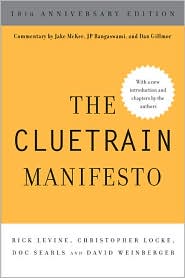
Cluetrain 10th Anniversary edition
Cluetrain 10th Anniversary
Everything Is Miscellaneous
Small Pieces cover
Small Pieces Loosely Joined
Cluetrain cover
Cluetrain Manifesto
My face
Speaker info
Who am I? (Blog Disclosure Form) Copy this link as RSS address Atom Feed

December 16, 2008

NYT likes the Internet

In the wake of yesterday’s repudiatathon of the WSJ.com’s misleading, inaccurate, biased, and wrong article on Net neutrality, the NY Times weighs in with a crisp, clear, and right-headed editorial.

[Tags: net_neutrality wsj policy nyt obama ]

Tweet
Follow me

Categories: Uncategorized Tagged with: digital rights • media • net neutrality • nyt • obama • policy • wsj Date: December 16th, 2008 dw

8 Comments »

December 15, 2008

Google to WSJ: google “net neutrality” and get back to us

Stephen Schultze as usual has a helpful post on the WSJ’s misreporting of Google’s supposed violation of the Net neutrality principle that Google has long supported. Steve points to Google’s Rick Whitt’s reply and to an aggregation of posts that makes it clear that this issue is being spun — and rather clumsily — by the WSJ into something it isn’t.

David Isenberg provides excellent, fightin’ analysis, including the following:

In other words, if Google does edge caching it buys access. It’s the same as when I, as a residential customer, pay $34.95 for one megabit DSL service or $49.95 for 3 megabit DSL.

cThe concern of Network Neutrality advocates is not with access but with delivery. The fear is that Internet connection providers would charge for expedited delivery of certain content to the end user, and in so doing would put themselves in the business of classifying which content gets enhanced delivery. Since they were charging for expedited delivery, they’d get more revenue for improving the enhanced delivery, so the only network upgrades would be for the enhanced service. Non-enhanced would fall further and further behind. Plus the power to decide what gets delivered might, indeed, be powerful, and power corrupts; just ask NARAL.

Since the edge caching Google is proposing is about access, not delivery, there’s no problem.

Net neutrality is not about everyone having equal access to the Net. Net neutrality is not about Google (or Microsoft or WSJ.com) being able to pay for fatter pipes, faster servers, or fancy-pants caching equipment that keeps the most-requested pages in memory and ready to go. Net neutrality is about not letting the carriers decide whose bits are more important than others once those bits have entered the network. It’s about the carriers not slowing down the Internet telephony bits from competitors or delaying your YouTube bits because the carriers think their “The Nanny” re-run bits are more important.

I do have to stand in admiration of whatever PR person pitched this story to WSJ. Masterfully done! [Tags: google net_neutrality ]

LATER: Scott Rosenberg on the inadequacy of the WSJ’s response. Harold Feld on what Google is up to. Tim Karr on the entrenchment of Net neutrality. Richard Bennett on why this is non-news (and why Net neutrality is non-neutral, or at least a myth).

Tweet
Follow me

Categories: Uncategorized Tagged with: digital rights • google • media • net neutrality Date: December 15th, 2008 dw

8 Comments »

December 6, 2008

NY Times evolves lungs and stubby legs

NYTimes.com has come a looong way.

At first, all the links on the site pointed to more of its own content, except for ads, as if the NYT was the only place ever worth reading. Then the NYT took a big step backwards with the Times Select program, locking its most valuable content behind a pay wall. But the Times saw that, although they were making money, they were losing influence. So, they came up with Times Topics as a place where we could point our links, enabling the NYT to climb up the Google rankings. And they unlocked their oldest archives, which is a great social boon.

And now they’ve started Times Extra: Articles on the NYTimes.com site now are suffixed with links out to other newspapers and blogs that talk about the same topic. So, at the end of an article on, say, Obama’s economic pledge, there may be a link to a Washington Post story, a post at Crooks and Liars, and maybe even a comment section.

Consider how unlikely such a thing would have seemed ten or even give years ago. Well done, NYT

[Tags: nyt new_york_times ny_times times_extra everything_is_miscellaneous media journalism news newspapers ]

Tweet
Follow me

Categories: Uncategorized Tagged with: digital culture • everythingIsMiscellaneous • journalism • media • news • newspapers • nyt Date: December 6th, 2008 dw

7 Comments »

December 5, 2008

Leadership and info: LeWeb pre-interview

I haven’t listend to this (I’m in an Amtrak station riding on some good soul’s free but flaky wifi), but here’s a podcast interview I did a couple of days ago as part of the LeWeb prep ‘n’ PR. I talk sort of about what I’m going to be talking about there, which (unless and until I rewrite it yet again) has something to do with leadership as the age of information ends. In the current draft of my overheads (Yes, I called them “overheads.” I’m old.), the connection seems to be that both the Information Age and leadership as we’ve generally known it assume/create scarcity. When the scarcity goes away, so does the primacy of information and the old idea of leadership.

I’ll try to say more about this as my overheads (Yes, overheads, dammit! And dittos that come from the mimeo machine!) go from draft to locked-in objects of fear and self-loathing. [Tags: leweb leweb2008 leadership information_age abundance overheads mimeo ]

Tweet
Follow me

Categories: Uncategorized Tagged with: abundance • business • digital culture • entertainment • infohistory • leadership • leweb • leweb2008 • mac • media • mimeo • overheads Date: December 5th, 2008 dw

2 Comments »

November 24, 2008

US’s Somali war gets some MSM attention

The Chicago Tribune actually has an article about the war we’ve been waging — and losing — in Somalia.

By the way, it’s interesting to put that article, which I think is quite good, next to Ethan Zuckerman’s recent post about Somali pirates. Who do you think is the more interesting, more knowledgeable commentator?

[Tags: somalia ethan_zuckerman piracy media ]

Tweet
Follow me

Categories: Uncategorized Tagged with: bridgeblog • media • piracy • somalia Date: November 24th, 2008 dw

1 Comment »

November 20, 2008

Internet not the child-devouring swamp many adults fear

A three-year research project, headed by Mimi Ito, involving 28 researchers and 800 subjects, and sponsored by the MacArthur Foundation, finds that the stereotypical idea of the Internet as a soul-devouring, anti-social wasteland for our kids is just plain wrong. If you suspected otherwise, now you know you were right.

The report makes a key distinction that helps explain some of the confusion we’ve been living through. From the press release:

The researchers identified two distinctive categories of teen engagement with digital media: friendship-driven and interest-driven. While friendship-driven participation centered on “hanging out” with existing friends, interest-driven participation involved accessing online information and communities that may not be present in the local peer group.

Here’s one interesting observation, from the overview:

Some youth “geek out” and dive into a topic or talent. Contrary to popular images, geeking out is highly social and engaged, although usually not driven primarily by local friendships. Youth turn instead to specialized knowledge groups of both teens and adults from around the country or world, with the goal of improving their craft and gaining reputation among expert peers. While adults participate, they are not automatically the resident experts by virtue of their age. Geeking out in many respects erases the traditional markers of status and authority.

The study’s implications for education are significant. From the overview:

Youths’ participation in this networked world suggests new ways of thinking about the role of education. What, the authors ask, would it mean to really exploit the potential of the learning opportunities available through online resources and networks? What would it mean to reach beyond traditional education and civic institutions and enlist the help of others in young people’s learning? Rather than assuming that education is primarily about preparing for jobs and careers, they question what it would mean to think of it as a process guiding youths’ participation in public life more generally.

[Tags: internet_sociology macarthur_foundation education digital_natives ]v

Tweet
Follow me

Categories: Uncategorized Tagged with: digital culture • education • everythingIsMiscellaneous • media Date: November 20th, 2008 dw

9 Comments »

November 16, 2008

Sunday morning roundup

I’ve come to look forward to Jason Linkins ultra-snarky live-blogging of the Sunday morning news talk shows. Very funny. Here’s today’s.

[Tags: news jason_linkins snark politics ]

Tweet
Follow me

Categories: Uncategorized Tagged with: humor • media • news • politics • snark Date: November 16th, 2008 dw

1 Comment »

November 15, 2008

Book on innovative business models tries innovative business model

Alex Osterwalder and Yves Pigneur are writing a book on innovative business models that’s due out in May. That seems to them to be too far away, so they’re thinking that maybe for $24 you could get a subscription to their book that provides:

* first & exclusive access to raw book content

* influence authors

* x installments of book chunks (in a non-linear order – as we write them)

* 50% discount off the final book (approx.)

* participate in exclusive book chunk webinars

* access to templates

* being part of the business model innovation community

Alex calls this idea a prototype and welcomes comments, as well as suggestions for what other benefits the authors might offer. (He does not require that you pay a subscription to read his blog and comment on this idea itself, however. Recursion is not always a good idea.)

I’m glad they’re floating this idea — because floating ideas rises all tides? — although I am skeptical. This doesn’t sound like a book that’s so urgent that people will pay a 50% premium ($24 + half off the printed version) for some number of out-of-sequence rough drafts. Of course, I could be wrong about that, especially since about a dozen people in the comments to Alex’s post have already said they’d sign up. But, since the authors benefit from comments from early readers, this business model also has a cost to the authors. It limits the community, but maybe it will also gel the community. We won’t know until we know.

These social projects are all in the details. In 2000-1, I wrote Small Pieces Loosely Joinedcompletely in public, posting my current draft every night. I got some excellent commentary and during the dark days of writing that book I received encouragement that was quite important to me. But I inadvertently structured the engagement in way that discouraged readers. The writing process was Penelope-like, so I think I would have done better to have updated the site only when I had finished a complete draft of a chapter. Readers get understandably discouraged by commenting on a draft that is undrafted the next day.

I wrote the next book, Everything Is Miscellaneous, offline for reasons I can’t articulate, except to say that I felt that the book posed a challenge to me as a craftsperson. So, I blogged about the ideas in the book and floated pieces from it in various forms, but I composed the actual text with the door closed. I’m not recommending that. I’m thrilled by the fact that writers now routinely break out of the old “private ’til it’s published” constraint. But there are many ways to do that, as well as times when you shouldn’t do it. There may even be times when you should charge $24 for the service.

All ideas are good until proven otherwise. [Tags: business_models publishing writing Alex_Osterwalder Yves_Pigneur books media ]

Tweet
Follow me

Categories: Uncategorized Tagged with: books • business • digital culture • everythingIsMiscellaneous • marketing • media • publishing • writing Date: November 15th, 2008 dw

3 Comments »

November 14, 2008

[berkman] Craig Newmark

Craig Newmark has dropped by the Berkman Center to chat. He begins by asking us what we want him to talk about. A voice opts for the history of CraigsList.com. [NOTE: I’m live-blogging, typing quickly, not correcting typos, getting things wrong, missing entire paragraphs, etc.]

He says that he got a better education than he needed at Case-Western. In early 1995 he wanted to give back some of what he received, he started some mailing lists, including for events, AnonSalon (a fundraiser) and others. People suggested new categories, including apartments. He was using Pine for email, but it started breaking at 240 mailing addresses. He was going to call the list “SFEvents,” but people said they already call it “CraigsList” and that it’s a brand. Craig didn’t know what a brand is, but he stuck with it.

He says he was a literal nerd in HS. He was not on the AV Squad [I was] but he was on the debating team, which led him to delusions about the effectiveness of rational discourse. He says he’s now comfortable with being a nerd.

Eventually he realized he could turn emails into HTML, an instant Web-publishing solution. Over the next few years, he refined the software. If a task took more than an hour a day, he would automate it. At the end of 1997, he hit three milestones: 1. A million page views per month (he hit a billion in 2004 and now is headed toward 13B. There are 26 people at the company). 2. Microsoft Sidewalk asked him to run banner ads. He turned them down because “I am an overpaid programmer.” 3. People volunteered to help. But it failed because he didn’t lead. So, in 1999 he turned it into a business.

He hired Jim Buckmaster “who is a full foot taller than I am.” He’s a really good manager. “I suck as a manager.” The culture there is that people make suggestions, they listen, and they decide what to act on. Also, it’s continued to try to be simple. And they decided to charge people who are already paying but for less effective ads, so they started charging people listing jobs and real estate brokers. “They asked us to charge them to cut down on certain types of spam, and on the need to post and repost.”

He’s always surprised people are willing to pay for what he does for fun. He’s generalized it to nerd values, including: once you have a comfortable living, it’s more fun to change things than to make more money. His business model: “We can do really well by treating people well and doing some good.”

He says he’s now going to half time as a customer service rep, after 14 years of fulltime. You sometimes see ugly things in customer service, he says. E.g., they saw ugly racist stuff during the campaign. “That takes something out of you.”

“I’ve only regretted giving my email address out once.” It was when he was on The View.

Over the past several years, they’ve begun to understand why CL is successful. “It has to do with the culture of trust we have.” There are bad guys but they’re a tiny percentage. “People look out for one another.” E.g., you can flag abusive ads. If enough people vote for it, it’s removed automatically. “That’s a flawed mechanism,” but it works better than not doing it. As Jon Stewart says, (Craig says) you do hear from extremists, but that’s because moderates have stuff to do. You should treat people the way you want to be treated. Corollaries: Live and let live, and give the other person a break. Nothing profound, he says, but it’s hard to follow through. “We’re trying to listen to people still.” “We decide on new cities based primarily on requests for them.” (567 cities now.) Novel ideas are rare. Most of what’s on the site is based on community feedback, although the child care section was Craig’s idea.

“I have no vision at all, but I know how to keep things simple, and I listen some.”

“We’re a good example of how people collaborate in mundane ways to make things happen. Not bad.” On his way to One Web Day he realized, “I’m a community organizer. I’m more of a meta-organizer.”

Nothing about CraigsList is, in his view, altruistic. It’s just people giving another person a break. “I figured I should extend this to other areas.” E.g., “I help people smarter than me help figure out the future of journalism.” E.g., Jeff Jarvis and Jay Rosen.

He’s also interested in grassroots democracy. Face to face is a better way of communicating but it doesn’t scale. On the Net, we get millions of people working together to make stuff happens. “This changes the nature of our democracy,” so that grassroots democracy can address the traditional problems with representative democracy. Craig thanks Joe Trippi and Zephyr Teachout. Now we have this big grassroots infrastructure. What do we do with it? “2008 is the new 1776.”

All sorts of things are happening. “It used to be that the guys with money, power and guns got to write the history and our narratives about ourselves. With Wikipedia, everyone has a shot at doing that…It changes the whole course of human history.” We are at a “singularity,” he says. We’re living in a time like 1776. It’s happening faster because the Internet accelerates everything. “I’m trying to play a microscopic part in it.”

He’s involved with the SunlightFoundation.org. He’s working with ConsumerReports. He was involved a little bit in SF’s 311 number. “Mundane, but it’s part of everyday governance. In my fantasies, I apply that to all levels of government.” A bunch of this is in the Obama platform, he says, and we could see some of it next year.

Veterans have been treated badly by the White House, he says, so he’s on the IAVA.org board. To screen claims faster, maybe they shouldn’t care about fraud so much, since veterans and their families are suffering as they wait for their claims to be processed.

As a nerd, it’s a “crime against nature” to be involved in promotion or communication. But he does it anyway. For one thing, he likes the idea of more people getting involved in service. “I do have one message for the kids: Stay off of my lawn.” :)

“The Constitution will be restored on January 20.”

He says focuses on people who can get things done. He lacks patience for those who can’t get things done.

Q: Are there any ways Craigslist has gone in directions you couldn’t have imagined?
A: I never tried to foresee them so it’s hard to answer. I had to have my arms twisted to create personals. They’ve done much more good than problems. Like “missed connections.” I’ve been asked to perform marriages. In a way, the whole thing has been a surprise. I have no vision. I’ve only responded to feedback. It’s all very surreal, but that’s life now.

Q: Why did CL succeed in the early days, as opposed to doing it over newsgroups?
A: Part of it was that everyone understood mail and Web browsers, while newsgroups were hard to used. And newsgroups were ad-spammed badly.We have a problem with spam, and last week we announced a suit against a company that sells ad-spam software. We aren’t litigious but we thought that was a good way to do it.

Q: Has it been a problem keeping CL simple?
A: Keeping it simple is a habit. There are times when we have to debate whether there should be a specific category, or should people have to register with a valid email on the message boards, but I don’t know how to do things except simply.

Q: What about the deal with National Center for Missing and Exploited Children.. How consensual was the deal?
A: Jim knows the details. He felt strongly about it. There was genuine abuse of our site involving minors. We’re not law enforcement professionals, so we got advice from the real experts. There is that sort of abuse and we have to help out. We just started charging for erotic services and we’ll contribute all that to philanthropies. And how do you manage anonymity? Sometimes you need it, for whistleblowers. We tend to the anonymity side. But congresspeople want to know that an email comes from a constituent rather than a mass spammed email. We’re talking about ways to balance anonymity and authentication, but we do need anonymity as a kind of check and balance against an oppressive government.

Q: Does your exposure to some of the uglier aspects has led you to see a more expansive role for government?
A: I have become more balanced, but mainly because I’ve been doing customer service. The best label I can figure is “moderate Libertarian.” I’m looking for a better label. I’m increasing interested in private-public partnerships since I’ve seen market solutions don’t always work, like for health insurance. I’m in the Net neutrality debate and see people misrepresenting it on purpose. (He adds that most lobbyists are ok, and a small number are predatory.)

Q: You’re in many cities but it still seems to be geared towards regional breakdowns. On purpose?
A: Initially we just followed our gut. CL is like a flea market. People get together to do commerce, but really just to socialize. Penelope Green talked about our site being a market in the ancient sense: chaotic and vividly human.

[me] Why doesn’t your company have meetings?

A: We have some. But we minimize them. A meeting of more than six people is already going to be dysfunctional (small group comms theory). Effective communication is a meeting is tough. This also reflects my impatience, a flaw as a human being.

What will be the future of the Communications Decency Act?
A: This is the part of law that says that a site isn’t responsible for what people say on the site, so long as they take some reasonable measures. I think it will stay and possibly be improved.

Q: Have you had any negative interactions with the police?
A: Not really. Once the FBI called asking if we knew there was an ad for plutonium on our site. The result was that someone got a stern talking to from his parents. The police just want to be treated decently and not jerked around. That’s our customer service idea.

Q: Why can’t people search for subsections?
A: Mysql chews up server time doing these searches. We have some ideas for how to do this, but there are bigger things they’re working on.

[Tags: craiglist craig_newmark customer_service community_organizer cluetrain berkman ]

Tweet
Follow me

Categories: Uncategorized Tagged with: berkman • cluetrain • craiglist • digital culture • digital rights • egov • everythingIsMiscellaneous • marketing • media • net neutrality • politics • social networks Date: November 14th, 2008 dw

2 Comments »

November 11, 2008

The Broadcasting Treaty that won’t stay dead

The Electronic Frontier Foundation (did you remember to join?) has blogged about the WIPO Broadcasting Treaty that won’t seem to stay dead. (Great backgrounder and eval by Nate Anderson at Ars Technica.)

The new treaty would mean that to record or reuse a broadcast of a TV show, you would have to get rights not only from the company that created the show, but also from the broadcaster whose signal you recorded. The Europeans have supported this since they backed the Rome Convention in 1961; the proposed treaty would globally standardize this new layer of rights/restrictions.

The EFF has argued that if passed, it would mean that it would be illegal to record even a Creative Commons licensed broadcast; the creator of the work may be fine with it, but the broadcaster might not be. There are no “fair use” exceptions in the proposed Treaty, although it allows signatories to carve out exceptions based on their own copyright laws; the EFF claims that this would create confusion that would chill innovation and speech, as different countries implement different exceptions.

The US delegation has taken up again its call for “broadcast” to include transmissions over the Net.

The new push for the treaty, according to an update by Nate at Ars Technica, is likely to fail because there seems to be an irreconcilable split among countries that want to add this new layer of rights and those that would solve the problem of people stealing and reselling broadcasts simply by using existing laws to prosecute the people who do it.

Yay.

[Tags: wipo broadcasting copyright copyleft media eff ]

Tweet
Follow me

Categories: Uncategorized Tagged with: broadcasting • copyleft • copyright • digital rights • eff • media • policy • wipo Date: November 11th, 2008 dw

Be the first to comment »

« Previous Page | Next Page »


Creative Commons License
This work is licensed under a Creative Commons Attribution-NonCommercial-ShareAlike 3.0 Unported License.
TL;DR: Share this post freely, but attribute it to me (name (David Weinberger) and link to it), and don't use it commercially without my permission.

Joho the Blog uses WordPress blogging software.
Thank you, WordPress!