


logo
EverydayChaos
Everyday Chaos
Too Big to Know
Too Big to Know
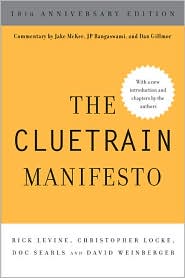
Cluetrain 10th Anniversary edition
Cluetrain 10th Anniversary
Everything Is Miscellaneous
Small Pieces cover
Small Pieces Loosely Joined
Cluetrain cover
Cluetrain Manifesto
My face
Speaker info
Who am I? (Blog Disclosure Form) Copy this link as RSS address Atom Feed

April 17, 2009

[ugc3] The Evolution of UGC

Dan Hunter of NY Law School begins with an informal talk called “UGC: From Threat He disagrees with Eli Noam that the end game will be commercialization. [Ah, the exceptionalist battle is joined!] He thinks about UGC as amateur media, focusing on the motivation of the users. His question: Is there a role for commercial providers, outside of providing the infrastructure? The content will increasingly be provided by people whose motivations are non-commercial. (He shows Wolf Loves Pork at YouTube.com. Very cool.)

It’s important to not think this is about traditional media forms, he says. It includes virtual worlds, collaborative games. People are living out their lives in these environments. UGC is not something separate from our lives. It is our environment.

Amateur work is crowding out the commercial, he says. E.g., YouTube, music, user reviews at Amazon etc. Most of the money is in the infrastructure, not the content: Blizzard providing World of Warcraft, Google, etc.

Q: Google lost $500M this year on YouTube.
Dan: If you’re suggesting there’s no money in infrastructure…We can’t yet know if that’s a blip, a market indicator, etc.

Q: Two examples that support your case: 1. Orpheus Orchestra has no conductor. 2. YouTube orchestra is collaborative.
Dan: Sites like Wikipedia can be quite bureaucratic. There’s a range of examples, some totally spontaneous.

Q: Wolf Eats Pig actually ends the other way around, which is a bad moral and is very worrisome for Japanese society.


Next, David Card of Forrester Research presents research. [I’m not going to try to capture the numbers.]

Social networking is becoming ubiquitous, but the “creative stuff” is still a minority behavior and is not growing at the same pace as social networking, watching videos, or writing reviews. Budgets for social marketing are still pretty low because the value of it is unproven. [His data actually show that few people can prove profitability from social marketing but a majority think it is valuable]

Social network business models: It will be like air (cf. Charline Li). Or it’s a walled garden. Or it’s a media model. The portal model faces threates from Google and social networking sites. AT SNS’s people view photos and videos, keep up with friends, etc. They’re not consuming much professional content there. Marketers should “tap entertainment media, then build out social marketing promise.” Facebook’s “Beacon” idea was powerful but ineptly handled. [Beacon: When buy something, it asks if you want to share that news with your FB friends.] Money is more likely to come from the audience than from authors; the real social marketing potential is untapped.

Q: Opportunity: Harvesting social networking data for customer relationship management. [Doc Searls: This one’s for you! :)]
David: Lots of people do this. P&G. Fox. They bring in the audience to get feedback. “If you get them into real product development, that’s a nirvana.” Although you have to be careful that you’re not handing design to a niche market of your most enthusiastic customers.
Q: Keeping track of the metadata about the types of info makes this huge market of info usable.
David: Do you mean Amazon ought to make its customer available to others?
Q: No.

Q: The virtual is piercing the physical, ending up in offline retail.
A: Interesting.

Q: What guidance for employees active in these spaces, so they feel free to express their ideas but also potentially censorship?
David: Forrester analysts have personal blogs as well as company blogs. Neither are reviewed. We have policies that say you should think about what you’re saying. But if it’s too heavy handed so that employees look like shills, they won’t get a very big audience. You have to play by the rules of the medium — uncensored, rapid response (e.g., WholeFoods responds instantly, even if it’s an intern in a closet sometwhere) — authenticity, etc. It’s a delicate line.


Robert Cohen talks about business adoption of virtual worlds. He points to the broad use of interactive sites by children 7-12, suggesting that we’re seeing a deep change. There are over 100M subscribers to the Barbi site and 100s of millions of Habbo users. This may portend a generational change.

He points to three waves: Content-centric, Surface [he’s using a Microsoft chart], and immersive. He’s interviewed 50 vendors about how virtual worlds will be used. It has the potential to affect the way business operates (he says). First, it enhances training and teamwork. Then, more interactive corporations. Over the next tend years we’ll see collaborative corporations (among suppliers and product developers) and “modern guild system firms” (“highly technologically competent firms that come together to collaborate on projects”). He points to oil companies using virtual worlds to model environments for training, exploration.

Q: The press is reporting that SecondLife has stumbled in growth and development. And how can we get from Barbi style product focus to a platform approach?
Bob: There’s controversy about this. BTW, Mitch Kapor is working on putting your photo on your avatar and making the movement more realistic. SecondLife also has bought a company that does business operations. But IBM has shown a way to connect virtual worlds through a firewall. But SecondLife is trying. There’s a lot going on i n Europe.

[Posting without rereading so I can go to the break. Sorry.] [Tags: ugc ugc3.0 user_generated_content exceptionalism virtual_worlds second_life social_networks everything_is_miscellaneous ]

Tweet
Follow me

Categories: Uncategorized Tagged with: business • conference coverage • digital culture • everythingIsMiscellaneous • exceptionalism • expertise • marketing • media • ugc Date: April 17th, 2009 dw

1 Comment »

April 10, 2009

T-Mobile’s structured, commercial spontaneity

I have not unmixed feelings about T-Mobile’s “spontaneous” dance fest in London’s Liverpool Station. (You can see it here. You can see the making of it here.) On the one hand, it’s a very cool event, and people seemed to like it. On the other, I think I’d feel a bit betrayed if I found out that my joyous dancing was actually part of a commercial.

So, overall, thumbs up, and kudos for creativity. But just a bit of pucker of distaste for commercializing the flash mob vision. Not that anyone asked me.

[Tags: flash_mob t-mobile marketing cluetrain ]

Tweet
Follow me

Categories: Uncategorized Tagged with: cluetrain • culture • digital culture • marketing • t-mobile Date: April 10th, 2009 dw

3 Comments »

April 1, 2009

April Fools and the April Fooled

I like Google’s April Fools joke a lot, a singularity spoof. Be sure to visit the page Cadie built for herself based on her vastly intelligent analysis of the Web. (The little story the posts tell reminds me a little of something — The Turing Tests — I posted a few months ago, but which I had hesitated to post because I didn’t like it much.)

But then there’s SlideShare. I like what SlideShare does, and I like that they did an April Fools joke. But, frankly, I think they didn’t think it through. This morning I got an email from them:

Hi davidjoho,

We’ve noticed that your slideshow on SlideShare has been getting a LOT of views in the last 24 hours. Great job … you must be doing something right. ;-)

Why don’t you tweet or blog this? Use the hashtag #bestofslideshare so we can track the conversation.

Congratulations,
-SlideShare Team

It fooled me plenty. I even sent the support team the suggestion that they include a link to the slideshow that’s doing well since some of us have more than one posted there. I got a quick and friendly reply from a support person explaining that this was an April 1 joke. For the day, everyone’s “number of views” number has been boosted wildly.

Hmmm. For the joke to work, we have to be able to figure out it’s a joke. But for that, I’d have to have known how many views my slideshows had had, and even if I’d noticed the anomaly, I’d have to make the leap to it being a joke, rather than a meme taking off. Worse, if I didn’t realize that I was being fooled, the email entices me to twitter-brag to the world about a non-accomplishment, including a hashtag so I can be added to the list of the fooled. I don’t mind being the butt of an April Fools joke, but it shouldn’t take a letter to Support to figure it out, and it shouldn’t spur me to announce my vain foolishness to the world.

Now, the truth is that I like SlideShow a little better than I did on March 31 because it did an April Fools Day joke, even though I think the joke was kinda lame. I even kinda like the lameness. Next year I hope they come up with something better.

[Tags: april_fools ]

Tweet
Follow me

Categories: Uncategorized Tagged with: marketing Date: April 1st, 2009 dw

3 Comments »

March 30, 2009

[f2c] Eva Sollberger

Eva Sollberger talks about SevenDaysVt.com, about being “stuck in Vermont” videos. The videos don’t make the newspaper a lot of money but it does help “brand” Vermont and Burlington. Shes done 122 of them over the past two years. Highly edited. Highly viewed. One person, a bunch of videos, making a difference.

[Tags: f2c f2c09 vermont ]

Tweet
Follow me

Categories: Uncategorized Tagged with: conference coverage • digital culture • f2c • f2c09 • marketing • vermont Date: March 30th, 2009 dw

1 Comment »

March 24, 2009

[berkman] Doc Searls

Doc Searls is giving a Berkman lunch called “The Intention Economy.” [Note: I’m live-blogging, missing points, paraphrasing badly, making spellping errors, etc.

He begins by talking about some problems. E.g., “the people vs. Comcast.” Customers are unhappy. “Comcast can’t fix itself alone.” Or, customer loyalty cards that are the Green Stamps of our time. “They leverage something that’s broken about e-commerce.” E.g., the Harvard Co-op gives a 10% “discount” if you join. But they make you enter a ton of personal data, the same data you enter at every other e-comm site. Or public radio: Everyone in the room listens, but only about half give. Doc would like to be able to give to support particular programs.

The problem in all these cases is Customer Relationship Management (CRM). CRM is not about relating. “The problem is that most big businesses think that the best customer is a captive one.” “That’s why the free market is still your choice of captor.” But “we’re now about three minutes into the Big Bang” when it comes to the Net. The challenge is to “prove that a free customer is more valuable than a captive one.”

So, Doc has started Project VRM (vendor relationship management) to provide ways for customers to drive relationships with vendors. “With VRM, the individual is the point of integration for his or her own data” and is also the “point of origination of what’s done with” that data. There have been VRM meetups across Europe and North America.

VRM is an open source project (although there are some commercial projects underway also). Doc talks briefly [too quickly for me to keep up] about some of the people involved. Likewise for projects: Personal health info. “Personal RFPs” where a customer sends a query to vendors for bids on things the customer wants to buy. The user wouldn’t give away any unnecessary info. Also: Making terms of service readable and user-focused.

Doc spends a little more time on creating a new business model for free media that isn’t advertising. Free media first means non-commercial media, but ultimately for blogs, etc. The model is temporarily named “PayChoice,” and is based on letting individuals pay how much they want when they want for what they want. The Public Radio tuner is one result. 1.3M have downloaded it into their iPhones already. It turns your iPhone into a radio tuned into public radio. It enables listeners to hold up their end of relationship. The “R” button lets a user pay for what she wants. But it’s not just for paying. It could also represent an intention to buy, and intention to sell, etc.

So, what happens when customers get real power?

– “Customers get their own pricing guns” [i.e., the “guns” that print out price labels].

– “The intention economy” will get real because it’s based on what customers really want, as opposed to the attention economy that’s based on guesses.

– “The advertising bubble will burst.” There will still be ads, but they won’t be the “communications method of first resort.”

– “Cluetrain will finally be right.”

Q: What about eBay?
A: There are lots of sites that do this, but why should we only have sites? Your eBay reputation is only inside eBay. Why should it be stuck there? We want service portability.

Q: What will be the method conveying your desires to companies? A third party service? A non-profit?
A: On the public radio tuner, the “listen log” keeps track of what you’ve listened to. Ideally that would sit on our own computers in encrypted form. Some of that we’re solving with Ian Henderson’s personal data store, some with Lukas’ The Mine. But let’s say we have that solved. Right now, we use “third parties,” which generally live on the vendor’s side. We see a fourth party business, driven by users. E.g., with music, it’d be good to be able to set a price on the music you stream. Some fourth party business will pull that money together. We’re working on a chapter-based association for user-driven services.

Q: So you create sort of a DNS service…?
A: One model is RSS. It’d be good to be able to advertise your needs, possibly through RSS. Maybe it’s tag-based, maybe it’s anonymous.

Q: What do you envision for traditional companies dealing with this?
A: Let’s we have our own loyalty card. As customers inject more intelligence into the marketplace about what they’re willing to say about themselves, we’ll see things like fact-checking of vendors’ claims against us; it’d be cool if the customer could as a data backup. I don’t see a downside for traditional customers. More intelligence and more good will in the market will benefit everyone. It’s a fallacy to think that people only shop on price. Starbucks proves the contrary

Q: [me] Situate this in micropayments and tipjars, and identity management.
A: We’re doing micro-accounting, not micropayments. Small payments are accumulated. Micropayments haven’t worked for anyone except the phone company, and they abused it. WRT identity: I’ve been interested in that for a long time. Along the way, Andre Durand (of Jabber) once said that we have to get identity worked out. Identities are given to us by other corporations: what the DMV, the library, Visa (etc) tell us who we are. Andrew thought this was backwards. We have to reverse it. I now think that that’s important, but it’s separate from VRM. There are times when identity isn’t used at all. My wife about 15 years ago asked why we can’t take our shopping cart from one site to another. And when I was working with the ID management folks, my wife said she wants less identity, not more. Adriana Lukas’ The Mine project is intended to work independent of any identity system. The whole identity movement is a separate thing that overlaps VRM somewhat. VRM isn’t part of the identity space.

What happens on the aggregate level? A lot of CRM is about companies aggregating anonymized data and using it for recommendations, etc.
A: Companies will continue to gather intelligence about us. Companies can improve that. Amazon’s recommendations are the best, but they’re still broken. Your kids use your computers and your recos go off track. Or you buy one book and Amazon thinks you’re interested in the category. Those recos are still guesswork. And they don’t know what only you know, and what’s outside their system.

Comcast is actively providing what I don’t want because they want to sell more on-demand. Do you see VRM breaking down those monopolies?
A: Cable TV is really broken. We have Verizon FIOS. The TV is fantastic. But they only provide 20MB for Internet. For us that’s backward. I tried canceling, and they came back with an offer that reflects their real costs. But we don’t watch TV, so we still said no. I offered to pay a la carte, but nope.

Q: What are the enabling technologies for VRM? If companies still haven’t figured out how to do this, what do you have to provide?
A: Money. If there’s money left on the table…We’re doing field of dreams here.

Q: Thinking about Linked Data/RDF for putting this data out in a much richer way? It’s the rich, decentralized model you’re looking for.
A: The short answer is no, but the longer answer is sure. We’re in touch with those folks. It’s a matter of who shows up.

Q: Is this more generational?
A: I don’t know. It’s whoever shows up. We need to make stuff that benefits everyone.

Q: What about characterizing the ecosystem you’re trying to build with certification levels of VRM? Companies could advertise that they’re at different levels of VRMitude.
A: We have a draft of this, on the wiki: ProjectVRM.org We also want a list of core principles.

Q: How do you balance the explicit data sharing in advertising intent (“I’m looking for a car”) with the fact that sites are selling that data to vendors?
A: The whole VRM idea came out of one use case: car rental. The variables are never what they’re offering. E.g., I want to be able to get a car that plays MP3 CDs. As more customers can advertise their needs, it will change those businesses, and probably discourage the profligate sharing of information.

Q: What about customized fabrication, i.e., making products in response to customer desires. What does this do to branding?
A: Some companies are going to succeed by giving people what they want. We’re all different and want different things. That’s what the Net will come down to eventually.

Q: Insurance companies and lendors have competitive vendors markets. Imagine that for car rentals…
A: That’s an example of a personal RFP. It’s an example of a substitutable service.

Q: Individuals will never be on an equal basis with, say, Verizon. What about collaboration?
A: I avoided that. We don’t want to start with the collective and move to the personal. We want to start with the personal. We need lots of individuals doing VRM for it to work. We want this to be a victory for Verizon as well.

Q: It’s going to be hard to get businesses out of the captive customer mindset. Is VRM a pipe dream? Will companies fail and VRM-ish ones arise?
A: All of the above. Some leopards won’t change their stripes. They’ll also have to wake up and smell the coffee.

Q: What about the cultural domain? NGOs?
A: Huge opportunities. Britt Blaser is working on Government Relationship Management. A lot of great opportunities came out of the Obama campaign. There’s a great outfit in the UK with a site called fixmystreet.org: post photos of potholes and the local gov’t patches them. Being able to express what you’re looking for will work with any type of organization. Take Relationship Management and stick another letter in front of it. We want the demand side and supply side to get along. [Tags: doc_searls vrm ecommerce business public_radio ]

Tweet
Follow me

Categories: Uncategorized Tagged with: business • cluetrain • digital culture • ecommerce • marketing • vrm Date: March 24th, 2009 dw

8 Comments »

March 9, 2009

The Zen of Skittles

David Berkowitz has a terrific post at MediaPost about why Skittles has removed its own content from its Web site and is instead featuring the Wikipedia page about Skittles, a page that aggregates Skittles-mentioning tweets, and its Facebook page. David writes:

Here’s the message Skittles is sending: What consumers say about the brand is more important than what the brand has to say to consumers.

…

By just about any rational indication, Skittles went too far. Highlighting Twitter Search in particular seems absurd, especially since Twitter tends to skew older relative to other social media properties, and Skittles seems to target a younger audience. I came home and showed Skittles.com to my wife. Her first reaction, before I even told her why I was showing it to her, was, “That’s it?” Then she added, “What happens if you don’t care about Twitter or don’t know about Twitter? It seems like it’s only for people who are really technical. I just wouldn’t care.”

But why would anyone care about what Skittles has to say? What, pray tell, could Skittles ever say that was so important, unless we woke up one day to find out that eating Skittles is the world’s tastiest cancer cure, or alternatively that Skittles lower men’s sperm count. Then, perhaps, the world will listen.

It goes on from there. And I say: OMG, I actually went to — and enjoyed! — Skittles.com. Awesome!

[Tags: skittles twitter marketing cluetrain ]

Tweet
Follow me

Categories: Uncategorized Tagged with: cluetrain • marketing • skittles • twitter Date: March 9th, 2009 dw

4 Comments »

March 7, 2009

Tales of data pirates: Opting out of Verizon’s open-ended sharing

A small legalistic pamphlet from Verizon arrived today telling me that I have 45 days to opt out of “agreeing” to let Verizon share Customer Proprietary Network Information, i.e., “information created by virtue of your relationship with Verizon Wireless,” including “services purchased (including specific calls you make and receive,” billing info, technical info and location info. They promise to only share this with “affiliates, agents and parent companies.” It will definitely not be shared with “unrelated third parties” … unless, perhaps that third party pays Verizon to become an affiliate, whatever the heck “affiliate ” means.

To opt out you can call 1-800-333-9956. Or you can follow the instructions in the mailing to go to verizonwireless.com and log into My Verizon where you will find no mention, no button, no link and no help. Ah, but you forgot to check your Messages. There you will indeed find a link to CPNI. The link is marked “Not available.” Dead end.

You could then call Verizon’s excellent telephone support. (Nope, I’m not being sarcastic.) They won’t be able to find the opt out button either. But during the 8 minutes the rep puts you on hold, you’ll be amused to hear one of their continuous bits of self-promotion tell you that Verizon never shares your personal information. Oh, what a wry sense of humor Verizon has!

When you escalate the call, you will finally be told to click on the My Profile tab in My Verizon, then click on Phone Controls, and there you will conveniently find the link. It’s just that simple!

The whole thing sucks :( [Tags: verizon marketing privacy fcc ]


[March 10:] Verizon responds in its blog. GigaOm responds more broadly to that response. And I still say that the if you’re going to make the mistake of opting us in to sharing private info, then you have an ethical obligation to make it damn clear to us that you’re doing so, and making it a damn site easier for us to opt out.


[March 11:] Al Gidari, Jr. of Perkins Cole is giving a talk at the Berkman Center about the privacy of mobile-based info. I asked him about CPNI. Here are my notes on what he said:

The kerfuffle was an example of bad journalism. The article expressed it badly. The info you are opted in to giving can be used only within the family of companies for marketing purposes. For sharing outside, it requires explicit opt-in. And CPNI has a higher standard for location info, which does not get shared. An “affiliate” is an entity you own or control. Verizon is incorporated in separate states, so they’re trying to share the info among that family of corporations.

Tweet
Follow me

Categories: Uncategorized Tagged with: digital rights • fcc • marketing • privacy • verizon Date: March 7th, 2009 dw

214 Comments »

February 27, 2009

Beware the Military-Halitosis Complex

Cold war, the cult of expertise, the broadcast metaphor, scientism, chaste kissing…why this one’s got it all!

[Tags: certs advertising expertise ]

Tweet
Follow me

Categories: Uncategorized Tagged with: advertising • certs • culture • expertise • marketing • science Date: February 27th, 2009 dw

5 Comments »

February 13, 2009

The Pope of Advertising

I read David Ogilvy’s “Confessions of an Advertising Man” when I was a kid and was greatly impressed, I think by the subtlety with which humans could be influenced. It was also quite entertaining. Here’s David Susskind’s hour-long interview of him from 1983.

(Thanks to Richard Pachter for the link.)

[Tags: david_ogilvy advertising marketing ]

Tweet
Follow me

Categories: Uncategorized Tagged with: advertising • business • cluetrain • marketing Date: February 13th, 2009 dw

6 Comments »

February 7, 2009

Spot the difference!

Can you spot the most important difference?

Here’s a well-known photo of the original, extant Kindle:

Kindle 1 - Bezos holding it on cover of Newsweek

Here’s a photo from MobileRead that purports to be of the soon-to-be-announced Kindle 2.

Kindle 2

If you said that the Kindle 2 can be held without inadvertently pressing buttons, you win!!!

[Tags: kindle amazon ]

Tweet
Follow me

Categories: misc Tagged with: amazon • kindle • marketing • misc Date: February 7th, 2009 dw

4 Comments »

« Previous Page | Next Page »


Creative Commons License
This work is licensed under a Creative Commons Attribution-NonCommercial-ShareAlike 3.0 Unported License.
TL;DR: Share this post freely, but attribute it to me (name (David Weinberger) and link to it), and don't use it commercially without my permission.

Joho the Blog uses WordPress blogging software.
Thank you, WordPress!