



logo
EverydayChaos
Everyday Chaos
Too Big to Know
Too Big to Know
Cluetrain 10th Anniversary edition
Cluetrain 10th Anniversary
Everything Is Miscellaneous
Small Pieces cover
Small Pieces Loosely Joined
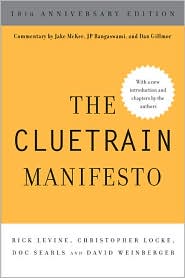
Cluetrain cover
Cluetrain Manifesto
My face
Speaker info
Who am I? (Blog Disclosure Form) Copy this link as RSS address Atom Feed

April 20, 2013

Subverting ads

I’m a sucker for ads that comment on the dishonesty of ads. For example, I laughed at this one from Newcastle Brown Ale:

I also really liked this one as well:

I do have a duck-rabbit disagreement with Piper Hoffman’s reading of it at BlogHer. I took the ad as a direct comment on the sexism of beer ads: if you’re not an attractive woman, beer companies won’t include you. But Piper raises an interesting point. [SPOILER ALERT] She’s right that if the pronoun had been “she,” the point would have been less ambiguous. But it also would have been a bit crueler, since the ad would have had Newcastle calling their brewmistress unattractive, and it also could have been taken as Newcastle agreeing that only attractive women should ever be shown on in an ad.

While I enjoy a meta-ad like this (at least as I take it), I also feel a bit meta-fooled: What does that have to do with whether their beer is any good? I’m not looking to be friends with a beer.

I get more enjoyment from viewers subverting ads. For example, I saw an ad for KFC about some new boneless chicken product.

I wasn’t paying attention, in part because it was a commercial, and in part because I haven’t eaten anything from KFC since I became a vegetarian 1979 but I have not forgotten the sensation of eating chicken that’s been so close to liquefied that it’s held together only by a layer of deep-fried cholesterol. But I saw the hashtag #iAteTheBones and checked it out on Twitter.

Bunches of the tweets praise the commercial as amusing. (It was directed by David O.Russell, who also directed the Oscar-winning Silver Linings Playbook.) But prominent in the list is this:

THE MAJORITY OF INSTAGRAM POSTS BEARING KFC’S #IATETHEBONES HASHTAG FEATURE DIRT TUNNELS LITTERED WITH SHREDDED CLOTHING.

— Daniel Manitou (@ActualPerson084) April 20, 2013

Well, not as far as I can tell. But the tweet made me look.

And a heavily-favorited tweet is quite savage:

.@kfc_colonel Is it normal to fill a toilet with blood? #IAteTheBones

— Jocelyn Plums (@FilthyRichmond) April 16, 2013

Someone in the KFC Marketing Department has already written an email to senior management explaining why this is a good thing for KFC. But, um, it’s not.

Neither is this:

Tweet
Follow me

Categories: cluetrain, marketing Tagged with: advertising • cluetrain • marketing • social media Date: April 20th, 2013 dw

1 Comment »

March 7, 2013

Are brands people, my friends?

The always thoughtful Terry Heaton [twitter:TerryHeaton] has posted a provocative thesis, which is expressed in the post’s title: “How Brands Can Behave as People (And Why They Should).” Terry writes:

Futurist Stowe Boyd believes that we’ve entered a stage of “social business” in which “brands will try to look and feel as much like people as possible, online.”

Terry cites two examples of this, both during the Superbowl power outage: Oreos tweeted a photo with the caption “You can still dunk in the dark,” and Audi tweeted something about bringing LEDs to the stadium (which may be an Audi reference that I don’t get). Brands, says Terry, need to play “by the rules of human interactivity instead of the hierarchical ‘driving’ of behavior.” This means not only tweeting humorously in real time, but being more menschlich: “New York ad agency Young & Rubicam has been studying consumer behavior for decades and shocked the world last year by noting a 391% spike in ‘kindness and empathy’ as a favored brand attribute among consumers.”

Terry gives five practical rules for these new persona-brands. These rules are ethical and sensible. But they also raise interesting issues. In particular, rule #3 says:

  • No selling whatsoever.

  • No calls to action not based in participation.

  • No gimmicks. None.

  • Nothing artificial or fake.

And #5 says “Be personal.”

But brands acting like people is artificial and fake, and how can you be personal when you’re not a person? So, on the one hand, I want to dismiss this idea. But on the other hand I want to hand it to Terry. The ability of a company to sally forth into social media is, I believe, giving rise to what Terry and Boyd are pointing to: a new type of entity that acts like a duck, quacks like a duck, is not a duck, and that fools no one into think it’s a duck.

Companies used to do something like this when they would personify their product and their brand: green giants, cookie elves, prepubescent dough balls. Some of these became figures of popular culture. But that’s not what Terry is pointing to. The Oreo tweet didn’t come from a cartoon character acting like a cookie. It came from Oreo, which is obviously not itself a particular cookie, and is also not the same as Nabisco or Kraft Foods Inc. You read the tweet understanding that it came from some marketing folks who are talking for the cookie and for the company. The closest entity I can think of is: the Oreo tweet came from the brand. Pure brand. No mediation through a character. Pure brand.

I’m guessing that part of the charm comes from our recognition that there are people behind the brand’s tweets. And we seem to like that. Those people seem to be like us. They have a sense of humor. They don’t have to run all their tweets through focus groups. Nor do they have to dress up in some stupid mascot costume or hire an actor to speak like a squeaky-voiced chipmunkâ?¢ or something.

Businesses have always had this problem. They are not people and thus seem phony and manipulative when they try to speak like people. But businesses do need to speak via social media, or, as we used to say in the Cluetrain days, join the conversation. Some have done so by empowering people from their marketing staff â?? usually young folks â?? to speak for them on Twitter and the Eff Book, often using their own names along with their corporate identification. That makes sense and it sometimes works. I expect it’ll continue. But I suspect we’ll see a growth in the construction of social brands that are like what the brand would be if it were a person, and that is understood as having real individuals behind it.

One could perfectly well bemoan this development. After all, it is phony down to its core. Brands aren’t people, and the people pretending to be a brand are terribly constrained in what they can say and do by the requirement that they advance the brand. These people-brands are not folks you’d become friends if only because they won’t shut up about Oreos and Audis. But, I’m assuming that by this time we’re smart enough to understand that a talking brand has a ventriloquist behind it.

Further, these social brands may erode the wall between the authentic and the inauthentic. Yay.That’s a wall that needs to come down anyway because the concept of authenticity makes even less sense now than it ever did. Our Web selves are constructed selves. If tweeting Oreos can help us recognize that, then they’ve done us a service, in addition to being quite delicious.

Tweet
Follow me

Categories: culture, marketing Tagged with: authenticity • brands • cluetrain • marketing Date: March 7th, 2013 dw

Be the first to comment »

January 28, 2013

Unstartling presentation

Oy. I fell for an ad today because it promised to tell me four startling things that happen to you before you get a heart attack. The video, which has no pause or fast forward button, is a grating infomercial, with a heavy emphasis on the “mercial.” So, here’s the startling information Dr. Chauncey Crandall so selflessly is imparting to us:

The four things are:

Chest discomfort. Most heart attacks involve discomfort in the center of the chest that lasts for more than a few minutes, or goes away and comes back. The discomfort can feel like uncomfortable pressure, squeezing, fullness, or pain.

Discomfort in other areas of the upper body. Can include pain or discomfort in one or both arms, the back, neck, jaw, or stomach.

Shortness of breath. Often comes along with chest discomfort. But it also can occur before chest discomfort.

Other symptoms. May include breaking out in a cold sweat, nausea, or light-headedness To prevent heart attacks, cut back on fat intake but most importantly, cut back on sugar.

Yeah, these are the symptoms you will find listed anywhere that discusses heart attacks. For example, try a little place I like to call “Google”: top hit for “heart attack”.

It takes Dr. Crandall forever to get even the slightest piece of information — first promoting himself and pitching his newsletter etc. — that I gave up. So I quoted the above from trogdor1 on a discussion board. Thanks, Trogdor1, for taking the hit for the team.

Tweet
Follow me

Categories: cluetrain, marketing Tagged with: ads • cluetrain • heart attack • marketing Date: January 28th, 2013 dw

Be the first to comment »

May 25, 2012

[mesh] Michael O’Connor Clarke

Yesterday at the Mesh conference I caught the second half of Michael O’Connor Clarke‘s presentation, to a packed house, about how not to use social media for marketing. I’ve known Michael since the Cluetrain days, and it was great to warch him argue against viewing social media as a messaging vehicle.

Michael has long championed understanding the Net as, well, a conversation that needs to be respected. Keeping that conversation as open and vibrant as possible is more important than your business’s tawdry ambitions, he says. (I am not just paraphrasing here, but entirely putting words in his mouth.) If your business wants to engage with it — and not every business has to, he says — then it should be engaged with by actual people, with actual names, actual interests, and actual personalities. Completely transparently, of course.

Great teaching, great examples, plus Michael’s hilarious. [Michael on twitter]

Tweet
Follow me

Categories: cluetrain, marketing, social media Tagged with: cluetrain • marketing • michaelocc • pr • social media Date: May 25th, 2012 dw

5 Comments »

Marketing music: Amanda Palmer shows you how it’s done.

A few days ago I pointed to Elizabeth ‘s thread at Reddit where she engaged with the public in a way that everyone who manages customer support, PR, or marketing ought to learn from.

Today, Amanda Palmer posted about her current Kickstarter project, which has raised $855,000 with eight days yet to run. Her goal was $100,000…except in her post she responds with complete frankness (she’s AFP, after all) about what her real expectations were. The post is both an explanation and a demonstration of how musicians and theandir audiences can love and support each other.

Tweet
Follow me

Categories: business, culture, marketing Tagged with: afp • business • fans • kickstarter • marketing • music • pr • social media Date: May 25th, 2012 dw

2 Comments »

May 23, 2012

Customer support (and collateral PR) at Reddit: How it’s done

A user who goes by the name Loyal2nes (NES = Nintendo gaming platform) had a problem: the game Civilization 4 kept crashing. So s/he posted about it on the game maker’s customer support site. Two days later, a customer support agent, Alexis L, replied that the problem is that Loyal2nes’s device only has 4096mb of RAM, whereas it needs at least 2 gigabytes. Unfortunately, Alexis did not understand that 4096 megabytes is the same as 4 gigabytes. Ooops.

Loyal2nes posted a screencapture of the exchange under a sarcastic headline, and opened up a thread about it at Reddit, where it climbed to the front page.

And the top-voted comment among the 460+ comments is from the Reddit user dahanese. Here’s her response:

Hey Loyal –

I’m Elizabeth Tobey and I’m the head of customer service – first off, I want to apologize because that’s a pretty embarrassing mistake. Secondly, I want to let you know I’m reopening your ticket and escalating it up. Chances are, I won’t get a response from the team who can help test out tonight and we’ll have a bit more back and forth in the coming days to try and troubleshoot the issue, but I promise I won’t tell you 4096MB is under spec and close your ticket.

Let me know if you have more questions now (although we can use the Support system and not reddit if you want!)

-e.

It doesn’t end there, though. Elizabeth stays with the thread as it expands and diverges. She’s frank, funny, and, as the thread continues, makes it clear that she’s not an interloper at Reddit. In fact, she’s been a Redditor (participant) for a while, participating in the threads that interest her. Often those threads are about gaming, but she also comments on ther serendipitous topics that make Reddit so much fun.

So, what’s so right about how Elizabeth handled this?

  • Her reply was frank, helpful, non-defensive, and understood the customer’s point of view

  • She identified herself by name and position

  • She exhibited a genuine interest in the overall thread, not simply in patching up a problem

  • She was speaking for 2K but very clearly also as herself and in her own voice

  • She spoke in a way that did not just serve her employer but, more importantly, served the conversation

  • She was already a member of the community — an enabler for the rest of this list

The only thing that could have made this a better example of how customer support and public relations is changing would be if Elizabeth were not the head of Customer Support but was an empowered customer support rep. But all the other main themes are there. Clear as day.

Tweet
Follow me

Categories: business, marketing Tagged with: cluetrain • customer support • marketing • pr Date: May 23rd, 2012 dw

2 Comments »

April 14, 2012

[2b2k] Too Big to Know’s network

Valdis Krebs has posted a map of books that Amazon says people who bought 2b2k also bought, and then the web of books that are one degree away from those books.

It’s interesting to parse as you try to discern what the shared interests are. And I’m surprised that Amazon hasn’t picked up on it as a way to sell more books, and that publishers haven’t picked up on it to understand their market better.

In any case, thanks, Valdis!

Tweet
Follow me

Categories: everythingIsMiscellaneous, marketing, too big to know Tagged with: 2b2k • amazon • marketing • networked knowledge • valdis krebs Date: April 14th, 2012 dw

1 Comment »

March 28, 2012

The Gettysburg Principles for keeping your customers

I’ve got a post at the Harvard Business Review site about what I’m calling (not too seriously) The Gettysburg Principles. The point is that you can keep your customers buying from you if your business is of your customers, by your customers, and for your customers. “Of” means that your business is made up of people like your customers. “By” means that your customers are contributing to the creation of your product. “For” your customers means you put them first. These three terms give a handy way of analyzing why customers stick with some businesses even if they have to pay a bit more or make some other adjustments.

Anyway, there’s more over at HBR…

Tweet
Follow me

Categories: business, cluetrain, marketing Tagged with: business • cluetrain • marketing Date: March 28th, 2012 dw

5 Comments »

November 8, 2011

Warm Birthday Wishes to [your_name_here]

It used to be that on my birthday I’d get untouched-by-humans birthday wishes from my dentist’s firm and perhaps a local car company and real estate agent. Now I get them from sites I once age-verified for (gaming sites, not porn, fellas), a Prius forum, a diabetes forum, and — one level of abstraction up — from Xing itself.

If these groups are going to issue pro forma birthday wishes, I think they ought to be required to hire someone who has to sit there and actually think warmly about each person before pressing the “send” button.

And then, as a special birthday present, keep your stupid marketing messages to yourself.

Tweet
Follow me

Categories: cluetrain, marketing, whines Tagged with: birthday • cluetrain • marketing Date: November 8th, 2011 dw

2 Comments »

October 5, 2011

Respect the Internet

With Douglas Rushkoff I’m keynoting a Ketchum event called “Respect the Internet” [more here] tomorrow. The subtitle of the day is “Is marketing ruining the Net?” Sounds like it should be fun. (It’s being webcast, starting at 10am.)

I have a 20-30 min slot in which I’m planning on saying something like the following:

Yes, markets are conversations, as Doc once said. That shifts power from vendors to customers. It also turns markets as demographic abstractions into real social entities. But markets are conversations now because they are networked, and thus are taking on the properties of networks: evanescent, light-weight group formation, and, most of all connected via shared interests. For example, the people on the Web right now talking about which bike to buy constitute a networked market of bike purchasers. The bad news for traditional businesses is that hierarchical businesses (i.e., businesses) do not fit well architecturally on the Net. E.g., who gets to talk for the business, for businesses do not actually have mouths?

I then plan on talking about two properties of networks being expressed by markets now.

1. The fact that the Net is composed of interests has exposed what we always knew: there is usually a lack of alignment between markets and businesses. Markets talk about bikes because they have the usual range of interests in bikes: to be green, to save money, to get exercise, to recapture one’s youth, etc. But bike companies as businesses are interested in having us pay them money. Same objects of discussion (bikes) but very different interests. Businesses have tried to rationalize their lack of alignment by talking about “authenticity,” a term that I think does not apply very meaningfully to companies. Nor do I think that Michael Porter’s “shared value” idea addresses the real misalignment of interests.

2. Networks tend toward transparency. I will quickly mention four types of relevant transparency: of self (you are who you say you are), of sources, of humanity (you and your products are fallible), and of interests. (I may drop this section. I think the line of thought would be clearer if I do.)

Finally, I want to ask why the Net is such a weird and different medium. Answer: The Internet is not a medium. We are the medium. Because the Net is interest based, messages (memes, links, poems, whatever) move through us: I send you that link because I think you’ll like it, and I have something invested in your liking it when I pass it along. We are literally the medium.

So, that’s why marketers should respect the Internet. The Internet is ours. No, we don’t own Verizon’s wires. But that’s not the Internet. The Net is its open protocol and the social products and life it has engendered. So, mess with the Net with intrusive marketing and you are messing with us. We won’t like it.

That’s roughly it.

(By the way, I rarely mention where I’m talking because I’m a little shy, in weird ways. I’m thinking I ought to bite the bullet and just blurt out my scheduled talks. Why? Marketing! E.g., would you like to know that this morning I keynoted the Canadian Research Knowledge Network meeting outside of Ottawa, and that on Monday I gave the John Seely Brown lecture at the University of Michigan School of Information? Or is it just boastful noise, which is how it sounds to me?)

Tweet
Follow me

Categories: cluetrain, marketing Tagged with: cluetrain • marketing Date: October 5th, 2011 dw

7 Comments »

« Previous Page | Next Page »


Creative Commons License
This work is licensed under a Creative Commons Attribution-NonCommercial-ShareAlike 3.0 Unported License.
TL;DR: Share this post freely, but attribute it to me (name (David Weinberger) and link to it), and don't use it commercially without my permission.

Joho the Blog uses WordPress blogging software.
Thank you, WordPress!