logo
EverydayChaos
Everyday Chaos
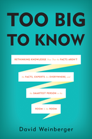
Too Big to Know
Too Big to Know
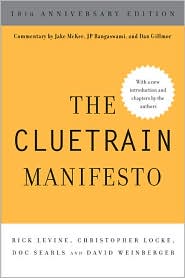
Cluetrain 10th Anniversary edition
Cluetrain 10th Anniversary
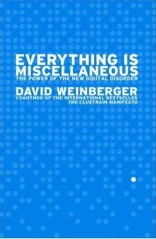
Everything Is Miscellaneous
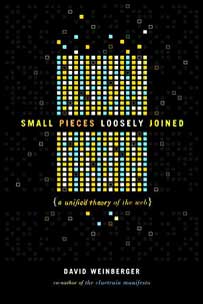
Small Pieces cover
Small Pieces Loosely Joined
Cluetrain cover
Cluetrain Manifesto
My face
Speaker info
Who am I? (Blog Disclosure Form) Copy this link as RSS address Atom Feed

December 9, 2011

CBC interview with me about library stuff

The CBC has posted the full, unedited interview with me (15 mins) that Nora Young did last week. We talk about the Harvard Library Lab’s two big projects, ShelfLife and LibraryCloud. (At the end, we talk a little about Too Big To Know.) The edited interview will be on the Spark program.

Tweet
Follow me

Categories: everythingIsMiscellaneous, libraries Tagged with: everythingIsMiscellaneous • libraries • shelflife Date: December 9th, 2011 dw
1 Comment »

November 29, 2011

[2b2k] Curation without trucks

If users of a physical library could see the thousands of ghost trucks containing all the works that the library didn’t buy backing away from the library’s loading dock, the idea of a library would seem much less plausible. Rather than seeming like a treasure trove, it would look like a relatively arbitrary reduction.

It’s not that users or librarians think there is some perfect set (although it wasn’t so long ago that picking a shelf’s worth of The Great Books seemed not only possible but laudable). Everyone is pragmatic about this. Users understand that libraries make decisions based on a mix of supporting popular tastes and educating to preferred tastes: The Iliad is going to survive being culled even though it has far fewer annual check-outs than The Girl with the Dragon Tattoo. Curating is a practical art and libraries are good at it. But curating into a single collection that happens to fit within a library-sized building increasingly looks like a response to the weaknesses of material goods, rather than as an appropriate appreciation of their cultural value. Curation has always meant identifying the exceptions, but with the new assumption of abundance, curators look for exceptions to be excluded, rather than to be included. In the Age of the Net, we’re coming to believe that just about everything deserves to be in the library for one reason or another.

It seems to me there are two challenges here. The first is redeploying the skills of curators within a hyper-abundant world that supports multiple curations without cullings. That seems to me eminently possible and valuable. The second is cultivating tastes when there are so many more paths of least cognitive and aesthetic resistance. And that is a far more difficult, even implausible, challenge.

That is, our technology makes it easy to have multiple curations equally available, but our culture wants (has wanted?) some particular curations to have priority. Unless trucks are physically removing the works outside the preferred collection, how we are going to enforce our cultural preferences?

The easy solution is to give up on the attempt. The Old White Man’s canon is dead, and good riddance. But you don’t have to love old white men to believe that culture requires education — despite what Nikolas Sarkozy believes, we don’t “naturally” love complex works of art without knowing anything about their history or context — and that education requires taking some harder paths, rather than always preferring the easier, more familiar roads. I won’t argue further for this because it’s a long discussion and I have nothing to say that you haven’t already thought. So, for the moment take it as an hypothesis.

This I think makes clear what one of the roles of the DPLA (Digital Public Library of America) should be.

Ed Summers has warned that the DPLA needs to be different from the Web. If it is simply an index of what is already available, then it has not done its job. It seems to me that even if it curates a collection of available materials it has not done its job. It is not enough to curate. It is not even enough to curate in a webby way that enables users to participate in the process. Rather, it needs to be (imo) a loosely curated assemblage that is rich in helping us not only to find what is of value, but to appreciate the value of what we find. It can do that in the traditional ways — including items in the collection, including them in special lists, providing elucidations and appreciations of the items — as well as in non-traditional, crowd-sourced, hyperlinked ways. The DPLA needs to be rich and ever richer in such tools. The curated works should become ever more embedded into a network of knowledge and appreciation.

So, yes, part of the DPLA should be that it is a huge curated collection of collections. But curation now only has reliable value if it can bring us to appreciate why those curatorial decisions were made. Otherwise, it can seem as if we’re simply looking at that which the trucks left behind.

Tweet
Follow me

Categories: everythingIsMiscellaneous, libraries, too big to know Tagged with: 2b3k • curation • dpla • libraries Date: November 29th, 2011 dw

4 Comments »

November 22, 2011

Physical libraries in a digital world

I’m at the final meeting of a Harvard course on the future of libraries, led by John Palfrey and Jeffrey Schnapp. They have three guests in to talk about physical library space.

NOTE: Live-blogging. Getting things wrong. Missing points. Omitting key information. Introducing artificial choppiness. Over-emphasizing small matters. Paraphrasing badly. Not running a spellpchecker. Mangling other people’s ideas and words. You are warned, people.

David Lamberth lays out an idea as a provocation. He begins by pointing out that until the beginning of the 20th century, a library was not a place but only a collection of books. He gives a quick history of Harvard Library. After the library burned down in 1764, the libraries lived in fear of fire, until electric lights came in. The replacement library (Gore Hall) was built out of stone because brick structures need wood on the inside. But stone structures are dank, and many books had to be re-bound every 30 years. Once it filled up, 25-30 of Harvard libraries derived from the search for fireproof buildings, which helps explain the large distribution of libraries across campus. They also developed more than 40 different classification systems. At the beginning of the 20th C, Harvard’s collection was just over one million. Now it adds up to around 18M. [David’s presentation was not choppy, the way this paraphrase is.]

In the 1980s, there was continuing debate about what to do about the need for space. The big issue was open or closed stacks. The faculty wanted the books on site so they could be browsed. But stack space is expensive and you tend to outgrow it faster than you think. So, it was decided not to build any more stack space. There already was an offsite repository (New England Book Depository), but it was decided to build a high density storage facility to remove the non-active parts of the collection to a cheaper, off-site space: The Harvard Depository (HD).

Now more than 40% of the physical collections are at HD. The Faculty of Arts and Sciences started out hostile to the idea, but “soon became converted.” The notion faculty had of browsing the shelves was based on a fantasy: Harvard had never had all the books on a subject on a shelf in a single facility. E.g., search on “Shakespeare” in the Harvard library system: 18,000 hits. Widener Library is where you’d expect to find Shakespeare books. But 8,000 of the volumes aren’t in Widener. Of Widener’s 10K Shakespeare, volumes, 4,500 are in HD. So, 25% of what you meant to browse is there. “Shelf browsing is a waste of time” if you’re trying to do thorough research. It’s a little better in the smaller libraries, but the future is not in shelf browsing. Open and closed stacks isn’t the question any more. “It’s just not possible any longer to do shelf browsing, unless we develop tools for browsing in a non-physical fashion.” E.g., catalog browsers, and ShelfLife (with StackView).

There’s nobody in the stacks any more. “It’s like the zombies have come and cleared people out.” People have new alternatives, and new habits. “But we have real challenges making sure they do as thorough research as possible, and that we leverage our collection.” About 12M of the 18M items are barcoded.

A task force saw that within 40 years, over 70% of the physical collection will be off site. HD was not designed to hold the part of the collection most people want to use. So, what can do that will give us pedagogical and intellectual benefit, and realizes the incredible resource that our collection is?

Let me present one idea, says David. The Library Task Force said emphatically that Harvard’s collection should be seen as one collection. It makes sense intellectually and financially. But that idea is in contention with the 56 physical libraries at Harvard. Also, most of our collection doesn’t circulate. Only some of it is digitally browsable, and some of that won’t change for a long long long time. E.g., our Arabic journals in Widener aren’t indexed, don’t publish cumulative indexes, and are very hard to index. Thus scholars need to be able to pull them off the shelves. Likewise for big collections of manuscripts that haven’t even been sorted yet.

One idea would be to say: Let’s treat physical libraries as one place as well. Think of them as contiguous, even though they’re not. What if bar-coded books stayed in the library you returned to them to? Not shelved by a taxonomy. Random access via the digital, and it tells you where the work is. And build perfect shelves for the works that need to be physically organized. Let’s build perfect Shakespeare shelves. Put them in one building. The other less-used works will be findable, but not browsable. This would require investing in better findability systems, but it would let us get past the arbitrariness of classification systems. Already David will usually go to Amazon to decide if he wants a book rather than take the 5 mins to walk to the library. By focusing on perfect shelves for what is most important to be browsable, resources would be freed up. This might make more space in the physical libraries, so “we could think about what the people in those buildings want to be doing,” so people would come in because there’s more going on. (David notes that this model will not go over well with many of his colleagues.)

53% of library space at Harvard is stack space. The other 47% is split between patron space and space staff. About 20-25% is space staff. Comparatively, Harvard is lower on patron space size than typical. The HD is holding half the collection in 20% of the space. It’s 4x as expensive to store a work on a stack on campus than off.

David responds to a question: The perfect shelves should be dynamic, not permanent. That will better serve the evolution of research. There are independent variables: Classification and shelf location. We certainly need classification, but it may not need to map to shelf locations. Widener has bibliographic lists and shelf lists. Barcodes give us more freedom; we don’t have to constantly return works to fixed locations.

Mike Barker: Students already build their own perfect shelves with carrels.

Q: What’s the case for ownership and retention if we’re only addressing temporal faculty needs?

A lot of the collecting in the first half of the 20 C was driven by faculty requests. Not now. The question of retention and purchase splits on the basis of how uncommon the piece of info is. If it’s being sold by Amazon, I don’t think it really matters if we retain it, because of the number of copies and the archival steps already in place. The more rare the work, the more we should think about purchase and retention. But under a third of the stack space on campus ideal environmental conditions. We shouldn’t put works we buy into those circumstances unless they’re being used.

Q: At the Law Library, we’re trying to spread it out so that not everyone is buying the same stuff. E.g., we buy Peruvian materials because other libraries aren’t. And many law books are not available digitally, so we we buy them … but we only buy one copy.

Yes, you’re making an assessment. In the Divinity library, Mike looked at the duplication rate. It was 53%. That is, 53% of our works are duplicated in other Harvard libraries.

Mike: How much do we spend on classification? To create call numbers? We annually spend about 1.5-2M on it, plus another million shelving it. So, $3M-3.5M total. (Mike warns that this is a “very squishy” number.) We circulate about 700,000 items a years. The total operating budget of the Library is about $152M. (He derived this number by asking catalogers who long it takes to classify an item without one, divided into salary.)

David: Scanning in tables of contents, indexes, etc., lets people find things without having to anticipate what they’re going to be interested in.

Q: Where does serendipity fall in this? What about when you don’t know what you’re looking for?

David: I agree completely. My dissertation depended on a book that no one had checked out since 1910. I found it on the stacks. But it’s not on the shelves now. Suppose I could ask a research librarian to bring me two shelves worth of stuff because I’m beginning to explore some area.

Q: What you’re suggesting won’t work so well for students. How would not having stacks affect students?

David: I’m being provocative but concrete. The status quo is not delivering what we think it does, and it hasn’t for the past three decades.

Q: [jeff goldenson] Public librarians tell us that the recently returned trucks are the most interesting place to go. We don’t really have the ability to see what’s moving in the Harvard system. Yes, there are privacy concerns, but just showing what books have been returned would be great.

Q: [palfrey] How much does the rise of the digital affect this idea? Also, you’ve said that the storage cost of a digital object may be more than that of physical objects. How does that affect this idea?

David: Copyright law is the big If. It’s not going away. But what kind of access do you have to digital objects that you own? That’s a huge variable. I’ve premised much of what I’ve said on the working notion that we will continue to build physical collections. We don’t know how much it will cost to keep a physical object for a long time. And computer scientists all say that digital objects are not durable. My working notion here is that the parts that are really crucial are the metadata pieces, which are more easily re-buildable if you have the physical objects. We’re not going to buy physical objects for all the digital items, so the selection principle goes back to how grey or black the items are. It depends on whether we get past the engineering question about digital durability — which depends a lot on electromagnetism as a storage medium, which may be a flash in the pan. We’re moving incrementally.

Q: [me] If we can identify the high value works that go on perfect shelves, why not just skip the physical shelves and increase the amount of metadata so that people can browse them looking for the sort of info they get from going to the physical shelf?

A: David: Money. We can’t spend too much on the present at the expense of the next century or two. There’s a threshold where you’d say that it’s worth digitizing them to the degree you’d need to replace physical inspection entirely. It’s a considered judgment, which we make, for example, when we decide to digitize exhibitions. You’d want to look at the opportunity costs.

David suggests that maybe the Divinity library (he’s in the Phil Dept.) should remove some stacks to make space for in-stack work and discussion areas. (He stresses that he’s just thinking out loud.)

Matthew Sheehy, who runs HD, says they’re thinking about how to keep books 500 years. They spend $300K/year on electricity to create the right environment. They’ve invested in redundancy. But, the walls of the HD will only last 100 years. [Nov. 25: I may have gotten the following wrong:] He thinks it costs about $1/ year to store a book, not the usual figure of $0.45.

Jeffrey Schnapp: We’re building a library test kitchen. We’re interested in building physical shelves that have digital lives as well.

[Nov. 25: Changed Philosophy school to Divinity, in order to make it correct. Switched the remark about the cost of physical vs. digital in the interest of truth.]

Tweet
Follow me

Categories: everythingIsMiscellaneous, libraries, taxonomy, too big to know Tagged with: 2b2k • everythingIsMiscellaneous • libraries • shelflife Date: November 22nd, 2011 dw

4 Comments »

November 19, 2011

[avignon] Google’s Cultural Institute

Steve Crossan, head of the Cultural Institute in Paris, is demo-ing Google’s super spiffy swirling virtual bookcase. The Cultural Institute was set up in April. It’s a group of engineers. They’re building tools and services for the cultural sector, to help people get to online content in an emotionally engaging way.

One pilot project: Dead Sea Scrolls online, searchable and zoomable. Another the WebGL Bookcase.

Another: Memory of a Nation. In 2012 they’re focusing on bringing together archival content with personal testimony.

They’re also developing a physical space. In a virtual world, what shall one do with a physical space to explore culture? The space will be opening in April-May 2012.

Steve introduces Amit Sood to talk about the Google Art Project. He was working on Android, but spent his 20% time (“on Saturdays and Sundays” :) on a collaborative project with 17 great museums. It launched on Feb 1. It’s trying to give an idea of how to enjoy the museums and art in a different way.

He points out that it does not look like a Google page. He goes to a Brueggel at the Met. He zooms in extremely tight (brushstroke close) and very easily, without obvious latency. The “gigapixel” zoom is crazy good. There’s an info panel with plenty of info, including multi-media. You can also do a street view through the museum. (Not all the paintings are at the gigapixel level.) You can add artworks to your personal collections, and annotate it, including sharing details. (The details can always be zoomed back out.) You can share your collections on any social medium.

Why did Google do the project? It started out of passion, not out of corporate strategy. But after they launched, it got a lot of internal support. The four person team was multicultural. Access to info is critical, he says. He grew up in India, where simply walking into a museum was not a real possibility. He reminds us how lucky we are. That was his personal motivation. Other team members did it in order to create new audiences. How can we reduce the snob factor of museums? Finally, because it’s an immersive experience.

25M people have visited. 100,000 collections. Version 2 is coming.

Q: Will you open archives of unplayed music? And can artists create their own gigapixel images?

A: We’re working with archives.

Tweet
Follow me

Categories: libraries Tagged with: google • libraries • museums Date: November 19th, 2011 dw

1 Comment »

November 1, 2011

[2b2k] Interview with Kevin Kelly on What Libraries Want

Dan Jones just posted my Library Lab Podcast conversation with Kevin Kelly, of whom I’m a great admirer.

Tweet
Follow me

Categories: libraries, too big to know Tagged with: 2b2k • libraries • podcasts Date: November 1st, 2011 dw

Be the first to comment »

October 26, 2011

[2b2k] Will digital scholarship ever keep up?

Scott F. Johnson has posted a dystopic provocation about the present of digital scholarship and possibly about its future.

Here’s the crux of his argument:

… as the deluge of information increases at a very fast pace — including both the digitization of scholarly materials unavailable in digital form previously and the new production of journals and books in digital form — and as the tools that scholars use to sift, sort, and search this material are increasingly unable to keep up — either by being limited in terms of the sheer amount of data they can deal with, or in terms of becoming so complex in terms of usability that the average scholar can’t use it — then the less likely it will be that a scholar can adequately cover the research material and write a convincing scholarly narrative today.

…

Thus, I would argue that in the future, when the computational tools (whatever they may be) eventually develop to a point of dealing profitably with the new deluge of digital scholarship, the backward-looking view of scholarship in our current transitional period may be generally disparaging. It may be so disparaging, in fact, that the scholarship of our generation will be seen as not trustworthy, or inherently compromised in some way by comparison with what came before (pre-digital) and what will come after (sophisticatedly digital).

Scott tentatively concludes:

For the moment one solution is to read less, but better. This may seem a luddite approach to the problem, but what other choice is there?

First, I should point out that the rest of Scott’s post makes it clear that he’s no Luddite. He understands the advantages of digital scholarship. But I look at this a little differently.

I agree with most of Scott’s description of the current state of digital scholarship and with the inevitability of an ever increasing deluge of scholarly digital material. But, I think the issue is not that the filters won’t be able to keep up with the deluge. Rather, I think we’re just going to have to give up on the idea of “keeping up” — much as newspapers and half hour news broadcasts have to give up the pretense that they are covering all the day’s events. The idea of coverage was always an internalization of the limitation of the old media, as if a newspaper, a broadcast, or even the lifetime of a scholar could embrace everything important there is to know about a field. Now the Net has made clear to us what we knew all along: most of what knowledge wanted to do was a mere dream.

So, for me the question is what scholarship and expertise look like when they cannot attain a sense of mastery by artificial limiting the material with which they have to deal. It was much easier when you only had to read at the pace of the publishers. Now you’d have to read at the pace of the writers…and there are so many more writers! So, lacking a canon, how can there be experts? How can you be a scholar?

I’m bad at predicting the future, and I don’t know if Scott is right that we will eventually develop such powerful search and filtering tools that the current generation of scholars will look betwixt-and-between fools (or as an “asterisk,” as Scott says). There’s an argument that even if the pace of growth slows, the pace of complexification will increase. In any case, I’d guess that deep scholars will continue to exist because that’s more a personality trait than a function of the available materials. For example, I’m currently reading Armies of Heaven, by Jay Rubenstein. The depth of his knowledge about the First Crusade is astounding. Astounding. As more of the works he consulted come on line, other scholars of similar temperament will find it easier to pursue their deep scholarship. They will read less and better not as a tactic but because that’s how the world beckons to them. But the Net will also support scholars who want to read faster and do more connecting. Finally (and to me most interestingly) the Net is already helping us to address the scaling problem by facilitating the move of knowledge from books to networks. Books don’t scale. Networks do. Although, yes, that fundamentally changes the nature of knowledge and scholarship.

[Note: My initial post embedded one draft inside another and was a total mess. Ack. I’ve cleaned it up – Oct. 26, 2011, 4:03pm edt.]

Tweet
Follow me

Categories: experts, too big to know Tagged with: 2b2k • libraries • open access • scholarship Date: October 26th, 2011 dw

3 Comments »

October 17, 2011

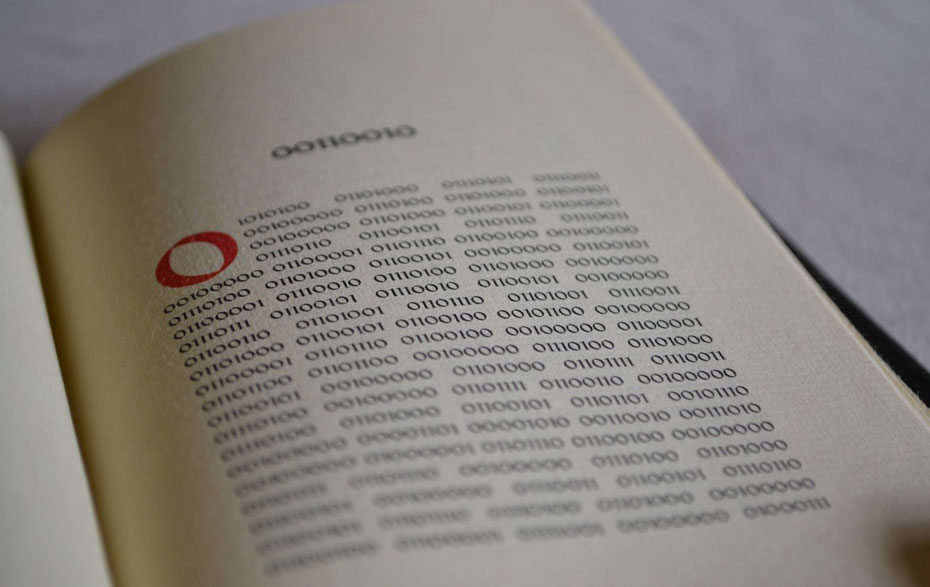
[2b2k] Bookbinding and the Digital Bible

Avi Solomon at BoingBoing has a terrific interview with Michael Greer about the appeal of bookbinding, and about Michael’s “Digital Bible.”

I love the photo:

Digital Bible: Book with ones and zeroes as text

Tweet
Follow me

Categories: libraries, too big to know Tagged with: 2b2k • books • libraries Date: October 17th, 2011 dw

Be the first to comment »

October 9, 2011

Library: Future.0

I put this video together as the opener of the first in a series of public conversations Harvard is holding about the future of libraries and of the Harvard Library system.

Tweet
Follow me

Categories: libraries Tagged with: harvard • libraries Date: October 9th, 2011 dw

3 Comments »

October 4, 2011

ShelfLife and LibraryCloud: What we did all summer

We’re really really really pleased that the Digital Public Library of America has chosen two of our projects to be considered (at an Oct. 21 open plenary meeting) for implementation as part of the DPLA’s beta sprint. The Harvard Library Innovation Lab (Annie Cain, Paul Deschner, Jeff Goldenson, Matt Phillips, and Andy Silva), which I co-direct (along with Kim Dulin) worked insanely hard all summer to turn our prototypes for Harvard into services suitable for a national public library. I have to say I’m very proud of what our team accomplished, and below is a link that will let you try out what we came up with.

Upon the announcement of the beta sprint in May, we partnered up with folks at thirteen other institutions…an amazing group of people. Our small team at Harvard , with generous internal support, built ShelfLife and LibraryCloud on top of the integrated catalogs of five libraries, public and university, with a combined count of almost 15 million items, plus circulation data. We also pulled in some choice items from the Web, including metadata about every TED talk, open courseware, and Wikipedia pages about books. (Finding all or even most of the Wikipedia pages about books required real ingenuity on the part of our team, and was a fun project that we’re in the process of writing up.)

The metadata about those items goes into LibraryCloud, which collects and openly publishes that metadata via APIs and as linked open data. We’re proposing LibraryCloud to DPLA as a metadata server for the data DPLA collects, so that people can write library analytics programs, integrate library item information into other sites and apps, build recommendation and navigation systems, etc. We see this as an important way what libraries know can become fully a part of the Web ecosystem.

ShelfLife is one of those possible recommendation and navigation systems. It is based on a few basic principles hypotheses:

– The DPLA should be not only a service but a place where people can not only read/view items, but can engage with other users.

– Library items do not exist on their own, but are always part of various webs. It’s helpful to be able to switch webs and contexts with minimal disruption.

– The behavior of the users of a collection of items can be a good guide to those items; we think of this as “community relevance,” and calculate it as “shelfRank.”

– The system should be easy to use but enable users to drill down or pop back up easily.

– Libraries are social systems. Library items are social objects. A library navigation system should be social as well.

Apparently the DPLA agreed enough to select ShelfLife and LibraryCloud along with five other projects out of 38 submitted proposals. The other five projects — along with another three in a “lightning round” (where the stakes are doubled and anything can happen??) — are very strong contenders and in some cases quite amazing. It seems clear to our team that there are synergies among them that we hope and assume the DPLA also recognizes. In any case, we’re honored to be in this group, and look forward to collaborating no matter what the outcome.

You can try the prototype of ShelfLife and LibraryCloud here. Keep in mind please that this is live code running on top of a database of 15M items in real time, and that it is a prototype (and in certain noted areas merely a demo or sketch). I urge you to talk the tour first; there’s a lot in these two projects that you’ll miss if you don’t.

Tweet
Follow me

Categories: education, everythingIsMiscellaneous, libraries, taxonomy, too big to know Tagged with: 2b2k • dpla • everytningismis • libraries • metadata Date: October 4th, 2011 dw

3 Comments »

October 1, 2011

[2b2k] Open access to a life of work

From Kattallus, via metafilter:

Humanities and the Liberal Arts is the personal website of former Middlebury classics professor William Harris who passed away in 2009. In his retirement he crafted a wonderful site full of essays, music, sculpture, poetry and his thoughts on anything from education to technology. But the heart of the website for me is, unsurprisingly, his essays on ancient Latin and Greek literature some of whom are book-length works. Here are a few examples: Purple color in Homer, complete fragments of Heraclitus, how to read Homer and Vergil, a discussion of a recently unearthed poem by Sappho, Plato and mathematics, Propertius’ war poems, and finally, especially close to my heart, his commentaries on the poetry of Catullus, for example on Ipsithilla, Odi et amo, Attis poem as dramatic dance performance and a couple of very dirty poems (even by Catullus’ standard). That’s just a taste of the riches found on Harris’ site, which has been around nearly as long as the world wide web has existed.

There are months of serious browsing in the world of Prof. Miller’s thought. It is a particularly wonderful illustration of the boon of having worldwide access to unlimited worlds of thought.

Tweet
Follow me

Categories: libraries, open access, philosophy, too big to know Tagged with: classics • libraries • literature • open access • philosophy • william miller Date: October 1st, 2011 dw

1 Comment »

« Previous Page | Next Page »


Creative Commons License
This work is licensed under a Creative Commons Attribution-NonCommercial-ShareAlike 3.0 Unported License.
TL;DR: Share this post freely, but attribute it to me (name (David Weinberger) and link to it), and don't use it commercially without my permission.

Joho the Blog uses WordPress blogging software.
Thank you, WordPress!