logo
EverydayChaos
Everyday Chaos
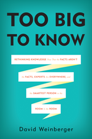
Too Big to Know
Too Big to Know
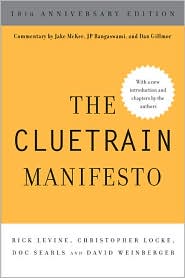
Cluetrain 10th Anniversary edition
Cluetrain 10th Anniversary
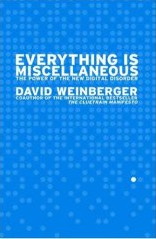
Everything Is Miscellaneous
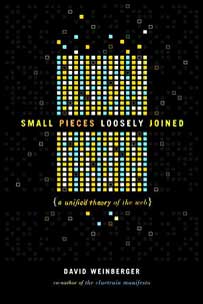
Small Pieces cover
Small Pieces Loosely Joined
Cluetrain cover
Cluetrain Manifesto
My face
Speaker info
Who am I? (Blog Disclosure Form) Copy this link as RSS address Atom Feed

October 20, 2013

[templelib] Rachel Frick. Digital Library Federation

NOTE: Live-blogging. Getting things wrong. Missing points. Omitting key information. Introducing artificial choppiness. Over-emphasizing small matters. Paraphrasing badly. Not running a spellpchecker. Mangling other people’s ideas and words. You are warned, people.

At Temple University’s symposium in honor of the inauguration of the University’s new president, on Oct. 18, 2013.

[I came in late. Sorry!!]

Rachel Frick is talking about the importance of the Commons. Too often, she says, librarians come into the conversation as if they’re from a bounded place. We keep producing the same solutions to different problems. (She recommends Steven John’s Where Good Ideas Come From. She earlier recommend Networked by Lee Rainie and Barry Wellman. [I concur with these recommendations!])

Rachel says she likes SxSW for idea sharing. She was talking with Bonnie Tijerina and they came up with the idea of the Idea Drop house for librarians at SxSW for livestreaming conversations. [I did one last year! It was a very cool venue: an AirBnB residence with librarians and refreshments. What more could you want?] They had 800+ visitors. [*This is even more impressive since the house was not on the main campus of SxSW.]

She worked with DPLA, Europeana and OpenGLAM on “Culture Hack”: use our data! Also meetups at SxSW. Also, LibraryBox: an instant wifi distribution point run on a battery for distribution of library content. They used it to distribute tons of open content at the conference. It was a great way to engage people in conversation about libraries.

Jason Griffey wanted to upgrade the LibraryBoxes. He needed about $3K. He needed to make a case for its need. So what are some non-ilbrary-centric use cases? Health care info in remote areas. Unmonitored conversations. He raised $13K in 4 days on Kickstarter. At the end of 30 days, he’d raised $33K. Because he could reach beyond the library space, and because it spoke to open access to info, it succeeded.

Now is the time for creators and makers, she says. Bess Sadler talks about the hacker epistemology: adopt a problem solving mindset, the truth is what works, solve for interesting. Bethany Nowviskie at Code4Lib a few years ago talked about the creative mindset: meticulous, practical, an impulse to build and maintain, and to suffer fools gladly. Kathy Sierra talks about how you get over The Big Frickin’ Wall between incremental changes and transformation. John Voss, who works for HistoryPin [and organizer of LODLAM], says you get over the wall by connecting what we do to a greater purpose.

“The mission of librarians is to improve society through facilitating knowledge creation in their communities” David Lankes, Atlas of New Librarianship. This is how Linked Data will be made real, Rachel says. She cites the LODLAM conference, and DPLA: intracommunity conversation.

Tweet
Follow me

Categories: libraries, liveblog Tagged with: dlf • libraries Date: October 20th, 2013 dw

1 Comment »

[templelib] Siobhan Reardon: Renewing the Free Library of Philadelphia

At Temple University’s symposium in honor of the inauguration of the University’s new president, on Oct. 18, 2013.

NOTE: Live-blogging. Getting things wrong. Missing points. Omitting key information. Introducing artificial choppiness. Over-emphasizing small matters. Paraphrasing badly. Not running a spellpchecker. Mangling other people’s ideas and words. You are warned, people.

Siobhan A. Reardon is president and director of the Free Library of Philadelphia. [So awesome!] She came in 5 years ago when the system was facing serious financial cutbacks. She brought in a consulting group to help the library come up with a strategic plan. The consultants took the Library through an extensive and well-structured process. [Siobhan gives us a lot of info; the following is at best an outline.]

They looked at four scenarios for where the economy and the state of tech access might be, from booms in both to busts in each. Since we don’t know what the future will be, how do you create an organization that can shift from one scenario to another?

Key success factors include not only operational effiiciency and marketing, but also the possibility of offering a premium service for a fee. Also, partnerships, virtual presence, facility design, and specialized talent.

Vision: Building an enlightened community devoted to lifelong literacy. Mission: advance literacy, guide learning, and inspire curiosity.

This works out to a dozen operational goals, which include focusing on providing especially strong support for: children under 5, new Americans, jobseekers, and small businesses.

Key takeaways from the study: Every project needs an owner.

  • Marketing has to be amplified.
  • Staff training is imperative.
  • The library must have a robust virtual aspect.
  • Each of the 48 neighborhood libraries have to be focused on its community.

They have a set of new potential programs. One is fine-free cards for children. (The library takes in $800,000/year in fines, so this will affect its bottom line.) The most progress has been in reaching jobseekers. They’ve also focused on users with special needs (which includes people with emotional issues and the homeless).

They then went through an organizational restructuring. After studying 14 other libraries, they realized that the Philadelphia Library is not sufficiently focused on customer engagement. Also, they’ve clustered libraries geographically, with shared staff and shared specializations.

Siobhan shows the layout of a re-designed library. Books are on the perimeter, with social space in the middle. Plus quiet rooms. Plus a cafe. She points out that libraries traditionally don’t like food near books, but people take books home and read them while drinking coffee and eating donuts. “Go figure,” she says.

She quickly cycles through photos of other libraries, each of which address some problem or opportunity. Beautiful.

Tweet
Follow me

Categories: libraries, liveblog Tagged with: libraries • philadelphia • templelib Date: October 20th, 2013 dw

Be the first to comment »

October 9, 2013

Derek Attig on the history of bookmobiles

I’m at a Harvard Library talk by Derek Attig [twitter: @bookmobility], a Ph.D. at candidate U. of Illinois Champaign/Urbana: “Here Comes the Bookmobile: How Mobile Libraries Made America.” (Bold title!) (Thank you, Office for Scholarly Communication and the Library Test Kitchen class!)

NOTE: Live-blogging. Getting things wrong. Missing points. Omitting key information. Introducing artificial choppiness. Over-emphasizing small matters. Paraphrasing badly. Not running a spellpchecker. Mangling other people’s ideas and words. You are warned, people.

In 1905 in Washington County Maryland, a woman commissioned a horse and carriage to reach far-flung areas. Five years later, the carriage was hit by a train. (The horses were fine.) She replaced it with a gas-powered vehicle. So, you can tell the story of the bookmobile as a story about machines. But a better way would be to tell it as a story of people and what they thought books could do if they put them on wheels: they thought if you moved books through space, you could make a community. The maps of book mobile routes looks like a network. “Filling space with books and linking the county together with its presence.” “This dream of connection was so powerful that it shaped how children imagined bookmobiles.” Derek shows a kid’s drawing from the 1930s, and it too looks like a community connected by a network.

It didn’t always work out that way, he says. Book mobiles were used to bring books to African Americans so that African Americans wouldn’t come to libraries. Still, the dream of networked community drove bookmobiles forward.

Derek is going to focus on three moments, he says: the birth of book mobiles in the 1890s, the role of them in the Cold War in the 1950s, and the supposed current death of book mobiles.

“Libraries must be mobilized. Books must travel more,” said Melvil Dewey. That began in earnest in the 1890s, especially in rural states with populist governments. Traveling libraries took books from a central repository and shipped them. Post Offices, general stores, and living rooms became ad hoc libraries. After a set time, the books would be shipped back. This gave a constantly refreshed stream.

Women played an enormous role in the traveling library movement. Many began as the projects of women’s clubs. They claimed this was an extension of their domestic duties, e.g., tempering male children.

Most of Derek’s work has been on the Kansas traveling library, founded in 1898, by the suffragette Mary Brown Johnston [correct?]. A woman lived on a ranch wanted to know if she could join the library. MBJ said that the traveling library needed a library club to bring he books to. Presley [lost track of who that is] says that she’s made a “circuit of our district” and found people willing to form an “association.” Derek points out the importance of libraries establishing circuits and associations. “Wherever the traveling library system is introduced, it makes friends with the people,” said [someone], and says Derek, makes friends among people.

“By the 1950s, book mobiles were at the height of their iconic power.” Children’s books and romance novels were written about them. And they were tools of diplomacy. In 1959, a book mobile from Delmar NY was lowered into a Moscow Park as part of a US exhibition. It was a huge hit. Thousands of Russians toured it. In fact, thousands of them — 75% of them — were stolen. The ALA and publishers shipped thousands more books.

In the 1960s there were US book mobiles in Mexico City, Libya, Jakarta, and more, but the largest number were in West Germany. 24 book mobiles were roaming that country, stocked with US books in German. We were at that time trying to heal the wounds of WWII and to keep West Germany firmly in the Western bloc. “The most important symbol of that process were the bookmobile’s open shelves.” European libraries generally had closed stacks and were fort-like. Still, there was some pushback. Some Germans felt it was an attempt at establishing American cultural dominance. Also, the Americans sometimes felt (as one wrote) “The type of books read fall somewhat short of the ideal.” In fact, the Germans were reading the books they want, and building the sort of community they wanted.

Where are book mobiles now? Green Day traveled in one. But there were no books in it. (There was, however, weed.) “By the 1990s, the book mobile’s iconic status had faltered.” Shrinking budgets, high gas costs, and the illusions of ubiquitous Internet access led people to think that book mobiles are archaic.

But there’s another story, in which the book mobile remains useful and surprising. At public libraries all over the country, book mobiles still travel the roads. Topeka KS just got a $200K grant to buy a new one, continuing 70 yrs of service. There was one at Burning Man.

You can even find them at the heart of the Internet. E.g., the Internet Archive. One of the advantages is that you can turn the digital works back into paper. IA has been sending out book mobiles that print public domain works into paper books. [I blogged about this ia while ago.] Google has funded a local one as well.

Derek ends by pointing to the dream of ubiquitous broadband as a continuation of the impulse behind the development of book mobiles. [Nice talk! I had no idea.]

(More at BookMobility.org.]

Tweet
Follow me

Categories: libraries Tagged with: history • libraries Date: October 9th, 2013 dw

Be the first to comment »

September 24, 2013

[berkman][misc] Curated by the crowd

I’m at a Berkman lunchtime talk on crowdsourcing curation. Jeffrey Schnapp, Matthew Battles [twitter:matthewBattles] , and Pablo Barria Urenda are leading the discussion. They’re from the Harvard metaLab.

NOTE: Live-blogging. Getting things wrong. Missing points. Omitting key information. Introducing artificial choppiness. Over-emphasizing small matters. Paraphrasing badly. Not running a spellpchecker. Mangling other people’s ideas and words. You are warned, people.

Matthew Battles begins by inviting us all to visit the Harvard center for Renaissance studies in Florence, Italy. [Don’t toy with us, Matthew!] There’s a collection there, curated by Bernard Berenson, of 16,000 photos documenting art that can’t be located, which Berenson called “Homeless Paintings of the Italian Renaissance.” A few years ago, Mellon sponsored the digitization of this collection, to be made openly available. One young man, Chris Daley [sp?] has since found about 120 of the works. [This is blogged at the metaLab site.]

These 16,000 images are available at Harvard’s VIA image manager [I think]. VIA is showing its age. It doesn’t support annotation, etc. There are some cultural crowdsourcing projects already underway, e.g., Zooniverse’s Ancient Lives project for transcribing ancient manuscripts. metaLab is building a different platform: Curarium.com.

Matthew hands off to Jeffrey Schnapp. He says Curarium will allow a diverse set of communities (archivist, librarian, educator, the public, etc.) to animate digital collections by providing tools for doing a multiplicity things with those collections. We’re good at making collections, he says, but not as good at making those collections matter. Curarium should help take advantage of the expertise of distributed communities.

What sort of things will Curarium allow us to do? (A beta should be up in about a month.) Add metadata, add meaning to items…but also work with collections as aggregates. VIA doesn’t show relations among items. Curarium wants tomake collections visible and usable at the macro and micro levels, and to tell stories (“spotlights”).

Jeffrey hands off to Pablo, who walks us through the wireframes. Curarium will ingest records, and make them interoperable. They take in reords in JSON format, and extract the metadata they want. (They save the originals.) They’re working on how to give an overview of the collection; “When you have 11,000 records, thumbnails don’t help.” So, you’ll see a description and visualizations of the cloud of topic tags and items. (The “Homeless” collection has 2,000 tags.)

At the item level, you can annotate, create displays of selected content (“‘Spotlights’ are selections of records organized as thematized content”) in various formats (e.g., slideshow, more academic style, etc.). There will be a rich way of navigating and visualizing. There will be tools for the public, researchers, and teachers.

Q&A

Q: [me] How will you make the enhanced value available outside of Curarium? And, have you considered using Linked Data?

A: We’re looking into access. The data we have is coming from other places that have their own APIs, but we’re interested in this.

Q: You could take the Amazon route by having your own system use API’s, and then make those API’s open.

Q: How important is the community building? E.g., Zooniverse succeeds because people have incentives to participate.

A: Community-building is hugely important to us. We’ll be focusing on that over the next few months as we talk with people about what they want from this.

A: We want to expand the scope of conversation around cultural history. We’re just beginning. We’d love teachers in various areas — everything from art history to history of materials — to start experimenting with it as a teaching tool.

Q: The spotlight concept is powerful. Can it be used to tell the story of an individual object. E.g., suppose an object has been used in 200 different spotlights, and there might be a story in this fact.

A: Great question. Some of the richness of the prospect is perhap addressed by expectations we have for managing spotlights in the context of classrooms or networked teaching.

Q: To what extent are you thinking differently than a standard visual library?

A: On the design side, what’s crucial about our approach is the provision for a wide variety of activities, within the platform itself: curate, annotate, tell a story, present it… It’s a CMS or blogging platform as well. The annotation process includes bringing in content from outside of the environment. It’s a porous platform.

Q: To what extent can users suggest changes to the data model. E.g., Europeana has a very rigid data model.

A: We’d like a significant user contribution to metadata. [Linked Data!]

Q: Are we headed for a bifurcation of knowledge? Dedicated experts and episodic amateurs. Will there be a curator of curation? Am I unduly pessimistic?

A: I don’t know. If we can develop a system, maybe with Linked Data, we can have a more self-organizing space that is somewhere in between harmony and chaos. E.g., Wikimedia Loves Monuments is a wonderful crowd curatorial project.

Q: Is there anything this won’t do? What’s out of scope?

A: We’re not providing tools for creating animated gifs. We don’t want to become a platform for high-level presentations. [metaLab’s Zeega project does that.] And there’s a spectrum of media we’ll leave alone (e.g., audio) because integrating them with other media is difficult.

Q: How about shared search, i.e., searching other collections?

A: Great idea. We haven’t pursued this yet.

Q: Custodianship is not the same as meta-curation. Chris Daly could become a meta-curator. Also, there’s a lot of great art curation at Pinterist. Maybe you should be doing this on top of Pinterest? Maybe built spotlight tools for Pinteresters?

A: Great idea. We already do some work along those lines. This project happens to emerge from contact with a particular collection, one that doesn’t have an API.

Q: The fact that people are re-uploading the same images to Pinterest is due to the lack of standards.

Q: Are you going to be working on the vocabulary, or let someone else worry about that?

A: So far, we’re avoiding those questions…although it’s already a problem with the tags in this collection.

[Looks really interesting. I’d love to see it integrate with the work the Harvard Library Interoperability Initiative is doing.]

Tweet
Follow me

Categories: libraries, misc Tagged with: crowdsourcing • everythingIsMiscellaneous • libraries Date: September 24th, 2013 dw

Be the first to comment »

August 29, 2013

Innovation at Countway

The Countway Library at Harvard Medical School today held a forum/seminar on what they’re working on. What they’re working on is pretty great.

NOTE: Live-blogging. Getting things wrong. Missing points. Omitting key information. Introducing artificial choppiness. Over-emphasizing small matters. Paraphrasing badly. Not running a spellpchecker. Mangling other peoples ideas and words. You are warned, people.

Griffin Weber – “Discovering Expertise using research networking websites”

In 2008 Countway built Catalyst, a site with faculty profiles. Passive networks, shown on the right, are the existing networks. Active networks, shown on the right, grow over time. It provides a set of visualizations, including of co-authors out two degrees, topics, people with similar interests, physical neighbors, etc.

Last year they extended this to the entire university with the Faculty Finder. It’s a search site with links back to the faculty members school or departmental website.

Then they decided to link up the instances of this open source software being used at 30 universities, via federated search.

The data in the system can be used to do interesting visualizations of various relations; Griffin shows some examples.

Internally it uses the VIVO ontology.

Emily Gustainis, Head of Collection Services for Center for the History of Medicine – “Collaborative Content Building Using Omeka”

Omeka, from George Mason University, has had a big effect. It’s a “free, flexible, open source web-publishing platform for the display of library, museum, archives and scholarly collections and exhibitions.” It combines the cataloging and exhibiting of content, enabling users to self-curate their collections.

They are collaborating on the Our Marathon site that Northeastern is building, as well as with other institutions on other projects, including a collection of historical embryo photos. They’re also working on the Harvard Library Interoperability Initiative [yay!] on making cross-institutional collections available through Omeka without requiring local instances of all the content. (Here are some of the collections.)

Jonathan Kennedy: ASHE (Automatic Subject Heading Extraction)

Jon works with Countway Library and CBMI (Center for Biomedical Informatics) on semantic technologies. They’re working on semantic search, so that searches for, e.g., cancer return results about tumors, neoplasms, etc..

ASHE uses automated processes to try to generate the sort of subject headings for medical articles that a human would apply. They developed a tool and tested it on 50 books that had already been categorized by humans so they’d have something to compare the algorithmic results to. The results have been very encouraging. The system’s top ten suggested headings quite consistently contain the human-generated headings, and about 25% of the time the human-generated headings are way towards the top of the suggested ones. Also, ASHE does a good job supplying secondary headings.

They would like to expand beyond the medical domain. Criteria: Well-supported ontologies that provide dictionaries of synonymous terms, with parent to child relationships. Also, the granularity has to be right. The Library of Congress Subject Headings generally aren’t hierarchical enough for the project. But the Getty Thesaurus might be good, as well as an astrophysics ontology.

Julia Whelan: “Research in Medical Education: A bibliometric study of scholarship”

Harvard Medical School and the University of Pittsburgh Medical School are partnering to address a set of questions including: Is scholarship about medical education growing? Which journals publish it? What’s it growth compared to other medical topics? Which topics in medical ed are covered? etc. They use MeSH headings (Medical Subject Headings) to track studies and articles. They looked at 72.5K articles from 1960-2010 in 3,869 different journals. They saw growth in the number of articles and substantial growth in the number of journals. These grew faster than other medical articles and journals. They’ve also analyzed topic coverage over time, and which journals publish the most on particular topics. E.g., 80% of articles in medical education are not published in medical education journals.

Future projects: studying topics by the gender of the authors, medical specialities, medical school culture, promotion criteria, and making data available to historians on the Web. Here’s a paper on this project.

David Osterberg: “Strategic Planning at Countway: Innovation and Collaboration from the Bottom Up”

(David gives a highly condensed version of his talk because a tour of Countway is about to start.) Countway has a very flat organization. The staff is small enough to meet in one room, which they do every month. At one meeting, they brainstormed what they can do to make Countway better, and lots of great ideas arose. They formed working groups on everything from the use of space to a set of in-depth training videos to e-special collections that pull together info from all across the spectrum…

Tweet
Follow me

Categories: libraries Tagged with: countway • harvard • innovation • libraries Date: August 29th, 2013 dw

2 Comments »

August 4, 2013

Paradata

Hanan Cohen points me to a blog post by a MLIS student at Haifa U., named Shir, in which she discourses on the term “paradata.” Shir cites Mark Sample who in 2011 posted a talk he had given at an academic conference, Mark notes the term’s original meaning:

In the social sciences, paradata refers to data about the data collection process itself—say the date or time of a survey, or other information about how a survey was conducted.

Mark intends to give it another meaning, without claiming to have worked it out fully. :

…paradata is metadata at a threshold, or paraphrasing Genette, data that exists in a zone between metadata and not metadata. At the same time, in many cases it’s data that’s so flawed, so imperfect that it actually tells us more than compliant, well-structured metadata does.

His example is We Feel Fine, a collection of tens of thousands (or more … I can’t open the site because Amtrak blocks access to what it intuits might be intensive multimedia) of sentences that begin “I feel” from many, many blogs. We Feel Fine then displays the stats in interesting visualizations. Mark writes:

…clicking the Age visualizations tells us that 1,223 (of the most recent 1,500) feelings have no age information attached to them. Similarly, the Location visualization draws attention to the large number of blog posts that lack any metadata regarding their location.

Unlike many other massive datamining projects, say, Google’s Ngram Viewer, We Feel Fine turns its missing metadata into a new source of information. In a kind of playful return of the repressed, the missing metadata is colorfully highlighted—it becomes paradata. The null set finds representation in We Feel Fine.

So, that’s one sense of paradata. But later Mark makes it clear (I think) that We Feel Fine presents paradata in a broader sense: it is sloppy in its data collection. It strips out HTML formatting, which can contain information about the intensity or quality of the statements of feeling the project records. It’s lazy in deciding which images from a target site it captures as relevant to the statement of feeling. Yet, Mark finds great value in We Feel Fine.

His first example, where the null set is itself metadata, seems unquestionably useful. It applies to any unbounded data set. For example, that no one chose answer A on a multiple choice test is not paradata, just as the fact that no one has checked out a particular item from a library is not paradata. But that no one used the word “maybe” in an essay test is paradata, as would be the fact that no one has checked out books in Aramaic and Klingon in one bundle. Getting a zero in a metadata category is not paradata; getting a null in a category that had not been anticipated is paradata. Paradata should therefore include which metadata categories are missing from a schema. E.g., that Dublin Core does not have a field devoted to reincarnation says something about the fact that it was not developed by Tibetans.

But I don’t think that’s at the heart of what Mark means by paradata. Rather, the appearance of the null set is just one benefit of considering paradata. Indeed, I think I’d call this “implicit metadata” or “derived metadata,” not “paradata.”

The fuller sense of paradata Mark suggests — “data that exists in a zone between metadata and not metadata” — is both useful and, as he cheerfully acknowleges, “a big mess.” It immediately raises questions about the differences between paradata and pseudodata: if We Feel Fine were being sloppy without intending to be, and if it were presenting its “findings” as rigorously refined data at, say, the biennial meeting of the Society for Textual Analysis, I don’t think Mark would be happy to call it paradata.

Mark concludes his talk by pointing at four positive characteristics of the We Feel Fine site:? It’s inviting, paradata, open, and juicy. (“Juicy” means that there’s lots going on and lots to engage you.) It seems to me that the site’s only an example of paradata because of the other three. If it were a jargon-filled, pompous site making claims to academic rigor, the paradata would be pseudodata.

This isn’t an objection or a criticism. In fact, it’s the opposite. Mark’s post, which is based on a talk that he gave at the Society for Textual Analysis, is a plea for research thatis inviting, open, juicy, and is willing to acknowledge that its ideas are unfinished. Mark’s post is, of course, paradata.

Tweet
Follow me

Categories: everythingIsMiscellaneous, libraries Tagged with: everythingIsMiscellaneous • libraries • metadata • paradata Date: August 4th, 2013 dw

Be the first to comment »

June 25, 2013

The kids are reading more than we thought

A fascinating new report from Pew Internet includes the following:

As with other age groups, younger Americans were significantly more likely to have read an e-book during 2012 than a year earlier. Among all those ages 16-29, 19% read an e-book during 2011, while 25% did so in 2012. At the same time, however, print reading among younger Americans has remained steady: When asked if they had read at least one print book in the past year, the same proportion (75%) of Americans under age 30 said they had both in 2011 and in 2012.

In fact, younger Americans under age 30 are now significantly more likely than older adults to have read a book in print in the past year (75% of all Americans ages 16-29 say this, compared with 64% of those ages 30 and older). And more than eight in ten (85%) older teens ages 16-17 read a print book in the past year, making them significantly more likely to have done so than any other age group.

Also:

…younger Americans have a broad understanding of what a library is and can be—??a place for accessing printed books as well as digital resources, that remains at its core a physical space.

Overall, most Americans under age 30 say it is “very important” for libraries to have librarians and books for borrowing;

Tweet
Follow me

Categories: libraries Tagged with: books • libraries Date: June 25th, 2013 dw

1 Comment »

June 22, 2013

What I learned at LODLAM

On Wednesday and Thursday I went to the second LODLAM (linked open data for libraries, archives, and museums) unconference, in Montreal. I’d attended the first one in San Francisco two years ago, and this one was almost as exciting — “almost” because the first one had more of a new car smell to it. This is a sign of progress and by no means is a complaint. It’s a great conference.

But, because it was an unconference with up to eight simultaneous sessions, there was no possibility of any single human being getting a full overview. Instead, here are some overall impressions based upon my particular path through the event.

  • Serious progress is being made. E.g., Cornell announced it will be switching to a full LOD library implementation in the Fall. There are lots of great projects and initiatives already underway.

  • Some very competent tools have been developed for converting to LOD and for managing LOD implementations. The development of tools is obviously crucial.

  • There isn’t obvious agreement about the standard ways of doing most things. There’s innovation, re-invention, and lots of lively discussion.

  • Some of the most interesting and controversial discussions were about whether libraries are being too library-centric and not web-centric enough. I find this hugely complex and don’t pretend to understand all the issues. (Also, I find myself — perhaps unreasonably — flashing back to the Standards Wars in the late 1980s.) Anyway, the argument crystallized to some degree around BIBFRAME, the Library of Congress’ initiative to replace and surpass MARC. The criticism raised in a couple of sessions was that Bibframe (I find the all caps to be too shouty) represents how libraries think about data, and not how the Web thinks, so that if Bibframe gets the bib data right for libraries, Web apps may have trouble making sense of it. For example, Bibframe is creating its own vocabulary for talking about properties that other Web standards already have names for. The argument is that if you want Bibframe to make bib data widely available, it should use those other vocabularies (or, more precisely, namespaces). Kevin Ford, who leads the Bibframe initiative, responds that you can always map other vocabs onto Bibframe’s, and while Richard Wallis of OCLC is enthusiastic about the very webby Schema.org vocabulary for bib data, he believes that Bibframe definitely has a place in the ecosystem. Corey Harper and Debra Riley-Huff, on the other hand, gave strong voice to the cultural differences. (If you want to delve into the mapping question, explore the argument about whether Bibframe’s annotation framework maps to Open Annotation.)

  • I should add that although there were some strong disagreements about this at LODLAM, the participants seem to be genuinely respectful.

  • LOD remains really really hard. It is not a natural way of thinking about things. Of course, neither are old-fashioned database schemas, but schemas map better to a familiar forms-based view of the world: you fill in a form and you get a record. Linked data doesn’t even think in terms of records. Even with the new generation of tools, linked data is hard.

  • LOD is the future for library, archive, and museum data.


Here’s a list of brief video interviews I did at LODLAM:

  • Kevin Ford gives a BIBFRAME update
  • Sean Thomas and Sands Fish on getting Open Access research into the hands of people who need it
  • Debra Riley-Huff on whether library standards are webby enough
  • Richard Wallis on Schema.org
  • Corey Harper on rethinking Linked Open Data from the user’s point of view
  • Kitio Fofack on why linked data
  • Richard Urban on building a linked data pattern library
  • Tweet
    Follow me

Categories: everythingIsMiscellaneous, libraries Tagged with: everythingIsMiscellaneous • libraries • linked data • lodlam • metadata • standards Date: June 22nd, 2013 dw

Be the first to comment »

June 21, 2013

[lodlam] Kevin Ford on the state of BIBFRAME

Kevin Ford who is a principle member of the team behind the Library of Congress’ BIBFRAME effort — a modern replacement for the aging MARC standard — gives an update on its status, and addresses a controversy about whether it’s “webby” enough. (I liveblogged a session about this at LODLAM.)

Tweet
Follow me

Categories: interop, libraries, podcast Tagged with: bibframe • libraries • linked data • lodlam • marc • podcast Date: June 21st, 2013 dw

3 Comments »

[lodlam] Kitio Fofack on why Linked Data

Kitio Fofack turned to Linked Data when creating a prototype app that aggregated researcher events. He explains why.

Tweet
Follow me

Categories: interop, libraries, podcast Tagged with: libraries • linked data • lodlam • podcast Date: June 21st, 2013 dw

Be the first to comment »

« Previous Page | Next Page »


Creative Commons License
This work is licensed under a Creative Commons Attribution-NonCommercial-ShareAlike 3.0 Unported License.
TL;DR: Share this post freely, but attribute it to me (name (David Weinberger) and link to it), and don't use it commercially without my permission.

Joho the Blog uses WordPress blogging software.
Thank you, WordPress!