logo
EverydayChaos
Everyday Chaos
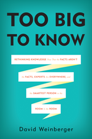
Too Big to Know
Too Big to Know
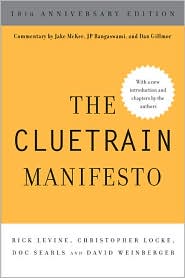
Cluetrain 10th Anniversary edition
Cluetrain 10th Anniversary
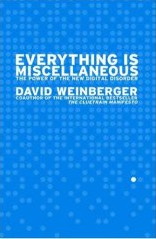
Everything Is Miscellaneous
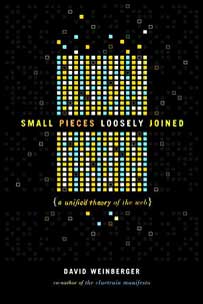
Small Pieces cover
Small Pieces Loosely Joined
Cluetrain cover
Cluetrain Manifesto
My face
Speaker info
Who am I? (Blog Disclosure Form) Copy this link as RSS address Atom Feed

March 23, 2009

Andrew Lih on Wikipedia

Vincent Rossmeier has a solid interview at Salon with Andrew Lih, author of The Wikipedia Revolution.

I’m going to interview Andrew as a Berkman event on Wednesday night, 6pm at Griswold Hall, room 110, at Harvard Law. Andrew is certainly a partisan, but he’s also an insider whose book is quite candid and direct about troubling episodes in Wikipedia’s history. I enjoyed his book and look forward to talking with him. (He and I will probably talk for 30 mins, and then we’ll open it up.)

[Tags: wikipedia andrew_lih ]

Tweet
Follow me

Categories: Uncategorized Tagged with: digital culture • everythingIsMiscellaneous • expertise • knowledge • wikipedia Date: March 23rd, 2009 dw

Be the first to comment »

March 15, 2009

Andrew Lih on Wikipedia

I just read Andrew Lih’s The Wikipedia Revolution, in preparation for an interview I’m doing on March 25 for the Berkman Center. It will be held in Griswold Hall, room 110. (Actually, the actual location hasn’t been announced yet. But somewhere at Harvard.) It’s a terrific book.

Andrew tells the story historically, providing tons of context and background. As the title makes clear, he thinks Wikipedia is epochally important, but the book isn’t about touting Wikipedia and gesticulating towards its implications. Rather, given that Wikipedia is at least rather interesting, how did it get there? The simple story we’ve heard so frequently — it’s the encyclopedia we all wrote in our spare time — masks a complex mix of personality, theory, politics, social interaction, software and hardware. Andrew doesn’t shy away from the controversies and tells the story from a neutral point of view … neutral given that he implicitly thinks Wikipedia is overall pretty awesome. In that he mirrors Wikipedia itself: It is (overall) neutral given that the contributors agree that a group-authored encyclopedia that aims for NPOV is worth working on.

If you want to understand Wikipedia, I highly recommend this book, especially in tandem with How Wikipedia Works by Phoebe Ayers, Charles Matthews, and Ben Yates, a terrific and detailed explanation of the intricacies of Wikipedia’s structure, ethos, rules, and hierarchy.

[Tags: wikipedia ]

Tweet
Follow me

Categories: Uncategorized Tagged with: digital culture • everythingIsMiscellaneous • knowledge • wikipedia Date: March 15th, 2009 dw

14 Comments »

March 8, 2009

Wolfram computes it all

Stephen Wolfram is promising “A new paradigm for using computers and the web.” It involves “a mixture of many clever algorithms and heuristics, lots of linguistic discovery and linguistic curation, and what probably amount to some serious theoretical breakthroughs.” He doesn’t lay it out explicitly, but says “…armed with Mathematica and NKS I realized there’s another way: explicitly implement methods and models, as algorithms, and explicitly curate all data so that it is immediately computable.”

Wolfram is very very very very very smart. No one doubts that. He’s smart enough that he would not be posting and hyping this site unless there’s something there. I don’t understand it, but, frankly I’m looking forward to it.

The site is called WolframAlpha, and it opens in May.

[Tags: wolfram semantic_web search metadata ]

Tweet
Follow me

Categories: Uncategorized Tagged with: everythingIsMiscellaneous • knowledge • metadata • search • wolfram Date: March 8th, 2009 dw

7 Comments »

March 3, 2009

Radio Berkman: Peter Suber on open access

Peter Suber gave a terrific talk last week, hosted by the Berkman Center. Afterwards, I sat down with him for a podcast on the politics around open access.

[Tags: peter_suber open_access podcasts knowledge libraries journals publishing ]

Tweet
Follow me

Categories: Uncategorized Tagged with: digital rights • everythingIsMiscellaneous • journals • knowledge • libraries • media • podcasts • politics • publishing Date: March 3rd, 2009 dw

Be the first to comment »

February 26, 2009

[berkman] Peter Suber on the future of open access

Peter Suber, Research Prof. of Philosophy at Earlham College, a visiting fellow at Yale Law’s Information Society Project, and blogger of open access news, is giving a full-house lecture at Harvard, sponsored by the Berkman Center. [Note: I’m live blogging, making mistakes, leaving things out, paraphrasing ineptly, etc. POSTED WITHOUT PROOFING or even with a basic re-reading. Speed over accuracy. Welcome to the Web :(]


Peter says he’s going to assume that we know what open access is, etc. But he does want to define Green Open Access (= open access through a repository) and Gold OA (= OA through a journal). There’s also Gratis OA (free of charge but may be licensing restrictions) and Libre OA (free of charge and free of licensing restrictions).


Peter says he doesn’t know the future of OA. He likes Alan Kaye’s comment that the future is easier to make than predict. He’s going to talk about 12 cross-over points in OA, in rough order of when they might occur:


1. For-pay journals allow green OA. About 63% of these journals already do this.


2. OA books:: When there are more gratis OA books online than in the average university library. We crossed this a couple of years ago. “The permission problem is harder than digitization.” The next cross over point here is getting more libre OA books online, which we are quite a distance from.


3. Funder policies: “When most publicly-funded research is subject to OA mandates.” This seems to be spreading, Peter says. Today, 32 public funders and more than 3 private funders have OA mandates.


4. Green OA deposits: “When most new peer-reviewed manuscripts are self-archived when accepted for publication.” In particle physics, this happens routinely. If 20% of researchers publish 80% of the articles, we could reach cross-over fairly quickly in some fields.


5. Author understanding: “When most publishing researchers have an accurate understanding of OA.” This is happening, but notvery quickly.


6. University repositories: “When most universities have institutional repositories,” individually or as part of a consortium. This is happening slowly. In the absence of a universal repository, every university ought to have one. Universities will get to this point more slowly than funders because they move more slowly than funders. And we ought to ask why. Aren’t universities interests in line with OA?


Libre gold OA: “When most OA journals are libre OA.” Most OA journals are still merely gratis, but curb copying to drive traffic to their site. This crossover could happen overnight if the journals understood the issues. They’d lose a little traffic, but nothing else. There are grounds for optimism: Open Access Scholarly Publishers Association is an assoc of OA journal publishers and it requires libre gold OA. The SPARC Europe program sets standards for what a good OA journal is, and it recommends CreativeCommons attribution licenses. These two orgs are helpful because there’s no topdown org defining OA, so we rely on bottom up orgs like these two to set the standards.


8. Journal backfiles: “When most TA journals have OA backfiles.” This is expensive to do. Google will do it, but Google’s terms are difficult: They don’t give the journal a copy of the digital files. (Libraries do get copies of the files of the books they let Google scan.) The OCA focuses on public domain literature. “Once digitized, the benefits of increased visibility and citations should outweigh the trickle of revenue.” Journals make most of their money from new issues, so having greater presence should help. In physics, almost 100% of articles are available OA but the publishers can’t see any dip in subscriptions.


9. Author addenda: “When most new research is covered by author addenda” (i.e., additions that grant OA permission, tacked onto standard publisher-author contracts). Now there are few adopters. It’d be good to standardize these. The cross over will come when universities or funders require it. If enough journals allow green OA, that’d make addenda unnecessary.


10. University policies: “When most university research is subject to university-level OA mandates.” Today, 27 universities and 4 depts have these mandates. It’d help to have the largest/most productive universities move on this first.


11. OA journals: “When most peer-reviewed journals are OA.” “I don’t expect this for a long time.” Now 15% are OA. Progress is slow, but there is progress. High prestige journals are likely to hold out for a long time.


Libre green OA: “When most green OA is libre OA.” Today, only a small fraction is libre OA because most OA repositories depend on permission from publishers. UKPMC Funders Group demands green libre. We will reach the cross-over “when it’s safe.” Harvard has taken the lead on this, Peter says, and it will spread as another large university takes this step, then another one … “It becomes self-fulfilling leadership.”


Q: Are we stuck with the Sonny Bono copyright extension act?
A: Yes. All copyright reform in the past few decades have been in the wrong direction. And it’s very hard to roll back copyright terms. The only silver lining is that when we have a consenting partner, we can bypass copyright via contract. The problem is that they’re not the default.


Q: Under libre OA, how are our scholarly attributions protected?
A: It’s a range. One end is public domain, which does not preserve attribution. But all the CreativeCommons licenses preserve attribution. Most scholars don’t want public domain; they want CC-attribution.”Creative Commons attribution license provides everything a scholar could want.”


Q: [me] Conyers!
A: The Conyers bill would tell agencies not to require OA for works they fund. [I’ve put this badly.] The OA advocates are fighting it, but the agencies affected are not yet. I think Conyers is serious about it. I think he introduced it early because we don’t have a Sect’y of Health and Human Services or of NIH. Conyers may be fighting a turf battle. [Paraphrasing!] “He’s motivated primarily to protect the jurisdiction of his committee.” Peter thinks it won’t pass, but it might be introduced into another bill. “We’d like to spread the NIH policy to the rest of the government.”


Q: Is the economic downturn accelerating the adoption of OA?
A: The NIH just got $10B in the stimulus, which means there will be more and more OA articles. NSF also, but not as much because NSF requires OA for reports generated by those they fund [may not have gotten this right]. But, Peter thinks the downturn strengthens the case for OA. Libraries are going to be canceling subscriptions. And the Stimulus’ emphasis on green research will be more valuable if it’s OA. Open access to research amplifies its value.


Q: [jpalfrey] You’ve noticed there’s no OSF equivalent for OA. But I’d argue that the people in this room — librarians — are your OA OSF. What do you say to these librarians to advance our common cause?
A: Librarians are among the most important allies in the OA movement. But put all the allies together and you still don’t have OSF. Libraries should be sending letters against the Conyers bill. When you negotiate subscriptions you should negotiate the right to pur articles from your authors into an OA repository. Libraries are the only buyers of peer-reviewed journals. When you’re the only buyer, you can dictate your terms, subject to anti-trust. Obama says that we have the right to demand transformation from the banks we’re saving. Librarians can do the same thing for journals. Journals are not serving all of our interests and are acting against other interests. Use your bargaining power. Get the right of self-archive, and, when the time is right, get the right of libre self-archive. Network with one another when you launch repositories. And, btw, every school with an enlightened OA policy had librarians in the head of the charge.


Q: Can you give an example of an archive that works?
A: Universities that have mandatory language still have to supplement the language with incentives and education. As you go from unmandated to mandated, it goes from 15% toward 100%. (15% is the average for voluntary, spontaneous archives.) It works best in the Dutch universities that let the “cream” of the article rise to the top. Every week they feature good work in public. This gets academics to archive their work without a mandate.


Q: Might universities work with publishers collaboratively to create new business models?
A: Publishers differ in their attitudes toward OA. Some are experimenting in good faith. Some, in bad faith. Some who do OA are actively lobbying for the Conyers bill. Librarians understand the scholarly landscape better than publishers and could educate publishers. Society publishers [i.e., societies that publish] could be told that they’re threatened not by OA but by the “big deal” that brings in academic journals.


Q: Is Springer’s taking over of BioMed Central a good thing?
A: Yes. BMC is for-profit. BMC was the world’s largest OA publisher. Now Springer is. Springer says that OA http://arubatourism.com/assets/blog/index.php?=buy-viagra-through-paypal/ is a sustainable part of their bsiness. My reading is that Springer is preparing for an OA future. [Tags: berkman open_access libraries digital_rights education everything_is_miscellaneous publishing scholarship conyers copyright copyleft ]

Tweet
Follow me

Categories: misc Tagged with: berkman • conyers • copyleft • copyright • digital rights • education • everythingIsMiscellaneous • knowledge • libraries • publishing • scholarship Date: February 26th, 2009 dw

7 Comments »

February 25, 2009

James Boyle on keeping public science open to the public

The Financial Times yesterday ran a terrific op-ed by James Boyle, explaining the ridiculousness of the Conyers bill “that would eviscerate public access to taxpayer funded research.” The op-ed is written in Jamie’s light-hearted-yet-penetrating style, and should be read simply for that reason — preeminent legal scholars of copyright are not supposed to be entertaining.

Then, at the end, he adds an argument that I think is crucial because it addresses the Internet’s effect on knowledge and authority:

Think about the Internet. You know it is full of idiocy, mistake, vituperation and lies. Yet search engines routinely extract useful information for you out of this chaos. How do they do it? In part, by relying on the network of links that users generate. If 50 copyright professors link to a particular copyright site, then it is probably pretty reliable.

Where are those links for the scientific literature? Citations are one kind of link; the hyperlink is simply a footnote that actually takes you to the desired reference. But where is the dense web of links generated by working scientists in many disciplines, using semantic web technology and simple cross reference electronically to tie together literature, datasets and experimental results into a real World Wide Web for science? The answer is, we cannot create such a web until scientific articles come out from behind the publishers’ firewalls….

[Tags: copyright copyleft conyers james_boyle knowledge everything_is_miscellaneous ]

Tweet
Follow me

Categories: Uncategorized Tagged with: conyers • copyleft • copyright • digital rights • everythingIsMiscellaneous • infohistory • knowledge • science • social networks Date: February 25th, 2009 dw

1 Comment »

February 9, 2009

Fourier Tweet Transforms

Me, on Twitter:

Challenge: Explain Fourier Transforms, w/o math, to a Humanities major (me), more clearly than http://tinyurl.com/27n3g … in 1 tweet?

Note: I somehow got the TinyURL, which points to the Wikipedia article, wrong. The Wikipedia article begins this way: “In mathematics, the Fourier transform is an operation that transforms one complex-valued function of a real variable into another.” It does not get clearer after that, at least for this Humanities major.


The responses, in the order received:

jonathanweber Looking at a periodic signal in time, the Fourier transform explains it in terms of what mix of frequencies is present. Helps?

DarrylParker the better question is why does a humanities major like you need to understand it? ;)

cparasat It’s just adding waves to other waves.

DarrylParker simpler overview of the Fourier series, but still a bit mathematical – http://tinyurl.com/chw5pp

fantomplanet Fourier Xformations are like ironing your shirt. It smooths things out.

JoeAndrieu FTs take a signal in time and represent it as a series of frequencies. Makes audio signal look like an equalizer graph.v

ts_eliot in 1 tweet?! impossible

fanf the FT splits a signal into separate frequencies, like a prism splits light

fjania – it shows us which, and how much of each, simple sine waves we can add together to reconstruct the signal we’re transforming.

ricklevine Hm. Fourier transforms convert a bunch of sample measurements (audio, seismic data, etc) into frequency info: http://is.gd/iQP3

ricklevine Of course there’s a lot more to it. Try: it’s a way of taking seemingly rndm data and fitting a curve to it, enabling analysis.

fields Things you don’t understand can be expressed in smaller equivalent pieces of things you don’t understand.

IanYorston “Explain Fourier Transforms to a Humanities major”. Smart maths breaks large constructs down into small things loosely joined.

mtobis: your tinyurl fails. Fourier transform an audio signal and get back an amplitude for each pure tone; no information is lost.

vasusrini Sound=Vibrating Air.Bee Buzz & dog bark=diff. frequency signatures. Ear hears all at once & sorts it. FT is the m/c equivalent.

chichiri just say without it you wouldn’t have JPEGs, enough said ;)

artficlinanity Every signal, no matter how complex, is made up of simple sinusoids. Fourier Transformation is how you find those.

vnitin every physical phenomenon can be viewed as existing in space+time or vibrations+energy. FourierTrfm converts view1 -> view2

_eon_ think of waves on the ocean

To follow any of these twitterers, add their name to this url: http://www.twitter.com/

[Tags: fourier twitter ]

Tweet
Follow me

Categories: misc Tagged with: digital culture • everythingIsMiscellaneous • fourier • knowledge • misc • twitter Date: February 9th, 2009 dw

8 Comments »

January 21, 2009

Top 100 Open Courseware courses

A site called Christian Colleges has posted a list of top 100 open courseware courses in theology and philosophy. Open courseware, of course, are real world courses recorded for distribution over the Net. MIT has blazed this path, and this particular Top 100 list is dominated by courses from that school, with Notre Dame showing heavily as well. The Online Education Database has its own, more generic, Top 100 list.

Open courseware is a fantastic idea. It will only spread further and further, because it wrings significant extra value — value perfectly aligned with most educational institutions’ mission — at relatively little extra cost. And while simply recording a class without paying attention to the needs of those watching afterwards is suboptimal, we’re getting better at it. In any case, I don’t mean to carp. Less-than-perfect open courseware is a zillion times better than no open courseware. And we’re just beginning this. Open courseware will change, and it will also change how courses are taught in the real world. Here comes atomization, the Long Tail, network effects, backchannels, and, OMG, spam and undoubtedly porn and …


The most obvious missing piece has to do with metadata. Right now, there is a relative scarcity of open courseware, so sites like iBerry aggregate the known offerings. But, as recording and posting courses becomes the norm, we will have the problems of abundance. And then we’ll want the usual — and perhaps some unusual — ways of filtering to find exactly the courses we want to invest in. For undertaking to listen to a course is not a trivial task. Listening to the first three minutes may lead you to dismiss a course that would have changed your life if you’d made it to the third lecture. We need tags, ratings, reputation systems, trust mechanisms, social networks, and ways to talk with our fellow auditors. And the sites that do this for us well will take on some of the role, value, authority, and standing of universities themselves.

(And now y’all get to tell me about all the sites I’ve missed that do exactly that already.) [Tags: open_courseware ocw education ]

Tweet
Follow me

Categories: Uncategorized Tagged with: digital culture • education • everythingIsMiscellaneous • knowledge • libraries • ocw Date: January 21st, 2009 dw

3 Comments »

November 22, 2008

Our strange new home

I’ve published a new issue of my free newsletter

Our strange new home: A talk to the people in the Chinese government designing ways to use the Net to deliver government services.

Has the Internet been saved?: Obama’s appointments to head the FCC transition team fill me with joy.

The main article is the text of a talk I gave a few weeks ago in Beijing at a one-day seminar/conference for the people in the Chinese government who are putting together sites — portals, usually — to provide government services. These were, I was told, the government people most excited about the opportunities brought by an open Internet. I gave the closing keynote. The previous speakers, from China, S. Korea and Denmark, had expanded the audience’s practical imaginations. I would’ve if I could’ve. Instead, I tried to resolve the seeming contradiction and doubtless cross-cultural meaninglessness that the Internet is weird and the Internet feels homey. It occurred to me afterward that that is the theme of Small Pieces Loosely Joined.

You can read it here.

[Tags: china internet small_pieces ]

Tweet
Follow me

Categories: Uncategorized Tagged with: china • digital culture • egov • infohistory • internet • knowledge • social networks • tagging Date: November 22nd, 2008 dw

Be the first to comment »

November 19, 2008

Bertha Bassam lecture

I gave a lecture at my alma mater, the University of Toronto, a few weeks ago, at the Faculty of Information. The video is here. (Nit: The slides have the wrong font.)

[Tags: university_of_toronto knowledge moi_moi_moi ]

Tweet
Follow me

Categories: Uncategorized Tagged with: digital culture • digital rights • education • everythingIsMiscellaneous • knowledge • philosophy Date: November 19th, 2008 dw

Be the first to comment »

« Previous Page | Next Page »


Creative Commons License
This work is licensed under a Creative Commons Attribution-NonCommercial-ShareAlike 3.0 Unported License.
TL;DR: Share this post freely, but attribute it to me (name (David Weinberger) and link to it), and don't use it commercially without my permission.

Joho the Blog uses WordPress blogging software.
Thank you, WordPress!