


logo
EverydayChaos
Everyday Chaos
Too Big to Know
Too Big to Know
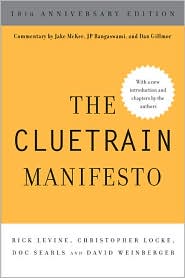
Cluetrain 10th Anniversary edition
Cluetrain 10th Anniversary
Everything Is Miscellaneous
Small Pieces cover
Small Pieces Loosely Joined
Cluetrain cover
Cluetrain Manifesto
My face
Speaker info
Who am I? (Blog Disclosure Form) Copy this link as RSS address Atom Feed

March 14, 2009

Shirky’s classic post on the fate of newspapers

This post by Clay Shirky will be at the center of future discussions about the newspaper revolution. It is itself a pivot point. And it’s beautifully written, with a pause-worthy insight in every paragraph.

[Tags: newspapers journalism media clay_shirky everything_is_miscellaneous ]

Tweet
Follow me

Categories: Uncategorized Tagged with: culture • digital culture • everythingIsMiscellaneous • journalism • media • newspapers Date: March 14th, 2009 dw

4 Comments »

March 13, 2009

Jon Stewart: Squirmatastic righteousness

I thought Jon Stewart’s interview with Jim Cramer last night was a righteous misfire. Stewart was on his high horse, but Cramer was on his little Shetland pony. The result: It was hard to watch.

Stewart was making an important, broad point: Mainstream financial journalism as embodied by CNBC fails the most basic tests of journalism overall. These folks knew better, but give us bread and circuses. Right on, Jon

But feisty, cocky Cramer came onto the show as a Stewart fan, and just kept agreeing and apologizing. I thought ultimately that was pretty disingenuous of Cramer, but it left Stewart looking like a bully. We wanted to see Stewart tear into William Randolph Hearst, but Hearst sent Dear Abby in his place. Except — to mess up the metaphor — Cramer does epitomize CNBC’s tabloiding of financial news, Cramer is a financial insider who knows better, and Dear Abby would have put up more of a fight.

[Tags: jon_stewart jim_cramer cnbc media journalism financial_news ]


You can see the entire, unedited interview here.


The Daily Show runs an anagram contest. The phrase to be anagrammed at the moment is: “Envoys to Afghanistan and Iraq Are Named”

Here’s my best attempt: “On the QT, Iran damns any gain of area saved”

And yours?

Tweet
Follow me

Categories: Uncategorized Tagged with: business • cnbc • culture • entertainment • expertise • journalism • media Date: March 13th, 2009 dw

5 Comments »

March 11, 2009

Berkman MediaCloud tracks feeds ‘n’ memes

The Berkman Center has launched one of its most exciting projects. MediaCloud is subscribing to hundreds of RSS feeds, including many from the mainstream media, is automagically performing topic analysis (actually, entity extraction using Reuter’s OpenCalais) on it, and is building a gigantic database so researchers can see how ideas and information move through and across the Net.

Here’s what the announcement says:

The Berkman Center for Internet & Society is pleased to announce the launch of Media Cloud, a new project that seeks to track news content comprehensively — providing free, open, and flexible research tools:

http://www.mediacloud.org

Researching the nature of news, and media information flows, has always faced a difficult challenge: there is so much produced by so many outlets that it is hard to monitor it all. Researchers have used painstaking manual content analysis to understand mass media. On the web, the explosion of citizen media makes such an approach far more difficult and less comprehensive. By automatically downloading, processing, and querying the full text of thousands of outlets, Media Cloud will allow unprecedented quantitative analysis of media trends.

Today’s launch allows a first view into some of what is possible on the Media Cloud platform. At http://www.mediacloud.org you can generate simple charts of media coverage across sources and countries. The actual capabilities of the system are much greater, and the Media Cloud team is actively looking for other researchers who will bring their own questions as the tools are further developed. Ultimately, Media Cloud will provide open APIs that can support a variety of lines of inquiry.

Visit the Media Cloud site, try the visualizations, share your research ideas with the team, and sign up for the Media Cloud mailing list to hear about functionality enhancements and other project developments.

The Berkman Center is proud to be incubating the project in its initial phases and is now seeking partners to help Media Cloud realize its full research potential….

[Tags: berkman mediacloud media memes journalism blogging ]

Tweet
Follow me

Categories: blogs Tagged with: berkman • blogging • blogs • everythingIsMiscellaneous • journalism • media • mediacloud • memes Date: March 11th, 2009 dw

4 Comments »

March 10, 2009

Future of News: The Tag

To encourage people to start using the FutureOfNews tag at Delicious.com, The Knight Foundation is giving away an entrance badge to the SxSW conference to someone who uses that tag today or tomorrow. Knight hopes that we’ll keep using the tag forever after on pages of interest to those who care about the FutureOfNews.

The winner will be announced on their site, KnightPulse.org at 5pm EDT, Wed.

[Tags: news knight media journalism futureofnews ]

Tweet
Follow me

Categories: Uncategorized Tagged with: everythingIsMiscellaneous • futureofnews • journalism • knight • media • news • tagging Date: March 10th, 2009 dw

1 Comment »

March 4, 2009

Three from the Boston Globe: Conflict, amusement, and maddening missing of the point

Part One

The big page two story of today’s Boston Globe is an article by Lori Montgomery of the Washington Post. It begins:

Two of the administration’s top economic officials defended President Obama’s $3.6 trillion budget plan yesterday, arguing that the proposal would finance a historic investment in critical economic priorities while restoring balance to a tax code tipped in favor of the wealthy.

The first nine paragraphs are about the fierce conflict. Only in paragraph ten do we get the most important news:

Despite those and a few other contentious issues, Obama’s budget request was generally well-received yesterday, as lawmakers took their first opportunity to comment on an agenda that many have described as the most ambitious and transformative since the dawn of the Reagan era. Democratic budget leaders said they are likely to endorse most of Obama’s proposals sometime in April in the form of a nonbinding budget resolution.

If it bleeds, it leads. Sigh.


Part Two

Because I generally disagree on policy with the Globe’s conservative columnist Jeff Jacoby, I try to give him the benefit of the doubt in his reasoning. But this morning, he’s driven me officially nuts. Well done, sir!

Jacoby devotes his column to the philosopher Peter Singer. First, he lauds Singer for “his commitment to charity.” But the bulk of the column is given over to Singer’s controversial — too mild a word — argument for permitting infanticide under careful legal conditions.

Actually, I’ve misspoken. Jacoby doesn’t mention Singer’s argument. He only gives the conclusion. Jacoby’s own conclusion is that Singer’s stance shows what happens “if morality is merely a matter of opinion and preference — if there is no overarching ethical code that supersedes any value system we can contrive for ourselves…”

In fact, Singer’s most objectionable conclusions come from rigorously applying standards of morality against opinion and preference. For example, if we say it’s our superior intelligence that gives us certain rights, then we should be willing to accord those rights to other creatures that turn out to have the same intelligence, even in preference to humans who lack that intelligence by accidents of birth or personal history. Or, as Singer says in the conclusion of the brief column in Foreign Policy that Jacoby cites:

…a new ethic will … recognize that the concept of a person is distinct from that of a member of the species Homo sapiens, and that it is personhood, not species membership, that is most significant in determining when it is wrong to end a life. We will understand that even if the life of a human organism begins at conception, the life of a person—that is, at a minimum, a being with some level of self-awareness—does not begin so early. And we will respect the right of autonomous, competent people to choose when to live and when to die.

There are lots of ways to argue with Singer’s conclusions. (I found him so convincing on animal rights in the 1970s that I’ve been a vegetarian ever since. I find him less convincing on infanticide.) But saying that Singer is merely expressing personal opinion is not to argue with him at all. In short, Jacoby is merely expressing his own opinions and preferences, and thus is guilty of exactly what he criticizes Singer for.


Part Three

The headline over the continuation of an article from the front page says:

Amid Maine’s extremes, teams of dogs and humans vie

It’s mildly disappointing to learn that the article is about dog sled racing in Maine, rather than about a dogs vs. humans sports event. [Tags: media newspapers journalism ethics philosophy peter_singer jeff_jacoby stimulus ]

Tweet
Follow me

Categories: Uncategorized Tagged with: ethics • journalism • media • newspapers • philosophy • stimulus Date: March 4th, 2009 dw

4 Comments »

January 16, 2009

Ethanz: Are print ads crazy?

Ethan, in a long, careful, and superb speculative piece, wonders if newspapers have been propped up by the fact that advertisers couldn’t tell just how over-priced the ad space in newspapers has been:

Basically, there are two ways to explain the disparity in online and offline ad cost. One is to argue that paper ads are, for some combination of reasons, ten to a hundred times more effective than online ads. The other is to argue that advertisers are better at pricing online ads than offline ads.

So, if we lose the irrational pricing of offline ads, how are newspapers going to support expensive, investigative journalism? Or, as Ethan puts it.

What if the model that brought us Upton Sinclair and Woodward and Bernstein – impression advertising – can’t bring us into the future because it’s based on uneven distribution of information and bad math?

And Ethan’s answer is: We don’t know yet.

Great, provocative piece.

[Tags: ethan_zuckerman journalism newspapers media advertising ]

Tweet
Follow me

Categories: Uncategorized Tagged with: advertising • journalism • media • newspapers Date: January 16th, 2009 dw

4 Comments »

January 13, 2009

Inaugural legal guide for citizen media

Berkman’s Citizen Media Law Project has published a guide for bloggers, twitterers, and other citizen media folks on the rights and restrictions of those documenting the inauguration.

[Tags: citizen_media journalism blogging inauguration berkman ]

Tweet
Follow me

Categories: blogs Tagged with: berkman • blogging • blogs • inauguration • journalism • media Date: January 13th, 2009 dw

Be the first to comment »

January 12, 2009

Jay crystallizes the media situation and the change

Jay Rosen explains beautifully both why the media maintains its limited range of acceptable views and what’s shifted. Jay gives us a great frame for understanding this, drawing on Daniel Hallin‘s work.

[Tags: media jay_rosen journalism daniel_hallin ]

Tweet
Follow me

Categories: Uncategorized Tagged with: digital culture • journalism • media Date: January 12th, 2009 dw

2 Comments »

December 6, 2008

NY Times evolves lungs and stubby legs

NYTimes.com has come a looong way.

At first, all the links on the site pointed to more of its own content, except for ads, as if the NYT was the only place ever worth reading. Then the NYT took a big step backwards with the Times Select program, locking its most valuable content behind a pay wall. But the Times saw that, although they were making money, they were losing influence. So, they came up with Times Topics as a place where we could point our links, enabling the NYT to climb up the Google rankings. And they unlocked their oldest archives, which is a great social boon.

And now they’ve started Times Extra: Articles on the NYTimes.com site now are suffixed with links out to other newspapers and blogs that talk about the same topic. So, at the end of an article on, say, Obama’s economic pledge, there may be a link to a Washington Post story, a post at Crooks and Liars, and maybe even a comment section.

Consider how unlikely such a thing would have seemed ten or even give years ago. Well done, NYT

[Tags: nyt new_york_times ny_times times_extra everything_is_miscellaneous media journalism news newspapers ]

Tweet
Follow me

Categories: Uncategorized Tagged with: digital culture • everythingIsMiscellaneous • journalism • media • news • newspapers • nyt Date: December 6th, 2008 dw

7 Comments »

August 17, 2008

Best. Explanation of sub-prime mortgage crisis. Ever

Jay Rosen calls the special This American Life episode on the mortgage/credit crisis “probably the best work of explanatory journalism I have ever heard.” After listening to the podcast yesterday, I’ve got to agree. Not only do I now understand what happened, I think I’m actually going to remember the explanation.

Furthermore, the show focuses on the question that really bothers most of us: What the hell were we thinking? Didn’t we know that offering huge loans to anyone who walked in was unlikely to end well? The show interviews people at different levels in the process, and asks them exactly that.

It is a great piece of journalism. And be sure to read Jay’s piece about it, which is both insightful and wise.

[Tags: journalism media mortgage jay_rosen ]

Tweet
Follow me

Categories: Uncategorized Tagged with: infohistory • jay_rosen • journalism • media • mortgage Date: August 17th, 2008 dw

27 Comments »

« Previous Page | Next Page »


Creative Commons License
This work is licensed under a Creative Commons Attribution-NonCommercial-ShareAlike 3.0 Unported License.
TL;DR: Share this post freely, but attribute it to me (name (David Weinberger) and link to it), and don't use it commercially without my permission.

Joho the Blog uses WordPress blogging software.
Thank you, WordPress!