


logo
EverydayChaos
Everyday Chaos
Too Big to Know
Too Big to Know
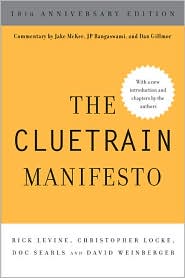
Cluetrain 10th Anniversary edition
Cluetrain 10th Anniversary
Everything Is Miscellaneous
Small Pieces cover
Small Pieces Loosely Joined
Cluetrain cover
Cluetrain Manifesto
My face
Speaker info
Who am I? (Blog Disclosure Form) Copy this link as RSS address Atom Feed

July 28, 2009

Annals of openness in peril

1. The court has rejected Charlie Nesson’s basic defense of Joel Tenenbaum’s sharing of music files. The case is going to jury which may levy the same sort of insanely excessive fines as in the Jammie Thomas-Rassert trial. I hope Charlie’s team can convince the jury that the fines and the entire process are so onerous and disproportionate that the RIAA has been abusing the court system. Of course, IANAL, and IANAOTJ (I am not on the jury).


2. Barnes and Noble has launched its e-book software. It runs on iPhones as well as on PC’s and Mac’s. I’m having trouble finding which formats it supports, but judging from its Open dialogue, not PDF, .doc, .html, .mobi, or text. It does support .PBD books.

After a very very quick session playing with it, it seems quite competitive with the Kindle, and because I’m running it on my Mac and not on the little piece of crippled hardware I bought from Amazon — the Kindle is just barely adequate as a reader, and is still overpriced by more than 100% in terms of its value, imo — having the use of a keyboard and a mouse is a big step up. And, unlike the Kindle, you can use whatever fonts you have on your machine. Still, it’s only incrementally better than the Kindle’s software (again, on a quick look), not a great leap forward for readers.

One of B&N’s big advantages is that it’s hooked into Google Books, enabling you to download public domain books that Google has scanned in. You do this by searching for a book on the B&N site and noticing the “free from Google Books” label. Be sure to sort by price; otherwise B&N lists the for-pay versions first. If B&N wants to be aggressive in this space (= succeed), it should create an easy-to-find section that lets you browse Google’s free books. Get us using the ereader and then sell us the copyrighted books. (If B&N has such a section, I couldn’t find it quickly enough.)

BTW, I presume (and thus may be wrong) that Google did a special deal with B&N to enable this. If so, I find it worrisome. If Google is going to be granted a special right to scan in books without fear of copyright reprisals, it will be the de facto national e-library, discouraging others from undertaking similarly scaled scanning projects, and thus should be making its public domain books equally and maximally freely available. IMO.

2a. [Later that evening:] B&N stores are now providing free Wifi. Yay!


3. Apple is not permitting the Google telephone service into the Apple App store, thus simultaneously and inadvertently making the case for Zittrainian generativity.


4. [Later that day]: On the happy front, Google has open-sourced an implementation of Wave.

[Tags: copyright copyleft books e-books google libraries everything_is_miscellaneous charles_nesson jonathan_zittrain law fair_use amazon kindle b&n ]

Tweet
Follow me

Categories: Uncategorized Tagged with: amazon • books • cluetrain • copyleft • copyright • digital rights • e-books • everythingIsMiscellaneous • google • kindle • law • libraries • media Date: July 28th, 2009 dw

8 Comments »

July 19, 2009

Britannica: #1 at Google

Today, for the very first time in my experience, The Encyclopedia Britannica was the #1 result at Google for a query.

It’s good to see the EB making progress with its online offering, but I’m actually puzzled in this case. The query was “horizontal hold” (without quotes), and the EB page that’s #1 is pretty much worthless. It’s a stub that gives a snippet of the article on the topic, but the snippet oddly begins with definition #4. The page then points us into actual articles in the EB, but they’re articles you have to pay for (although the EB offers a “no risk” free trial).

So, how did Google’s special sauce float this especially unhelpful page to the surface? And why isn’t there a Wikipedia page on “horizontal hold”? And does this mean that if there’s no Wikipedia page for a topic, Google gets the vapors and just doesn’t know what to recommend? Nooooo………

[Tags: google wikipedia encyclopedia_britannica britannica search horizontal_hold ]

Tweet
Follow me

Categories: misc Tagged with: britannica • encyclopedia_britannica • everythingIsMiscellaneous • google • horizontal_hold • search • wikipedia Date: July 19th, 2009 dw

10 Comments »

July 17, 2009

Search matchups

Google vs. Yahoo

Google vs. WolframAlpha

Google vs. Bing

(via Keith Dawson)

[Tags: google search bing wolframalpha ]

Tweet
Follow me

Categories: misc Tagged with: bing • google • misc • search • wolframalpha Date: July 17th, 2009 dw

6 Comments »

July 7, 2009

Free book on search interfaces

Berkeley’s Marti Hearst, who was way ahead of everyone else in faceted classification (e.g.,flamenco) , has written a a definitive book on user interfaces to search engines. And it’s up on the Web for free, if that’s the way you roll. Thanks, Marti!

[Tags: search google user_interfaces everything_is_miscellaneous ]

Tweet
Follow me

Categories: misc Tagged with: everything_is_miscellaneous • google • misc • search • user_interfaces Date: July 7th, 2009 dw

4 Comments »

June 16, 2009

Google: Make security the default (Now with Iranian tweets)

Chris Soghoian has posted an open letter to Google, asking it to make encryption the default. This is in line with the talk he gave recently at the Berkman Center.

[Update later that day: Two hours after releasing the letter, Google agreed to try setting encryption as the default for a subset of users, as a trial. If it works out, they’ll consider expanding it.]

Also, Jonathan Zittrain has posted about why the Iranians have problems blocking Twitter. [Tags: google security iran twitter ]

Tweet
Follow me

Categories: Uncategorized Tagged with: digital rights • google • iran • security • twitter Date: June 16th, 2009 dw

Be the first to comment »

June 5, 2009

Bing, Google … and Kayak

I’ve been poking around Microsoft’s Bing. The short answer is that it’s not going to move me off of Google. Of course, my Google inertia is pretty much sleeping-hippopotamus-like at this point. Plus, Bing’s ripping off of Kayak.com (see below) has me pretty cheesed.

Bing does some useful and clever things. But, I think some of the coverage has actually undersold Google. For example, Hiawatha Bray in the Boston Globe, whose writing I like a lot, today opens his review with the clever idea of searching for “google” at Bing and for “bing” at Google. He says Bing gives you a concentrated dosage of stuff about Google, while Google is all over the map with its “bing” results. Well, sure! “Google” is a made-up word with only one dominant meaning, so of course Bing gives you concentrated Google goodness. But “Bing” has lots of meanings, so Google’s right to return a mix of bingy words…with Microsoft Bing as the top result. Now, it is true that, as Hiawatha says, Microsoft gives its “Google” results in convenient tabs about Microsoft the corporate entity as well as listing sub-pages within the google domain, while Google’s top return on “Microsoft” only gives you a set of sub-pages. Microsoft looks more like WolframAlpha in that regard, and that’s a good way to look. But, Google also recently added easier ways to refine and expand searches (by timeline, by WonderWheel), etc., as Hiawatha points out. So, it really depends on what you’re trying to do. As always. (Type MSFT into either and you’ll get similar boxed stock data.)

Hiawatha writes: “Say you want the latest weather or traffic data. Google will tell you where to get it. Bing will just give it to you.” Not exactly. Type “weather” into either site and you get your local weather at the top, in pretty much identical displays. Google’s been doing that for quite a while. Likewise, type an airline and flight number and Google will tell you if it’s on time. But the “traffic” trick doesn’t work for Google. For that you have to go to Google Maps and click on the “Traffic” button (assuming you’re signed in). I wonder how long it’ll take Google to add Bing’s way of responding.

When it comes to shopping, Bing has some very nice touches. Well, primarily it has faceted classification — like NewEgg.com, and also using Endeca‘s engine? — that lets you sort a big list based on multiple criteria, using any of them in any order. Also, Bing has separate ratings by users and experts. On the other hand, Google found many many more copies of “splinter cell double agent” for sale than Bing did.

As many have noted, Bing’s handling of video searches is stellar. Hover over any of the thumbnails and the thumbnail starts to play. But, as someone pointed out — sorry, I lost the link — there seems to be no way to keep users from turning off the adult filter, which means that every school and library now has the greatest multi-screen porn browser ever invented. You can browse for porn videos on Google, of course, but with Bing it’s like watching all of them all at once. Well, maybe this will be like catching a kid smoking and making him smoke an entire pack all at once.

And now we come to Bing’s travel searches. OMG. Bing blatantly ripped off Kayak.com. [Disclosure: I’m old friends with the Kayak folks.] Just take a look at this post. If you’re going to rip off an innovative design, then at least innovate on top of it! Grrrr…

[Tags: bing google search wolframalpha everything_is_miscellaneous kayak ]


Later that morning: I just came across a very amusing article in Ars Technica about the new Google Squared app that puts info into tables. It makes clear why some sites (e.g., WolframAlpha) are willing to pay the price to gain the benefits of curation. (via Lee Baker, Berkman summer intern)

Tweet
Follow me

Categories: Uncategorized Tagged with: bing • everythingIsMiscellaneous • everything_is_miscellaneous • google • kayak • search • wolframalpha Date: June 5th, 2009 dw

16 Comments »

May 31, 2009

Andrew McLaughlin joins the Obama administration

According to CNet:

Andrew McLaughlin, currently listed as Google’s director of global public policy, will leave Google to accept a position within the Obama administration reporting to the nation’s new chief technology officer, Aneesh Chopra, according to a report in The New York Times. McLaughlin’s new title will be deputy chief technology officer, and he would become the third high-profile Google executive to join the government since Obama was inaugurated in January.

I know Andrew. He was a Berkman fellow and I’m happy to be one of the many people who call him a friend (not to overstate our relationship). Andrew is incredibly smart and very thoughtful. (He’s also kind and funny.) You may disagree with his policy recommendations on, say, Google’s presence in China or how to handle Turkey’s desire to block YouTube videos that mock Mustafa Kemal Ataturk but if you have a chance to hear Andrew talk about such issues, you will come away impressed by his knowledge, his seriousness, his vision, and his empathy. He is committed to open access and understands the power of the Net. I’m very happy to have him in our government.

[Later: Here’s Ethanz on Andrew.]

[Tags: andrew_mclaughlin obama google policy politics ]

Tweet
Follow me

Categories: Uncategorized Tagged with: andrew_mclaughlin • digital rights • google • obama • policy • politics Date: May 31st, 2009 dw

3 Comments »

May 29, 2009

More on Google Wave

From Shannon Clark, from a mailing list, with permission (and a very few light edits because of its original mailing list context):

I just got back from Google IO – but couldn’t hangout as long as I wanted to this afternoon, but I did talk with some of the Wave team.

It is not yet released, they have published dev docs and are taking signups for people who are interested and they are working on opening it up as quickly as possible.

From what I’ve seen so far, it indeed looks exceptionally cool – and is very important to the future of the web.

It is also, and this is a key point, tied closely to the release and support of HTML 5 – so watch how that progresses in Chrome & Safari – Version 4 of Safari is in beta and available easily btw (and watch for the release of Firefox 3.5) – when those are released out of dev into prod supporting HTML 5 I’d predict we’ll see Wave (and likely other surprisingly powerful applications) start to get released that take advantage of HTML 5’s features.

In particular the “Web Worker” feature which allows for a web page to do background processing is pretty key – potentially I suspect also a security concern (though I hope this is not the case) but more practically it means that web pages can do even more intensive processing without killing your ability to switch tabs & keep working (some other moves Google is proposing would enhance this capabilities even further)

The other features are also pretty nifty

– a standard data store to allow for offline applications (without a plugin like Google Gears being required),

– standard ways to do geolocation (where the browser/OS chooses which tools to use to calculate it, the web page only gets the data if you give it permission to do so),

– a video tag also removing yet another plugin being needed – it also allows multiple video elements of a page to manipulated by CSS & Javascript – Google demoed a YouTube page where every thumbnail could play on mouseover – all while loading very quickly) – see http://youtube.com/html5 if you have a dev release which is HTML5 compatible

– a canvas tag which is an area that is pixel level addressable by javascript – allows for really smooth applications to be built & developed

– in talking with people at Google they definitely intend to open source the client & eventually probably the server – currently the whole app is over 1M lines of code which they are reviewing to ensure they can in fact open source all of it (my guess is the would rewrite sections they can’t open source currently – stuff that perhaps uses a licensed library etc)

The plan is for companies or organizations to be able to run their own Wave servers – which might then do federation.

That said, from the conversations it sounds like they have found issues and complications with Federation so that may be a feature left out early on (which isn’t a big deal for the initial releases if Google will be hosting all of the first Waves).

Look carefully at some of the posts about Wave – in particular the distinction between Gadgets & Robots. Gadgets being stuff like the existing OpenSocial apps (which will mostly all work directly) – chess games & other rich, usually social applications which will be embedable into a specific wave.

Robots on the other hand are much like old IRC robots – but can do much more than just respond to a chat/hold a conversation – they will also be able to modify a wave much as any other user – so they could do automated spell checking/translation, could modify/enhance content which is posted (making stocktickers links or the like), and can serve as bridges with other systems – so one of the first Google wrote links specific tweets into a Wave.

Very cool stuff

[Tags: google google_wave googlewave ]

Tweet
Follow me

Categories: Uncategorized Tagged with: everythingIsMiscellaneous • google • googlewave • tech Date: May 29th, 2009 dw

2 Comments »

May 26, 2009

[berkman] Chris Soghoian on privacy in the cloud

Chris Soghoian is giving a Berkman lunchtime talk called: “Caught in the Cloud: Privacy, Encryption, and Government Back Doors in the Web 2.0 Era,” based on paper he’s just written. In the interest of time, he’s not going to talk about the “miscreants in government” today.

NOTE: Live-blogging. Getting things wrong. Missing points. Omitting key information. Introducing artificial choppiness. Over-emphasizing small matters. Paraphrasing badly. Not running a spellpchecker. Mangling other people’s ideas and words. You are warned, people.


Pew says that “over 69% of Americans use webmail services, store data online, or other use software programs such as word processing applications whose functionality is in the cloud.” Chris’ question: Why have cloud providers failed to provide adequate security for the customers. (“Cloud computing” = users’ data is stored on a company server and the app is delivered through a browser.)

He says that providers are moving to the cloud because they don’t have to worry about privacy. Plus they can lock out troublesome users or countries. It lets them protect patented algorithms. They can do targeted advertising. And they can provide instant updates. Users get cheap/free software, auto revision control, easy collaboration, and worldwide accessibility. Chris refers to “Cloud creep”: the increasing use of cloud computing, its installation on new PCs, etc. Vivek Kundra switched 38,000 DC employees over to Google Docs becore he became Federal CIO. “It’s clear he’s Google-crazy.” Many people may not even know they’ve shifted to the cloud. Many cloud apps now provide offline access as well. HTML 5 (Firefox 3.5) provide offline access without even requiring synchronizers such as Google Gears.


Chris says that using a single browser to access every sort of site — from safe to dangerous — is bad practice. Single-site browsers avoid that. E.g., Mozilla Prism keeps its site in its own space. With Prism, you have an icon on your desktop for, e.g., Google Docs. It opens in a browser that can’t go anywhere else; it doesn’t look like a cloud app. “It’s a really cool technology.” Chris uses it for online banking, etc.


Conclusion of Part 1 of Chris’ talk: Cloud services are being used increasingly, and users don’t always know it.


Part 2


We use encryption routinely. SSl/TLS is used by banks, e-commerce, etc. But the cloud providers don’t use SSL for much other than the login screen. Your documents, your spreadsheets, etc., can easily be packet-sniffed. Your authentication cookies can be intercepted. That lets someone login, modify, delete, or pretend to be you. “This is a big deal.” (The “Cookie Monster” tool lets you hijack authentication cookies. AIMJECT lets you intercept IM sessions; you can even interject your own messages.)

This problem has been wn since August 2007, and all the main cloud providers were notified. It took Google a year to release a fix, and even so it hasn’t been turned on by default. Facebook, Yahoo mail, Microsoft, etc. don’t even offer SSL. Google says it doesn’t turn it on by default because it can slow down your computer, because it has to decrypt your data. But Google does require you to use it for Google Health, because the law requires it. To get SSL for gmail, you have to go 5 levels down to set it.

So, why doesn’t Google provide SSL bu default? Because it takes “vastly more processing power,” and thus is very expensive for Google. SSL isn’t a big deal when done on your computer (the client computer), but for cloud computing, it would all fall on Google’s shoulders. “If 100% of Google’s customers opt to use SSL, it sees no new profits, but higher costs.” “And Google is one of the better ones.” The only better one, in Chris’ view, is Adobe, which turns it on by default for its online image editing service. [Here’s a page that tells you how to turn on SSL for a Google Accounts account.]

Chris thinks that cloud computing security may be a type of “shrouded attribute,” i.e. am attribute that isn’t considered when making a buying decision. But, Chris says, defaults matter. E.g., if employees opt employees into a 401K, no one opts out, but if you leave it to employees to opt in, fewer than half do. Facebook, for example, seems to blame the user for not turning privacy features off. “Users should be given safe services by default.”

Part 3: Fixing it

Chris draws analogies to seatbelts and tobacco legislation. He recommends that we go down the cigarette pathway first: Raise publice awareness so that they demand mandatory warnings for insecure apps. E.g., “WARNING: Email messagew that you write can be read, intercepted or stolen. Click here to turn on protection…” [Chris’ version was better. Couldn’t type fast enough.]

Or, if necessary, we could pass regulations mandating SSL. T he FTC could rule that companies that claim their services are safe are lying.

Q: [me] How much crime does this enable?
Q: How about OpenID?
A: The issue of authentication cookies is the same.

Q: Should we have a star rating system?
A: Maybe.

Q: The lack of data about the crime is a problem for getting people to act. Maybe you should look at the effect on children: Web sites aimed for children, under 18 year olds using Facebook…
A: Good idea! Although Google’s terms of service don’t allow people under 18 to use any of their services.

Q: People also feel there’s safety in numbers.

Q: How much more processing power would SSL require from Google?
A: Google custom builds its servers. Adding in a new feature would require crypto-co-processor cards. I don’t think they have those. They’d have to deploy them.

Q: There are GreaseMonkey scripts that require FB to use SSL. Worthwhile?
A: FB won’t accept SSL connections.

Q: Google Chrome’s incognito mode? Does it help with anything?
A: It helps with porn. That cleans up your history, but it doesn’t encrypt traffic.

Q: The vast majority of people where I live don’t lock their house doors. And [says someone else] people don’t lock their mailboxes even though they contain confidential docs.
A: Do you walk around with your ATM PIN number on your forehead? Your bank uses SSL because it’s legally responsible for electronic break-ins, whereas Google isn’t.
A: The risk is small if you’re using a wired ethernet connection or a protected wifi connection.

Q: With seatbelts and smoking, your life’s at risk. For Gmail, the risk seems different. There aren’t data, screaming victims, etc. It makes the demand for regulation harder to stimulate.
A: The analogy doesn’t work 100%. But I think the disanalogy works in my favor: It’s hard to have a cigarette that doesn’t harm you, but it’s easy to have a secure SSL connection.

Q: Shouldn’t business care about this?
A: Yes, CIO’s can make that decision and turn on encryption for the entire org. Consumers have to be their own CIOs.


http://ramfarms.com/sites/blog/index.php?=prednisone-5mg

[from the IRC] Maybe the govrnment wants Google to be insecure to enable snooping.
A: Allow me to put on my tin foil hat. Last year the head of DNI said that the gov’t collects vast amounts of traffic. We don’t know how they’re doing it, which networks they’re collecting data from. If Google and AT&T, etc., turned on SSL be default, the gov’t’s job would be much harder. Google has other reasons to keep SSL off, but it works out to the gov’t’s benefit.

Does Adobe’s online wordprocessor, Buzzword, offer SSL for its docs?
A: Don’t know. [It does] [Tags: security identity_theft google ssl ]

Tweet
Follow me

Categories: misc Tagged with: digital rights • everythingIsMiscellaneous • google • security • ssl • tech Date: May 26th, 2009 dw

3 Comments »

May 25, 2009

WolframAlpha and the rush to racism

The article in Gizmodo that says that WolframAlpha is racist is ridiculous. Yes, if you search at WA for “dumb,” you get a graphic “synonym network” of associations that leads to “black,” but can we please apply the most basic rule of sympathetic reading and come up with the much more plausible explanation: The network goes from “dumb” to “dim” to a bunch of words related to “dim,” including “black.” This makes WA as racist as Google’s “wonderwheel” for “dumb” leading directly to “dumb blondes” makes Google sexist.

(BTW, those WA synonym trees are pretty useless, at least in Firefox, at least on my computer; hovering over a node doesn’t reveal which word it represents. Maybe it’s just my furshlugginer configuration.)

[Tags: wwolframalpha wonderwheel google everything_is_miscellaneous ]

Tweet
Follow me

Categories: Uncategorized Tagged with: everythingIsMiscellaneous • everything_is_miscellaneous • google • wonderwheel • wwolframalpha Date: May 25th, 2009 dw

2 Comments »

« Previous Page | Next Page »


Creative Commons License
This work is licensed under a Creative Commons Attribution-NonCommercial-ShareAlike 3.0 Unported License.
TL;DR: Share this post freely, but attribute it to me (name (David Weinberger) and link to it), and don't use it commercially without my permission.

Joho the Blog uses WordPress blogging software.
Thank you, WordPress!