


logo
EverydayChaos
Everyday Chaos
Too Big to Know
Too Big to Know
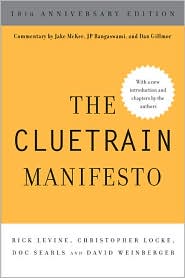
Cluetrain 10th Anniversary edition
Cluetrain 10th Anniversary
Everything Is Miscellaneous
Small Pieces cover
Small Pieces Loosely Joined
Cluetrain cover
Cluetrain Manifesto
My face
Speaker info
Who am I? (Blog Disclosure Form) Copy this link as RSS address Atom Feed

December 2, 2008

[Berkman] Chris Dede on Immersive interfaces and education

Chris Dede is giving a Berkman lunchtime talk on using the new immersive environments. [Note: I’m live-blogging, which means IO’m not checking for errors, and that I’m missing stuff, getting things wrong, paraphrasing, etc.]

Why immersion? “Immersion is the subjective impression that one is participating in a comprehensive, realistic experience.” Immersion can help learning by providing multiple perspectives, situated learning, and shifts in identity. Chris is interested in how we can make meaning out of complexity, using immersive interfaces in middle schools.

He sketches three types of immersive interfaces:

1. Augmented reality. You’re in the real world — you’re not an avatar — with a device that lets you overlay the real with the virtual. Entertainment and education can be anywhere. He shows a bit of his middle school math curriculum called “Alien Contact,” which uses mobile phones. Aliens have landed outside the school. The students explore the area (the real physical area), interviewing virtual characters and using mathematical and literacy skills. Students see different pieces of evidence based on their roles (FBI agent, linguist, computer expert, chemist), and have to collaborate to see the entire picture.

2. Alice-in-Wonderland, like SecondLife. Chris’ project has its own MUVE (multi-user virtual environment). This is partial immersion because you’re sitting in front of a monitor. He shows a clip about RiverCity. It’s a 3D simulation of a 1880 town battling infectious diseases. The students have to figure out what’s going on, learning the scientific method.

Situated learning — e.g., a medical internship — i s another example. You learn by doing and by watching people who know what they’re doing. Chris is using a virtuated environment to created a distributed-learning community.

3. Full immersion. Head-mounted displays. E.g., NewtonWorld, where you can see how balls interact, varying mass, velocity, etc. Similarly for MaxwellWorld.

He opens up the discussion.

Q: Would this work with university students? More sophisticated students?
A: A virtual ecosystem can be easy enough for a middle school student, but you can also imagine one complex enough for a university or graduate student.
Q: Complex environments are hard to create.
A: The good news is that the tools are being created by the entertainment industry. We then re-fit them our purposes. E.g., the authoring shell for the game Oblivion is very powerful. Within 5 years we’ll probably be able to build mixtures of emergent behaviors and scripted behaviors that are really compelling.

Q: Why did you make RiverCity historically situated. Doesn’t that make less obviously relevant to the kids.
A: We needed our kids to be experts. Even the least sophisticated kid today knows more about medicine than the most sophisticated person in the 1800s. [I love this idea.] Also, I wanted to show you could teach multiple things at the same time: science, history, English…

Q: [jz] Harvard Libraries have an outpost in SecondLife but not in Wikipedia. There seems to be something about participating in virtual places. Do you think of Wikipedia as an immersive environment? What would it mean to make it so? And would it improve it?
A: Wikipedia doesn’t work for sensory immersion, actional immersion (being able to fly, e.g.), but it might for symbolic immersion (what you get late at night if you’re reading a horror novel), depending on what you’re reading about or co-creating. A better example might be a Harry Potter fan fiction site. You can imagine putting the Wikipedia for HP inside a virtual HP world — your HP avatar could write an entry in the inner Wikipedia. And would it be better? Lectures are generally better in the real world. But it’d take a lot of discussion to answer your question fully….

Q: Some manuscripts can only be experience in a group via a virtual environment.
A: Yes. You could set up a virtual museum exhibit that brings together works, and that might let you explore the artist’s world. Or, for Van Gogh, what the world looked like a schizophrenic.

Q: How can you keep up with the commercial environments so that the educational ones don’t look old fashioned?
A: It depends on what factors matter. In terms of fidelity, many studies show that you need high fidelity in the parts where the experience requires it — e.g., teaching how to read X-rays — but you can have low fidelity for the parts not directly related to what you’re teaching. If it’s engaging, users don’t care about the low fidelity. None of the 15,000 students who have used RiverCity have complained that it’s too cartoon like, even though it’s not even remotely as photo realistic as the games they play.

Q: Metrics?
A: All of these projects measure gains carefully. They’re research projects. Typically the research shows that if it’s well designed, you get gains in learning…which is what research shows for just about educational technique.

Q: [me] First, I love the idea that in RiverCity, students are treated as experts. How much of this would you do in a day? How much of this is the film strip break in the day?
A: It varies developmentally. For young children, I’d do very little. You learn over and under by crawling, not by having your avatar do it. As they get older, maybe 15-20% of the day? It depends on the topic, the age of the students, etc…For my courses, I’d use the virtual environment at the beginning to let them see the scope of the landscape. In the middle, they’d do a formative experience inside the virtual environment: Here’s what I understand so far. At the end, you’d do a summative experience.

Q: [ethanz] Have people done side by side studies of these environments and other creative interventions, including teachers putting in an enormous of creativity into changing a lesson plan. Your examples tell us about engaged teachers more than about virtual environments, perhaps.
A: It’s a question very relevant to policy. One of the considerations: RiverCity’s cost for 30 kids is about the same as for 3,000 kids. But even the most skilled teacher could give students the sense of going back in time. Where the world is not doing much more than lecturing, you’re right to be skeptical. How are we testing this claim? We have control conditions for RiverCity and Alien Contact. The control conditions are paper-based games. We found a strong difference in engagement. In RC, we found a big difference in learning; in AC we’re breaking even in learing, but it’s a first gen project.

Q: I teach law. You are expected to immerse students into being just, fair and convincing. That’s entirely inter-human. To what extent could this virtual, artificial interface enable the inter-human relation, or perhaps hinder it.
A: Immersive interfaces aren’t equally powerful for all subjects. I don’t know the answer to your question, but one of the thigns we can do in RC is have two people can be in the same room and have different experiences. E.g., you could build a pre-Civil War environment. Two avatars walk down the street together. They see the same things, but one is a slave and one is a slave-holder. That leads to an interesting conversation.

Q: [charlie nesson] Can you establish a transfer of skills from games to real world skills?
A: I’m skeptical about claims of far transfer. The evidence there is weak. I’m quite more convinced about near transfer. So, saying that you’re good at World of Warcraft and thus you’d be good as a lawyer isn’t going to get you too far. It might mean that you can make fast decisions, but WoW aggression probably doesn’t correlate with aggression in the courtroom. The first is a near transfer, and the second is a far transfer.
Q: Has there been a lot of research on this?
A: Not that I’ve found. Closest you get to this is the military that has evidence that military skills transfer to civilian life, and many of those skills are gained by simulation. [Tags: education teaching simulations secondlife chris_dede games learning avatars ]

Tweet
Follow me

Categories: Uncategorized Tagged with: avatars • conference coverage • education • games • learning • secondlife • simulations • teaching Date: December 2nd, 2008 dw

Be the first to comment »

September 7, 2008

Hacking the Trivial: Governor of Poker game

During the nine-hour plane ride from Amsterdam (after the 1.5 hr flight from Vienna) to Dallas, I figured out how to increase the amount of money you have in the game the Governor of Poker by flipping a bit in the save game file.

I did this because I’ve had a little trouble with the game. It’s a cute Texas hold’em game in which you progress through Texas based on your winnings. Quite possibly because of the oddities of my system, the game several times acted as if it had lost the save file. So, now I copy the save file after every game. But I also was annoyed at having lost the three or four days of “work” acquiring a lump o’ cash. (Please note that in this game, you play against the computer for purely fictitious money. Also, it’s a Windows game I’m running under VMware on my Mac.) So, I spent time on the plane figuring out which bytes in the save file encode the amount of money you have in the game.

So, here are some rough instructions on how to do this. Or, quite likely, totally screw up the game.

The save file is “GovernorOfPoker.sol,” which will be in something like: C:\Documents and Settings\[username]\Desktop\E4VWWMXNC:\Documents and Settings\{username}\Application Data\Macromedia\Flash Player\#SharedObjects\TS2J3QVB\localhost. Make a copy of it and put it somewhere safe.

Did you remember to make a copy? You’re about to edit the save file, and a single wrong byte can trash it.

Get yourself a hex editor. PSPad is free and works well. Open up the save file in it. (Did you remember to make a copy first?)

Look for the word “money” towards the end of the file. The byte you want is 3 bytes after the end of that word. In the version I have, the key byte is #7959.[LATER: The file size changes as you play the game, so there’s no predicting which byte is at issue. Instead, go to the end of the file and look backwards for “money” or “m.o.n.e.y”, depending on how your hex editor displays it.] Change it to “A” and you’ll have something like $3,000 available. Change it to “F” and you’ll have over $100,000. But I haven’t experimented enough to know exactly what the rules are. There’s clearly another byte or two involved in recording the amount. So, you have have to do some experimenting.

Also, did you make a copy?

By the way, on the plane I also watched “Vantage Point,” which just gets more convoluted and less believable with each iteration, plus an hilarious episode of “Frasier” in which Daphne asks Niles to pretend to be her husband to discourage an old flame. [Tags: games governor_of_poker make_a_copy ]

Tweet
Follow me

Categories: Uncategorized Tagged with: entertainment • games • tech Date: September 7th, 2008 dw

77 Comments »

September 3, 2008

BioShock postmortem

I really enjoyed BioShock, and think that it took computer games an evolutionary step forward (well, if evolution had a direction). I thus was prepped to like this postmortem on the design of the game. Very interesting, and quite frank. No mention, though, of the disappointing ending of the game.

The Slashdot discussion of the article is almost entirely about BioShock’s famously onerous DRM, which the postmortem article doesn’t mention.

(The postmortem points to a fabulous downloadable collection of art from the game.)

[Tags: bioshock games ]

Tweet
Follow me

Categories: Uncategorized Tagged with: bioshock • entertainment • games Date: September 3rd, 2008 dw

Be the first to comment »

August 27, 2008

Yet another way to avoid working

Fantastic Contraption is a free, simplified riff on the old Incredible Machine game. Your aim is to move a box into a zone by hooking together some wheels and sticks. It lacks the inventive motor elements of the older game (set the balloon to pop to lower the basket that has the mice that will cause the elephant to move onto the scale that flips the lighter that sets off the rocket, etc.), but its simplicity also works in its favor.

You may have a child that will love it. You might also. If not, there are bunches of other games on the site.

[Tags: games ]

Tweet
Follow me

Categories: Uncategorized Tagged with: entertainment • games Date: August 27th, 2008 dw

1 Comment »

August 24, 2008

The Google Magic 8 Ball

Yesterday afternoon, my assorted nieces and nephews clustered around the ol’ laptop, googling their name + the word “needs,” and reading aloud the amusing results.

Amusing!

[Tags: google games ]

Tweet
Follow me

Categories: misc Tagged with: digital culture • games • google • misc Date: August 24th, 2008 dw

Be the first to comment »

August 13, 2008

Model bodies

Check out NaturalMotion’s show reel for Endorphin, software that models the human body without using motion capture devices. Given sufficiently fast processors and ample memory, it was just a matter of time before algorithms started out-doing putting tracing paper over matter.

[Tags: animation games ]

Tweet
Follow me

Categories: Uncategorized Tagged with: animation • entertainment • games Date: August 13th, 2008 dw

1 Comment »

May 27, 2008

Moral games

Gene Koo sets up the problem: We are wired to react morally to the people we see, but we have trouble extending that to people at a distance. Yet, we have to broaden our moral embrace if we are to make it through another century. So, Gene wonders whether games might help:

Computer games offer at least two possible responses to our collective human predicament. First, they can open players’ eyes to the moral implications of systems by experimenting with them and witnessing the results. Games might offer moments of reflection and of epiphany, connecting personal morality with systemic awareness. A player might see how tweaking health care policies affects a family’s lives, or how environmental regulation could shape the destiny of a polar bear. Games might lead people to begin to see a soul within the machine.

And perhaps systems might begin to learn lessons from game design. Why must the computer systems that exercise more and more control over our daily lives be morally inert? If computer games — mere software — can lead players to weep, perhaps the mechanization of our world needn’t be soulless…

Gene’s not saying that games will save us. He’s suggesting that morally designed games might help.

So, before you point to all the games that seem to abrade our conscience — Grand Theft Auto, just about every first person shooter ever made, even PacMan if you look at it from the point of view of the dots — you might want to note that The Sims has sold 100 million copies.

[Tags: games morality gene_koo ]

Tweet
Follow me

Categories: Uncategorized Tagged with: games • gene_koo • morality • uncat Date: May 27th, 2008 dw

2 Comments »

April 17, 2008

CorporateSpeak: The Game

This BoingBoing gadget lets you smash corporate shillery in a most amusing way.

[Tags: marketing games boingboing ]

Tweet
Follow me

Categories: Uncategorized Tagged with: boingboing • cluetrain • games • humor • marketing Date: April 17th, 2008 dw

1 Comment »

April 16, 2008

The politics of playing cards

Thanks to my relentless ego-surfing, um, I mean my participating in the ongoing conversation that is the Web, I came across a rough draft of a course paper by Devin Dadigan about the racism and sexism implicit in playing cards, — which, apparently are ordered the way they have been since the 14th century. Kings beat queens, and, the black queen is an especially disastrous card in several games.

At first I thought Devin’s hypothesis about race was problematic, because I thought clubs are sometimes taken as the highest suit, even though Devin says that black cards represent labor and slaves. (That link seems incontestable in America where “spade” has been a demeaning — and occasionally hip — term for African-Americans.) Wikipedia, however, says that when suits are ranked, clubs sometimes come first because the ranking is done alphabetically. Ah, the hidden power of alphabetization! Why, it even cures racism!

Fascinating fact: According to the paper, the ascent of the ace as the highest card “was hastened in the late 18th century by the French Revolution, where games began being played ‘ace high’ as a symbol of lower classes rising in power above the royalty.”

[Tags: cards games history devin_dadigan ]

Tweet
Follow me

Categories: Uncategorized Tagged with: cards • devin_dadigan • games • history • uncat Date: April 16th, 2008 dw

9 Comments »

February 9, 2008

Crysis game of the year? Hah!

Finishing Crysis has confirmed my disappointment that PC Gamer chose it as Game of the Year, especially with Bioshock as a contender. Jeesh, what’s a game got to do to win Game of the Year around here?

Crysis was good. The graphics are the most photo realistic ever, even though I had to stop ’em down and revert to DX9 to run the game — and this is with a high end machine and graphics card. But, the plot is totally familiar, the enemies were derivative — Matrix-y vermin, HalfLifey striders — , and the game play was fun until it ran out of steam in the final acts where increasing the size of a boss replaces having a new idea. Overall, Crysis is good but not great, much less best of the year.

Bioshock, on the other hand, was far more creative. It was an improbable yet convincing world, beautifully rendered, with fantastic sound and terrific comic acting. It was involving not just as a narrative but as a place. Yes, there were some nits ,the DRM was especially insulting, and the gameplay was occasionally off — solving the pipe flow puzzle gets tiresome after the first couple of dozen times — and the very last scene sort of sucked, but Bioshock violated rules in the name of creativity and actually had some ideas in it.

In the fullness of time — now — the crowning of Crysis over Bioshock will be seen as the folly it is.

PS: The Orange Box was also better than Crysis, and is officially your PC Gaming Value of the Year. [Tags: crysis bioshock orange_box pc_games games ]

Tweet
Follow me

Categories: Uncategorized Tagged with: bioshock • crysis • entertainment • games Date: February 9th, 2008 dw

4 Comments »

« Previous Page


Creative Commons License
This work is licensed under a Creative Commons Attribution-NonCommercial-ShareAlike 3.0 Unported License.
TL;DR: Share this post freely, but attribute it to me (name (David Weinberger) and link to it), and don't use it commercially without my permission.

Joho the Blog uses WordPress blogging software.
Thank you, WordPress!