



logo
EverydayChaos
Everyday Chaos
Too Big to Know
Too Big to Know
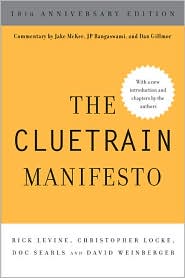
Cluetrain 10th Anniversary edition
Cluetrain 10th Anniversary
Everything Is Miscellaneous
Small Pieces cover
Small Pieces Loosely Joined
Cluetrain cover
Cluetrain Manifesto
My face
Speaker info
Who am I? (Blog Disclosure Form) Copy this link as RSS address Atom Feed

July 1, 2014

[2b2k] That Facebook experiment

I have an op-ed/column up at CNN about the Facebook experiment. [The next day: The op-ed led to 4 mins on the Jake Tapper show. Oh what the heck. Here’s the video.]

All I’ll say here is how struck I am again (as always) about the need to leave out most of everything when writing goes from web-shaped to rectangular.

Just as a quick example, I’m not convinced that the Facebook experiment was as egregious as the headlines would have us believe. But I made a conscious decision not to address that point in my column because I wanted to make a more general point. The rectangle for an op-ed is only so big.

Before I wrote the column, I’d observed, and lightly participated in, some amazing discussion threads among people who bring many different sorts of expertise to the party. Disagreements that were not just civil but highly constructive. Evidence based on research and experience experience. Civic concern. Emotional connections. Just amazing.

I learned so much from those discussions. What I produced in my op-ed is so impoverished compared to the richness in that tangle of linked differences. That’s where the real knowledge lives.

Tweet
Follow me

Categories: free culture, social media, too big to know Tagged with: 2b2k • facebook • privacy Date: July 1st, 2014 dw

1 Comment »

July 2, 2012

How I became a creepy old man

I was checking Facebook yesterday afternoon, as I do regularly every six months or so. It greeted me with a list of friend requests. One was from the daughter of a colleague. So I accepted on the grounds that it was unexpected but kind of cute that she would ask.

Only after I clicked did I realize that the list was not of requests but of suggestions for people I might want to friend. So, now the daughter of a colleague has received a friend request from a 61 year old man she never heard of, and I’m probably going to end up on the No Fly list.

The happy resolution: I contacted my colleague to let him know, and he took it as an opportunity to have a conversation with his daughter about how to handle friend requests from people she doesn’t know, especially pervy-looking old men.

Tweet
Follow me

Categories: social media Tagged with: facebook • privacy Date: July 2nd, 2012 dw

3 Comments »

November 4, 2011

Draft: What’s new about social media?

I’m on a panel about “What’s Next in Social Media?” at the National Archives tonight , moderated by Alex Howard, the Government 2.0 Correspondent for O’Reilly Media, and with fellow panelists Sarah Bernard, Deputy Director, White House Office of Digital Strategy; Pamela S. Wright, Chief Digital Access Strategist at the National Archives. It’s at 7pm, with a “social media fair” beginning at 5:30pm.

I don’t know if we’re going to be asked to give brief opening statements. I suspect not. But, if so I’m thinking of talking about the context, because I don’t know what social media will be:

1. The Internet began as an open “address space” that enabled networks to be created within it. So, we got the Web, which networked pages. We got social networks, which networked people. We are well on our way to networking data, through the Semantic Web and Linked Open Data. We are getting an Internet of Things. The DPLA will, I hope, help create a network of cultural objects.

2. The Internet and the Web have always been social, but the rise of networks particularly tuned to social needs is of vast importance because the social determines all the rest. Indeed, the Internet is a medium only because we are in fact that through which messages pass. We pass them along because they matter to us, and we stake a bit of selves on them. We are the medium.

3. Of all of the major and transformative networks that have emerged, only the social networks are closed and owned. I don’t know how or if we will get open social networks, but it is a danger that as of now we do not have them.

Tweet
Follow me

Categories: net neutrality, social media Tagged with: facebook • google • social media • social networks Date: November 4th, 2011 dw

12 Comments »

October 18, 2011

Chris Poole is so right about identity

Jon Mitchell at ReadWriteWeb reports on a ten-minute talk Chris Poole (founder of 4chan and Canvas) gave at Web 2.0. Chris argues that Facebook and Google are getting identity wrong. “Identity is prismatic.”

Being confined to a single identity on the Web is like a wiki accepting only a single final draft, only far more tragic.

Tweet
Follow me

Categories: culture Tagged with: chris poole • facebook • google • identity • moot Date: October 18th, 2011 dw

1 Comment »

July 8, 2011

What is Google+ for?

Edward Vielmetti asked on Google Plus “What is Google+ for?” I thought Peter Kaminski‘s response was particularly insightful. (Quoted in full with Pete’s permission.)

The purpose of Google+ is to keep you within the Google web (as opposed to having you outside anybody’s web, or in someone else’s web). Where “web” used to mean the spidered collection of documents and files available via HTTP, but has grown to mean your Digital Life.

Google’s business is to mediate as much of your Digital Life as it can — similar to the way Microsoft’s business in the old days was to mediate as much of your Digital Office as it could (back in the day when Digital Life and Digital Office were nearly equivalent). The monetization model is completely different, of course; but the more of your Digital Life Google can mediate, the more they can monetize, and the more sticky the whole suite is. Google wants to be as ubiquitous as Microsoft used to feel.

(Google and Microsoft have also had altruistic goals of making the world a better place while running their business, but of course that means they have to be successful at business to be successful in their altruistic goals.)

Google has been pretty good at understanding how far Digital Life will reach into Real Life. Want to find out where you are physically and where you’re going? There’s a Google (Maps) for that. Want to watch millions of channels of video? There’s a Google (YouTube) for that. Want to talk to your friends, family and business associates on the phone? There’s a Google (Android, Voice) for that. Etc.

It took them a while to figure out that “socializing with friends” was a big part of regular folks’ Real Life, and then it’s taken them a while to figure out how to make a Google for that. But it looks to me like they got it right with Plus.

Bonus look at the other players in the game:

Apple: understands the idea of a Digital Life, but hampered by its long-term view that Digital Life would be built around digital assets (documents, apps, media), instead of Real Life.

Facebook: has a huge head start on mediating your Digital Life, because it’s built on socializing, which is a big part of regular folks’ Real Life. May or may not figure out there are other parts to it.

Microsoft: mediated most people’s Digital Life for a long time. Parts of it understand that there’s more to Digital Life than Digital Office. But they may die by milking their old cash cow (Innovator’s Dilemma) before succeeding in the new game.

Yahoo: accidentally, subconsciously, understood Digital Life early on. Couldn’t wake up and realize it consciously, gave away the race.

Tweet
Follow me

Categories: social media Tagged with: facebook • google • google plus • sns • social nets Date: July 8th, 2011 dw

12 Comments »

December 15, 2010

Face of the Year

Time Magazine’s choice of Person of the Year is meaningless as data, but meaningful as metadata. Picking one person as the most influential in a year is almost always just silly. No one takes it seriously except as a signifier of broader cultural currents.

This year it’s Mark Zuckerberg. That seems to me to be one of the many reasonable choices Time could have made. But I have two meta-comments.

1. I’m glad that Time took MZ over Julian Assange. Facebook is truly influential and important. WikiLeak’s importance is primarily symbolic, and it has been given that symbolic importance mainly by forces that want to use it as justification for killing what they don’t like about the Internet — its openness, its bottom-uppity character, its distrust of extrinsic controls…in other words, all that makes it the Internet.

2. The contrast the Time article draws between MZ and the portrait of him in The Social Network (a movie I did not care for) will, I hope, hurt the movie’s chances at the Oscars. It makes vandalism of Wikipedia’s biographies of living people look bush league.

(Lev Grossman’s cover story about MZ for Time is well worth reading.)

Tweet
Follow me

Categories: culture Tagged with: facebook • mark zuckerberg • moty • time • wikileaks Date: December 15th, 2010 dw

6 Comments »

November 30, 2010

[bigdata] Panel: A Thousand Points of Data

Paul Ohm (law prof at U of Colorado Law School — here’s a paper of his) moderates a panel among those with lots of data. Panelists: Jessica Staddon (research scientist, Google), Thomas Lento (Facebook), Arvin Narayanan (post-doc, Stanford), and Dan Levin (grad student, U of Mich).

NOTE: Live-blogging. Getting things wrong. Missing points. Omitting key information. Introducing artificial choppiness. Over-emphasizing small matters. Paraphrasing badly. Not running a spellpchecker. Mangling other people’s ideas and words. You are warned, people.

Dan Levin asks what Big Data could look like in the context of law. He shows a citation network for a Supreme Court decision. “The common law is a network,” he says. He shows a movie of the citation network of first thirty years of the Supreme Court. Fascinating. Marbury remains an edge node for a long time. In 1818, the net of internal references blooms explosively. “We could have a legalistic genome project,” he says. [Watch the video here.]

What will we be able to do with big data?

Thomas Lento (Facebook): Google flu tracking. Predicting via search terms.

Jessica Staddon (Google): Flu tracking works pretty well. We’ll see more personalization to deliver more relevant info. Maybe even tailor privacy and security settings.

Dan: If someone comes to you as a lawyer and ask if she has a case, you’ll do a better job deciding if you can algorithmically scour the PACER database of court records. We are heading for a legal informatics revolution.

Thomas: Imagine someone could tell you everything about yourself, and cross ref you with other people, say you’re like those people, and broadcast it to the world. There’d be a high potential for abuse. That’s something to worry about. Further, as data gets bigger, the granularity and accuracy of predictions gets better. E.g., we were able to beat the polls by doing sentiment analysis of msgs on Facebook that mention Obama or McCain. If I know who your friends are and what they like, I don’t actually have to know that much about you to predict what sort of ads to show you. As the computational power gets to the point where anyone can run these processes, it’ll be a big challenge…

Jessica: Companies have a heck of a lot to lose if they abuse privacy.

Helen Nissenbaum: The harm isn’t always to the individual. It can be harm to the democratic system. It’s not about the harm of getting targeted ads. It’s about the institutions that can be harmed. Could someone explain to me why to get the benefits of something like the Flu Trends you have to be targeted down to the individual level?

Jessica: We don’t always need the raw data for doing many types of trend analysis. We need the raw data for lots of other things.

Arvind: There are misaligned incentives everywhere. For the companies, it’s collect data first and ask questions yesterday; you never know what you’ll need.

Thomas: It’s hard to understand the costs and benefits at the individual level. We’re all looking to build the next great iteration or the next great product. The benefits of collecting all that data is not clearly defined. The cost to the user is unclear, especially down the line.

Jessica: Yes, we don’t really understand the incentives when it comes to privacy. We don’t know if giving users more control over privacy will actually cost us data.

Arvind describes some of his work on re-identification, i.e., taking anonymized data and de-anonymizing it. (Arvind worked on the deanonymizing of Netflix records.) Aggregation is a much better way of doing things, although we have to be careful about it.

Q: In other fields, we hear about distributed innovation. Does big data require companies to centralize it? And how about giving users more visibility into the data they’ve contributed — e.g., Judith Donath’s data mirrors? Can we give more access to individuals without compromising privacy?

Thomas: You can do that already at FB and Google. You can see what your data looks like to an outside person. But it’s very hard to make those controls understandable. There are capital expenditures to be able to do big data processing. So, it’ll be hard for individuals, although distributed processing might work.

Paul: Help us understand how to balance the costs and benefits? And how about the effect on innovation? E.g., I’m sorry that Netflix canceled round 2 of its contest because of the re-identification issue Arvind brought to light.

Arvind: No silver bullets. It can help to have a middleman, which helps with the misaligned incentives. This would be its own business: a platform that enables the analysis of data in a privacy-enabled environment. Data comes in one side. Analysis is done in the middle. There’s auditing and review.

Paul: Will the market do this?

Jessica: We should be thinking about systems like that, but also about the impact of giving the user more controls and transparency.

Paul: Big Data promises vague benefits — we’ll build something spectacular — but that’s a lot to ask for the privacy costs.

Paul: How much has the IRB (institutional review board) internalized the dangers of Big Data and privacy?

Daniel: I’d like to see more transparency. I’d like to know what the process is.

Arvind: The IRB is not always well suited to the concerns of computer scientists. Maybe current the monolithic structure is not the best way.

Paul: What mode of solution of privacy concerns gives you the most hope? Law? Self-regulation? Consent? What?

Jessica: The one getting the least attention is the data itself. At the root of a lot of privacy problems is the need to detect anomalies. Large data sets help with this detection. We should put more effort in turning the date around to use it for privacy protection.

Paul: Is there an incentive in the corporate environment?

Jessica: Google has taken some small steps in this direction. E.g., Google’s “got the wrong bob” tool for gmail that warns you if you seem to have included the wrong person in a multi-recipient email. [It’s a useful tool. I send more email to the Annie I work with than to the Annie I’m married to, so my autocomplete keeps wanting to send Annie I work with information about my family. Got the wrong Bob catches those errors.]

Dan: It’s hard to come up with general solutions. The solutions tend to be highly specific.

Arvind: Consent. People think it doesn’t work, but we could reboot it. M. Ryan Calo at Stanford is working on “visceral notice,” rather than burying consent at the end of a long legal notice.

Thomas: Half of our users have used privacy controls, despite what people think. Yes, our controls could be simpler, but we’ve been working on it. We also need to educate people.

Q: FB keeps shifting the defaults more toward disclosure, so users have to go in and set them back.
Thomas: There were a couple of privacy migrations. It’s painful to transition users, and we let them adjust privacy controls. There is a continuum between the value of the service and privacy: all privacy and it would have no value. It also wouldn’t work if everything were open: people will share more if they feel they control who sees it. We think we’ve stabilized it and are working on simplification and education.

Paul: I’d pick a different metaphor: The birds flying south in a “privacy migration”…

Thomas: In FB, you have to manage all these pieces of content that are floating around; you can’t just put them in your “house” for them to be private. We’ve made mistakes but have worked on correcting them. It’s a struggle of a mode of control over info and privacy that is still very new.

Tweet
Follow me

Categories: too big to know Tagged with: 2b2k • bigdata • facebook • google • privacy Date: November 30th, 2010 dw

1 Comment »

July 20, 2009

Facebook at 250M huddled masses

Brian Solis reports on Facebook’s claim of 250M souls, as well as on the social networking sites popular in various parts of the world.

Simply the map of the global distribution of Facebook users makes clear the danger of building our social nets in proprietary systems that don’t start from the premise that first they must interoperate.

[Tags: facebook social_networks ]

Tweet
Follow me

Categories: Uncategorized Tagged with: bridgeblog • digital culture • everythingIsMiscellaneous • facebook • social_networks Date: July 20th, 2009 dw

1 Comment »

May 5, 2009

[berkman] Elizabeth Losh on Obama’s use of social media

Elizabeth Losh of UC Irvine is giving a Berkman lunchtime talk called “From the Crowd to the Cloud: Social Media and the Obama Administration.” She looks at “institutions as digital content creators.”

NOTE: Live-blogging. Getting things wrong. Missing points. Omitting key information. Introducing artificial choppiness. Over-emphasizing small matters. Paraphrasing badly. Not running a spellpchecker. Mangling other people’s ideas and words. You are warned, people.

She begins by pointing to a Congressional hearing in which someone unknowingly referred to some footage from Battlefield 2, in which you can play on either side, as proof that Jihadists are recruiting on the Net.

In the 2008 election, McCain had a series of rhetorical disasters when using social media, Liz says. McCainSpace, she says, was “an unmitigated disaster.” She also points to the mashups done with greenscreen videos of McCain. The Obama campaign, on the other hand, used social media well. It used low bandwidth interactivity effectively (e.g., online tax calculator). And third parties injected memes.

So, how much change has happened now that Obama is president?

It’s not all that difference. She compares 4parents.gov, an abstinence site put up by the Bush administration. The Obama administration has kept it pretty much the same, except that some of the conversation starters have been slightly modified. Ready.gov/kids has moved from featuring mountain lions as the guardians of children (an odd choice, says Liz) to Muppets. The Bush admin did some health initiatives using SecondLife, she points out.

How much privacy? Whitehouse.gov uses YouTube.com and has responded to concerns about the privacy implications. When you leave a .gov domain, it signals that you are leaving a protected area. Liz wonders about the efficacy of using disclaimer language, however. At Change.gov, if you decided to apply for a job, you start getting a lot of emails from the transition team.

The State Dept. Blog, “unfortunately named DipNote,” has been expanded. They twitter now. On Twitter, they’ve responded to citizen questions. E.g., Rebecca MacKinnon pointed out that a Chinese citizen had been arrested. The State Dept. tweeted that they were looking into it, although that tweet was deleted from Twitter shortly afterward. Rebecca also noticed that State Dept. photos posted on Flickr were marked as copyrighted; State now gives them Creative Commons licenses. Liz points to the CC notice and the DMCA takedown notice on the same page at Change.gov and says that there we see the manifestation of the conflict between acknowledging the culture of sharing and the support of existing rules.

She worries about the “googlization of government,” i.e., commercial entities hosting info that is part of the public record. E.g., gov’t sites that use Google Maps.

At Recovery.gov, you are encouraged to “share your story.” But what happens to those comments? How are they archived? Which ones will be displayed. They say in six months they’ll start posting that material, but it’s not clear how.

Q: [me] Whitehouse.gov has started posting at Facebook where people can comment…
A: And this is a disaster for archiving.
Q: What would you do with comments at Whitehouse.gov blog?
A: I’d like to see moderated comments. I do understand that there are limited government resources. Creating digital versions of Congressional records would maybe be a better way to spend the money.

Q: By going onto Facebook, the Admin is reaching out into civic society. That conversation would have been in coffee shops and not part of the public level. So maybe this shouldn’t be archived. How do we draw the lines as the lines between public and private are being blurred?
A: It’s a complicated thing. Suppose there are responses from officials to comments on FB? These are always difficult issues. [Paraphrasing!]

Q: Does government data include the back and forth between citizens? If we say it’s part of the public record, the gov’t won’t be able to participate, or build helpful stuff, as quickly. Would we want an archived federal Twitter that was crappy but kept a permanent record? Should the gov bring more of these social tools in house, or use existing, commercial sites and give up on including everything in the permanent record?
A: I tend toward wanting more stuff in public and archived. Let’s think about harvesting some of the discourse going on in the crowd.

Q: It seems like they’re doing lots of experimentation without the backbone of a full, stable archive behind it. Is this experimentation is leading us into an unknown state…?
A: The Archive is archiving some material on third party sites. The WhiteHouse.com blog is impersonal and press-release-y, while the TSA blog (started under Bush) is folksy. So, some of these experiments have histories.

A: I’d give Recovery.gov low marks for transparency because the PDFs are packed with charts that are not reusable.

Q: Social media is relatively new but and people express things that they don’t want known 5 years later…
A: A student applying for a job as a police officer found that they looked at his FB page and the pages of his friends. In the old days, they would have called his friends and asked questions.
Q: We’ve shifted the line between public and private life. Are we going to be able tor retract things from the public record?
A: That will be an issue.

Q: Any examples of the next frontier or participation, namely direct democracy
A: They still count emails. It’s quantitative, not qualitative. I worry about pseudo-interactivity, such as town hall meetings and the use of the Internet for political spectacle. That’s why I worry about these “share your stories” sites.

Q: During the Malagasi coup, people in Madagascar started talking about the deposed president finding sanctuary in the US Embassy, using Twitter. That could have flash-mobbed the embassy. Within 7 mins, the US embassy had responding, tweeting that the rumor was false. Can we give Obama a little bit of a break? All of us engaged in social media will screw up dozens of times …
A: That’s why we shouldn’t be cheerleaders. “I’m impressed by many of the social media efforts, but I think this form of criticism is important to do.”
Q: How do we encourage people to experiment in these spaces? As people go into these tools, they’re inept at first. At what point does the criticism discourage government officials from experimenting?
A: Many of my criticisms are that they’re not doing enough. Not enough commenting, with data representation, experimenting with new forms of participation.

Q: How much of out-of-the-box thinking are they doing with social media?
A: Theyre usually using them the way people already do. I wish they’d be more experimental.

Q: A crowd consists of the people who are uninformed. Government is about managing uncertainty. But if the info you get is biased and uninformed, you can’t manage. What’s the role of the crowd?
A: I don’t take as dark a view of the crowd. You can create political spectacles where a crowd is just a display, but you can get more participatory forms. There can be smart mobs. There are ways they can participate that are meaningful. The Obama admin is trying to take advantage of social occasions that are oriented around civic identity, not persuasion. “As a rhetorician, this is an interesting administration to watch.”

Q: Are Republicans inherently bad at social media?
A: Not at all. Sam Brownback had a great Web site. It does not divide easily along partisan lines.
Q: It depends in part on the demographics of the party. Libertarians have an incredible presence on line.
Q: Markos Moulitas says that Republican’s political philosophy leads them to be uncomfortable with bottom-up media…
A: Republicans do seem to like talk radio, where only a few get to participate.

Q: There was a time when there were a small number of leftwing political blogs and they bemoaned the fact that they had so little Web presence compared to conservative and libertarian blogs, around 2002-3. The populist element is present in all parties and drives a lot of social media. Some believe that the Dean campaign derailed because it thought the comments on its blog were representative of the world…
A: The postmortems are still being done.

Q: I’m not sure how I feel about the gov’t investing enough in social media to do it well. Experimentation is great, but totally botching it at the federal level isn’t good for anyone…
A: Good search on gov’t websites should be a top priority. To get all of Bush’s signing statements, you’d have to know to search on “shall construe.”

Q: Don’t you need a proprietary company to provide those services?
A: We need to be asking questions. [Tags: egovernment egov e-gov social_media facebook twitter transparency ]

Tweet
Follow me

Categories: Uncategorized Tagged with: e-gov • egov • egovernment • facebook • social networks • transparency • twitter Date: May 5th, 2009 dw

1 Comment »

May 3, 2009

Whitehouse.gov turns on the comments. Sort of.

To me, the coolest thing about WhiteHouse.gov going all social media on us is not that it shows that the White House knows about this stuff, or even that it understands that we now want the news to come to us. It’s that at the White House Facebook page, the comments are turned on.

I do understand why the WhiteHouse.gov site has been reluctant to allow us to leave comments on the official site. Oh, sure, you can fill out a form and submit it, but this knowingly commits the Fallacy of Scale, i.e., believing that anyone is going to read your message. We want at least to be able to read one another’s messages. But, I assume the staff is afraid that open commenting on White House blog posts will enable situations that are sticky beyond escape. What do you do when people get racist, anti-Muslim, and all around stupid? There are answers, but none are as good (from the White House media point of view) as not enabling the problem in the first place.

So, now WhiteHouse.gov is cross posting to its Facebook page. If you want to comment, go there. Because it’s not the White House’s site, trashy comments don’t littering the White House lawn. Facebook allows WhiteHouse.gov to distance itself sufficiently from the commenters to enable commenting. It’s a great step forward.

The next step: WhiteHouse.gov should respond to some of the comments, either in the comments area or in blog posts themselves.

Meanwhile: Well done, WhiteHouse.gov! Well done.

[Tags: white_house whitehouse.gov egov e-gov cluetrain e-government blogging facebook ]

Tweet
Follow me

Categories: Uncategorized Tagged with: blogging • cluetrain • digital culture • e-gov • e-government • egov • facebook • white_house Date: May 3rd, 2009 dw

15 Comments »

« Previous Page | Next Page »


Creative Commons License
This work is licensed under a Creative Commons Attribution-NonCommercial-ShareAlike 3.0 Unported License.
TL;DR: Share this post freely, but attribute it to me (name (David Weinberger) and link to it), and don't use it commercially without my permission.

Joho the Blog uses WordPress blogging software.
Thank you, WordPress!