


logo
EverydayChaos
Everyday Chaos
Too Big to Know
Too Big to Know
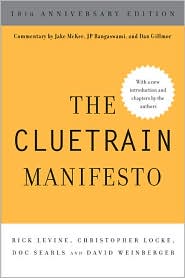
Cluetrain 10th Anniversary edition
Cluetrain 10th Anniversary
Everything Is Miscellaneous
Small Pieces cover
Small Pieces Loosely Joined
Cluetrain cover
Cluetrain Manifesto
My face
Speaker info
Who am I? (Blog Disclosure Form) Copy this link as RSS address Atom Feed

April 13, 2009

New criteria for academic recognition

The University of Maine has approved new guidelines for tenuring and promoting academics [later:] in the New Media program (although see the comments for a complexification of this). The new guidelines allow crediting an academic for contributing to social media.

This the right thing to do not only because it is a more realistic assessment of an academic’s worth. It’s also the right thing to do because it helps to build the value of the network. If knowledge and expertise are becoming properties of the network, it is the social responsibility of our institutions to encourage the enhancement of that network.

[Tags: social_media social_networks academics universities scholarship expertise ]

Tweet
Follow me

Categories: Uncategorized Tagged with: academics • digital culture • education • everythingIsMiscellaneous • expertise • knowledge • scholarship • universities Date: April 13th, 2009 dw

7 Comments »

March 26, 2009

Data in its untamed abundance gives rise to meaning

Seb Schmoller points to a terrific article by Google’s Alon Halevy, Peter Norvig, and Fernando Pereira about two ways to get meaning out of information. Their example is machine translation of natural language where there is so much translated material available for computers to learn from, which (they argue) works better than trying to learn from attempts that go up a level of abstraction and try to categorize and conceptualize the language. Scale wins. Or, as the article says, “But invariably, simple models and a lot of data trump more elaborate models based on less data.”


They then use this to distinguish the Semantic Web from “Semantic Interpretation.” The latter “deals with imprecise, ambiguous natural languages,” as opposed to aiming at data and application interoperability. “The problem of semantic interpretation remains: using a Semantic Web formalism just means that semantic interpretation must be done on shorter strings that fall between angle brackets.” Oh snap! “What we need are methods to infer relationships between column headers or mentions of entities in the world.” “Web-scale data” to the rescue! This is basic the same problem as translating from one language to another, given a large enough corpus of translations: We have a Web-scale collection of tables with column headers and content, so we should be able to algorithmically recognize clustering concordances of meaning.

I’m not doing the paper justice because I can’t, although it’s written quite clearly. But I find it fascinating. [Tags: data everything_is_miscellaneous natural_language translation semantic_web google ]

Tweet
Follow me

Categories: Uncategorized Tagged with: data • everythingIsMiscellaneous • expertise • google • infohistory • translation Date: March 26th, 2009 dw

1 Comment »

March 23, 2009

Andrew Lih on Wikipedia

Vincent Rossmeier has a solid interview at Salon with Andrew Lih, author of The Wikipedia Revolution.

I’m going to interview Andrew as a Berkman event on Wednesday night, 6pm at Griswold Hall, room 110, at Harvard Law. Andrew is certainly a partisan, but he’s also an insider whose book is quite candid and direct about troubling episodes in Wikipedia’s history. I enjoyed his book and look forward to talking with him. (He and I will probably talk for 30 mins, and then we’ll open it up.)

[Tags: wikipedia andrew_lih ]

Tweet
Follow me

Categories: Uncategorized Tagged with: digital culture • everythingIsMiscellaneous • expertise • knowledge • wikipedia Date: March 23rd, 2009 dw

Be the first to comment »

March 17, 2009

[berkman] Jeff Howe on crowd sourcing

Jeff Howe of Wired is giving a Berkman lunchtime talk on his book Crowd Sourcing. (He coined the term in 2006.) [Note: I’m live blogging, making mistakes, missing stuff, paraphrasing inappropriately, etc.]

From the beginning, he says, he’s been ambivalent about crowd sourcing. His book is a series of stories showing crowdsourcing’s promise and perils. The book is short on quantitative data, he says. As he was finishing up the edits, he came across a survey of 650 iStockPhoto.com photo contributors. iStock was one of Jeff’s main examples, a stock photo agency that undercut competitors by 99%. They were able to do this because amateur photographers were willing to upload entire libraries of their photos. iStock culled them. iStock runs its corporate decisions past the community. The survey showed that contributors had a rich mix of motivations. He’d like to revisit this question.

Jeff gives his 45 minute book talk in 20 mins: He got interested in crowdsourcing by watching Myspace. “User generated content” doesn’t begin to tap the change that’s taking place. (Plus, he adds, he hates the phrase.) He spent a night searching for user-generated anything to show that it was about more than teenagers making “content.” E.g., John Fluevog Open Source Shoeware names shoes after designs contributed by users. He wrote an article for Wired in June 2006. The term took off.

As an example, he tells the story of the Two Jakes who created a crowdsourced t-shirt company, threadless.com. It created a community of designers and people who like to vote on designs. Revenues in 2007 topped $30M. The community provides the designs, does the marketingt, and Threadless has a mechanism that lets them gauge how much they need quite accurately.

iStockPhoto was bought by Getty, and revenues have continued to climb…over $100M in 2008, with 50% profit margin.

Another example: The way amateur ornithologists have transformed the way ornithology works, Current.tv, the Elements restaurant in DC…

Why did crowdsourcing happen? Lots of amateurs, open source, tools, online communities. The cardinal rule of crowdsourcing: “Ask not what your community can do for you, etc.”

Jeff ends by asking about the study of iStock contributions’ motivations. 80% of iStockers religiously visit the site. The study shows the primacy of the financial motivation. Only 4% of the contributors make their primary living off of photography. The forum gets 37 posts per minute. 80% consider their work profitable, and 20% consider it extremely profitable. iStockers are largely not out to make friends or to network with others. iStockers are unsure that other iStockers can be trusted. This runs counter to how the company portrays them.

Q: I just had a logo made for $250 through LogoTournament. 30-40 designers worked on it from all over the world. The contestants all see one another’s designs.
A: Anectodotally, people seem to love it. There’s also CrowdSpring and 99Designs.

I used worth1000 for cover design. The Berkman folk loved it, but when I posted about it, I got flamed.
A: I understand that crowdsourcing is disruptive. It’s an emotional subject. Creatives can shape the transformation by embracing it.

Q: Your examples largely focused on highly creative forms of work. People do these things on their own as hobbies. How about crowdsourcing that has people transcribing podcasts via MechanicalTurk. Are these two types of crowdsourcing the same phenomenon?
A: MechanicalTurk is for repetitive, boring tasks. I don’t know how to encompass this. This makes the motivation for crowdsourcing more complex. That doesn’t dismay me.

Q: Is the difference about passion?
A: My catchphrase is that passion is the currency of the 21st century.

Q: [me] You position this as a contradiction. But it’s not if you define crowdsourcing as the action of a crowd, etc., and stir in economics: Those with leisure will do it for passion, while the rest will do more boring tasks for money. Unless what matters to you, and to the media that took it up, is that it’s a statement about human motivation.

Q:[eszter] You’re putting too much faith in the study. It’s only 1% of users and the methodology isn’t necessarily rock solid.
A: I called iStock’s founder and he has the same problems with the study.

Q: When I got the book, what was exciting was the possibility of solving altruistic problems. Do you have any examples?
A: GlobalVoices. Transcription services from a mobile phone for nonprofits.

Q: ReCaptcha is a great example. Also, spamornot.org.

Some of the crowdsourced stock photo sites are scams.

Q: Is crowdsourcing exploitative?
A: Sure could be. Professional stock photographers certainly think so. [Tags: berkman crowd_sourcing everything_is_miscellaneous ]

Tweet
Follow me

Categories: Uncategorized Tagged with: berkman • business • cluetrain • digital culture • everythingIsMiscellaneous • expertise Date: March 17th, 2009 dw

1 Comment »

March 13, 2009

Jon Stewart: Squirmatastic righteousness

I thought Jon Stewart’s interview with Jim Cramer last night was a righteous misfire. Stewart was on his high horse, but Cramer was on his little Shetland pony. The result: It was hard to watch.

Stewart was making an important, broad point: Mainstream financial journalism as embodied by CNBC fails the most basic tests of journalism overall. These folks knew better, but give us bread and circuses. Right on, Jon

But feisty, cocky Cramer came onto the show as a Stewart fan, and just kept agreeing and apologizing. I thought ultimately that was pretty disingenuous of Cramer, but it left Stewart looking like a bully. We wanted to see Stewart tear into William Randolph Hearst, but Hearst sent Dear Abby in his place. Except — to mess up the metaphor — Cramer does epitomize CNBC’s tabloiding of financial news, Cramer is a financial insider who knows better, and Dear Abby would have put up more of a fight.

[Tags: jon_stewart jim_cramer cnbc media journalism financial_news ]


You can see the entire, unedited interview here.


The Daily Show runs an anagram contest. The phrase to be anagrammed at the moment is: “Envoys to Afghanistan and Iraq Are Named”

Here’s my best attempt: “On the QT, Iran damns any gain of area saved”

And yours?

Tweet
Follow me

Categories: Uncategorized Tagged with: business • cnbc • culture • entertainment • expertise • journalism • media Date: March 13th, 2009 dw

5 Comments »

February 27, 2009

Beware the Military-Halitosis Complex

Cold war, the cult of expertise, the broadcast metaphor, scientism, chaste kissing…why this one’s got it all!

[Tags: certs advertising expertise ]

Tweet
Follow me

Categories: Uncategorized Tagged with: advertising • certs • culture • expertise • marketing • science Date: February 27th, 2009 dw

5 Comments »

May 20, 2008

Libguides … letting librarians be librarians!

I’m about to run for an airport (this is probably the single phrase I utter the most in the course of a month, alas), so I only had time to take a quick look at Libguides, but it looks very interesting. It aims to let librarians (and others) share their wisdom and insight, while engaging the community of readers. Interesting! (Thanks to Karen Schneider for the link, via a tweet. And, congratulations to Karen on her new job!)

[Tags: libraries metadata expertise everything_is_miscellaneous ]

Tweet
Follow me

Categories: Uncategorized Tagged with: everythingIsMiscellaneous • expertise • libraries • metadata Date: May 20th, 2008 dw

1 Comment »

« Previous Page


Creative Commons License
This work is licensed under a Creative Commons Attribution-NonCommercial-ShareAlike 3.0 Unported License.
TL;DR: Share this post freely, but attribute it to me (name (David Weinberger) and link to it), and don't use it commercially without my permission.

Joho the Blog uses WordPress blogging software.
Thank you, WordPress!