



logo
EverydayChaos
Everyday Chaos
Too Big to Know
Too Big to Know
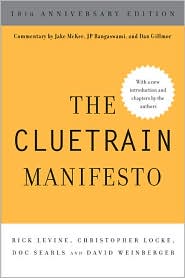
Cluetrain 10th Anniversary edition
Cluetrain 10th Anniversary
Everything Is Miscellaneous
Small Pieces cover
Small Pieces Loosely Joined
Cluetrain cover
Cluetrain Manifesto
My face
Speaker info
Who am I? (Blog Disclosure Form) Copy this link as RSS address Atom Feed

June 18, 2009

Why I love the Web, Reason #1375

Yesterday, I was sitting in the comfy chair, waiting for the dentist to come back with a larger mallet, browsing around on my Blackberry (“Your Knothole to the Web!”). I settled on part 5 of Akma’s series on exegesis. I like Akma, I’m interested in how we interpret texts, Akma’s Christian perspective deeply respects its differences with others, Akma is a genuine scholar, and he is a lovely, funny writer. What could be bad? Nothin’ that doesn’t have the word “dentist” in it!

So, there I am, in a three-minute interstice. Before the Web, I’d have been contemplating my aching stub of a tooth. Now I’m getting to spend time with a wise friend talking about something I barely understand. It feels like the Web has made Time itself better.

Sure, I’m just as likely to have clicked on a link to some gossip or a joke. Telling you about Akma served my twin nefarious purposes of pointing you at his series on exegesis and making me sound smart by reference. But, while the Web is not ubiquitous, it’s worth remembering how wonderful it is to for those of us who have ubiquitous access to it. That’s all. Just a little moment of thanks.

[Tags: misc everything_is_miscellaneous ]

Tweet
Follow me

Categories: misc Tagged with: digital culture • everything_is_miscellaneous • philosophy Date: June 18th, 2009 dw

1 Comment »

Weak copyright spurs creativity

Michael Geist — Canada’s free-culture bulldog — summarizes a Harvard Business School working paper by economists Felix Oberholzer-Gee and Koleman Strumpf “File Sharing and Copyright” that argues that the inability to strictly enforce today’s draconian and clinically insane copyright laws has in fact benefited society. It’s been slashdotted.

Tags: copyright copyleft everything_is_miscellaneous

Tweet
Follow me

Categories: Uncategorized Tagged with: copyleft • copyright • culture • digital culture • digital rights • everything_is_miscellaneous Date: June 18th, 2009 dw

1 Comment »

June 12, 2009

Newsy is meta-newsy

Newsy, a project in collaboration with Univ. of Missouri’s Journalism School, pulls together a half-dozen media reports on a topic, stringing them together with their own reporter-at-a-desk commentary. The sources include mainstream news and less mainstream news. For example, here’s Newsy’s meta-coverage of China’s new Net blockage:

Newsy is a manual curation and production project. At least during this beta phase, it seems to be doing one or two a day, which means they may have more luck getting their stories embedded elsewhere than in drawing a regular crowd to their own site. In fact, the site has announced a syndication deal with Mediacom to provide stories for mid-Missouri cable tv subscribers. (The project is also probably a Fair Use lawsuit magnet, unfortunately.)

[Tags: media news missouri global_voices everything_is_miscellaneous newspapers journalism copyright copyleft fair_use ]

Tweet
Follow me

Categories: Uncategorized Tagged with: copyleft • copyright • everythingIsMiscellaneous • everything_is_miscellaneous • fair_use • global_voices • journalism • knowledge • media • missouri • news • newspapers Date: June 12th, 2009 dw

Be the first to comment »

June 9, 2009

Meaning-mining Wikipedia

DBpedia extracts information from Wikipedia, building a database that you can query. This isn’t easy because much of the information in Wikipedia is unstructured. On the other hand, there’s an awful lot that’s structured enough so that an algorithm can reliably deduce the semantic content from the language and the layout. For example, the boxed info on bio pages is pretty standardized, so your algorithm can usually assume that the text that follows “Born: ” is a date and not a place name. As the DBpedia site says:

The DBpedia knowledge base currently describes more than 2.6 million things, including at least 213,000 persons, 328,000 places, 57,000 music albums, 36,000 films, 20,000 companies. The knowledge base consists of 274 million pieces of information (RDF triples). It features labels and short abstracts for these things in 30 different languages; 609,000 links to images and 3,150,000 links to external web pages; 4,878,100 external links into other RDF datasets, 415,000 Wikipedia categories, and 75,000 YAGO categories.

Over time, the site will get better and better at extracting info from Wikipedia. And as it does so, it’s building a generalized corpus of query-able knowledge.

As of now, the means of querying the knowledge requires some familiarity with building database queries. But, the world has accumulated lots of facility with putting front-ends onto databases. DBpedia is working on something differentL accumulating an encyclopedic database, open to all and expressed in the open language of the Semantic Web.

(Via Mirek Sopek.) [Tags: wikipedia semantic_web everything_is_miscellaneous ]

Tweet
Follow me

Categories: Uncategorized Tagged with: everythingIsMiscellaneous • everything_is_miscellaneous • knowledge • metadata • semantic_web • web 2.0 • wikipedia Date: June 9th, 2009 dw

5 Comments »

June 5, 2009

New open access blog

Stuart Shieber, one of Harvard’s Open Access ringleaders, has started a blog on that topic. He says it’ll be occasional — maybe per week, not per day — and it promises to be reflective and important to those who care about making more of the world’s research and knowledge available to, well, the world. (Stuart is the director of Harvard’s Office for Scholarly Communication, and was one of the important voices in the push for Harvard’s open access initiatives.)

[Tags: open_access stuart_shieber harvard everything_is_miscellaneous ]

Tweet
Follow me

Categories: Uncategorized Tagged with: digital rights • education • everythingIsMiscellaneous • everything_is_miscellaneous • harvard • knowledge • libraries • open_access • stuart_shieber Date: June 5th, 2009 dw

Be the first to comment »

Bing, Google … and Kayak

I’ve been poking around Microsoft’s Bing. The short answer is that it’s not going to move me off of Google. Of course, my Google inertia is pretty much sleeping-hippopotamus-like at this point. Plus, Bing’s ripping off of Kayak.com (see below) has me pretty cheesed.

Bing does some useful and clever things. But, I think some of the coverage has actually undersold Google. For example, Hiawatha Bray in the Boston Globe, whose writing I like a lot, today opens his review with the clever idea of searching for “google” at Bing and for “bing” at Google. He says Bing gives you a concentrated dosage of stuff about Google, while Google is all over the map with its “bing” results. Well, sure! “Google” is a made-up word with only one dominant meaning, so of course Bing gives you concentrated Google goodness. But “Bing” has lots of meanings, so Google’s right to return a mix of bingy words…with Microsoft Bing as the top result. Now, it is true that, as Hiawatha says, Microsoft gives its “Google” results in convenient tabs about Microsoft the corporate entity as well as listing sub-pages within the google domain, while Google’s top return on “Microsoft” only gives you a set of sub-pages. Microsoft looks more like WolframAlpha in that regard, and that’s a good way to look. But, Google also recently added easier ways to refine and expand searches (by timeline, by WonderWheel), etc., as Hiawatha points out. So, it really depends on what you’re trying to do. As always. (Type MSFT into either and you’ll get similar boxed stock data.)

Hiawatha writes: “Say you want the latest weather or traffic data. Google will tell you where to get it. Bing will just give it to you.” Not exactly. Type “weather” into either site and you get your local weather at the top, in pretty much identical displays. Google’s been doing that for quite a while. Likewise, type an airline and flight number and Google will tell you if it’s on time. But the “traffic” trick doesn’t work for Google. For that you have to go to Google Maps and click on the “Traffic” button (assuming you’re signed in). I wonder how long it’ll take Google to add Bing’s way of responding.

When it comes to shopping, Bing has some very nice touches. Well, primarily it has faceted classification — like NewEgg.com, and also using Endeca‘s engine? — that lets you sort a big list based on multiple criteria, using any of them in any order. Also, Bing has separate ratings by users and experts. On the other hand, Google found many many more copies of “splinter cell double agent” for sale than Bing did.

As many have noted, Bing’s handling of video searches is stellar. Hover over any of the thumbnails and the thumbnail starts to play. But, as someone pointed out — sorry, I lost the link — there seems to be no way to keep users from turning off the adult filter, which means that every school and library now has the greatest multi-screen porn browser ever invented. You can browse for porn videos on Google, of course, but with Bing it’s like watching all of them all at once. Well, maybe this will be like catching a kid smoking and making him smoke an entire pack all at once.

And now we come to Bing’s travel searches. OMG. Bing blatantly ripped off Kayak.com. [Disclosure: I’m old friends with the Kayak folks.] Just take a look at this post. If you’re going to rip off an innovative design, then at least innovate on top of it! Grrrr…

[Tags: bing google search wolframalpha everything_is_miscellaneous kayak ]


Later that morning: I just came across a very amusing article in Ars Technica about the new Google Squared app that puts info into tables. It makes clear why some sites (e.g., WolframAlpha) are willing to pay the price to gain the benefits of curation. (via Lee Baker, Berkman summer intern)

Tweet
Follow me

Categories: Uncategorized Tagged with: bing • everythingIsMiscellaneous • everything_is_miscellaneous • google • kayak • search • wolframalpha Date: June 5th, 2009 dw

16 Comments »

June 4, 2009

Why we have the Web, Reason #3546

Donald and Jill Knuth have posted about their collection of 962 photos of diamond shaped signs. The post points to two other sites about diamond shaped signs (1 2), as well as to a Google Maps mashup. To complete the webbiness, I heard about this via a tweet from nanofoo.

[Tags: everything_is_miscellaneous knuth diamond_shaped_signs signs traffic_signs road_signs ]

Tweet
Follow me

Categories: Uncategorized Tagged with: diamond_shaped_signs • digital culture • everythingIsMiscellaneous • everything_is_miscellaneous • knuth • road_signs • signs • traffic_signs Date: June 4th, 2009 dw

1 Comment »

June 2, 2009

Why did E Ink sell?

E Ink has sold itself to Prime View International, a large Taiwanese display manufacturer, and I don’t understand why.

Now, it’s not surprising I don’t understand why. I have no info about E Ink’s financial state other than this article by Robert Weisman in the Boston Globe, and in any case I’m not a great financial guy (and I have the bank statements to prove it). So, my surprise may well be due to nothing but ignorance. Nevertheless, here’s why I was taken aback by the announcement.
E Ink is on a roll in a market that is about to explode (in the good sense). After ten years of work developing a low-power, highly legible display, it’s got something that works. Thanks to Kindle, it’s proven itself in the mass market and it’s in lots of people’s hands. And the market is about to take off now that we have digital delivery systems, a new generation of hardware, and a huge disruption in the traditional publishing market. So, why would E Ink sell itself?

The price — $215M — seems relatively low for such a hot product. If they need the money to fund R&D or to build manufacturing facilities, surely (= it’s not at all sure) there were other possibilities. Apparently the market crisis made an IPO implausible, although, to tell the truth, I — with my weak financial grasp — am not convinced. Investors are looking for places to invest, and E Ink looks like it’s exactly the sort of company they’d love to back: a proven leader in a market that’s obviously on the verge of explosive growth. It’d be like getting in on the early stage of iPods, only potentially bigger, since everyone who reads eventually will have an e-reader. But, if an IPO was out, why wouldn’t E Ink have preferred other forms of investment, including giving a partnership and equity stake to Prime View?

The most likely explanation by far is that I don’t understand what I’m talking about. Another explanation is that the company and its investors simply wanted to cash in by cashing out; the Globe article suggests this. But, that again raises the question of why they’d want to exit a company with a product in a market that’s about to take off. Perhaps they have reason to think the market is not going to take off , but that seems wrong; note that Google yesterday announced it’s going to enter the online book sales business. Or maybe they have doubts about E Ink technology. Maybe they worry the cost won’t drop fast enough for a commoditized market. Maybe color isn’t on its way fast enough. Maybe they’re worried about the inability (or so I’m presuming) of their tech ever to handle video, since the winning e-reader will eventually be multimedia. Maybe they know about ebooks on the way — Apple iPad or whatever the presumed product will be called — that will make static, black-on-gray pages seem obsolete.

So, I don’t know. But it smells fishy to me…although, as I may have mentioned, my financial sniffer has never been very reliable, and I’ll be happy to be set straight about this.

[Tags: e_ink kindle displays ebooks e-books everything_is_miscellaneous ]

Tweet
Follow me

Categories: Uncategorized Tagged with: business • displays • e-books • ebooks • everythingIsMiscellaneous • everything_is_miscellaneous • e_ink • kindle • tech Date: June 2nd, 2009 dw

12 Comments »

June 1, 2009

Law journal goes open access

The Columbia Science and Technology Law Review is going open access:

…we’ve refined our author agreement (already very liberal) to explicitly ensure that authors retain their copyrights, and we’re making our agreement public on our website. At the same time, we’re also embracing open publication, formally putting our articles under a Creative Commons Non-Commercial No-Derivatives license, and allowing our authors to distribute themselves under even more liberal licenses if they so choose.

Yay!

[Tags: open_access journals law_journals everything_is_miscellaneous ]

Tweet
Follow me

Categories: Uncategorized Tagged with: digital rights • education • everythingIsMiscellaneous • everything_is_miscellaneous • journals • knowledge • law_journals • libraries • open_access Date: June 1st, 2009 dw

1 Comment »

May 25, 2009

WolframAlpha and the rush to racism

The article in Gizmodo that says that WolframAlpha is racist is ridiculous. Yes, if you search at WA for “dumb,” you get a graphic “synonym network” of associations that leads to “black,” but can we please apply the most basic rule of sympathetic reading and come up with the much more plausible explanation: The network goes from “dumb” to “dim” to a bunch of words related to “dim,” including “black.” This makes WA as racist as Google’s “wonderwheel” for “dumb” leading directly to “dumb blondes” makes Google sexist.

(BTW, those WA synonym trees are pretty useless, at least in Firefox, at least on my computer; hovering over a node doesn’t reveal which word it represents. Maybe it’s just my furshlugginer configuration.)

[Tags: wwolframalpha wonderwheel google everything_is_miscellaneous ]

Tweet
Follow me

Categories: Uncategorized Tagged with: everythingIsMiscellaneous • everything_is_miscellaneous • google • wonderwheel • wwolframalpha Date: May 25th, 2009 dw

2 Comments »

« Previous Page | Next Page »


Creative Commons License
This work is licensed under a Creative Commons Attribution-NonCommercial-ShareAlike 3.0 Unported License.
TL;DR: Share this post freely, but attribute it to me (name (David Weinberger) and link to it), and don't use it commercially without my permission.

Joho the Blog uses WordPress blogging software.
Thank you, WordPress!