



logo
EverydayChaos
Everyday Chaos
Too Big to Know
Too Big to Know
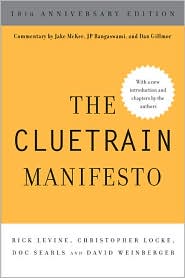
Cluetrain 10th Anniversary edition
Cluetrain 10th Anniversary
Everything Is Miscellaneous
Small Pieces cover
Small Pieces Loosely Joined
Cluetrain cover
Cluetrain Manifesto
My face
Speaker info
Who am I? (Blog Disclosure Form) Copy this link as RSS address Atom Feed

April 24, 2009

Hodgman is Benchley

I’ve been reading John Hodgman‘s More Knowledge than You Require and The Areas of My Expertise. They are laugh-out-loud funny. I know this because I’ve been laughing out loud.

They make me wonder if Hodgman knows he is Robert Benchley born into the Internet Age. And I mean that as high praise.

[Tags: john_hodgman robert_benchley humor ]

Tweet
Follow me

Categories: Uncategorized Tagged with: culture • entertainment • humor Date: April 24th, 2009 dw

1 Comment »

April 22, 2009

Transparency of zombies

I really like the fact that when Left 4 Dead (the great cooperative zombie killing game) introduced a new type of gameplay, one of the developers explained the math behind the balancing of the waves of incoming undead.

[Tags: games left_4_dead zombies transparency blogging expertise ]

Tweet
Follow me

Categories: blogs Tagged with: blogging • blogs • entertainment • expertise • games • transparency • zombies Date: April 22nd, 2009 dw

3 Comments »

SpokenWord.org getting excellenter

Doug Kaye keeps on polishing SpokenWord.org, a free site that collects spoken word podcasts (well, it only collects pointers to them) and lets you find, rate, discuss, and hear them. You can also add ones links to ones you like to the collection (i.e., share them). SpokenWord is getting quite useful and usable. Give it a try. (Disclosure: I’m on its board of directors; it’s a non-profit.)

[Tags: podcasts media ]

Tweet
Follow me

Categories: Uncategorized Tagged with: digital culture • education • entertainment • everythingIsMiscellaneous • libraries • media • metadata • podcasts Date: April 22nd, 2009 dw

Be the first to comment »

April 17, 2009

[ugc3] Final panel

I went first. I talked about exceptionalism, responding to Eli Noam’s challenge at the beginning of the conference that if we’re going to think the Net is going to bring about substantial changes, we have to be able to point to characteristics of it that are different from other technologies that also looked revolutionary but that turned out to be rather prosaic.

NOTE: Live-blogging. Getting things wrong. Missing points. Omitting key information. Introducing artificial choppiness. Over-emphasizing small matters. Paraphrasing badly. Not running a spellpchecker. Mangling other people’s ideas and words. You are warned, people.

Len Downie was executive editor of Washington Post. He’s not going to propose any new form of delivery of the news. He’s not sure the old will die out completely. WaPo is reorganizing itself as a news operation and as a company. They have Facebook and iPhone apps, etc. When it comes to UGC, “this is not a zero sum game.” On WashingtonPost.com you find lots of user comments, participation in blogs, user photos and videos, crowd-sourcing. E.g., Amanda Michel’s “Off the Bus” crowd sourcing, which went through professional editors. (Amanda is now at ProPublica.) They hope the Net will help end the traditional alienation from their readers. And the Net has made their audience bigger than ever before.

The big problem is the loss of classified advertising. Hundreds of millions of dollars lost, hitting local newspapers especially hard. Also, display ads have been driven down. Local news stations are covering fewer stories. There’s less reporting. That’s the problem Len is going to examine in his new academic role at Arizon State.

There are some things the government could do, but not a “bail out,” Len says. Maybe newspapers will become 501C3’s. Maybe they’ll become LC3’s, so they could still be profitable and yet receive tax-exempt contributions. Maybe convert them into endowments, although Len says there isn’t enough money for that: You’d need a ginormous endowment to generate the requisite funds. There are more and more non-profit investigative reporting organizations. There’s a lot going on. It’s impossible to tell what’s going to happen.

Q: How much does investigative reporting cost?
A: At ProPublica, they do it in the best way, and it’s tens of thousands of dollars, mainly for the reporter’s time.

Q: In Germany they’re aggregating news and selling access [I got this wrong] …
A: I’d have to look at it.
Q: Isn’t that what AP does?
A: Don’t get me started. AP is supposed to be a collaborative. If we don’t all charge at the same time, we won’t be able to raise enough money. Alan Mutters [sp] suggests that we all decide on July 4 to start charging. The Obama admin is concerned about the future of news. They’re going to look at loosening anti-trust regs so newspapers can band together, but you don’t want to create another cartel like AP.

Q: If the NYT shut down its presses and went totally online, how would that affect their costs and prices?
A: The Times might save 40-50% of their costs, but it would take away 90% of their revenue. Kindle is great for books but not very good for newspapers. Looking forward to the big multimedia tablets.

Q: The NYT is doing well on the Web. But last year their Web revenue increased just 1%. What’s the future business model?
A: That’s what I’m trying to figure out.


Greg Lastowka (law prof, Rutgers) is going to talk about legal aspects of UGC. First question: What is UGC? It’s a fuzzy concept. “User” is an important term because of copyright. Copyright is not about monetizing the works of authors. Copyright is there to promote the progress of science and the useful arts. Our Constitutional mention is based on the earlier British Statute of Ann that took control away from publishers and gave it to authors, in order to promote education.

Greg predicts that copyright won’t change very much in the next ten years. Copyright law will probably ignore UGC and be large unaffected by it. UGC will be treated as a problem, it will change the rules somewhat (through litigation), but the fundamental shape of copyright law won’t change in response to UGC (says Greg). Ten years ago, he was more optimistic about it. He thought UGC was a huge social boon that was a very bad fit for copyright law, so copyright law would change to reflect that value. The Web was meeting the goals copyright law was established to meet.

Four changes to get copyright law to fit the Web: 1. Simplify the law. 2. People want credit for their work even when they’re happy to have it spread. People get copyright law mixed up with plagiarism. We should work the attribution right into it. 3. Reform terms of service and their enforcement. 4. Subsidize free access content. Copyright is a subsidy for authors.

Greg was arguing this ten years ago. Not much has changed, although there’s progress in open access to academic work. Why haven’t there been more changes? Maybe because our legislators don’t understand what’s happening. The better, sadder, answer is that Greg’s politics were naive. Copyright law today is realistically about protecting big money incumbents. Dan likes copyright and blockbuster movies, but thinks there should be an ecology that enables them and UGC. We’re unlikely to strike a new social contract that reflects the rights of amateur creators.

Q: To what extent is international trade motivating maintaining strict copyright?
A: Legislators certainly care about it.


Stefaan Verhuist (Markle Foundation) presents his model of UGC: Mediation 3.0. It has three new mediating functions that converge to create a new type of mediation. Those functions can be accelerated and made more valuable by making sure they are cheap, deep, and speed. The success depends on four challenges: the 4 Ps.

Setfaan draws a triangle: 1. Establish relations. 2. Provide a new kind of resource that has value for users and that may be created by the users. 3. Remix. Ensure a relation that creates a resource that may be remixed. Their convergence creates UGC. If you can provide resources that are cheap, deep (the value for its users, related perhaps to a geographical location), and speediness. But it can be hard to be cheap, deep and speedy; that’s the challenge.

The 4 Ps: Privacy (relationship), Property (remix), Public sphere obligations and responsibilities (resource), Push and pull (in the center of the triangle) of information. The push-pull presents the policy challenges.

[Posted without re-reading. Gotta run.]

[Tags: journalism media newspapers copyright copyleft creative_commons marketing ]

Tweet
Follow me

Categories: Uncategorized Tagged with: business • conference coverage • copyleft • copyright • culture • digital culture • digital rights • entertainment • everythingIsMiscellaneous • journalism • marketing • media • newspapers Date: April 17th, 2009 dw

Be the first to comment »

[ugc3] Understanding evolving online behavior

NOTE: Live-blogging. Getting things wrong. Missing points. Omitting key information. Over-emphasizing small points. Paraphrasing badly. Not running a spellpchecker. Mangling other people’s ideas and words. You are hereby warned.

John Horrigan of Pew Internet and American Life, gives a “non-Koolaid” presentation. He says that about 12% of Internet users have a blog. The percentage of people doing some form of content sharing is not increasing much at all. The demographics says that 18-24 do the most sharing, and then it goes down in pretty much a straight line. The change over time is not distributed evenly across age groups. Younger adults are turning away from the 6 core UGC behaviors, the 24-35s are increasing. The rest: not much change.

But people are increasingly going to social networkingIf UGC is migrating to rules-based environments, is it a good bargain? On the one hand, good governance can build sustainable mechanisms. OTOH, bad governance is a risk, so you want an open Internet.

Q: A decrease in activity among younger folk? Because they were so heavily involved initially?
John: They’re going to social networking sites instead of maintaining their own sites. But UGC is still an important activity to them.

Q: The changing behaviors as people age and how that will effect UGC?
John: Impossible to answer because we don’t know how the tech will change.


Mainak Mazumdar of The Nieslen Company begins by looking at blogging topics. It’s quite diverse he says. Next: size. Wikipedia has many more topics than Britannica. Also, social networking is very big: Member communities are #4 on most visited lists, after search, portals, and software manufacturers. #5 is email. Social media is big everywhere. (Biggest: 80% of Brazil. 67% in US.) The US is showing comparatively slower growth in “active reach of member communities.” Time spent in CGM has been increasing. So is the time spent on social networking. 35-49 years are the fastest growing audience for social networking sites. Teen consumption of SNS is going down, because they’re going more and more mobile. Mobile will be huge. TV will be big. People are watching more TV. Big media companies are doing well. “Becoming a mother is a dramatic inflectin point and drives women to the Web in search of advice and a desire to connect with others in her shoes” (from the slide).

Is the Net a game-changer for research companies? He compares it to scanner data in the 90s and online surveys in 1990s. In 2000s, perhaps [perhaps??] social networking will once again change the game. Reasons to think the Net is a game-changer overall [i.e., exceptionalism] : Pervasive, sticky, generational.

Q: Is TV watching growing on all screens or just on the living room screen?
Mainak: Time spent watching TV content on a TV.

Q: Maybe SNS have surpassed email because email was used to listserves to serve the social function.
Mainak: We’re talking about how long you spend in Outlook + Web mail. We install monitors that report on how long you spend in each application.

Russ Neuman: Be careful of projecting out from the current tech. It can be disrupted easily.

Q: Older people are entering SNSs. I call them “parents.” To what extent will that change what started out as a youth movement? Is the move to mobile a move out of the SNS as they become mom and dad’s spots? [Oprah is on twitter.]
A: Yes. Some younger teens are going straight to mobile and circumventing the Internet.


Eszter Hargittai talks about the role of skill in Internet use. Yes, young people use digital media and spend a lot of time online, but it’s true that they engage in lots of online activities or that they’re particularly savvy about the Net and Web tools. So, the idea of “digital natives” is often misguided.

She’s particularly interested in the skills people have and need. Her methodology: Paper and pencil surveys to avoid biasing towards those comfortable with using Web tools. 1,060 first year students at U of Illinois. Most of the data comes from 2007, although she has some pre-pub data from 2009. The question is: What explains variation in skill? Gender, education and income predict skill. “The Web offers lots of opportunities but those who can take advantage of them are those who are already privileged.”

This has an effect on how we intervene to equalize matters. You can’t change socio-economic status. And it turns out that motivation doesn’t seem to make much of an effect. You can only be motivated to do something that you already know is a possibility. She shows new data, not ready for blogging, that show that very small percentages of users have actually created content, voted on reviews, edited Wikipedia pages, etc. The number of teenagers who have heard of Twitter is quite low. [Sorry for the lack of numbers. I’m not sure I’m supposed to be reporting even these trends.]

Mainstream media remain strong. Eszter points to the media story about Facebook users having lower grades. Eszter looked at the study and finds it to be of poor quality. Yet it got huge mainstream play. Eszter tweeted about it. She blogged about it. The tweet led to a co-authored paper. Even so, the mainstream probably won’t care, and most of the tweets are still simply retweeting the bad data. The Net is a huge opportunity, but it’s not evenly distributed.

Q: A study found that people online are lonely. It was picked up by the media. The researcher revised to say that it’s the other way around. It wasn’t picked up. The media pick up on the dystopic.

Q: Your data reflects my experience with my students. They don’t blog, they don’t tweet. There’s a class component to this.
Eszter: We measure socio-economic status. Why does it correlate? We’re exploring this. We now ask about parental support of technology use, rules at home about tech use, etc. So far we’re finding (tentatively!) that lower-educated parents tend to have more rules for their kids.

Q: What happens when there’s universal wireline connection?
Eszter: As the tech changes, the skill sets change. The privileged stay ahead, according to my 8 years of studies.

Q: What skills should we be teaching?
A: Complicated. Crucial issue: The evaluation of the credibility of sources. There’s an extreme amount of trust in search engines. That’s one place we need to do more work. And librarians are highly relevant here.

Q: How do people use the Net to learn informally, e.g., WebMD?
Eszter: There are lots of ways and types to do this. But, first you need to know what’s on the Web. You need good search skills, good credibility-evaluation skills.


Cliff Lampe talks about how Mich State U students use Facebook. He presents a study just completed yesterday, so the data isn’t yet perfect. 97% of his sample are FB users (although Cliff expresses some discomfort with this number). Mean average of 441 friends; median = 381. Ninety percent of these they consider to be “actual” friends. 73% only accept friend requests from people they know in real life. Most spend just a little time (under 30mins) at FB per day. About half lets their friends (but not everyone in their network) to see everything in their profile. Almost everyone puts a photo of themselves up. Vast majority have a photo album. About a third think their parents are looking at their page. Overall they think they’re posting for their college and high school friends.

He talks about Everything2.com, a user-generated encyclopedia/compendium that is 11 years old. Why have people exited? Research shows they left because other sites came along that do the same thing better. Also, changes in life circumstances. Also, conflict with administration of the site. There’s a corporitization of some of the UGC sites. He also has looked into why new users don’t stick: They don’t glom onto the norms of the site.

Q: Are reasons for exiting a negative network effect? More than 150 and the network deteriorates?
Cliff: We see that in Usenet. But not so much at Facebook where you’re just dealing with your friends.

Q: Any sites that have tried to drive away new users?
Cliff: Metafilter has a bit of that. Slashdot has a “earn your bullshit” tagline.

Q: Are your students alone or with others when they are online? Are they aware of the technology?
Cliff: The rise of the netbook has had an effect. Most of my students experience social media as a group activity. But a lot of them are not that savvy. They generally don’t know how Wikipedia operates. [Tags: sns social_networking facebook exceptionalism tv wikipedia environment ]

Tweet
Follow me

Categories: blogs Tagged with: blogs • business • conference coverage • digital culture • education • entertainment • environment • everythingIsMiscellaneous • exceptionalism • expertise • facebook • knowledge • libraries • marketing • media • sns • tv • wikipedia Date: April 17th, 2009 dw

2 Comments »

April 14, 2009

RIAA DRM Mashup Smackdown

In its response to Charlie Nesson’s argument that one of the hearings in an RIAA suit ought to be webcast, the RIAA lawyer said:

“[The video footage] will be readily subject to editing and manipulation by any reasonably tech-savvy individual. Even without improper modification, statements may be taken out of context, spliced together with other statements and broadcast (sic) rebroadcast as if it were an accurate transcript. Such an outcome can only do damage to Petitioner’s case.”

So, Chris Soghoian is running a contest, asking you to mash up testimony given to the FTC about Digital Rights Management (DRM). The prize: He donates money to EFF. The real prize: The scalding breath of comedy.

[Tags: riaa mashups web2.0 charles_nesson chris_soghoian drm copyright copyleft ftc contest ]

Tweet
Follow me

Categories: Uncategorized Tagged with: contest • copyleft • copyright • digital rights • drm • entertainment • everythingIsMiscellaneous • ftc • mashups • riaa Date: April 14th, 2009 dw

1 Comment »

March 19, 2009

Least impressive Daily Show connection ever

I’m on the Daily Show site!

No, I haven’t been exposed as the pompous evil little man that I am. Not yet, anyway. The site runs an anagram contest, and mine was one of three the selected this week. The headline you had to anagram was:

Envoys to Afghanistan and Iraq Are Named

Mine was:

On the QT, Iran damns any gain of area saved.

I have to admit that the first pick (by Dharam) is better than mine:

Q: Are any afraid to have an assignment nod

On the other hand, I think there’s a steep fall-off in quality with #3:

God in Heaven! Idea man farts, annoys Qatar.

This week’s headline is:

An outpouring of anger from lawmakers at AIG hearing

I just submitted:

A gain? A mean Frank urges room: Torture, flog, whip again

Eh.

[Tags: anagrams daily_show ]

Tweet
Follow me

Categories: Uncategorized Tagged with: anagrams • entertainment • puzzles Date: March 19th, 2009 dw

1 Comment »

March 13, 2009

Jon Stewart: Squirmatastic righteousness

I thought Jon Stewart’s interview with Jim Cramer last night was a righteous misfire. Stewart was on his high horse, but Cramer was on his little Shetland pony. The result: It was hard to watch.

Stewart was making an important, broad point: Mainstream financial journalism as embodied by CNBC fails the most basic tests of journalism overall. These folks knew better, but give us bread and circuses. Right on, Jon

But feisty, cocky Cramer came onto the show as a Stewart fan, and just kept agreeing and apologizing. I thought ultimately that was pretty disingenuous of Cramer, but it left Stewart looking like a bully. We wanted to see Stewart tear into William Randolph Hearst, but Hearst sent Dear Abby in his place. Except — to mess up the metaphor — Cramer does epitomize CNBC’s tabloiding of financial news, Cramer is a financial insider who knows better, and Dear Abby would have put up more of a fight.

[Tags: jon_stewart jim_cramer cnbc media journalism financial_news ]


You can see the entire, unedited interview here.


The Daily Show runs an anagram contest. The phrase to be anagrammed at the moment is: “Envoys to Afghanistan and Iraq Are Named”

Here’s my best attempt: “On the QT, Iran damns any gain of area saved”

And yours?

Tweet
Follow me

Categories: Uncategorized Tagged with: business • cnbc • culture • entertainment • expertise • journalism • media Date: March 13th, 2009 dw

5 Comments »

February 12, 2009

Two reviews

We saw Slumdog Millionaire last night. Excellent. Going in, you should maybe know that it’s more about slumdogs than about millionaires and “Who Wants to Be a Millionaire.” The non-linear narrative style is the opposite of a gimmick; it makes total sense as a style. The narrative itself is oddly 1930s/1940s-ish, which is not a strength. On the other hand, it shows you something we in America don’t get to see much of.

Best movie of the year? Tough one. I thought Milk was terrific, with some great performances. Between Milk and Slumdogs I think I’d have to say that we have an example of the ridiculousness of trying to pick a single best movie. I mean, Wall-e had some pretty great filmmaking in it, too.


I’ve been reading Gone Baby Gone by Dennis Lehane thinking that it would be more than a good crime novel. I’m actually finding it to be less, with too many wince-worthy sentences, and too many characters written from their quirks outward. I’m only half way through so maybe it picks up, but since my problem is with the writing, I doubt it. I may not even finish it. Too bad. It’s the first Lehane book I’ve read, and I was looking forward to having a new author to enjoy.

[Tags: slumdog_millionaire slumdog harvey_milk milk oscars dennis_lehane lehane ]

Tweet
Follow me

Categories: Uncategorized Tagged with: entertainment • lehane • milk • oscars • slumdog Date: February 12th, 2009 dw

2 Comments »

February 11, 2009

How’s Your News?

I really enjoyed the first episode of How’s Your News?, a new series on MTV (Sundays at 10:30 pm EST/PST).

It’s tough to describe. (Tom Shales does a good job.) It documents the travels of a roving bus of “reporters” who are developmentally disabled. The reporters do person-in-the-street interviews and interviews with MTV-ish stars. It’s deeply funny, and bounces around through multiple levels all at the same time.

The obvious criticism is that the show exploits these folks. I don’t think it does even for a minute, although there are undoubtedly people who view it meanly. But, what are you going to do? There are idiots and bullies everywhere. The show in fact takes these folks for what they are. It doesn’t turn them into saints and it doesn’t condescend. The show is created by a guy who works closely with the developmentally disabled.

Now, the truth is that I know this group pretty well. I have a relative who goes to the same summer camp from which this project sprung, and I have spent enough time with them to know that the reporters are participating voluntarily, happily, enthusiastically, aware of their limitations but also of their special strengths and vantage points.

There’s nothing like it on TV.[Tags: hows_your_news jabberwocky developmentally_disabled ]

Tweet
Follow me

Categories: Uncategorized Tagged with: culture • entertainment • jabberwocky Date: February 11th, 2009 dw

Be the first to comment »

« Previous Page | Next Page »


Creative Commons License
This work is licensed under a Creative Commons Attribution-NonCommercial-ShareAlike 3.0 Unported License.
TL;DR: Share this post freely, but attribute it to me (name (David Weinberger) and link to it), and don't use it commercially without my permission.

Joho the Blog uses WordPress blogging software.
Thank you, WordPress!