


logo
EverydayChaos
Everyday Chaos
Too Big to Know
Too Big to Know
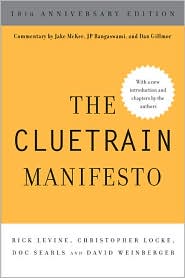
Cluetrain 10th Anniversary edition
Cluetrain 10th Anniversary
Everything Is Miscellaneous
Small Pieces cover
Small Pieces Loosely Joined
Cluetrain cover
Cluetrain Manifesto
My face
Speaker info
Who am I? (Blog Disclosure Form) Copy this link as RSS address Atom Feed

June 6, 2007

Cool tech at NY Tech Meetup

I’m at a company meeting at MeetUp.com and James Hong, founder of HotorNot is doing a speed history and demo. In his five minute talk, he makes three points of particular interest to me:

1. HotOrNot recently went from fee to free because, James says, because the Net is good at connecting people, and HotOrNot should not be putting money in the middle of that.

2. Your HotorNot photo can have keywords, AKA tags, which give people a quick sense of who you are. He says they took the tag idea from LiveJournal, before del.icio.us. But, he says, if you have too many tags, people won’t read them. So, HotorNot lets you put music, movies, etc. on yor hotlist. That says something about you. (If you see an item on someone else’s list that you want to add to yours, you just click the plus button.) You can also display these in some flashy widgets.

3. They added HotLists to Facebook, and hit 1M views per day in 4.5 days. Later, in his talk at the NY Tech Meetup, James said: “If I were starting from scratch today, I’d built on Facebook, not the Web.” Facebook wants to be the platform. “If they can pull it off, they’re the next Microsoft.”

Unsurprisingly, at the Tech Meetup, there’s huge interest in building on Facebook since not only is the market there, but the market is already clustered in social networks.


Robin Chase of GoLoco is giving a 15 minute demo at the same MeetUp meeting. (Robin was a co-founder of ZipCar, a success all the more impressive because it was so damn hard to start up.) It’s a terrific idea: Make it easy for people to share rides. She wants it to be more than just saving money on fuel: It should be more fun to ride together than alone. She recounts a trip she took a couple of weeks ago. She posted she was driving a ZipCar from an airport to a college and got an email from someone looking for a ride. It turns out that the guy was going to the same conference, and Robin knew two of his bosses. Otherwise, she might have turned him down. As it was, they they are now friends.

She talks about some of the partnerships they’re pursuing. I think the specifics are not bloggable, but some are not obvious and quite interesting.

She says “GoLoco” means you should go locally, go crazy, and go with low CO2. Clevah!


By the way, I’m glad to say that MeetUp.com is doing well, growing 10% per month. (Their only metric is how many successful meetups there are.) I love the Web, but I love faces more than screens. Also, I’m an admirer of MeetUp because it was founded to address a real social need. They are, well, good folk.


Now I’m at a NY technology meetup. Seven of us give five minute pitches, although I’ve been granted ten minutes to talk about my book. (Sanford Dickert did a great job liveblogging the event.)

Robin starts it off by giving the very short version of her demo. It’s even cooler the second time.

ExpoTV.com is about video product reviews done by users.E.g., if you search for “Fischer Price Swing,” you’ll find videos of users reviewing the swing. In this case the most played is about 2 mins long. The ExpoTV person (sorry, I’m missing everyone’s names) says you can tell that the person is a real mom, “not a sweaty old guy in a t-shirt.” You can leave comments. You can see more about the creator. The site sells nothing, but provides links to affiliated stores.

They attach “a tremendous amount of metadata” to the videos by pulling in product info based on UPCs. They syndicate their videos out to syndication partners, e.g., a channel on Yahoo Video and AOL Video. They also use the UPCs to match up with Buy.com. You can ask to see a video on a product by, say, a research-heavy user who has contributed more than 25 reviews. [It’s a great example of pulling together miscellaneous info, in part by using unique and meaningless IDs, and of profiting by becoming a meta-business.]

They have 100,000 videos and two VCs backing them.

Q: How will you screen out manufacturers pretending they’re authentic?
A: We have an advertiser tag since ads are sought by users. We hope our community will suss out the fake stories. And we require people to declare that they’re not affiliated [she said, rolling her eyes a bit].

Q: Multilingual?
A: We think it’s quite portable internationally.

[For products I want to see—not commodities—I definitely would check out this site.]


LiveLook.net has two products: 1. Show anytihng on your screen to anyone without downloading anything. Simpler than Webex. They charge $0.025/minute/user. 2) For online businesses, customer service reps can see your screen. That costs $50/agent/month.

They’re looking to raise capital and for tech partners


AdaptiveBlue.com works off a browser tool bar, bringing contextual relevancy to you as you’re browsing. It helps you “browse smarter.” E.g., if you’re on an Amazon page, AdaptiveBlue knows it’s a page about a CD and lets you browse for reviews, find other works by the singer or by CD, find photos on Flickr of the singer, create a station on Pandora.com, etc. On a movie page, the choices reflect its movie-ness. AdaptiveBlue cover about 20 categories. The menus personalize themselves based on your browsing history.

It’s Firefox only, but the “smartsLinks” menu adds relevant links inline. They make money through affiliate revenues.


Mogulus.com lets anyone launch their own own live, 24/7 video channel. It’s free. It is not video on demand. It’s linear. E.g., GroundReport.com, which is aiming to be the first user-created CNN. You can broadcast live or even drag in YouTubes (or from other sources), in case you’re not staffed up for 24/7 broadcasting. It’s all Flash based. The free version puts in an ad every ten minutes. They hope to have thousands of channels. “It’s all about empowering bloggers to take the next step.” It’s now in beta.

Founder Max Haot does an ultra cool demo. While he’s being broadcast live on GroundReport, he adds his name to the crawl, pulls in a YouTube, does some effects, etc. Ooohs and aaahs from the crowd.

Q: [me] How many channels do you have to have to consider it a success?
A: Thousands.

[Very very cool and it may find a market, but I suspect that market’s not going to consist of thousands of amateur 24/7 CNNs. Could it succeed if it instead got 100 channels? But if you’re willing to invest the labor in being on air that much, will Mogulus provide enough functionality? Or, will this be a platform for types of programming that don’t exist because they’re currently too hard. E.g., might a candidate set one up for use by her supporters? The Obama Channel? Or might people build channels consisting of nothing but YouTube playlists? I dunno, but it was a great freaking demo.]

[Tags: meetup meetup goloco hotornot mogulus adaptiveblue livelook expotv demos tech media cluetrain everything_is_miscellaneous ]

Tweet
Follow me

Categories: Uncategorized Tagged with: business • entertainment • everythingIsMiscellaneous • media Date: June 6th, 2007 dw

2 Comments »

May 21, 2007

Violate copyright? $150,000. Violate free speech? $0.

Viacom sends YouTube a list of 100,000 videos that Viacom claims violate copyright, and under the terms of the Digital Millennium Copyright Act, YouTube has no practical choice except to take them down. Viacom did not look at all 100,000. Some certainly did not violate copyright. For this violation of First Amendment free speech rights, Viacom was penalized, um, wait, let me get out my calculator…yeah, nothing.

We need to stop giving the world’s Viacoms business incentives for violating our right to speak freely.

So, let me get a little more precise. The DMCA says that if Viacom sends a notice to YouTube that Carla’s “I love Jon Stewart” video violates copyright, YouTube can either take the video down, or leave it up and risk being held liable for copyright infringement. (Viacom need not offer any evidence.) So, of course YouTube takes it down. Carla gets a notification of this. If she files a counter-notification, YouTube has to put the video back up. (Carla can go to ChillingEffects.org to find an online form she can fill in to file her counter-notification.) Viacom thus has no reason not to sweep wide in its takedown demands.

The DMCA does have a provision (17 U.S.C. Section 512(f)) for filing false takedown notices or counter-notices:

(f) Misrepresentations.- Any person who knowingly materially misrepresents under this section-

(1) that material or activity is infringing, or
(2) that material or activity was removed or disabled by mistake or misidentification,

shall be liable for any damages, including costs and attorneys’ fees, incurred by the alleged infringer, by any copyright owner or copyright owner’s authorized licensee, or by a service provider, who is injured by such misrepresentation, as the result of the service provider relying upon such misrepresentation in removing or disabling access to the material or activity claimed to be infringing, or in replacing the removed material or ceasing to disable access to it.

Carla could therefore sue Viacom, but since the damage done to her by having her video unavailable for a couple of days is negligible, it’s not worth it to her.

But the damage done to free speech by giving over-lawyered corporations license to take down free expressions of ideas without even viewing them is considerable.

So, why don’t we ask Congress to make the penalties for violating the First Amendment rights of citizens as painful as the penalties for sharing an mp3 of Metallica’s “Don’t Tread on Me”?

Here are the penalties for violating copyright (as paraphrased in an email from Wendy Seltzer):

Statutory damages for copyright infringement range up to $150,000 per copyrighted work. The statute gives three ranges, $750-30,000 for ordinary infringement; up to $150,000 for willful infringement, and down to $200 for “innocent” infringement where the work was unmarked with copyright notice and the person had no reason to know his activity infringed. [source]

None of these quite cover the Viacom case, which is more like reckless infringement than innocent infringement; Viacom had to know it would catch some non-violating videos in its algorithmic sweep. So, we could do something like $150,000 for the first false takedown (since the company was willing to violate free speech) and $750 for each subsequent false takedown on the list.

Ouch? I hope so. Protecting free speech ought to be at least as important as protecting the rights of copyright holders.

[Tags: copyright dmca copyleft youtube viacom digital_rights everything_is_miscellaneous]


Cory Doctorow points out in an email that the Electronic Frontier Foundation (did you remember to join?) has been suing over bogus takedowns, and the courts have been awarding damages and fees. This, Cory points out, lays the groundwork for lawyers to take these cases on a contingency basis, making them feasible for people without a lot of resources.

Way to go, EFF! But I’d like to see the law acknowledge that infringing free speech is at least as bad as infringing copyright. Establishing statutory penalties such as those for copyright infringement would make that point at least symbolically.

Tweet
Follow me

Categories: Uncategorized Tagged with: business • digital rights • entertainment • for_everythingismisc Date: May 21st, 2007 dw

7 Comments »

April 30, 2007

Rosie O’Donnell should look things up in Wikipedia first

HASSELBECK: Do you believe that the government had anything to do with the attack of 9/11? Do you believe in a conspiracy in terms of the attack of 9/11?

O’DONNELL: No. But I do believe the first time in history that fire has ever melted steel. I do believe that it defies physics for the World Trade Center Tower Seven, building seven, which collapsed in on itself, it is impossible for a building to fall the way it fell without explosives being involved, World Trade Center Seven. World Trade Center one and Two got hit by planes. Seven, miraculously, for the first time in history, steel was melted by fire. It is physically impossible.

HASSELBECK: And who do you think is responsible for that?

O’DONNELL: I have no idea. But to say that we don’t know it was imploded, that there was implosion in the demolition, is beyond ignorant. Look at the film. Get a physics expert here from Yale, from Harvard. Pick the school. It defies reason. [source]

Interesting.

OAKLAND, Calif. — A gasoline tanker crashed and burst into flames near the San Francisco-Oakland Bay Bridge yesterday, creating such intense heat that a section of highway melted and collapsed. [source]

And, from Wikipedia:

…Molten steel is cast into large blocks called “blooms”…. [emphasis added]

blast furnace

Jeesh. [Tags: rosie_odonnell bessemer_process]

Tweet
Follow me

Categories: Uncategorized Tagged with: entertainment • media Date: April 30th, 2007 dw

18 Comments »

Vista for gamers: A charitable assessment

Games for Windows magazine (formerly Computer Gaming World) has a frank article about the strengths and weaknesses of Vista as a platform for games. GFW is independent of Microsoft, yet when it comes time to give the overall rating, it pulls its punch. The article reports that many games run more slowly (albeit they didn’t compare on equivalent hardware…but why didn’t they?) and that whole bunches of games just don’t run. If any particular game had as many bugs and glitches, they’d drop the rating below 5 (out of 10). Instead, they give Vista 8 out of 10 as a gaming platform.

If you’re a gamer, ignore the rating and read the article. You will not be tempted to “upgrade” to Vista. [Tags: vista gfw games_for_windows pc_games]

Tweet
Follow me

Categories: Uncategorized Tagged with: entertainment • media Date: April 30th, 2007 dw

5 Comments »

April 23, 2007

JK Rowling’s next book after Harry Potter

Now that she’s finished the Harry Potter series, JK Rowling is probably wondering what to write next. With all modesty, I have an idea: She should answer her email.

I’m not kidding. Rowling’s been good about fan fiction, apparently, happy that her fans are so enthusiastic. That’s a welcome break from the brand mentality authors are encouraged to adopt by the life+70 copyright term. So, with those billion dollars in royalties in her back pocket (personally, I’d have it changed into one $500M bill and five $100,000,000’s) she could spend a few years on the Web, engaging with young readers and writers in every forum and format that she’s comfortable with.

That’d be some real magic. [Tags: jk_rowling harry_potter copyright books]

Tweet
Follow me

Categories: Uncategorized Tagged with: culture • digital culture • education • entertainment Date: April 23rd, 2007 dw

5 Comments »

April 19, 2007

The Ghost Map – Steve Johnson’s latest is terrific

Steven Johnson just keeps getting better as a writer and as a thinker. He takes big ideas and makes them compelling by finding their connections to unexpected ideas, and then uses them to pry up the floorboards of our assumptions. Just at the level of putting words together, Steve is a master. Best of all, he’s young, so we have many more years of his writing to look forward to, if the wily universe permits.

Although the topic of The Ghost Map is the cholera epidemic in London that led to the discovery that the disease is spread through contaminated water, it operates on several levels. In fact, it’s about the need to operate on several levels. So, at one level it a terrific procedural mystery with compelling real-life characters, at another it’s about the biology of bacteria, and at a third level it’s about the structure of cities. We would still be at the mercy of cholera if the hero of the tale had not been able to go up a level of abstraction to see the statistical pattern of deaths. And Johnson’s own meta-explanation requires going up to another meta-level to show how all the levels are required to tell the tale and understand the truth. It opens up a means of explanation that is rich and sometimes so surprising that it makes me laugh with delight. This fluidity with levels of abstraction also informs Steve’s books Emergence and Mind Wide Open. And with its multilayered points of view, The Ghost Map serves as further evidence for Steve’s point in Everything Bad Is Good for You that our culture is becoming more comfortable with complexity.

Steve is an intellectually sympathetic writer, which is a rare virtue. Rather than dismissing the then-prevalent theory that a “miasma” caused cholera, he is able to explain the good reasons why the miasmists held on to their theory so long. A lesser writer would have dismissed them as stupid, hide-bound, or buffoons. Steve is also able to explain why the doctor who figured it out was able to do so, tracing it to his previous work with ether, rather than claiming it was a bolt of genius lightning.

And to top it all of, The Ghost Map is a compelling, fun page-turner…a terrific read, as we say nowadays.

Steve makes my writerly cheeks burn with envy.

(Disclosure: I’m delighted to know Steve a bit. ADDED April 20 ’07: I should also have noted that Steve blurbed my book. Nevertheless, The Ghost Map is a really good book.) [Tags: ghost_map steve_johnson books reviews ]

Tweet
Follow me

Categories: Uncategorized Tagged with: culture • entertainment • philosophy Date: April 19th, 2007 dw

4 Comments »

April 17, 2007

[berkman] Wendy Seltzer on ChillingEffects and copyright take-downs

Wendy Seltzer is a founder of ChillingEffects.org. She talks about her “run in” with the National Football League.

Wendy waits for the room to fill by running a very funny YouTube clip of the Daily Show segment about Viacom vs. YouTube. (The room is now packed.)

She was watching the Super Bowl and saw the notice: “This telecast is copyrighted by the NFL for the private use of our audience. Any other use of this telecast or of any pictures, descriptions, or accounts of the game without the NFL’s consent, is prohibited.” She took the clip off her MythTV and posted it to YouTube under the title “Super Bowl Highlights,” with a caption that said: “The NFL’s overreaching copyright claim.” That was on Feb. 8. Five says later, she got a notification from YouTube saying that they had taken the clip down because the NFL claimed it was infringing under the DMCA .

YouTube had received a list of 158 clips the NFL claimed was infringing. It’s likely that the NFL had a robot search for anything that was titled or tagged as NFL. Wendy asked to see the list and received it.

Wendy believes her clip was Fair Use of copyrighted material. That copyright doesn’t protect people from giving accounts of the game or describing the game. It doesn’t even prevent people from making some pictures from the telecast. Wendy’s clip was Fair Use because:

My use is for nonprofit educational purposes; the copyright in the telecast is thin; the portion of football that follows the copyright warning is a minute portion of the whole, with no significant action or commentary, useful to show people what it was the NFL claimed its copyright covered; and the effect on the market for or value of the work is non-existent.

At ChillingEffects, there is a counter-notification generator form that requires the claimant to get specific about why the piece is infringing. Wendy filled it in. This gives YouTube the ability to re-post the material without penalty; the poster now takes the heat if the complainant still complains. Wendy says this isn’t quite an even balance because YouTube’s terms of service protect it from complaints by users anyway, so while Viacom can sue YouTube for not taking a clip down, users can’t really sue YouTube if it doesn’t put the clips back up upon receipt of a counter-claim.

YouTube put Wendy’s clip back up.

Then, on March 18, YouTube once again removed it because the NFL again complained. Wendy says that the DMCA has no explicit mention of a second take-down notice. If a company doesn’t like a counter-notification, it can sue.

This time, it was clear that an individual from the NFL had actually watched the clip. But, Wendy thinks they were falling foul of 512f of the DMCA, which makes a person liable for damages (including lawyers’ fees) for knowingly misrepresenting that a clip is infringing. YouTube was required to pass along Wendy’s original counter-notification, so the NFL knew that Wendy was saying that the clip was for educational purposes.

Wendy sent back the same counter-notification. The Wall Street Journal blog and the Newark Star Ledger covered it, resulting in a letter from the NFL saying that Wendy clearly “doesn’t understand” the DMCA. They objected to the fact that Wendy included 20 seconds of game play around the ten-second copyright notice. But, the letter said, she has their permission to use just the copyright notice. (She included the 20 seconds as context. It does not show a complete play.)

Wendy wrote back, saying that she thinks the clip in its entirety is covered under Fair Use.

They replied with an email, saying that “there is a substantial difference of opinion us on this matter that cannot be reconciled.” So, the clip is still on line. But the NFL says it can offer no assurance they won’t complain again.

YouTube is built on the DMCA safe harbor (512c) that says that it doesn’t have to screen or filter content, or check the copyright of each piece posted. Instead, YouTube has to reply to claims of infringement. No one has alleged that YouTube has not responded. It’s followed the DMCA to the letter. Instead, Viacom et al. say that it’s “too hard” to send YouTube all these notices, so they want to shift the burden to YouTube. Even if YouTube could manage to do all that work, the next startup would find that too high a hurdle; it’d badly hurt innovation…a chilling effect. “I think they’re trying to renege on the deal that was struck with the DMCA.” Wendy would like to see the DMCA reformed “to address some of the burdens on speech” but not thrown out.

Q: (catherine bracy) Why do you think the NFL is “materially misrepresenting”?
A: They know that this is non-infringing. The second notification makes it harder to claim it was a good faith mistake.

Q: (bracy) Can I take a camera into the stadium, tape it, and put it onto YouTube?
A: The guards frisk you and say that your ticket is a contract that prevents you from using a camera. You could look on from a rooftop and tape it from there.

Q: Could you sell it?
A: There’s no copyright in the game itself, so yes. But if you tape a concert you can hear from your house, there’s copyright in the music itself. And “Super Bowl” is trademarked, which is why ads for, say, chips say things like “Stock up for the big game.”

The “knowingly misrepresents” phrase, Wendy says, was added by the entertainment industry to make it harder to sue complainants.

Q: (john palfrey) What’s their strongest case against your Fair Use claim?
A: Their strongest claim against the 20 seconds of football is that I haven’t transformed it or added educational material into the clip itself. They’ll say the announcers describing the plays is a creative work. And there are markets for licensing virtually everything, they’ll say. If they want phone companies to continue paying them to stream clips to cellphones, this is a market into which I’m intruding.

Q: What might your damages be under 512f?
A: It’s hard to quantify damages from speech. I didn’t lose money from students not attending class because I couldn’t talk about the clip, etc.

Q: (gene koo) How long can this take-down and put-back dance go on?
A: California recognizes that legal process can be used to squelch legitimate speech, so if this process continued, I might have a claim.

Q: (me) Someone posted an aggregation of Couric’s questions of the Edwards. It was taken down. Was that fair use? And if this had been done by Jon Stewart, would it be protected the same way it was for the amateur who posted it.
A: Yes, it sounds like fair use, and Stewart and the poster are protected by the same law. But there is no DMCA coverage for broadcast. I don’t know if Stewart licenses his clips or just asserts they’re fair use.

[Tags: berkman fair_use copyleft copyright nfl youtube dmca]

Tweet
Follow me

Categories: Uncategorized Tagged with: business • digital rights • entertainment • everythingIsMiscellaneous • media Date: April 17th, 2007 dw

6 Comments »

April 6, 2007

Sopranos Spoilers: The guts to stay a comedy?

I’ve posted at Huffington Post today my latest doomed-to-fail attempt at spoilers for the new season of the Sopranos. [Tags: sopranos entertainment comedy]

Tweet
Follow me

Categories: Uncategorized Tagged with: entertainment Date: April 6th, 2007 dw

1 Comment »

March 27, 2007

Death of a President: A waste of a scandal

Death of a President bills itself as a thriller, but it got known first as the movie that shows George Bush being killed. No, no, the producers declared as some in the media protested before the movie was released. It’s not some cheap, sensationalistic revenge movie for rage-addled Liberals, said the producers. It’s about bigger issues.

Too bad, because it’s got nothing interesting to say about the bigger issues.

[SPOILERS AHEAD]

It is certainly true that the movie doesn’t dwell on the actual shooting of Bush. Since the entire movie pretends to be a documentary made a few years after the event, you see some chaotic video of “Bush” crumpling as he’s shaking hands in a crowd. That’s all. And yet, the movie’s premise is that Bush is an awful president who has brought us to the brink of totalitarianism. Nothing good comes from the assassination, so it clearly isn’t a call to arms. But it is an anti-Bush movie. That makes the fantasy of Bush’s death disturbing in the wrong way.

After Bush is killed, we learn that the Patriot III Act was quickly passed, further limiting our rights. But, unlike the underrated movie The Siege, the movie’s not interested in following the consequences of those limitations. In fact, we barely learn what they are. And a Syrian is arrested and falsely accused of the crime. The movie makes it clear that the system was stacked against him because he was a Syrian. Except that this is a Syrian living in America who, a few years earlier, accidentally (!) happened to go for terrorist training in Pakistan…which vitiates the theme that we’d take any Arab as the bad guy.

It took me three nights of viewing to get through the movie, so I guess that doesn’t make it much of a thriller. My favorite part were the interviews with the filmmakers in which we learn that the Chicago demonstration consisted of footage of a real protest march and some staged scenes.

I have to say that I was also bothered by the fact that although this is told entirely as a documentary, with interviews with “participants” and news reelish footage of the “events,” it is not a documentary that actually would have been made after the assassination, for it explains things that wouldn’t have needed explaining, and relies on a sense of suspense that no one would have had. It’s as if a documentary were made after JFK’s assassination that depended on viewers not knowing if he’d be assassinated while addressing the crowd or driving in the car.

I’ve seen worse movies for sure. But I’ve seen a lot better. (Disclosure: The film’s publicists sent me a free copy of the DVD. Thanks.)

[Tags: movies film reviews bush documentaries]

Tweet
Follow me

Categories: Uncategorized Tagged with: entertainment • politics Date: March 27th, 2007 dw

4 Comments »

March 17, 2007

Quick, vote for Oliver Brown!

The public radio show “Whad’ya Know” is wrapping up it’s American Idol-style hunt for a new song, and Oliver Brown — ukelele laureate, Wikipedian, and someone I’ve known since he was in fuzzy baseball-themed jammies — is a finalist. Listen to his song, The Girl with the Cotton Candy Hair, and immediately vote for him (ignore those other finalists, worthy though I’m sure they are), by sending a message to [email protected] with the subject line ” VOTE FOR SONG #2, “Girl with the Cotton Candy Hair” by OLIVER BROWN.”

Act now! The contest ends soon! Well, March 23. Oliver is funny, eccentric, a high school teacher…what’s not to like? [Tags: oliver_brown ukelele npr music]

Tweet
Follow me

Categories: Uncategorized Tagged with: entertainment Date: March 17th, 2007 dw

1 Comment »

« Previous Page | Next Page »


Creative Commons License
This work is licensed under a Creative Commons Attribution-NonCommercial-ShareAlike 3.0 Unported License.
TL;DR: Share this post freely, but attribute it to me (name (David Weinberger) and link to it), and don't use it commercially without my permission.

Joho the Blog uses WordPress blogging software.
Thank you, WordPress!