


logo
EverydayChaos
Everyday Chaos
Too Big to Know
Too Big to Know
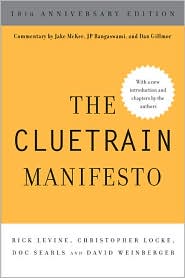
Cluetrain 10th Anniversary edition
Cluetrain 10th Anniversary
Everything Is Miscellaneous
Small Pieces cover
Small Pieces Loosely Joined
Cluetrain cover
Cluetrain Manifesto
My face
Speaker info
Who am I? (Blog Disclosure Form) Copy this link as RSS address Atom Feed

March 30, 2009

[f2c] Politico-Regulatory talks

[Note: Live blogging. Sloppy. Incomplete. Unchecked. Wrong. Flee! Flee!]

Chris Savage talks about “The Re-Birth of Intelligent Regulation and the Chicago School.” The Chicago School overemphasizes the value of individual thought (= “revealed preference theory”). When people make choices, that’s the best way to know what’s good for them (Chris says). But how can people know which wireless plan they want? “Empirical studies of decision making show that people don’t know what they want.” They don’t act rationally. They have trouble when there are too many alternatives, need to assess risk, etc. But, if you can’t assume that people know what they want, there’s no reason to think that the results from markets are good results. Hence, we need to regulate. If there’s no factual basis to think open competition will lead to the best outcome, regulators may have a role in shaping the outcome. But, timing matters and now is the time to make a “more citizen-friendly regulatory system.”

Derek Slater, a policy person for Google (and a former Berkman Fellow). He’s going to talk about MLab. We have all asked “WTF?” he says, especially when an app starts running badly. We don’t know what’s going on. We don’t have the tools to get the data that would help us understand that. Broadband policy needs data. mLab provides end-user testing tools. (It’s not just a Google project.) “We call it beta but that’s only because most people don’t now what alpha means.” Thirty-six servers at the moment.

John Peha, chief technologist of the FCC, talks about the “Mythology of Rural Broadband.” Myth 1: There’s less interest in broadband in rural areas. Nope. The percentage of US households with Internet overall and rural are almost the same, but rural has less broadband. They probably don’t like their Internet slow. About one third of rural households have no access to broadband of any ttype (except satellite). Myth 2: Customers are unwilling to pay the cost of the buildout. But there are spill-over benefits, affecting the community and not just the individual subscribers. Myth 3: Rural communities may not gain from the broadband they don’t have access to, but it doesn’t hurt them. Nah. “Reducing the size of a network harms those who remain.” Broadband is becoming the norm, hurting those who do not have it. Myth 4: “Government involvement in infrastructure always helps.” Nope. No “one size fits all” solution. We shouldn’t have the gov’t replicate solutions the market is doing well already. We shouldn’t assume that the market solves all problems. We’re getting some more spectrum in 2009 as the switch to digital TV kicks in, and there’s a new national broadband plan under development.

Q: [tim denton, CRTC commissioner] Expand on your point that we don’t know what market conditions will work, Chris?
Chris: We don’t know. It’s important for people, esp. regulators, to remember that.

Q: How can regulators make policy and maintain technological neutrality since technologies offer different capabilities?
Jon: Tech neutrality is a good thing to aim at.
Chris: I want to challenge that. We’re not neutral about houses that have electricity or not, or cars with airbags or not. The market won’t figure this out correctly, necessarily.
Derek: We need to set the goals and look at the data at what different technologies bring to the table.
Jon: The setting of the goals is the key part of that.

[amy wohl] I am a recovering Chicago economist. When the gov’t tries to fix market mistakes, it often introduces a lag that can create a new mistake. How can we help the gov’t make good decisions?
Chris: Elect the right people.
Derek: Infrastructure is special. That’s the message we need to be building on.
David I: Say more …
Audience: Because infrastructure is being built now but not being designed. [Tags: f2c f2c09 fcc broadband regulation ]

Tweet
Follow me

Categories: Uncategorized Tagged with: broadband • conference coverage • digital rights • f2c • f2c09 • fcc • policy • regulation • wifi Date: March 30th, 2009 dw

Be the first to comment »

[f2c] Politics

Tim Karr, campaign director of Free Press, moderates a small panel: Nathaniel James ( Media and Democracy Coalition) and Ellen Miller (Sunlight Foundation).

Tim: We’re in a period of turmoil, torn between “two distinct value systems”: Mass media and social media. Now is the crucial time for making the right policies. We’re seeing a perfect alignment of three movements: media reform, free culture, and open government. The principles of the unity of these three movements: Openness (neutral, nondiscriminatory net), transparency, innovation (through copyright reform), privacy, access.

Ellen: As Andrew Rasiej says, technology is not a slice of the pie, it’s the entire pan. (Ellen talks about the origins and current projects of the magnificent Sunlight Foundation.)

Nathaniel mentions that he’s very involved in One Web Day. But his talk is about fighting for the freedom to connect. He says the process of providing access needs to include a diverse swath of the country. The Internet policy process ought to be as participatory as Internet culture itself. “Are we building programs that allow empowerment and peer to peer education?”

Q: Politically, what’s it look like with the new administration and Congress?
Tim: We’re more hopeful. “The more the public gets involved in the sausage-making, the more visionary and courageous our politicians become”
Nathaniel: The Dems and Reps are equally opportunity offenders in this area.
Ellen: When it comes to the new admin, “it’s a delight to be pushing on an open door.”

Q: [googin] We’re seeing an increase in bottom up business, not just in media.

[Tags: f2c egov egovernment transparency f2c09 ]

Tweet
Follow me

Categories: Uncategorized Tagged with: conference coverage • digital rights • egov • egovernment • f2c • f2c09 • net neutrality • politics • transparency Date: March 30th, 2009 dw

Be the first to comment »

[f2c] First panel

At Freedom to Connect, the opening panel, moderated by Joanne Hovis, is on municipal wifi. [Note: Liveblogging. Missing stuff. Typing too fast. Not spellpchecking. No rereading. This is a terribly incomplete and occasionally wrong set of notes.]

Tim Nulty is the former head of Burlington Telecom, and is now the head of a consortium bringing fiber to rural Vermont. He says there are about 45 municipal wifi companies in the US. We pretty much know how to do that. It’s different in rural areas, where the average density is 13 residences per linear mile. About 60% have no broadband. Why should it be harder to replace copper wire with glass the second time around? Why is there this myth that it’s impossible? Because there are incumbents who have a financial interest in saying that it’s impossible because they don’t want to do it [because the margins are lower than they want, which would drive down their overall margins, even while increasing their revenue].

Dirk Van der Woude, program manager for broadband in Amsterdam. They provide boradband as a public service such as garbage collection.

Lev Gonick, founder of One Community, has a million institutional users, via a community network, a 501C3. It has about 4,000 route miles. The governance model is mayor-proof because the infrastructure owns the governance. The goal was not to build-up fiber optics but to enable and transform their communty.

Bill Schrier works on getting Seattle fibered. He says that they’re spending $4B on highway infrastructure, which is 8x what it would cost to bring fiber everywhere.

First Joanne question: Fiber vs. Wireless [which is the topic burning up the backchannel]. Dirk says he pays for fiber at home. Wifi works but is slow, he says. For wifi, you need access points with backhaul that is likely to be fiber.

Bill: What’s the killer app for a network? HDTV. Video teleconferencing.

Tim: Fiber is cheaper and more economic if you intend to be universal. Bringing fiber to his neck of the woods (1,000 sq miles) is $69M. Doing this through wireless, with 2.3 or 2.5gH Wimax, to get close to universality, would be $35M. It costs half as much but brings 1/4 the revenue. The capacity is 1% of what you get with fiber. The right thing economically to do is to put the Wimax on top of the fiber network, at which point it costs $10M, which makes it a great business.

Dirk: In Amsterdam, dwellings are stacked. Getting the fiber to move vertically is a problem.

Mark Cooper: Which comes first, fixed or mobile computing? For connecting the underserved, the killer app isn’t HDTV. It’s connectivity. We want wireless: 1. It gets you further. 2. Mobile computing is a twofer: Mobile computing and basic connectivity that meets the need for connectivity. 3. Mobile computing is future-proof. For this project [stimulus package?] wireless is the right thing to do. 4. Public accountability.

Tim: Rural fiber does not need public money. It can pay its own way. Rural wireless does not pay its own way.

Lev: This is a family dispute. We have a once-in-a-generation opportunity. Let’s move ahead, be pragmatic, etc…

Bill: Wireless and fiber are synergistic, (David I. asks for a show of hands; everyone agrees.)

Q: Fiber is the foundation that supports wireless. Now: Go mesh!

Tim: Mesh is great for thin uses. But for carrying lots of data, it breaks down.

Bob Frankston: We need to change the dynamic. We’re stuck in railroads where you pay for each trip. We need to get to the point where assume connectivity at any speed. The question is the funding model.

Dirk: Cooperate with anyone who wants to cooperate with you, so long as you get the network you want…

Bice Wilson: “Designing the hidden public way,” i.e., the infrastructure of connectivity. There’s a vast network of services that needs connectivity to the entire community.

Lev: That’s what One Community is about.

Bill: In Seattle, that’s where we’re directing our efforts.

Roxanne Googin: Current status…?

Tim: The really important investment is in universal fiber.

Joanne wraps up reminding us of the sense of the room that we want universal connectivity and we want it yesterday. [Gross paraphrase] [Tags: f2c f2c09 wifi broadband muni_wifi fiber connectivity ]

Tweet
Follow me

Categories: Uncategorized Tagged with: broadband • conference coverage • connectivity • digital rights • f2c • f2c09 • fiber • wifi Date: March 30th, 2009 dw

Be the first to comment »

March 29, 2009

The Google Book deal

I just heard Robert Darnton on On The Media talking about the Google Book settlement. (Sorry, but I don’t yet see a link specifically to that interview.) Brilliant. The two things I’d recommend reading about this massive and massively important deal are Darnton’s piece in the NY Review of Books, and an article by James Grimmelmann.

The book settlement is hugely complex, hugely important, and overall a big step forward. But, the ur-cause of the issues many of us have with it is that it’s a settlement among authors, publishers and Google, which leaves readers, scholars, teachers — AKA the rest of us — out.

[Tags: google books libraries copyright copyleft ]

Tweet
Follow me

Categories: Uncategorized Tagged with: books • copyleft • copyright • digital rights • everythingIsMiscellaneous • google • libraries Date: March 29th, 2009 dw

2 Comments »

March 26, 2009

Online anonymity challenged by courts in Ontario and Illinois

Michael Geist posts about an Ontario court decision to require FreeDominion.ca to reveal the identity of anonymous poster:

Protection for anonymous postings is certainly not an absolute, but a high threshold that requires prima facie evidence supporting the plaintiff’s claim is critical to ensuring that a proper balance is struck between the rights of a plaintiff (whether in a defamation or copyright case) and the privacy and free speech rights of the poster. … I fear that the high threshold seems to have been abandoned here….

Meanwhile, as I noted yesterday, Berkman‘s Citizen Media Law Project has filed an amicus (= friend of the court) brief in a case in Illinois. From the press release:

“Courts around the country have recognized that, although the right of free speech is not absolute, a plaintiff must show that its claims are legally and factually tenable before a court orders that the identity of an anonymous speaker be disclosed,” noted CMLP Assistant Director Sam Bayard. “Anonymous speech on blogs, online fora, and other websites leads to a vibrant exchange of information, and putting a plaintiff to its proofs before unmasking an online commenter helps to ensure constitutionally-protected speech is not chilled.”

[Tags: anonymity free_speech digital_rights ]

Tweet
Follow me

Categories: Uncategorized Tagged with: anonymity • digital rights Date: March 26th, 2009 dw

Be the first to comment »

March 25, 2009

Making it harder to de-anonymize speakers

From a press release:

In a case involving important First Amendment rights, the Citizen Media Law Project (“CMLP”) joined a number of media and advocacy organizations, including Gannett Co., Inc., Hearst Corporation, Illinois Press Association, Online News Association, Public Citizen, Reporters Committee for Freedom of the Press, and Tribune Company, in asking an Illinois appellate court to protect the rights of anonymous speakers online by imposing procedural safeguards before requiring that their identities be disclosed.

The CMLP is a Berkman project. More here…

[Tags: berkman cmlp freedom_of_speech anonymity privacy free_speech ]

Tweet
Follow me

Categories: Uncategorized Tagged with: anonymity • berkman • cmlp • digital rights • privacy Date: March 25th, 2009 dw

3 Comments »

March 24, 2009

Susan Crawford goes to the White House [REVISED]

[April 1, but no joke: I spoke with Susan a couple of days ago and de-confirmed this “news.” National Journal got it wrong, and I repeated it, perpetuating the error. Sorry. Susan is indeed part of the Obama team, but reporting to Larry Summers, advising on tech policy, which is indeed fantastic. And true.]

Fantastic news:

Internet law expert Susan Crawford has joined President Barack Obama’s
lineup of tech policy experts at the White House, according to several
sources. She will likely hold the title of special assistant to the
president for science, technology, and innovation policy, they said.
Crawford, who was most recently a visiting professor at the University
of Michigan and at Yale Law School, was tapped by Obama’s transition
team in November to co-chair its FCC review process with University of
Pennsylvania professor Kevin Werbach. Her official administration
appointment has not been formally announced. Crawford may be best
known for her work with the Internet Corporation for Assigned Names
and Numbers, the California-based nonprofit group that manages the
Internet address system. She served on ICANN’s board for three years
beginning in December 2005. She also founded OneWebDay, a global Earth
Day for the Internet that takes place every Sept. 22. Crawford, a Yale
graduate, clerked for U.S. District Judge Raymond Dearie before
joining Wilmer, Cutler & Pickering where she worked until the end of
2002.

[Tags: susan_crawford technology internet ]

Tweet
Follow me

Categories: Uncategorized Tagged with: digital rights • internet • policy • technology Date: March 24th, 2009 dw

2 Comments »

Ada Lovelace’s Internet freedom brigade: Wendy Seltzer

It’s the first International Ada Lovelace Day, when we celebrate women in tech by blogging about a woman in tech. My choice this year is Wendy Seltzer. This list of projects she’s been instrumental in of course does not tell the whole story, but it’s a good place to start.

Wendy graduated Harvard Law with a ticket to high-priced everything, but instead has dedicated her legal skill and deep technical understanding to preserving the Net as a place for free speech and free culture. She was a lawyer for EFF for years, an original and sustaining Berkman fellow, a careful observer of ICANN, the heart, head and hands behind ChillingEffects.org, and someone who never hesitates to pitch in when there’s a way to keep the Net open to all.

Wendy is modest and shy, and will undoubtedly be made uncomfortable by my singling her out. But, hey, what are friends for? :) Wendy, it makes me happy to know you are working for us all, and even happier to call you my friend.

[Tags: wendy_seltzer ald09 ada_lovelace_day adalovelaceday eff women_in_technology copyright copyleft ]

Tweet
Follow me

Categories: Uncategorized Tagged with: adalovelaceday • ald09 • copyleft • copyright • digital culture • digital rights • eff Date: March 24th, 2009 dw

3 Comments »

March 17, 2009

[berkman] David Post on scaling governance

David Post is giving a talk at the Berkman Center about his book In Search of Jefferson’s Moose. I haven’t read the book yet, but it looks fascinating. It looks at cyberspace through Thomas Jefferson’s eyes. [NOTE: I’m live blogging, with all the weaknesses and inaccuracies thereupon. Be warned. And I’ve done a particularly poor job of capturing the details of David’s talk.]

David says the Net is all about scaling. “The Internet isn’t big because it’s the Internet. It’s the Internet because it’s big.” It’s the inter-network that got big. Jefferson figured out how to scale a democratic republic, which works at the town level but hadn’t worked at the national level. Likewise, he says, we need to be thinking about how scale law and governance for this new territory.

He gives the example of copyright. Even if you wanted to clear the copyrights for a YouTube, it’d probably take you 10 hours. Copyright doesn’t scale. “Copyright is supposed to be incentivizing creators” but these works only get created if people ignore copyright. Jefferson scaled a republic to continental scale, we need to do the same for the Net, he says. David says he doesn’t know how to do it. Not through the UN. “We need collectively to begin working on this.” He sees his book as the start of that conversation.

He says we should buy his book because “the omens are with me.” The day he sent off the final draft of his manuscript, a male moose was standing in front of his house in Vermont. The moose stands there for a day and a half. It’s the first one he saw in twenty years. Then, a week after the book was published, they found a complete fossilized skeleton of a mammoth under the new Thomas Jefferson law school, and under that was a whale, and under that there was a giant ground sloth of the same genus as the one Jefferson wrote a scientific paper about. His book is about scale and they find a mammoth, a whale, and a giant sloth under the Jefferson law school.

Q: [zittrain] You’ve vindicated a strand of thinking about the future of the Net. Just as Jefferson was living in a privileged time to think about frontiers, is cyberspace undergoing a similar transformation from frontiered to settled and suburbanized?
A: No. Not if we can keep it growing and, um, generative. There’s a self-fulfilling aspect to our discussions of this. It continues to be a frontier.

Q: [benkler] Why did you mention the UN? Are you suggesting we turn to it? What made the republic scalable was its loosely coupled architecture. That’s what made the Net grow. What is the shape of this international that’s not UN that’s presumably more grownup than cyber-jurisdictions, that retains this loosely coupled…
A: I really don’t know. It’s not too farfetched to think about small groups joining together into larger and larger organizations and coming to the table and saying they deserve respect as a law-making body. It might happen via real world courts that might say that they respect the local laws of this community on the Net.
Q: [benkler] What’s not sustainable about muddling through?
A: It’s totally sustainable, although there are scaling problems that will need to be addressed in some form or another. But then we’ll miss the opportunity to build something even more extraordinary.

Q: You say in the intro that this isn’t a scholarly work, but at the end you do take on the unexceptionalists [i.e., those who think the Net isn’t an exceptional case]. How do you get from your discussion of scale at the routing level to the application layer.
A: Take Wikipedia as an application. I’m not sure that it can continue to scale.

Q: I’m interested in the interaction between copyright law and publishers. We no longer need publishers for the dissemination of scholarly information…
A: I don’t know what the future of copyright looks like. A subtext of the book is to try to have people start fresh, at least as a thought experiment. How might we design copyright law? I don’t know what that looks like or how we get there from here, but it’s worth thinking about … The Jeffersonian insight is that there are two types of people: Those are instrumentalists who only want copyright law if it helps people to create. Others think it’s a moral or natural right. These two views are irreconcilable.

Q [zittrain] Do we need a constitutional convention for the Net? The Clean Slate project at Stanford, David Clark at MIT…What do you think about those projects? If you were at a Clean Slate meeting, what would your charge to them be?
A: They may be premature. I’d like to see a call to netizenship, i.e., citizenship in this space. Taking seriously this as a place where important things happen. At Clean Slate, I’d start with copyright because you could get a consensus among netizens that the system is profoundly broken and needs a new paradigm…maybe a hybrid of law and tech.

Q: [me] Do you worry that if there were a founding constitutional moment for the Net, it might provide an opportunity for, say, the Taliban to object to the very protocols of the Net (as well as the rest of the stack) because the protocols don’t permit the control of content? Might we end up with something far from what you and I want?
A: I worried about this when ICANN was founded. I don’t know, but I have Jeffersonian faith that more discussion is better than less. You have to shine your light and take the chances that you will lose those battles.

Q: [lewis hyde] The Google Books settlement is a constitutinal moment. Isn’t this an example of an ad hoc agreement: Two parties show up in court and the court settles it. If you could change one thing in the settlement, what would it be?
A: I don’t want to shoot my mouth off about that. The Google Books settlement illustrates a point about scaling. There are 40M people who have written books who aren’t represented.

Q: [ethanz] Why doesn’t the conversation start earlier than consitutional moments, i.e., with revolutions that give you the constitutional moment. When and how do we reach the point where we say we can’t just muddle along. We rebel against Facebook but we only get a new fiat from FB. When do we stand up and say that we need to govern ourselves?
A: That’s why I say constitutional moments may be premature. We’re in early days. When people live more of their lives in cyberspace, then I think they care more about the rules under which they live. [Tags: copyleft copyright thomas_jefferson david_post policy ]

Tweet
Follow me

Categories: Uncategorized Tagged with: copyleft • copyright • culture • digital culture • digital rights • policy Date: March 17th, 2009 dw

2 Comments »

March 10, 2009

[berkman] Al Gidari on cellphone/mobile privacy

Al Gidari, Jr. of Perkins Cole is giving a Berkman talk on privacy called “They Know Where You Are: Location Privacy in a Mobile World.” [Note: I’m live blogging, getting things wrong, paraphrasing badly, missing stuff, not spell-checking, and generally just taking notes. ]

Early on, cellphone fraud was rampant. It was relatively easy to clone a phone. Al worked on tracking down offenders. The three-letter government agencies took note. E.g., the hacker Kevin Mittnick was tracked down by the FBI and the provider by using “trigger fish” tech that judges location based on cellular signals. But the carriers refused to put in the tech the feds wanted because it was too expensive. In 1994, Congress required carriers to install “surveillance-ready” technology; you could wiretap with just a flip of a switch.


“In those debates one of the serious privacy issues was whether or not the gov’t sought to have tracking capabilities for wireless phones included,” Al says. Louis Freeh said that the gov’t didn’t want such a capability, that it was a red herring, etc. CALEA separated the basic info from location info. For the basic info, you just need a subpoena. For location info, you need to go to a judge and show that it’s relevant to an ongoing investigation.

Cellphone carriers know and record a cellphone’s availability on a particular cell tower, whether or not you’re making a call. If you make a call, the tower is recorded. (This was required back when roaming agreements mattered a lot.) Google knows this also for use in Google Maps. So, location info is available from various sources. There’s also realtime inf about where you are. Then there’s prospective: mapping your movements over time.

CALEA only dealt with the historical aspect of this, not real time or prospective. Industry spent 4 years developing a standard for delivering info to law enforcement. There was a major debate over location info. In 2000, the courts decided the way the industry handled location info was proper. In a compromise, the carriers agreed that location would be given at the beginning and end of a call and the info would be included as part of the “pen register” info (the number you dialed, etc.) provided under the law. That’s “signaling info” that’s covered by CALEA.

The carriers immediately started receiving orders from the feds for the pen register info including the location info. The feds looked in the Stored Communication Act to find statutory justification for getting the prospective location info. But it’s about stored records that already exist, not records to be created in the future and stored in real time. The carriers weren’t ready to fight this. A couple of years ago, a judge said that the prospective info — where someone is going — isn’t permitted and that it violates the Fourth Amendment. Most of the following cases have gone against the feds. [Al talks about the applicability of various laws. I lost track.] “One magistrate’s decision doesn’t bind another, and we have inconsistent implementation…” Plus states get to make up their own minds about this, given the “floor.”

“The debate continues to age. We don’t know what the outcome will be.” But we need certainty, so a decision is being brewed. Feds want access, but at least are ok with bringing it before a judge. The carriers want probable cause.

The privacy implications are huge, Al says. For example, they get requests for all people on a cellphone on a site for a ten minute period, e.g., when looking for witnesses to a drug transaction. What about third parties who aren’t subject to this, e.g., Google Maps? Are the standards for requesting info lower for them? Google only responds to search warrants about location info. And if you’re a parent tracking your kid’s location, you’re developing a history that may or may not be subject to the law.

We need transparency, Al says. The carriers get 100 requests a week for location info, often for multiple people. That volume is high. And how long will they be required to track them. Because you can disclose location in emergencies without prior permission, law enforcement has gamed the system. No carrier withholds info if it’s a matter of life and death. But there’s no recording of any of these requests. There’s no oversight. Al tells about a state law enforcement official who insisted that a phone be manually pinged ever 15 mins, even when the phone was off, fort 24 hours. It turned out the guy was pinging his daughter who had not returned from a date. “How subject to abuse is that?” Al asks. Finally, if law enforcement wants to now about a particular target, should the location info of the people s/he calls also subject to disclosure?

“If the service provider is offering these location based services, can civil parties track someone who’s using the service?” he asks. Recently in a state court, a lawyer asked about info based on phone found on a container ship carrying counterfeit condoms. They wanted to know everywhere the phone had been and who it had called. The carriers refused. “The risk is enormous that location information will be abused and misused both in civil and criminal cases and it’s far from clear what Congress will do when this hot potato lands in its lap. But we do know it is coming.”

Q: What are the privacy considerations about providing aggregated, anonymized info? Can anyone other than gov’t request that?
A: Carriers want customer consent to disclose location info. But many customers buy phones for the family. Can the husband watch where the wife is going? But the customer must agree to it. It requires CPNI oy!, i.e., the customer’s consent. Non-carriers are not covered by law covering standards for aggregated or individual information. They all have policies about this and require permission.

[me] What about CPNI? Should it be opt-in
A: The kerfuffle was an example of bad journalism. The article expressed it badly. The info you are opted in to giving can be used only within the family of companies for marketing purposes. For sharing outside, it requires explicit opt-in. And CPNI has a higher standard for location info, which does not get shared. An “affiliate” is an entity you own or control. Verizon is incorporated in separate states, so they’re trying to share the info among that family of corporations.

[ez] When I meet with human rights groups, they disassemble their phones. Is anyone discussing the way in which the backdoors we put into phones will be used by repressive governments?
A: The standards are developed by manufacturers distributed to local markets. The standard reflect the local laws. The local gov’ts own the access points, so they don’t need much of a backdoor…
Q: That’s not true of China.

A: Providers do support the criminal law of their host countries. You end up with compromises made by providers. The quality of service capabilities built in, not there for surveillance, enable monitoring by protocol, etc.

Q: What are the standards for getting info on the people who attended an event? Vodaphone did that in Egypt
A: We get requests. The standard is: Your guess is as good as mine. Suppose we get a request for info about everyone who viewed a particular video at YouTube? What’s the standard? Wisconsin asked Amazon to list everyone who bought a particular book, and a court sided with Amazon’s refusal. We rely on service providers to make those objections. It’s not even clear that you would have standing to make those requests. The carriers object on the grounds that it’s burdensome. “If not for the service providers, that information would go. Most service providers are very concerned because their business rests on your comfort level with the privacy they support.” But it’s not uniform.

[I missed the last few questions. I believe Ethan Zuckerman, the greatest live blogger alive has been taking assiduous notes.] [Tags: calea privacy cellphones mobiles location ]

Tweet
Follow me

Categories: Uncategorized Tagged with: calea • cellphones • digital rights • location • mobiles • privacy Date: March 10th, 2009 dw

5 Comments »

« Previous Page | Next Page »


Creative Commons License
This work is licensed under a Creative Commons Attribution-NonCommercial-ShareAlike 3.0 Unported License.
TL;DR: Share this post freely, but attribute it to me (name (David Weinberger) and link to it), and don't use it commercially without my permission.

Joho the Blog uses WordPress blogging software.
Thank you, WordPress!