


logo
EverydayChaos
Everyday Chaos
Too Big to Know
Too Big to Know
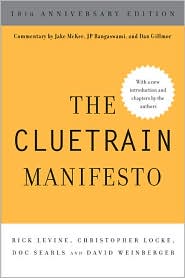
Cluetrain 10th Anniversary edition
Cluetrain 10th Anniversary
Everything Is Miscellaneous
Small Pieces cover
Small Pieces Loosely Joined
Cluetrain cover
Cluetrain Manifesto
My face
Speaker info
Who am I? (Blog Disclosure Form) Copy this link as RSS address Atom Feed

June 16, 2009

[berkman] Beth Kolko: Form, Function and Fiction

Beth Kolko is giving a Berkman lunchtime talk on what her group, Deiagn for Digital Inclusion, has been doing. It’s an interdisciplinary group.

NOTE: Live-blogging. Getting things wrong. Missing points. Omitting key information. Introducing artificial choppiness. Over-emphasizing small matters. Paraphrasing badly. Not running a spellpchecker. Mangling other people’s ideas and words. You are warned, people.

[Beth talks quickly. Hard to keep up.] The questions driving her group’s work: What ICTs are adopted in diverse communities and why. What do they do with ICTs? The aim is to design better technologies and policies.

When we name a technology, she says, we assume technologies have consistent meanings across cultural contexts. But that’s not true. There’s a whole lot of slippage. If you study diversity across disciplines, there’s a lot of research that says that diversity lends robustness. Without diversity, systems are fragile. He groups wants to make design more aware of diversity.

How do you have a conversation that brings in the hardware and software folks, and the social science folks? She says that in her talk, the division between form and function will get smudgy.

Beth says that if you say you study the developing world, they get sleepy because they don’t see how it relates to what they’re doing. So, she and others have reframed this as “resource constraint.” This removes the geographic focus. It also makes it dynamic, not static. Resources can be anything from economic and educational to screen size. The question is: How do you design to accommodate this complexity.

She goes through the methods for the Central Asia portion of her work. It’s quantitative and qualitative. Surveys every year, four countries, 1000 people in each. Interviews with different populations, usabilities tests, ethnography.

Form of tech in resource-constrained environments

1. Internet as weather-dependent technology. In Cambodia in a small village, the Net goes down after it rains because it interrupts the satellite access. The Net is neither ubiquitous nor constant. In Central Asia, access is far more sporadic and they are on for far less time in each session than is typical in, say, Cambridge, MA.

2. Internet as a public resource. Beth’s Central Asian research use the Net about equally at a home, at a friend’s home, and at school/work.

3. Mobile phone as bank. The use of phones for banking has design implications, e.g., how visible is your password?

Function of tech in resource-constrained environments

1. ICTs as strengthener of social neworks. With demographics taken off the table, people who use conventional social networks are more likely to use technology. And people who use technology are more likely to trust others. [I think I got that wrong.] Most people in Beth’s studies use their mobile phones at least once a day.

2. Mobiles as a platform for fraud. Beth got a 419 Nigerian scam SMS msg when in Kenya. “What we use mobiles for is complex.”

3. SMS as a weapon. The role of SMS in revolution. She points to Iran.

4. Games as tech training. Games provide the first touch of ICT for many people. It’s cheaper in Cental Asia to play LAN games than access the Net. About 64% of game players are urban, and 63% are men.

From understanding to building

In one project, they studied how people used mobiles, they’re use of social networks, and the pain points of everyday life. (This is “design ethnography.”) They decided to look at mobile social software (MoSoSo), and a public transporation project (Starbus). They tried to adopt the notion of “personas” based on their surveys and interviews. (Personas are models of typical users.) MoSoSo allows recommendations filtered through one’s social network. Starbus addresses the problem that intercity buses don’t depart until they’re filled. Starbus puts a GPS box on the buses so they can send SMS msgs about where the bus is. You can text it to find out when it will come to the stop near you.

MoSoSo and Starbus both arise from the research that drills down into what it means to be an Internet user.

Q: When do porn and gambling enter the equation?
A: Not gambling because of banking issues. Plenty of porn.

Q: Why do people who use the Net report higher levels of trust?
A: Don’t know.

Q: Correlation between quality of life and Internet use?
A: Hard to know what that means.

Q: Are the public access centers set up by gov’t agencies or entrepreneurial people?
A: The latter.

Q: [me] If I were a businessperson designing for a market…
A: Avoid generalizations about that people X do Y. Get real data about how people are actually using the tech. E.g., if people don’t have GPS in their phones, Starbus opens up the GPS on the bus as a community resource.

Q: [lokman] You have longitudinal studies. Does the slower adoption rate come because of a lack of local content.
A: We’ve done captures of web sites from ’03 or ’04. We’ve looked at the change over time. Until ’07 or ’08, the government site at Uzbekistan said the purpose of the site was to restrict info. I suspect the variance in adoption rate has to do with the split between communication and information tech. Abstract info doesn’t resonate in resource-constrained environments.

Q [colin]: Also, the lack of new media literacy. How does trust and social networks feed into that?
A: The issue of info literacy gets complicated in a post-Soviet context. What looks like media illiteracy may be a different type of media literacy. People sometimes mimeograph materials off the Net and distribute them, which is a different type of media literacy. [Tags: design ux central_asia ethnography beth_kolko ]

Tweet
Follow me

Categories: Uncategorized Tagged with: bridgeblog • culture • design • digital culture • ethnography • ux Date: June 16th, 2009 dw

5 Comments »

June 12, 2009

Tenth Anniversary of Cluetrain celebration at Berkman

The Berkman Center is putting on a little book launch for the tenth anniversary edition of Cluetrain. Doc and I will be interviewed by the estimable Jonathan Zittrain on the topic “Cluetrain at 10: So How’s Utopia Working Out for Ya?” at 6pm, Tuesday, June 16, at Austin East at Harvard Law [map.

If you can’t make it, or if you’ll only show up if there’s pizza (there isn’t), it’s being webcast.

BTW, the tenth anniversary edition has the complete original text (available here for free), as well as new chapters by each of the four authors, plus an intro to the intro by me, plus articles by Dan Gillmor, Jake McGee, and J.P. Rangaswami.

[Tags: cluetrain ]

Tweet
Follow me

Categories: Uncategorized Tagged with: business • cluetrain • digital culture • marketing Date: June 12th, 2009 dw

1 Comment »

June 10, 2009

[newmedia] Mike Slaby on Obama’s use of social media

NOTE: Live-blogging. Getting things wrong. Missing points. Omitting key information. Introducing artificial choppiness. Over-emphasizing small matters. Paraphrasing badly. Not running a spellpchecker. Mangling other people’s ideas and words. You are warned, people.

At the Edelman-sponsored NewMedia conference, a panel is beginning on “advancing reputation,” with Mike Slaby (CTO of Obama for America), Debbie Curtis-Magley (UPS), and David Liu (AOL). Premise: Companies can now advance their reputations through the channels they choose, without going through media distributors.

Mike (Obama): A lot of success came from Obama’s skills as a candidate. There was a movement, and our job in the new media departent was how to get the candidate in front of people more. Going into these spaces, you are an equal member with everyone else. It’s not broadcasting. If you tread on people’s space, you’ll piss them off. It’s hard for companies to find a persona and a personality for talking online, but it’s easy with a political campaign because you have a candidate. You have to have one set of values and one story, and you need to talk in the language of your audience. If you’re going to use Twitter, you have to have people in your organization who know how to tweet. And you have to trust your people and the people you’re talking about. We only filtered out comments that were truly, truly offensive. Sean Hannity came after us because someone at our social network made it look like the Black Panthers endorsed Obama on our social networking site, so we set up a profile for Hannity to show him that this was an open space.

We gave out our logos and let people make their own sites. There was an art exhibit of what people made out of this, called “Officially Unofficial.” Some of it I wish hadn’t been made, but so what? It made people feel that the campaign was theirs. This makes marketing people uncomfortable if they’re used to managing messages. You should give up control. It worked for us.

But social media works for politics only if it gets people out into the real world to vote. You have to convert your users into donors, volunteers, and voters. About 30% of our email was doing something in the real world … I’m proud of that.

He adds: Not every business should have a facebook page; it depends on what you’re trying to do.

Also: There are no switching costs online, which is a reason not to build your own social networking site. We had a multi-million person base ready to go, but that may never happen again in politics, and it probably never happens in business.

Q: Why did the campaign refer to Obama as Barack? Wasn’t that too informal?
A: People want an emotional connection. They want to know his story. We needed to talk about him as a person. But now I never refer to him as that. He’s president.

[Tags: newmedia politics obama social_media nms09 ]

Tweet
Follow me

Categories: Uncategorized Tagged with: conference coverage • digital culture • newmedia • nms09 • obama • politics • social networks • social_media Date: June 10th, 2009 dw

Be the first to comment »

June 9, 2009

[berkman] Lewis Hyde on the Commons

Lewis Hyde is giving a Berkman talk about the book he’s working on. The book is about the ownership of art and ideas, and argues that they should lie in a cultual commons, rather than be treated as property.

NOTE: Live-blogging. Getting things wrong. Missing points. Omitting key information. Introducing artificial choppiness. Over-emphasizing small matters. Paraphrasing badly. Not running a spellpchecker. Mangling other people’s ideas and words. You are warned, people.

Lewis begins by talk about what a commons is. The term comes from medieval property ideas, and Lewis thinks of commons as a kind of property. He asks the group for a definition of property. Suggestions from the audience: “Exclusive rights.” “Anything I can use and have some degree of control over, not necessarily exclusively.” Lewis says that a 1900 dictionary defines property as that over which one has “rights of action.” Property is a bundle of rights of action. Lewis likes this definition because it includes human actors, Blackstone defines property rights in maximalist terms: the right to exclude the entire universe. Scalia also thinks property is the right to exclude. Lewis thinks the right to exclude is one of the bundle, not the whole thing. This is because, he says, he’s interested in commons. (He notes that in medieval times, “common” could be used as a verb. E.g., “a man may commons in the forest.)

Lewis talks about Hardin’s “The Tragedy of the Commons” essay. In fact, traditionally commons had governance rules to prevent the destruction of the commons’ asset, including the right of exclusion. “Commons were in fact not tragic. They lasted for millennia in Europe. Not tragic because they were rule-governed and stinted.” Why has the phrase “The tragedy of the commons” persisted? In part, because the phrase is catchy. In part because Hardin proposed it during the Cold War and it was taken as showing that common-ism doesn’t work.

There used to be an annual ritual of “beating the bounds,” to keep any gradual encroachment on the commons. “These were convivial affairs.” Lewis wonders if there are ways we can recover this resistance to encroachment.

Applied to the cultural realm, Lewis thinks cultural products are by nature in a commons. In the 18th century you get the idea that we could own poems, novels, etc. Until then, people thought of property as applying only to land. If something is not excludable, there’s no property in it. Many argued in the 18th century that therefore artistic works can’t be property. (Lewis recommends Terry Fisher’s article on philosophies of property. Terry points to four : Labor, moral rights, commercial utilitarianism, and civic utilitarianism.)

The first copyright law was in 1710 (Statute of Anne). By giving authors and publishers rights, it removed the “in perpetuity” of the crown’s monopolistic grants. It also created the public domain by creating a clear limit on the term of ownership: After 14 years, it enters the public domain. It’s as if the commons is the default state, says Lewis.

Jamie Boyle talks about the “second enclosure” in which everything is copyrighted by default, the term is extended. The second enclosure is an enclosure of the mind, says Boyle. Lewis now thinks there might be a third enclosure: The enclosure of wilderness of the mind. Lewis agrees that it makes sense to let the creator of a work, say a novel, get rewarded for it. “I wrote it, so it’s mine.” But, asks Lewis, what does the “I” mean? What is the self? He cites a 12th century Buddhist: “We study the self to forget the self.” To forget the self is to wake up to the world around you. Creativity comes out of self-abnegation. To get to something truly new, you have to a door open to the unknown. We usually think that the outside of owned property is the public domain. But that’s a domesticated sphere, things we are familiar with. There’s a old tradition that during the period of maturation, you have to leave the known world, go away from where instruction is given, and become familiar with your ignorance. (Lewis says he’s drawing on Thoreau.)

He takes an example from Jonathan Zittrain. When the Apple II came out, there was a spurt in sales because the first spreadsheet emerged, something that had not been expected. If you want a generative Internet, you have to be careful about what you lock down. Another example: In the 1980s, San Diego cell biologists patented a sequence of amino acids. They didn’t know its biological purpose. Ten years later, other researchers think that that sequence blocks blood to tumors. The patent owners sued the researchers. The patent gums up the system. Exploratory science goes into the unknown. “To enclose wilderness means giving property rights in areas where we as yet have no understanding what’s happening.” Lewis adds: “This makes no sense.” Lewis would like us to restore the idea that there are things that are unowned.

Emblematic of the third enclosure is silence. John Cage in 1952 came to Harvard to see/hear a completely soundproofed room. But Cage could hear a low rumbling and high whining. The low rumbling is the sound of your blood and the high whining is the sound of your nervous system. Silence for Cage meant not no sound but non-intention. He composed “4 mins and 33 seconds” which is a stretch of silence. The audience hears the ambient noise. In 2002 a rock group called the Planets put in a minute of silence. As a joke/homage, they credited it to Cage. The royalty-collecting societies started to send checks to Cage’s publisher. The publisher sued for copyright infringement on moral rights grounds (i.e., misattribution). They settled. But Cage held a Buddhist-like view of artistic creation. He tried to remove the self. A lot of copyright law assumes the work contains the imprint of the author’s personality. That’s one of the reasons we give a copyright. But those laws can get in the way of our ability to live in the wilderness, i.e., the third enclosure. How do you become a creator in a world in which scientists can patent unknown sequences and silence can be copyrighted?

Q: Maybe part of the problem in defending the commons is that we say we’re defending freedom, not as in free beer. Fighting for free beer is more compelling than fighting for free speech.
A: Beating the bounds was a fun event. So, yes, people have to want to do this.

Q: [me] How do we counter the fairness argument: If I did it, I ought to get the reward. How do we respond to that?
A: It’s hard to do this in political debate because it’s a long argument. I raise the question of the “I”: To what extent is my contribution really from me? With cultural works, you’re working in a vast sea of existing material. What you create is not entirely yours. Even if it becomes popular and useful, it’s other people who made it so. You can also point to the utilitarian consequences: The public interest is advanced by enabling things to enter the public domain.

Q: [jason] You’re making a creativity defense, i.e., that the commons is generative. But, if we take Cage or Thoreau to heart and say that true creativity consists of transcending the self, could we say that that leads to saying all works should be owned, so that you’re forced to create something new?
A: The puzzle is how much you can actually go to the wilderness. You can face it, but there’s no way to escape the world you come out of. Thoreau has The Iliad with him. There’s no way to escape the known. You always work from materials you’ve collected elsewhere.

Q: [ethanz] What’s so bad about private property? You’re hearkening back to a romantic conception that worked for a very small set of people. We’ve got an enormous amount of development vased on increasingly strong enclosure movements. Those movements have given us a great deal of what we love. Despite the first and second enclosures, creativity seems not to have been much hindered. Why should we worry about the third enclosure? Couldn’t we say that you’re attempting to protect and defend something that most of us have not experienced? How do we know that your romantic vision is superior to the world we’re interacting with?
A: I’m not against private property. The question is always where the lines should be drawn. I think we’ve extended the right to exclude too far. Yes, the world is quite creative. But we don’t know what we’re missing. With the enclosing of wilderness, we’re enclosing that which we don’t know about. Researchers are reluctant to do certain kinds of work, for fear of being sued.
Ethan: My diabetes medicine — recombinant DNA — exists because Eli Lilly worked within enclosures. How do we know we would have made the same progress if those enclosures weren’t there?
A: Let’s leave that hanging as a question. It’s a good question. You’re right that the existing dominant system has produced remarkable results.

Q: Michael Heller in The Gridlock Economy goes through the economic models that explain what we lose by locking stuff down. What’s the cultural loss?
A: Lessig and others write books about this… [Tags: lewis_hyde copyright commons copyleft science art ]

Tweet
Follow me

Categories: Uncategorized Tagged with: art • commons • copyleft • copyright • culture • digital culture • digital rights • everythingIsMiscellaneous • knowledge • libraries • science Date: June 9th, 2009 dw

4 Comments »

June 8, 2009

Next, he dehydrates water

Rob Matthews has printed out and bound Wikipedia’s featured articles, creating a 5,000 page volume.

In case you were wondering, featured articles are articles that get a gold star from Wikipedia – about one in every 1,140 at the moment, for the English language version.

(If Rob hadn’t copyrighted the excellent photos, they’d be popping up in every third slide deck from now on.)

[Tags: wikipedia ]

Tweet
Follow me

Categories: Uncategorized Tagged with: digital culture • everythingIsMiscellaneous • knowledge • media • wikipedia Date: June 8th, 2009 dw

1 Comment »

Social media are jazz

Jeneane’s got a great post for businesses that think they’re playing well in the social media sandbox. She asks: You’re playing, but are you playing jazz?

[Tags: social_media marketing cluetrain business web_2.0 ]

Tweet
Follow me

Categories: Uncategorized Tagged with: business • cluetrain • digital culture • marketing • social_media • web 2.0 Date: June 8th, 2009 dw

Be the first to comment »

June 4, 2009

Why we have the Web, Reason #3546

Donald and Jill Knuth have posted about their collection of 962 photos of diamond shaped signs. The post points to two other sites about diamond shaped signs (1 2), as well as to a Google Maps mashup. To complete the webbiness, I heard about this via a tweet from nanofoo.

[Tags: everything_is_miscellaneous knuth diamond_shaped_signs signs traffic_signs road_signs ]

Tweet
Follow me

Categories: Uncategorized Tagged with: diamond_shaped_signs • digital culture • everythingIsMiscellaneous • everything_is_miscellaneous • knuth • road_signs • signs • traffic_signs Date: June 4th, 2009 dw

1 Comment »

White House bloggers get names

The bloggers who write the posts at the White House blog now are putting their names on their posts. I think this is a terrific move.

As I posted a couple of weeks ago, my interest isn’t in accountability. On the contrary. Usually, we think that along the Continuum of Responsibility, putting your name to something will push you toward the Staying In Line side, while being anonymous lets you run toward the Recklessness goal post. But, it doesn’t always work that way. At a site like WhiteHouse.gov, the anonymity of bloggers reinforced the notion that the blog is a faceless voice of authority, with an adjoining door to the Office of Press Releases. I’m hoping that now that the bloggers are signing their posts, they will feel free-er to speak in their own voices, and present shades of view that are a bit more off-angle, and thus more interesting than the Official View. That’s already been true of the posts of the guest bloggers on the site. Now I hope the official bloggers will feel ok about occasionally saying “OMG!!!! I CAN’T BELIEVE I’M IN THE WHITE HOUSE!!!!!!” except maybe a little more constructively and definitely with the caps only implied.

[Tags: white_house whitehouse obama e-gov e-government e-democracy egov blogs anonymity accountability ]

Tweet
Follow me

Categories: blogs Tagged with: accountability • anonymity • blogs • digital culture • e-democracy • e-gov • e-government • egov • everythingIsMiscellaneous • obama • whitehouse • white_house Date: June 4th, 2009 dw

1 Comment »

June 2, 2009

[berkman] Lokman Tsui: Beyond objectivity

Lokman Tsui is giving a Berkman talk called “Beyond Objectivity: Global Voices and the future of Journalism.” This is based on research he’s been doing for his doctoral dissertation.

NOTE: Live-blogging. Getting things wrong. Missing points. Omitting key information. Introducing artificial choppiness. Over-emphasizing small matters. Paraphrasing badly. Not running a spellpchecker. Mangling other people’s ideas and words. You are warned, people.

Lokman has been long interested in the Chinese Internet. He was born and raised in Amsterdam, and says that the Dutch often don’t like difference and diversity; they’re struggling with the idea of cultural complexity. After wrestling with what to study, he talked with Andrew Lih and came away wanting to study something that works but that we don’t understand well. Lokman chose Global Voices.

He’s interested in “how the world comes to know itself.” Lokman thinks journalism is crucial to this. James Carrey [sp?]: The public is what forms when people get together to talk about the news. Now, with the Internet, we have strangers everywhere. “What does that mean for the kind of journalism we want?” Lokman cites Habermas. We need to re-think journalism. “My purpose here is not to celebrate the Internet” or to dismiss the dangers, but to see it as an historic opportunity. By thinking about the global nature of communication, we can design better institutions.

His research begins with a study of GV as a a “newsroom.” What are the journalists’ routines? How do they socialize? How do they get news? E.g., it used to be easy and convenient to get info from gov’t sources, leading to a bias towards those sources. But the GV newsroom is different. Multicultural, global. And the newsroom is online, which leads to different interactions and shapes the news. We need a new conceptual toolkit to understand it.

Is GV journalism at all? GV is the trickster of journalism, in Lewis Hyde’s sense: it provokes us to respond and develop. GV and journalism are both ways of seeing. There are three ideals of journalism, intertwined with ideals of democracy. (1) Professional J, with liberal democracy, aimed at providing information. (2) Alternative media, with participatory democracy, aimed at representation. (3) Public journalism along with deliberative democracy, aimed at conversation.For a long time, we’ve taken objectivity as the “gold standard” of journalism. But this doesn’t make sense for public journalism; it makes no sense to ask whether a conversation is objectivity. How do we judge conversations? GV gives some hints. GV supports “communicative” democracy (a la Iris Young) , aiming at conversation, and replacing objectivity with hospitality. Habermas was thinking of coffee houses where people have to bracket differences to enable conversation. Hospitality enables conversations even when there’s a disparity of power. Differences can be very useful in having a good conversation. E.g., the powerful host serves the guest, subverting the power relationship. That’s hospitality. It’s a way of judging journalism as well, seeking to include difference and diversity.

Hospitality goes back to Kant’s “Perpetual Peace.” His third law suggests that hospitality is a right based on the fact that we share a world. Kant says we cannot refuse a visitor if it will lead to his/her destruction. Hospitality is about access, recognition, and appropriate response. Arendt wrote about intersubjectivity as a way toward truth. We now have an abundance of stories on line. The constraints have changed, so the way we judge journalism should change. The challenge is that, while the cost of speech as gone down, our attention is still scarce.At RottenTomatoes.com, the objectivity is in the dry summary. But the subjective reviews are more interesting and useful. The professionals should aggregate and amplify all these voices. You need to put them all together. What would an aggregation site look like for the news? It’d look a bit like GV. You get curated news and posts and tweets, and then comments and conversation.

Q: [me] Why has the term “hospitality” become less used precisely when we are most in contact with different cultures?
A: It may be partially due to the paradox of choice, and a fear of the unknown that’s come about in recent years. We’re very happy to send our products, our TV programs, and our money everywhere. But the flow of people is restricted. And it’s a matter of being able to listen, which some places are better at than others. I’m playing with the hospitality ratio: how much you listen vs. how much you speak. E.g., how many films you import vs. expert. A few years ago I looked at how many links link back to you and how many links to others. I compared a-list blogs and newspapers. Newspapers didn’t link out much at all.

Q: How do we train people for journalism?
A: J is a craft as well as a profession. The Internet is making us think about J as a craft: pursuing excellence for its own sake in something you care about. Most GV people think of themselves as craftspeople. Q: Where’s the hook in what you’re saying? And, btw, journalist didn’t come out of people seeking the truth but hard-drinking people who were getting paid to present a point of view. Also, you might look at Erik Erikson.

Q: Hospitality is reciprocal. How might the concept of respect apply to journalism?
A: Reciprocity is a huge part of hospitality. It means journalist need to include more views.Q: There are many public spheres, even within GV.
A: Yes.

Q: Does GV connect to other kinds of civic spaces, other than journalism?
A: GV isn’t just a bunch of people trying to do journalism. It’s an infrastructure for other sorts of projects, such as translation, herdict.org… There are tons of other civic practices there. Q: [ethanz] I want to temper some of your optimism. I think it’s great that you’re offering a new criterion — hospitality — for evaluating journalism. I think these ideas get stronger in combination. My main criticism of your work is that you’re not critical enough of GV [which Ethan co-founded]. GV is at best partially successful.

[I missed the last few questions. Sorry.] [Tags: journalism diversity objectivity hospitality global_voices everything_is_miscellaneous ]

Tweet
Follow me

Categories: Uncategorized Tagged with: bridgeblog • digital culture • diversity • globalvoices • hospitality • journalism • media • objectivity • peace Date: June 2nd, 2009 dw

Be the first to comment »

May 31, 2009

Utopianism: Threat or danger?

Shannon Bain has posted a long, thoughtful probing of Everything Is Miscellaneous and my defense of cyber-utopianism. It’s philosophical, serious, and generally right in its criticisms. He writes about my ideas in their philosophical context, as few have. I am very grateful for (and flattered by) this extended piece of clear-headed, morally-centered thinking.

His most telling criticism is (imo, anyway) that although he and I agree the Web is revolutionary, I assume the revolution will be for the good. Shannon worries that Cass Sunstein is right, and the Web’s openness and linkiness is really leading us to harden our positions, rather than opening up us to more diversity of thought.

My position has changed over the years on this, in part because I’ve had to the opportunity to hang out with folks at the Berkman Center. So, I now accept that the danger Sunstein points to is real. But, my reaction to this “echo chamber” argument is complex and confusing. I think (a) there are enormous challenges to evaluating the extent to which the Web is closing off thought; (b) the Web is probably leading us to be both more closed and more open simultaneously; (c) there is something wrong with the formulation itself; (d) the question probably mythologizes the degree of our openness in the pre-Web world. So, ultimately my position is: I don’t know, but it doesn’t matter too much because even if Sunstein is totally wrong (which he’s not), we’re still not doing enough to increase our interests and enlarge our sympathies. The Web won’t have this beneficial effect on us by itself; we must be ever vigilant and purposeful.

Shannon usefully connects this to my out-of-the-closet Heideggerianism. He wonders if I think cocooning (or, echo-chambering, if you prefer) “isn’t all bad”:

Maybe these cocoons of confirmation – these little webs of shared connotations and self-reinforced absolutist understandings, which I claim are negative aspects of a naturally biased humanity – are really what Heidegger’s beleaguered teacher Edmund Husserl called “lifeworlds:” the necessary and inescapable social, cultural and historical contexts within and through which we experience the world. Maybe so, but the problem is, these life worlds are hermetically sealed wholes of historical and cultural prejudice, incommensurable and unassailable. As Heidegger’s most influential student Hans-Georg Gadamer formulated it, prejudice – the historical, social and cultural “situatedness” we’re born into – is essential to Being-in-the-world. Outside of your lifeworld, your cocoon of prejudice, you simply aren’t… in the big metaphysical sense. Thus primordial prejudice – our cocoon of reinforcing ideas ever ready to disregard inconvenient or inconsistent “facts” – is the foundation of meaning in this Heideggerian sense.

Shannon’s right to see a connection, but I disagree with the conclusion he draws. I do strongly believe that we are inescapably thrown into a culture, language and history, and these determine much of who we are and how we thinkg. But, I don’t think that echo chambers are ok because of that. We cannot fully escape our context, but being a small-minded bigot who assumes that your beliefs and values are right simply because you believe them is not virtuous, wise, good, or acceptable.

This is, indeed, one of the reasons I think the “echo chambers” argument is mis-founded. The sharing of ideas, language, and values is essential to who we are. Without it, there is no culture and no conversation. But we are almost always in a complex dialectic of agreement and disagreement, identity and difference: We can only argue about something because we agree about so much already. So, in most arenas of life, we do better (as people, as a society) if we try to get past our own assumptions and sympathetically try to understand how the world matters to others. (FWIW, that’s what I found appealing about the academic study of philosophy. I saw it as a way to pry up the floor I was standing on, to see how many of the ideas I take for granted in fact have long, complex histories, and thus are not as “natural” and “self-evident” as I’d thought.)

(Also FWIW, I do think there are lots of areas in which asserting one’s agreement or identity has positive value, because it forms social and political bonds. But if that’s all you do, then you’re a small-minded nebbish.)

Shannon then tries to hang some anti-scientific beliefs on me, which I’m surprised he thinks I might hold. I don’t think science is just a Western superstition. Or whatever. But — and I’m sure Shannon agrees — I also don’t think science is the only way of thinking. It works at what it does. It doesn’t work at what it doesn’t work at. But, I love science. Sign me up for my flu shots!

Now, that doesn’t mean that every question can be settled, by facts, science, or by superstition for that matter. For example, in the piece Shannon refers to, I try to argue that the dispute among cyber-utopians, cyber-dystopians, and realists won’t be settled by facts because we are engaged in a political struggle, and the unknowable outcome of that struggle will give us the lens through we we look back and say “Hurray for the utopians!” or “Damn those utopians!” or whatever.

That criticism is toward the end of the piece, where Shannon then proceeds to argue against what I think is a strawman:

So, back to Weinberger’s utopianism. Remember that utopianism is the idea that the web is essentially good or for the best. Specifically that its native capacity to allow users to add metadata to content and make subtle, personal connections and relations is fundamentally and wholly positive.

Let’s drop the “wholly” from that last sentence. I never thought that the Web is wholly positive and I doubt I ever said it. (I am, however, quite capable of overstatement, so maybe I did. I am a writer with political interests, not a philosopher.) Shannon and I are closer than he thinks. He gives two alternatives to validate my utopianism. Either (says Shannon) I’m saying that we “Ignore the unfortunate facts about humans’ tendency to avoid disconfirmation…” or that we “embrace these tendencies as a prerequisite of authentic, human meaning.” I agree with Shannon that neither of these are acceptable. In order:

(1) I acknowledge our tendency to prefer the comfortable and closed. I acknowledge that the Web won’t magically overcome that. Rather, it is an unprecedented opportunity to work on overcoming it. Constant vigilance. And I think that may be a change in my thinking over the past decade. As I’ve said, I think the echo-chamber alarmists sometimes fail to acknowledge what sharing assumptions and values enables for us humans. But, my utopianism is not based on Shannon’s first alternative.

(2) I know ten years ago I thought “authenticity” was a good idea. But for the majority of the years since then, I’ve thought it’s a pretty bad idea. It does capture something that we want to be able to talk about — a country-western singer who grew up rich but pretends to be hardscrabble — but the metaphysics of authenticity is all screwed up…and within Heidegger it’s an unfortunately throwback to the essentialism he hated. (It did give philosophically-minded Germans a rationale for dying for their fatherland, however. Fucking Nazi.) I do think it’s good to acknowledge the inescapable effects of our birth, language, culture, history, family, etc. But acknowledging that doesn’t mean you can just settle into your prejudices. The reality is that we share our world with lots of people. They care about their lives and their world. If you reject that realization, you’re schizophrenic or evil. It’s our responsibility to always try to expand our circle of sympathy, to understand and care about how the world matters to others.

So, in what sense do I call myself a cyber-utopian? Applying that admittedly ridiculous term to myself is a political act. As I tried to say in the piece Shannon is commenting on, there are political consequences to these labels. I am a utopian because (in my view) it is useful to The Struggle to be one. Utopians remind us that the opportunity in front of us is epochal, and keep us from settling for too little imagination and hope. But the good the Web can do will not happen automatically, as we sit passively on our couches and let the Web work its magic on us. It will only manifest itself if we work tirelessly. My utopianism, as I understand it, is a denial of the sort of technological determinism that Shannon criticizes me for.

But, when you come down to it, I am indeed optimistic about the change we’re going through. It’s not inevitably or purely good, of course. And Shannon is completely right that I do tend to overstate the positive and understate the negatives. I tell myself that I do that for political reasons — there are enough fear mongers, and if they get their way, the Web gets restricted in ways I don’t want — but it means that I’m often writing a form of polemics. We are living through a “transvaluation of values,” and at this stage I feel a need to push on the door that’s opening. That undoubtedly means I need to acknowledge the risks and dangers more than I do, but I still want us to push on that door until it’s all the way open.

Thanks, Shannon, for your post. Truly. [Tags: shannon_bain everything_is_miscellaneous utopianism technodeterminism philosophy heidegger authenticity echo_chambers ]

Tweet
Follow me

Categories: Uncategorized Tagged with: authenticity • culture • digital culture • digital rights • heidegger • philosophy • technodeterminism • utopianism Date: May 31st, 2009 dw

4 Comments »

« Previous Page | Next Page »


Creative Commons License
This work is licensed under a Creative Commons Attribution-NonCommercial-ShareAlike 3.0 Unported License.
TL;DR: Share this post freely, but attribute it to me (name (David Weinberger) and link to it), and don't use it commercially without my permission.

Joho the Blog uses WordPress blogging software.
Thank you, WordPress!