


logo
EverydayChaos
Everyday Chaos
Too Big to Know
Too Big to Know
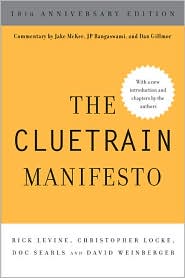
Cluetrain 10th Anniversary edition
Cluetrain 10th Anniversary
Everything Is Miscellaneous
Small Pieces cover
Small Pieces Loosely Joined
Cluetrain cover
Cluetrain Manifesto
My face
Speaker info
Who am I? (Blog Disclosure Form) Copy this link as RSS address Atom Feed

November 25, 2008

[berkman] Antony Loewenstein on blogging in rerpressive regimes

Antony Loewenstein is giving a Berkman Center lunchtime talk on “The Blogging Revolution: Going Online in Repressive Regimes.” He begins by reading a short paper. [Note: I’m live-blogging. Getting it wrong, Missing stuff. And this comes out far choppier than the actual discussion.]

In the paper he says that bloggers are at risk of being silenced in repressive regimes In Antony’s home, Australia, the PM is proposing filtering child porn and “excessively violent” sites. There has also been talk of blocking euthanasia and pro-anorexia sites. Wha next? Block Hamas sites? (Antony does not consider Hamas to be a terrorist group.) Despite all this, Australia isn’t one of the more repressive regimes when it comes to the Net. Antony’s book looks at bloggers’ attitudes toward their governments. E,.g., bloggers in the Middle East generally are angry at their governments for repressing the rise of Islamic government. There is a widespread desire to make incremental change without government involvement. Bloggers everywhere are unpacking issues governments would rather hide from view. “Blogging is not in itself revolutionary but the act of expressing yourself online can be.” Many of the bloggers he met with were aware of their international audience and hoped that would bring pressure on their regimes. They are also angry at global companies such as Microsoft, Yahoo, and Google in enabling the restrictions on the Net. “International laws and norms must be applied.” We need ethical labeling on media, as we have Fair Trade labels. And it’s not just other countries that we need to worry about it. Sen. Lieberman pressured YouTube to remove videos from supposedly Islamic fundamentalist terrorists. Blogging lets people write and publish without a Western filter.”

Q: [ethanz] In your book, you look at how the rest of the world gets filtered by the Western media. You say that the blogosphere lets people see the world unfiltered. But, people aren’t queueing up to read international blogs. There isn’t enough demand for it. What’s an ideal relationship among the people raising their voices — probably not in English — and the people around the world who could change policy and structure?
A: The bloggers I met with have very popular sites within their own country. Part of my job as a journalist is to talk with other journalists and tell them they ought to be paying more attention to these voices. It doesn’t mean that they will, but it’s likely these people will have an effect. During the Olympics, over Tibet, bloggers on both sides were shouting across each other. For one thing, language is a key problem. On the positive side, newspapers ran what Arab bloggers thought about the election.
Q: [ethanz] But wouldn’t the old man-on-the-street interviews be more representative than a handful of bloggers?
A: We need both. You, Ethan, may be underestimating the effect bloggers are having on journalists.

Q: [me] Do you have examples of blogging affecting repression?
A: Egypt. Bloggers filmed torture and rape. It was distributed via mobiles. Eventually the government was forced to respond. Police torture still goes on, but now people talk about it. Also, in Iran there are far more discussions of issues such as women’s rights, religious affiliations, the Iraq War. I don’t want to overplay that, but that is going on.

Q: The effect of Al Jazeera?
A: Major. Satellite is having more effect in many ways than the Net. It reaches more people.

Q: Yes, Western media ultimately turns everything into what’s about “us.” Western media define Arabs in light of the geopolitical struggle. The press reduces my identity to whether I’m pro or against Hamas. What is a positive message we can get out about working the system to get them to report on the real cases happening on the ground?
A: The Western media sense is that the Israelis are good and the Arabs are bad. Almost all Western journalists are based in Israel. That biases them. Not every story about the Middle East has to be focused through the terrorism prism.

Q: [jillian] What about Syria? Why didn’t you write more about that?
A: I don’t the Syrian blogosphere as having as much impact on that country as the Iranian and Egyptian blogosphere does on those countries.

Q: I was born in Poland and saw the Solidarity movement go from tiny to 1/3 of the population supporting it, in just a couple of months. It was so successful not because the NY Times supported it (which it did). I haven’t seen similar movements come about through the Net or cell phones. Why is it that even though we have all of this beautiful technology, we haven’t seen anything like Solidarity happening?
A: Blogging communities generally don’t have massive mainstream support. Many of the bloggers are not dissidents. E.g., Iranian bloggers are frequently pro-regime. Blogging plays one role among many. Bloggers on their own won’t bring down a regime. Frequently the reforms are old school. It’s not easier to get people on the streets to protest. No one I spoke to is looking for a violent revolution.

My understanding is that with the advent of the Net in Islamic states, people are finding new channels to discuss their questions about Islam, instead of going to the religious authorities or your family. This is eroding the authority of traditional religious authorities. Have bloggers in Islamic states mentioned this to you?
A: Even those who criticize the state still want an Islamic state.

You say a great deal of speech comes out of the Moslem Brotherhood that represents the people better than the Egyptian government does. What should those bloggers be doing to have a bigger influence nationally and internationally?
A: There’s a struggle within the Brotherhood between moderates and hard-liners. The old guard doesn’t like showing these internal struggles. It’s not about the Brotherhood changing their message to make the West happy. To bring about greater engagement means putting a Western-friendly face on.

[From the IRC comes a strong recommendation for this post by Roland Soong about Chinese blogging.]

Q: Technology backbones?
A: Facebook and Twitter are being localized. YouTube.

Q: Should YouTube block particular videos that offend, say, the Thais. Or should they just pull out of Thailand? If they block the particulars, is that collusion?
A: I think it’s inappropriate to do this without transparency. I’d rather have them block a few sites than block all of them, but what happens next?

[I had to leave at this point …] [Tags: berkman_antony_loewenstein blogging democracy ]

Tweet
Follow me

Categories: blogs Tagged with: blogging • blogs • bridgeblog • culture • democracy • digital culture • digital rights • peace Date: November 25th, 2008 dw

1 Comment »

November 17, 2008

Obama is the universal ex-officio

I’m enjoying watching various sub-cultures appropriate Obama as one of their own. Nerds, basketball fans, fantasy football leaguers, Blackberry owners, Mac owners, anti-torture believers in the Constitution…

[Tags: politics obama ]

Tweet
Follow me

Categories: Uncategorized Tagged with: culture • obama • politics Date: November 17th, 2008 dw

1 Comment »

November 12, 2008

Everyone’s position on linguistic correctness

AKMA points to two snippets from Stephen Fry on grammatical purity. The second snippet is classic Laurie and Fry.

AKMA expresses his usual admirable inclusiveness: He thinks grammatical correctness is worth striving for, but also acknowledges that language can usefully overflow its bounds. I’m with him. I was disappointed to hear Obama use the phrase “between her and meI,” and at his recent press conference to use “between” instead of “among” when referring to relationships of three or more. But I’m not a stickler. Why, I’ve recently become willing to blatantly split an infinitive or two.

When it comes to the sanctity of the rules of language, doesn’t everyone have the same position? While we think people ought to follow the grammatical rules that matter, we graciously condescend to permit others to make fools of themselves in public, unless they break rules the violation of which force a “Tut tut” from our lips. The difference is only over which particular rules we think are worth following, ignoring, or tut-tutting.

Or, to complete Henry Higgins’ thought: “Oh, why cahn’t the English … learn … to … speak … like me.” Pardon me: “…as I do.”

[Tags: akma grammar stephen_fry language ]

Tweet
Follow me

Categories: misc Tagged with: akma • culture • education • grammar • language • misc Date: November 12th, 2008 dw

8 Comments »

November 9, 2008

Star Spangled Obama

I like this video:

You could take it as yet more feel-good Obama propaganda, which it is. Or you could take it as a celebration supporters are entitled to, which we are. Or, you could take it as progressives (or liberals or lefties or whatever you want to call us) folding themselves back into the patriotism that the right had appropriated for itself, which is why I like it.

You could also replace those “or’s” with “and’s”. [Tags: obama election patriotism star_spangled_banner ]


And no comment needed:

Tweet
Follow me

Categories: Uncategorized Tagged with: culture • election • obama • patriotism • politics Date: November 9th, 2008 dw

1 Comment »

November 1, 2008

Harvard opts out of Google Books deal

Harvard is rescinding Google’s permission to scan its libraries’ books because Harvard thinks the settlement deal between Google and the publishers (which I blogged about enthusiastically here) is too restrictive. According to the Chronicle of Higher Ed, Harvard’s library guy, Robert Darnton, said:

“the settlement provides no assurance that the prices charged for access will be reasonable, especially since the subscription services will have no real competitors [and] the scope of access to the digitized books is in various ways both limited and uncertain.” He also expressed concern about the quality of the scanned books, which “in many cases will be missing photographs, illustrations, and other pictorial works, which will reduce their utility for research.”

[Tags: google libraries harvard copyright copyleft ]

Tweet
Follow me

Categories: Uncategorized Tagged with: copyleft • copyright • culture • digital rights • education • google • harvard • libraries Date: November 1st, 2008 dw

2 Comments »

October 28, 2008

Big book news from Google

Google has reached a settlement agreement in the lawsuit brought by publishers who were afraid that awareness of the existence of the publishers’ books might leak out onto the Internet. (Non-biased translation: Google has settled with the publishers suing over its books.google.com book search service.)

As far as I can tell from Google’s plain-English explanation (which, overall, is exceptionally clear), the default for out-of-print books that are still under copyright will be that they are available through Google Book Search. You’ll be able to not only see snippets (as now) but will be able to purchase them, with the money being distributed through a new, independent, book rights registry. In addition, libraries and universities will be able to purchase site licenses for all the books Google’s scanned.

For books currently in print and under copyright, it sounds like not much has changed. Google says publishers can “turn on” the purchase and preview options. Couldn’t they before?

Once this settlement is agreed on, we will have what sounds like a reasonable program for working within the bounds of copyright. Much will depend, of course, on what the pricing is.

Now we have to work on fixing copyright so that it serves its original purpose — providing an incentive sufficient to bring authors to write — rather than being used to create an artificial scarcity to serve the economic interests of an industry entrenched in a ditch carved into paper.

[Tags: books google copyright copyleft kindle ]


Wendy Seltzer worries that Google will now become iTunes for books …

Tweet
Follow me

Categories: Uncategorized Tagged with: books • copyleft • copyright • culture • digital culture • digital rights • everythingIsMiscellaneous • google • kindle • libraries Date: October 28th, 2008 dw

3 Comments »

October 26, 2008

Tweeting museum

Leslie Madsen Brooks at BlogHer writes about museums using Twitter. It’s a whole lotta links and a whole lotta love, including a link to Beth Kanter’s interview with MuseumTweets (= Amy Fox).

[Tags: museums twitter lesley_madsen_brooks beth_kanter amy_fox everything_is_miscellaneous ]

Tweet
Follow me

Categories: Uncategorized Tagged with: culture • digital culture • everythingIsMiscellaneous • knowledge • museums • twitter Date: October 26th, 2008 dw

Be the first to comment »

October 20, 2008

The following is a metaphor for something

Las Vegas Hilton in-room phone answering system interaction:

“Press U for user options.”
[You press U (= numeral 8)]
“User Options: Press X to exit user options.”

The war in Iraq? Sartre’s idea of bourgeois freedom? How I feel when I run into someone whose name I can’t remember who asks me, “Remember me?”?

[Tags: user_interface_design ]

Tweet
Follow me

Categories: Uncategorized Tagged with: culture • travel Date: October 20th, 2008 dw

1 Comment »

October 7, 2008

Spectacular 1960s jazz photos

Roberto Polillo has scanned and posted stunning black and white photos of jazz greats he took in the early to mid 1960s. (Disclosure: I had dinner at his home last night. Thanks, Roberto!)

Tweet
Follow me

Categories: misc Tagged with: culture • misc Date: October 7th, 2008 dw

3 Comments »

October 5, 2008

The opposite of Do Not Disturb

Often, on the back of a ‘Do Not Disturb’ sign is a ‘Make Up My Room Now’ message of some sort. But, now matter how they phrase it, isn’t it the same as an “I’m Out, So This Would Be a Good to Rob Me, Especially If You Are Squeamish about Violence” sign?

Tweet
Follow me

Categories: Uncategorized Tagged with: culture • travel Date: October 5th, 2008 dw

11 Comments »

« Previous Page | Next Page »


Creative Commons License
This work is licensed under a Creative Commons Attribution-NonCommercial-ShareAlike 3.0 Unported License.
TL;DR: Share this post freely, but attribute it to me (name (David Weinberger) and link to it), and don't use it commercially without my permission.

Joho the Blog uses WordPress blogging software.
Thank you, WordPress!