



logo
EverydayChaos
Everyday Chaos
Too Big to Know
Too Big to Know
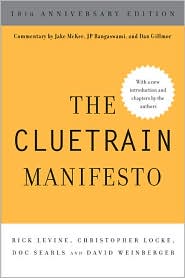
Cluetrain 10th Anniversary edition
Cluetrain 10th Anniversary
Everything Is Miscellaneous
Small Pieces cover
Small Pieces Loosely Joined
Cluetrain cover
Cluetrain Manifesto
My face
Speaker info
Who am I? (Blog Disclosure Form) Copy this link as RSS address Atom Feed

November 14, 2008

[berkman] Craig Newmark

Craig Newmark has dropped by the Berkman Center to chat. He begins by asking us what we want him to talk about. A voice opts for the history of CraigsList.com. [NOTE: I’m live-blogging, typing quickly, not correcting typos, getting things wrong, missing entire paragraphs, etc.]

He says that he got a better education than he needed at Case-Western. In early 1995 he wanted to give back some of what he received, he started some mailing lists, including for events, AnonSalon (a fundraiser) and others. People suggested new categories, including apartments. He was using Pine for email, but it started breaking at 240 mailing addresses. He was going to call the list “SFEvents,” but people said they already call it “CraigsList” and that it’s a brand. Craig didn’t know what a brand is, but he stuck with it.

He says he was a literal nerd in HS. He was not on the AV Squad [I was] but he was on the debating team, which led him to delusions about the effectiveness of rational discourse. He says he’s now comfortable with being a nerd.

Eventually he realized he could turn emails into HTML, an instant Web-publishing solution. Over the next few years, he refined the software. If a task took more than an hour a day, he would automate it. At the end of 1997, he hit three milestones: 1. A million page views per month (he hit a billion in 2004 and now is headed toward 13B. There are 26 people at the company). 2. Microsoft Sidewalk asked him to run banner ads. He turned them down because “I am an overpaid programmer.” 3. People volunteered to help. But it failed because he didn’t lead. So, in 1999 he turned it into a business.

He hired Jim Buckmaster “who is a full foot taller than I am.” He’s a really good manager. “I suck as a manager.” The culture there is that people make suggestions, they listen, and they decide what to act on. Also, it’s continued to try to be simple. And they decided to charge people who are already paying but for less effective ads, so they started charging people listing jobs and real estate brokers. “They asked us to charge them to cut down on certain types of spam, and on the need to post and repost.”

He’s always surprised people are willing to pay for what he does for fun. He’s generalized it to nerd values, including: once you have a comfortable living, it’s more fun to change things than to make more money. His business model: “We can do really well by treating people well and doing some good.”

He says he’s now going to half time as a customer service rep, after 14 years of fulltime. You sometimes see ugly things in customer service, he says. E.g., they saw ugly racist stuff during the campaign. “That takes something out of you.”

“I’ve only regretted giving my email address out once.” It was when he was on The View.

Over the past several years, they’ve begun to understand why CL is successful. “It has to do with the culture of trust we have.” There are bad guys but they’re a tiny percentage. “People look out for one another.” E.g., you can flag abusive ads. If enough people vote for it, it’s removed automatically. “That’s a flawed mechanism,” but it works better than not doing it. As Jon Stewart says, (Craig says) you do hear from extremists, but that’s because moderates have stuff to do. You should treat people the way you want to be treated. Corollaries: Live and let live, and give the other person a break. Nothing profound, he says, but it’s hard to follow through. “We’re trying to listen to people still.” “We decide on new cities based primarily on requests for them.” (567 cities now.) Novel ideas are rare. Most of what’s on the site is based on community feedback, although the child care section was Craig’s idea.

“I have no vision at all, but I know how to keep things simple, and I listen some.”

“We’re a good example of how people collaborate in mundane ways to make things happen. Not bad.” On his way to One Web Day he realized, “I’m a community organizer. I’m more of a meta-organizer.”

Nothing about CraigsList is, in his view, altruistic. It’s just people giving another person a break. “I figured I should extend this to other areas.” E.g., “I help people smarter than me help figure out the future of journalism.” E.g., Jeff Jarvis and Jay Rosen.

He’s also interested in grassroots democracy. Face to face is a better way of communicating but it doesn’t scale. On the Net, we get millions of people working together to make stuff happens. “This changes the nature of our democracy,” so that grassroots democracy can address the traditional problems with representative democracy. Craig thanks Joe Trippi and Zephyr Teachout. Now we have this big grassroots infrastructure. What do we do with it? “2008 is the new 1776.”

All sorts of things are happening. “It used to be that the guys with money, power and guns got to write the history and our narratives about ourselves. With Wikipedia, everyone has a shot at doing that…It changes the whole course of human history.” We are at a “singularity,” he says. We’re living in a time like 1776. It’s happening faster because the Internet accelerates everything. “I’m trying to play a microscopic part in it.”

He’s involved with the SunlightFoundation.org. He’s working with ConsumerReports. He was involved a little bit in SF’s 311 number. “Mundane, but it’s part of everyday governance. In my fantasies, I apply that to all levels of government.” A bunch of this is in the Obama platform, he says, and we could see some of it next year.

Veterans have been treated badly by the White House, he says, so he’s on the IAVA.org board. To screen claims faster, maybe they shouldn’t care about fraud so much, since veterans and their families are suffering as they wait for their claims to be processed.

As a nerd, it’s a “crime against nature” to be involved in promotion or communication. But he does it anyway. For one thing, he likes the idea of more people getting involved in service. “I do have one message for the kids: Stay off of my lawn.” :)

“The Constitution will be restored on January 20.”

He says focuses on people who can get things done. He lacks patience for those who can’t get things done.

Q: Are there any ways Craigslist has gone in directions you couldn’t have imagined?
A: I never tried to foresee them so it’s hard to answer. I had to have my arms twisted to create personals. They’ve done much more good than problems. Like “missed connections.” I’ve been asked to perform marriages. In a way, the whole thing has been a surprise. I have no vision. I’ve only responded to feedback. It’s all very surreal, but that’s life now.

Q: Why did CL succeed in the early days, as opposed to doing it over newsgroups?
A: Part of it was that everyone understood mail and Web browsers, while newsgroups were hard to used. And newsgroups were ad-spammed badly.We have a problem with spam, and last week we announced a suit against a company that sells ad-spam software. We aren’t litigious but we thought that was a good way to do it.

Q: Has it been a problem keeping CL simple?
A: Keeping it simple is a habit. There are times when we have to debate whether there should be a specific category, or should people have to register with a valid email on the message boards, but I don’t know how to do things except simply.

Q: What about the deal with National Center for Missing and Exploited Children.. How consensual was the deal?
A: Jim knows the details. He felt strongly about it. There was genuine abuse of our site involving minors. We’re not law enforcement professionals, so we got advice from the real experts. There is that sort of abuse and we have to help out. We just started charging for erotic services and we’ll contribute all that to philanthropies. And how do you manage anonymity? Sometimes you need it, for whistleblowers. We tend to the anonymity side. But congresspeople want to know that an email comes from a constituent rather than a mass spammed email. We’re talking about ways to balance anonymity and authentication, but we do need anonymity as a kind of check and balance against an oppressive government.

Q: Does your exposure to some of the uglier aspects has led you to see a more expansive role for government?
A: I have become more balanced, but mainly because I’ve been doing customer service. The best label I can figure is “moderate Libertarian.” I’m looking for a better label. I’m increasing interested in private-public partnerships since I’ve seen market solutions don’t always work, like for health insurance. I’m in the Net neutrality debate and see people misrepresenting it on purpose. (He adds that most lobbyists are ok, and a small number are predatory.)

Q: You’re in many cities but it still seems to be geared towards regional breakdowns. On purpose?
A: Initially we just followed our gut. CL is like a flea market. People get together to do commerce, but really just to socialize. Penelope Green talked about our site being a market in the ancient sense: chaotic and vividly human.

[me] Why doesn’t your company have meetings?

A: We have some. But we minimize them. A meeting of more than six people is already going to be dysfunctional (small group comms theory). Effective communication is a meeting is tough. This also reflects my impatience, a flaw as a human being.

What will be the future of the Communications Decency Act?
A: This is the part of law that says that a site isn’t responsible for what people say on the site, so long as they take some reasonable measures. I think it will stay and possibly be improved.

Q: Have you had any negative interactions with the police?
A: Not really. Once the FBI called asking if we knew there was an ad for plutonium on our site. The result was that someone got a stern talking to from his parents. The police just want to be treated decently and not jerked around. That’s our customer service idea.

Q: Why can’t people search for subsections?
A: Mysql chews up server time doing these searches. We have some ideas for how to do this, but there are bigger things they’re working on.

[Tags: craiglist craig_newmark customer_service community_organizer cluetrain berkman ]

Tweet
Follow me

Categories: Uncategorized Tagged with: berkman • cluetrain • craiglist • digital culture • digital rights • egov • everythingIsMiscellaneous • marketing • media • net neutrality • politics • social networks Date: November 14th, 2008 dw

2 Comments »

November 8, 2008

Happy unmeant birthday to you

I had a birthday recently. I find the happy birthday greetings sent from computer lists — the Prius Chat Forums and from UnusedWidget.com — to be merely inept marketing. But the jovial greeting from my dentist’s clinic sticks in my craw.

I have no personal relationship with the Prius or widget software, but the dentist is a guy who sticks his fingers in my mouth and asks me to spit in his presence. That’s intimate. So, getting a generic birthday greeting from his clinic’s computer is less than meaningless. If next time I’m in he wants to ask me how my birthday was, that’d be a reasonable topic of discussion. If he were to to call me up to wish me a happy birthday, I’d find that a little forced and weird. But having his computer set to send me wishes for a day that no human there observes, notes, or acts on, well, what type of fool does he take me for?

Of course, you don’t want to express that to someone who puts literal sticks in your craw, and who with a single tap can say, “Yup, that one’ll need to come out.”


I’m fine with telling you that I was born in 1950, but I don’t announce my birth date precisely so people won’t feel obliged to say “Happy birthday.” So, just skip it. I am, however, open to receiving presents. Year ’round. I’m a size should-lose-some-weight, who loves the works of artists-he-never-knew-he-liked.

[Tags: birthday dentist personalization one-to-one_marketing marketing cluetrain crotchety_old_man ]

Tweet
Follow me

Categories: Uncategorized Tagged with: birthday • cluetrain • dentist • humor • marketing • personalization Date: November 8th, 2008 dw

2 Comments »

September 19, 2008

[irmc] Government 2.0 and beyond

I’m at the 20th anniversary celebation of the Information Resources Management College of the National Defense University in DC. David Wennergren (Deputy asst secty of defense for info mgt, and DoD deputy chief info officer) is leading a panel on Gov’t 2.0, with Anthony Williams (nGenera, and coauthor of Wikinomics), Bruce Klein (Cisco, US public sector) and Mike Bradshaw (Google, federal sector). [I’m live blogging, making mistakes, being incomplete, mishearing …]

The moderator and the panelists each take a turn at the podium.

David says that Web 2.0 (etc.) is a powerful opportunity “for us to change differently.” Agencies don’t have to be isolated. Mashups, mass collaboration, etc., enable rapid innovation. “We’ve grown up in a world of systems,” big systems. In the new world, we need to be able to “focus and converge.” [David is citing someone else, but I didn’t catch the name.] He refers to the book “Polarity Management.” We have to get both security and sharing right. E.g., focus on secure networks and you create a “self-inflicted denial of service attack” on yourself. [Nice] If you don’t get sharing right, we lose our edge as a nation of innovators.

Anthony Williams (Wikinomics) says he’s been working with governments on e-gov ideas. If we can do Wikipedia, Galaxyzoo, Curriki, there’s no telling what we can do as citizens. The five big ideas: 1. Rethink public service. We still treat citizens as passive recipients. 2. Make sure the information flows horizontally and through all the governmental layers. 3. Open up the boundaries of government, inviting input from citizens, non-profits, private e, etc. 4. New models of democracy, especially interactive models of political communication. 5. Rethink our core institutions, redraw the division of labor. Can we source government services globally?

Bruce (Cisco) talks about how Cisco is using tech to transfer its business. Web 2.0 is about collaboration. Collaboration accelerates productivity, mission success (or growth), and innovation. But it’s more about the culture and the processes than the technology. He shows a crowded slide of how Cisco is using Web 2.0. Their Directory 3.0 includes profiles and areas of expertise. Ciscopedia is an internal wiki. And they have a portal for employees that includes info and apps. Wiki use went up 5x over a year, blogs up 3x, and video up 12x. Cisco is changing from command and control to collaboration and teamwork.

Mike (Google) begins with a title slide that has Google in one corner but that shares the space equally with Skype, Wikipedia, the iPhone, Facebook, AOL, YouTube, the iPod, Second Life, and Bebo. 98% of Google’s revenues come from its free products. Only 2% comes from Mike’s federal group. The cost of switching is zero, he says, so companies have to constantly work on providing good features that are usable without training. “We take that philosophy now to the workplace.” 89% people say they use at least one “unsanctioned” technology at work (Yankee Group). 49% say the tech they have at home is more advanced than what they have at work. He gives some examples of government embracing Web 2.0 tech. E.g., Homeland Security in Alabama used Google Earth as a platform for satellite imagery. Then firefighters started populating it with info about buildings and equipment. Then students started adding info. Etc. He ends by talking about the importance of cloud computing. He compares it to the early corporate resistance to PCs because they were insecure, etc. In addition to providing applications and infrastructure, cloud computing can be a platform (as with Google aps and Salesforce.com). In its own data centers, Google assumes things will fail. They buy commodity hardware and hold the drives in with velcro. Every minute, 13 hrs of video are uploaded to YouTube. The search engine gets a billion queries a day. Google has had to build a huge infrastructure, which they now make available to the public for free.

Q: How do we reconcile the rapidity of innovation and the slowness of the gov’t acquisition process?
A: (david) It’s changing. We’re becoming beter about using what’s on the Web. And we’re learning to move incrementally rather than building the big honking system.

Q: What kind of test did Cisco do to weed about the execs who are not ready to move from the command and control structure?
A: At Cisco, we measure everything. John Chambers put together boards and councils to run the company. The councils are cross-functional. You quickly see who collaborates and who doesn’t. Cisco changed the compensation so that for some, 70% of their compensation comes from how the company overall does.

Q: The DoD blocks many social networking sites. The younger employees want to collaborate all the time. How do we bring them in, let them live in their culture, and modify the environment to meet their needs?
A: (david) Blocking access is a non-sustainable policy. These government institutions do change when leaders stand up.
A: (anthony) We interviewed 10,000 youths globally. The public sector is the least desirable place to work in the US, UK and Canada. I agree with Dave on the blocking of sites. Canada banned Facebook for gov’t empoloyees, so everyone moved to MySpace. Canada is now looking at rolling out a Facebook-like product for the entire government.
A: (mike) Google has “20% time”: Spend 20% of your week doing something of great interest to you. That’s how Gmail was created. It includes community service, solar energy, etc. That helps retention. The federal gov’t attracts very smart people, but they get frustrated when tools they’re using — Facebook, for example — gets shut down. The first thing that has to be addressed are the security issues. We open our data centers to let federal folks see how secure we are. The old certification process takes too long.

Q: In the new model of gov’t how do you make sure the voice of all the people, even those without cmputers, is heard?
A: Yes, we don’t want simply to amplify the traditional values. But we hope some of the gaps will close. This needs political attention.

Q: The Toffflers [who are in the audience] point to the variance of rates of change. What’s Google doing to help accelerate change in education and law, to keep it up with the speed at which business changes?
A: (mike) We do try to influence policy. And we try to get info out to the gov’t. My 20% time is spent in bringing tech to charitable orgs.
A: (bruce) Cisco thinks there has to be a major transformation in education: Change in curriculum, in how teachers teach, how students can use tech to learn. We have bunches of pilots in place.

Q: We don’t have standards. Should there be government regulation of the Net to produce standards? And how would this work internationally?
A: (anthony) Regulating the Internet is not so good. But having the government using open standards is important.
A: (bruce) You stifle innovation if you over regulate.
A: (mike) Disruptive tech disrupts cost structures as well. We like open source and open standards because if you use our stuff, you’ll also be using other stuff as well.

Last thoughts? What do you see coming down the road?
A: (mike) Watch for Android. Open source.
A: (bruce) Work on culture to take advantage of what’s out there.
A: (anthony) How does the gov’t source expertise? How does it tap into the collaborative intelligence?
A: (david) We have to work on trust. It’s the single biggest inhibitor to making this shift. [Tags: irmc government federal web_2.0 ]

Tweet
Follow me

Categories: Uncategorized Tagged with: business • cluetrain • conference coverage • digital culture • federal • government • irmc • web 2.0 Date: September 19th, 2008 dw

11 Comments »

September 16, 2008

JuiceTorrent lets your supporters run ads to support you

Ok, I think I understand how this works. You sign up with JuiceTorrent. You get a widget to post on your site. It lists a few people who are supporting you. They’re supporting you by putting their own JT widget on their site, saying “I support so-and-so.” In addition, relevant ads are placed in designated spots on your supporters’ sites. The money those ads generate goes to you. So, your supporters get to support you financially by donating a little bit of ad space on their sites.

Interesting. As Emil Sotirov, CEO of the founding company, writes on his blog, JT creates

a new category of social vectors across the online identities of people and organizations – adding the moral and material dimension of “supporting” to the existing “linking,” “friending,” “visiting,”and “following.”

It’s currently in beta…

[Tags: social_networks business_models advertising marketing cluetrain ]

Tweet
Follow me

Categories: Uncategorized Tagged with: advertising • business • cluetrain • marketing Date: September 16th, 2008 dw

9 Comments »

September 15, 2008

Four ways businesses are using Twitter, three of them totally not sleazy

CIO has a brief article on how companies are using Twitter. Unfortunately, the first one is about how to hide your marketing messages in tweets. The other three, after the fold, are less objectionable (imo).

[Tags: twitter marketing cluetrain ]

Tweet
Follow me

Categories: Uncategorized Tagged with: cluetrain • marketing • twitter Date: September 15th, 2008 dw

2 Comments »

September 7, 2008

Not that there’s anything wrong with that.

Paul McDougall at InformationWeek explains what’s wrong with Microsoft’s $300M Seinfeld reruns.

[Tags: marketing cluetrain microsoft seinfeld advertising ]

Tweet
Follow me

Categories: Uncategorized Tagged with: advertising • cluetrain • marketing • microsoft • seinfeld Date: September 7th, 2008 dw

Be the first to comment »

August 24, 2008

Scrivener is on our side

I blogged yesterday about wanting a word processor that reflects better how we actually write. Islamoyankee in the comments suggested Scrivener, a Mac tool I tried once but didn’t take to, for whatever reason.

This morning, I took another look at it and found this paragraph on its home page, at the end of its product description:

Because Scrivener is about shaping chunks of text into a final typescript, Scrivener knows nothing of pages until it comes to exporting or printing and therefore does not have the page layout viewing features of modern word processor applications. So if you are just looking for an alternative to Word you might want to try Nisus Writer or Mellel. If you are drawn by Scrivener’s full screen mode but aren’t bothered about its large writing project management tools, try WriteRoom. If you came to this page because you have struggled with traditional word processors in trying to manage or finish a large writing project, try Scrivener by downloading the 30-day trial. And if after 30 days you decide that Scrivener isn’t the tool for you, be sure to check out the Links page for a list of alternative writing tools.

This is how a company acts when its confident of its product and is genuinely on the side of its users.

[Tags: scrivener marketing cluetrain ]

Tweet
Follow me

Categories: Uncategorized Tagged with: cluetrain • marketing • scrivener Date: August 24th, 2008 dw

1 Comment »

August 9, 2008

All your Now are belong to us

NBC tried to keep us Americans from seeing the Olympics in real time. So, how’s that working out for NBC? From the NYT:

NBC, which owns the exclusive rights to broadcast the Olympics in the United States, spent most of Friday trying to keep it that way.

NBC’s decision to delay broadcasting the opening ceremonies by 12 hours sent people across the country to their computers to poke holes in NBC’s technological wall — by finding newsfeeds on foreign broadcasters’ Web sites and by watching clips of the ceremonies on YouTube and other sites.

In response, NBC sent frantic requests to Web sites, asking them to take down the illicit clips and restrict authorized video to host countries. As the four-hour ceremony progressed, a game of digital whack-a-mole took place. Network executives tried to regulate leaks on the Web and shut down unauthorized video, while viewers deftly traded new links on blogs and on the Twitter site, redirecting one another to coverage from, say, Germany, or a site with a grainy Spanish-language video stream.

Temporal slapstick. It brings me odd joy. (Thanks to Jonathan Distler for the link.)

[Tags: olympics fort_business cluetrain ]

Tweet
Follow me

Categories: Uncategorized Tagged with: business • cluetrain • digital culture • olympics Date: August 9th, 2008 dw

9 Comments »

June 25, 2008

Chase Bank credit cards: Incompetent or scammy?

I received two Chase Quicken Visa credit cards yesterday. Neither were numbers I currently hold. So, I called their support line.

They told me that my current Citi credit cards had been bought by Chase, and would expire as of June 29, even though they’re marked as continuing into 2010.

The support guy couldn’t answer the most basic questions, including which new card number mapped to which old card number. So, I got Citi on the line while I escalated the Chase call. With one support person in each ear, I discovered that my two Citi cards were not being transferred, but an old Citi Quicken card was. And what about that second Quicken account for which I had received a new card? The Chase person explained that this was a card for an account that I had closed two years ago.

Why did they send me a card for a closed account? The Chase person said it was done automatically. So, presumably, thousands of cards have gone out with no indication that they’re for closed accounts. Was it a simple mistake, is Chase hoping that we’ll call the 800 number listed on the sticker on the front, thus re-activating accounts we’d closed?

I have now canceled my every single Chase Quicken account. (I don’t even use Quicken any more.) And I’ve asked for an acknowledgment in writing that I have done so. [Tags: cluetrain chase_bank credit_cards ]

Tweet
Follow me

Categories: Uncategorized Tagged with: cluetrain • uncat Date: June 25th, 2008 dw

31 Comments »

June 23, 2008

Death by tags

From BoingBoing comes this hilarious set of Amazon reviews of $500 audio cables from Denon. Best of all, BoingBoing points to the tags people have associated with the cables.

Oh, market conversations! What claims and brands won’t you take apart?

[Tags: market_conversations denon everything_is_miscellaneous ]

Tweet
Follow me

Categories: Uncategorized Tagged with: cluetrain • denon • everythingIsMiscellaneous • everything_is_miscellaneous • marketing • market_conversations • metadata Date: June 23rd, 2008 dw

1 Comment »

« Previous Page | Next Page »


Creative Commons License
This work is licensed under a Creative Commons Attribution-NonCommercial-ShareAlike 3.0 Unported License.
TL;DR: Share this post freely, but attribute it to me (name (David Weinberger) and link to it), and don't use it commercially without my permission.

Joho the Blog uses WordPress blogging software.
Thank you, WordPress!