



logo
EverydayChaos
Everyday Chaos
Too Big to Know
Too Big to Know
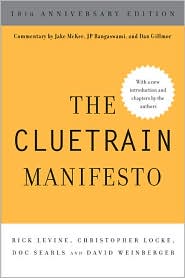
Cluetrain 10th Anniversary edition
Cluetrain 10th Anniversary
Everything Is Miscellaneous
Small Pieces cover
Small Pieces Loosely Joined
Cluetrain cover
Cluetrain Manifesto
My face
Speaker info
Who am I? (Blog Disclosure Form) Copy this link as RSS address Atom Feed

December 17, 2010

The Annals of Searching: Cluetrain circa 1505

Confine your search at Google Books for only the 19th century Cluetrain references, and you get four hits. In fact, the earliest reference to Cluetrain indexed by Google Books was in the 1505 business best-seller Extravagantes com[m]unes, in which appears the sentence “Markets are conversations…with that lying bastard Roger the Offal Merchant.”

Tweet
Follow me

Categories: cluetrain Tagged with: cluetrain • google • humor • search Date: December 17th, 2010 dw

1 Comment »

November 4, 2010

Customer satisfaction surveys that are totally unsatisfactory

I’ll skip explaining exactly why Citibank is impossible to deal with and how they are screwing up my credit by having created a fictitious account for me [see second comment for an update] and then sending it to a collection agency without ever having sent me a bill, and how multiple calls and escalations have not fixed this because Citibank’s various parts don’t communicate with one another, so getting it resolved with, say, the Customer Service folks remains invisible to the Personal Credit Destruction people.

So, last night, I spent another 20 minutes with Citi on the phone, talking with people who simply could not help me. They are fine folks doing their job as best they can, but they can’t see the computer files they need, and they can’t change the ones they can see. Citibank is broken.

Today I got a robocall from Citi asking me to complete a telephonic survey about my satisfaction. Hahahaha. But, in typical fashion, the questions pertain to the customer support person. How satisfied am I with her? Fine. She did what she could. But she couldn’t do anything because Citibank as a system sucks so bad. I’m not going to trash her because Citibank makes it structurally impossible for her to do her job.

If Citibank asked the right questions, it might find out just how broken it is.

Tweet
Follow me

Categories: cluetrain, marketing Tagged with: citi • citibank • cluetrain • marketing • vrm Date: November 4th, 2010 dw

6 Comments »

August 20, 2009

New issue of JOHO the Newsletter

I’ve just sent out the August 18, 2009 issue of JOHO, my newsletter. (It’s completely free, so feel free to subscribe.) It’s all new material (well, new-ish) except for one piece.

Cluetrain@10: Recently, the tenth anniversary edition of The Cluetrain Manifesto came out, a book I co-authored. Here’s some of what we got wrong in the original version.

In the new edition’s introduction, I list a bunch of ways the world has become cluetrain-y, many of which we take for granted. The fact is that I think Cluetrain was pretty much right. Of course, at the time we thought we were simply articulating things about the Web that were obvious to users but that many media and business folks needed to hear.

But Cluetrain also got some important things wrong…and I don’t mean just Thesis #74: “We are immune to advertising. Just forget it.”

Our kids’ Internet: 

Part 1: Will our kids appreciate the Internet?: Will the Net become just another medium that we take for granted? 

I love the Internet because even now, fifteen years into the Web, I remember what life used to be like. In fact, give me half a beer and I’ll regale you with tales of typing my dissertation on an IBM Model B electric, complete with carbon paper and Wite-Out. Let me finish my beer and I’ll explain microfiche to you, you young whippersnappers.

The coming generation, the one that’s been brought up on the Internet, aren’t going to love it the way that we do…

Part 2: The shared lessons of the Net: The Net teaches all its users (within a particular culture) some common lessons. And if that makes me a technodeterminist, then so be it.

In my network of friends and colleagues, there’s a schism. Some of us like to make generalizations about the Net. Others then mention that actual data shows that the Net is different to different people. Even within the US population, people’s experience of it varies widely. So, when middle class, educated, white men of a certain age talk as if what they’re excited about on the Net is what everyone is excited about, those white men are falling prey to the oldest fallacy in the book. 

Of course that’s right. My experience of the Web is not that of, say, a 14 year old Latina girl who’s on MySpace, doesn’t ever update Wikipedia articles, isn’t on Twitter, considers email to be a tool her parents use, and — gasp — hasn’t ever tagged a single page. The difference is real and really important. And yet …

Part 3: How to tell you’re in a culture gap: You’ll love or hate this link, which illustrates our non-uniform response to the Net.

The news’ old value:  

Part 1: Transparency is the new objectivity: Objectivity and credibility through authority were useful ways to come to reliable belief back when paper constrained ideas. In a linked world, though, transparency carries a lot of that burden.

Part 2: Driving Tom Friedman to the F Bomb: Traditional news media are being challenged at the most basic level by the fact that news has been a rectangular object, not a network.

Bogus Contest: Net PC-ness: What should we be politically correct about in the Age of the Web?

[Tags: joho newsletter technodeterminism news journalism media cluetrain ]

Tweet
Follow me

Categories: Uncategorized Tagged with: business • cluetrain • digital culture • digital rights • joho • journalism • marketing • media • news • newsletter • technodeterminism Date: August 20th, 2009 dw

2 Comments »

August 17, 2009

meta-meta-spam

I received this today:

FOR IMMEDIATE RELEASE

TWITTER ATTEMPTS TO SHUT DOWN USOCIAL

Twitter has recently moved to shut down web promotions company uSocial.net, by claiming the advertising agency is “spamming”.

According to uSocial CEO Leon Hill, Twitter recently sent accusations via a brand-management organisation that uSocial are using Twitter for spam purposes. Despite this, uSocial say the claims are false.

“The definition of spam is using electronic messaging to send unsolicited communication and as we don’t use Twitter for this, the claims are false.” Said Hill.

uSocial believe the claims are due to a service the company sells which allows clients to purchase packages of followers to increase their viewership on the site.

“The people at Twitter who are sending these claims are just flailing around trying to look for any excuse they can, though it’s going to take much more than this if they want us to pack up shop.” Said Hill. “We’re not going away that easily.”

The service in question can be viewed on uSocial’s site by going to http://usocial.net/twitter_marketing.

Based upon this press release, uSocial is correct: It is not a spammer. Rather, it enables spammers. And then they spammed me to tell me about it.

uSocial also helps companies game sites such as Digg.com by purchasing votes. uSocial is thus explicitly a force out to corrupt human trust. So, screw ’em.

(The uSocial site is down at the moment. Check this post by Eric Lander to read about the site.)

[Tags: spammers twitter marketing conversational_marketing ethics cluetrain ]

Tweet
Follow me

Categories: Uncategorized Tagged with: business • cluetrain • conversational_marketing • ethics • marketing • social networks • spammers • twitter Date: August 17th, 2009 dw

1 Comment »

August 13, 2009

Lego hops off the Cluetrain onto the tracks in front of it, wondering what that increasingly loud sound could be

Jake McKee was the Global Community Relations Specialist at Lego. In his essay in the tenth anniversary edition of Cluetrain (subtle product placement, eh?) he tells how Lego learned to engage with its users, and how this was good for everyone. (Josh Bernoff writes about this here.) Lego was a great example of how a business can benefit by getting down off its high horse and playing in the grass with its customers. Thank you, Jake.

Now Jake is gone from the company, and Lego has become an excellent example of how to be a clueless, frightened laughingstock. A 14-year-old user used Legos to create a stop-motion homage to Spinal Tap, which Spinal Tap projected in concert and wanted to include in its DVD. Lego refused to give permission. As a company spokesperson said: “…when you get into a more commercial use, that’s when we have to look into the fact that we are a trademarked brand, and we really have to control the use of our brand, and our brand values.”

First, I am not a lawyer, but: No. The Lego logo wasn’t shown anywhere in the video, and it’s hard to believe that Lego could win a suit.

Second, No. How customer unfriendly can you get? You sell us something that enables us to create what we want, and now you say you get to control what we create? You won’t let us take photos or videos of what we create? Does Crayola get to tell us we can’t post photos of the inappropriate messages I write with their crayons, because it might hurt their image among their target audience of 3-9 year olds and cretinous participants in political debates?

So:

Top Five Inappropriate Items to Construct out of Legosâ„¢ brand Legosâ„¢, owned by Lego Systemsâ„¢, a Lego Groupâ„¢ company

5. Legoâ„¢ Mindstormsâ„¢ dildo

4. Legoâ„¢ ThePiratesBay ship logo

3. Legoâ„¢ world’s most ineffective and uncomfortable condom

2. Legoâ„¢ official Spinal Tapâ„¢ Mud Flaps

1. Legoâ„¢ giant upraised middle finger

[Tags: copyleft copyright drm trademark spinal_tap harry_shearer ]

Tweet
Follow me

Categories: Uncategorized Tagged with: business • cluetrain • copyleft • copyright • digital rights • drm • harry_shearer • marketing • spinal_tap • trademark Date: August 13th, 2009 dw

1 Comment »

August 3, 2009

Twitter, markets, and marketing

Today’s WSJ has a good article by Sarah Needleman on companies using Twitter as a public relations tool.

Obviously, companies are paying attention to Twitter because lots of people have joined it; if it were a startup with 500 users, big companies wouldn’t care about it. But the way the massness of Twitter works may be teaching companies a lesson about the Web overall, and about markets.

Traditionally, marketing views a market as the set of potential customers — roughly, the people who are or might be made interested in the company’s offerings, and who are in a position to make a purchase. Marketers then segment their market according to some defining characteristics relevant to how the company can pique their interest and move them to completing a sale. Which means that messages define markets: Marketers choose age or ethnicity as the defining characteristics (for example) only if they think that those traits carve off a set of people susceptible to the same message.

Now, Twitter has this odd property of being able to support multiple scales: It works if you’re Ashton Kutcher with two million followers or if you’re a college kid with four followers. For Kutcher, Twitter is a mass medium. For most of his followers, it’s a far more social medium. This ability to work easily and simultaneously at scales separated by orders of magnitude is distinctive of the Web itself. Oh, sure, you could organize a phone bank to reach two million folks with your message, but that’s the opposite of an easy and natural use of telephones. For the Web, it’s just what it does.

Marketers are among those not used to this sort of continuity of scaling. Traditional marketing has aimed for the efficiencies bigger scales bring. Even the 1990s interest in “personalization” was a type of mass customization. So, it’s interesting to watch as marketers try to adjust to this new, slippery environment. The companies cited in the WSJ article seem not to be paying attention exclusively to Twitterers with huge followings. That by itself is a useful webby lesson to learn. But will marketers figure out how to make marketing scalable up and down, without violating norms or sounding like dicks?

[Tags: twitter marketing business cluetrain ]

Tweet
Follow me

Categories: Uncategorized Tagged with: business • cluetrain • marketing • social networks • twitter Date: August 3rd, 2009 dw

2 Comments »

July 29, 2009

Office hours for non-academics

Academics hold office hours — set periods when they can be found in their on-campus offices, available to talk — because they are not required to be on campus except for when they teach. Since more of the workforce is adopting that work-wherever-you-want approach, I really like Whitney Hess’ idea of establishing of office hours for herself. She’s a user experience designer, and if you want to talk with her, you can count on her being in her office, with a chat client open, on Sunday mornings, 9-10 EDT.

More of us ought to be doing that. I think it’s a keeper of an idea.

[Tags: office_hours free_agent_nation business ]

Tweet
Follow me

Categories: Uncategorized Tagged with: business • cluetrain • digital culture • everythingIsMiscellaneous • free_agent_nation • office_hours Date: July 29th, 2009 dw

5 Comments »

July 28, 2009

Annals of openness in peril

1. The court has rejected Charlie Nesson’s basic defense of Joel Tenenbaum’s sharing of music files. The case is going to jury which may levy the same sort of insanely excessive fines as in the Jammie Thomas-Rassert trial. I hope Charlie’s team can convince the jury that the fines and the entire process are so onerous and disproportionate that the RIAA has been abusing the court system. Of course, IANAL, and IANAOTJ (I am not on the jury).


2. Barnes and Noble has launched its e-book software. It runs on iPhones as well as on PC’s and Mac’s. I’m having trouble finding which formats it supports, but judging from its Open dialogue, not PDF, .doc, .html, .mobi, or text. It does support .PBD books.

After a very very quick session playing with it, it seems quite competitive with the Kindle, and because I’m running it on my Mac and not on the little piece of crippled hardware I bought from Amazon — the Kindle is just barely adequate as a reader, and is still overpriced by more than 100% in terms of its value, imo — having the use of a keyboard and a mouse is a big step up. And, unlike the Kindle, you can use whatever fonts you have on your machine. Still, it’s only incrementally better than the Kindle’s software (again, on a quick look), not a great leap forward for readers.

One of B&N’s big advantages is that it’s hooked into Google Books, enabling you to download public domain books that Google has scanned in. You do this by searching for a book on the B&N site and noticing the “free from Google Books” label. Be sure to sort by price; otherwise B&N lists the for-pay versions first. If B&N wants to be aggressive in this space (= succeed), it should create an easy-to-find section that lets you browse Google’s free books. Get us using the ereader and then sell us the copyrighted books. (If B&N has such a section, I couldn’t find it quickly enough.)

BTW, I presume (and thus may be wrong) that Google did a special deal with B&N to enable this. If so, I find it worrisome. If Google is going to be granted a special right to scan in books without fear of copyright reprisals, it will be the de facto national e-library, discouraging others from undertaking similarly scaled scanning projects, and thus should be making its public domain books equally and maximally freely available. IMO.

2a. [Later that evening:] B&N stores are now providing free Wifi. Yay!


3. Apple is not permitting the Google telephone service into the Apple App store, thus simultaneously and inadvertently making the case for Zittrainian generativity.


4. [Later that day]: On the happy front, Google has open-sourced an implementation of Wave.

[Tags: copyright copyleft books e-books google libraries everything_is_miscellaneous charles_nesson jonathan_zittrain law fair_use amazon kindle b&n ]

Tweet
Follow me

Categories: Uncategorized Tagged with: amazon • books • cluetrain • copyleft • copyright • digital rights • e-books • everythingIsMiscellaneous • google • kindle • law • libraries • media Date: July 28th, 2009 dw

8 Comments »

July 21, 2009

Boston: The New Marketing hub!

As everyone knows, Boston is the Hub of the Universe. The fact has been well-documented in Boston tourist literature, and in the way Bostonians superciliously ignore outsiders. Super-superciliously! We couldn’t do it if we weren’t the hub!

Now Scott Kirsner has proved that Boston is also the hub of the new wave of marketing literature, and he’s built the Amazon list to prove it.

[Tags: marketing web_marketing twitter boston the_hub ]

Tweet
Follow me

Categories: misc Tagged with: boston • business • cluetrain • marketing • the_hub • twitter • web_marketing Date: July 21st, 2009 dw

3 Comments »

July 13, 2009

Slow and steady wins the erase?

John Hagel and John Seely Brown have issued a new “Shift Index” report, which is way more facty and dataful than I can personally manage, but that many of you will find highly informative. Here’s just one point from an email they sent out about it:

The Shift Index suggests the current recession is masking long-term competitive challenges for U.S. businesses…

3. While firm performance has significantly deteriorated over this time period, total cash compensation for creative talent has increased substantially and consumers are wielding substantial power, suggesting that firm profitability is increasingly squeezed by talent and customers and that these other market participants have been much more effective in harnessing the value of expanding knowledge flows than firms themselves (pg. 107 – Shift Index Report).

Translation of point #3: Companies are the dumbest, slowest participants in their ecosystem.

[Tags: competitetiveness business ]

Tweet
Follow me

Categories: Uncategorized Tagged with: business • cluetrain • competitetiveness Date: July 13th, 2009 dw

Be the first to comment »

« Previous Page | Next Page »


Creative Commons License
This work is licensed under a Creative Commons Attribution-NonCommercial-ShareAlike 3.0 Unported License.
TL;DR: Share this post freely, but attribute it to me (name (David Weinberger) and link to it), and don't use it commercially without my permission.

Joho the Blog uses WordPress blogging software.
Thank you, WordPress!