

logo
EverydayChaos
Everyday Chaos
Too Big to Know
Too Big to Know
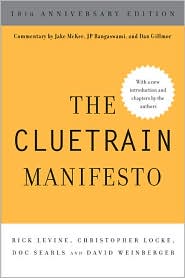
Cluetrain 10th Anniversary edition
Cluetrain 10th Anniversary
Everything Is Miscellaneous
Small Pieces cover
Small Pieces Loosely Joined
Cluetrain cover
Cluetrain Manifesto
My face
Speaker info
Who am I? (Blog Disclosure Form) Copy this link as RSS address Atom Feed

January 28, 2013

Unstartling presentation

Oy. I fell for an ad today because it promised to tell me four startling things that happen to you before you get a heart attack. The video, which has no pause or fast forward button, is a grating infomercial, with a heavy emphasis on the “mercial.” So, here’s the startling information Dr. Chauncey Crandall so selflessly is imparting to us:

The four things are:

Chest discomfort. Most heart attacks involve discomfort in the center of the chest that lasts for more than a few minutes, or goes away and comes back. The discomfort can feel like uncomfortable pressure, squeezing, fullness, or pain.

Discomfort in other areas of the upper body. Can include pain or discomfort in one or both arms, the back, neck, jaw, or stomach.

Shortness of breath. Often comes along with chest discomfort. But it also can occur before chest discomfort.

Other symptoms. May include breaking out in a cold sweat, nausea, or light-headedness To prevent heart attacks, cut back on fat intake but most importantly, cut back on sugar.

Yeah, these are the symptoms you will find listed anywhere that discusses heart attacks. For example, try a little place I like to call “Google”: top hit for “heart attack”.

It takes Dr. Crandall forever to get even the slightest piece of information — first promoting himself and pitching his newsletter etc. — that I gave up. So I quoted the above from trogdor1 on a discussion board. Thanks, Trogdor1, for taking the hit for the team.
Tweet
Follow me

Categories: cluetrain, marketing Tagged with: ads • cluetrain • heart attack • marketing Date: January 28th, 2013 dw

Be the first to comment »

December 2, 2012

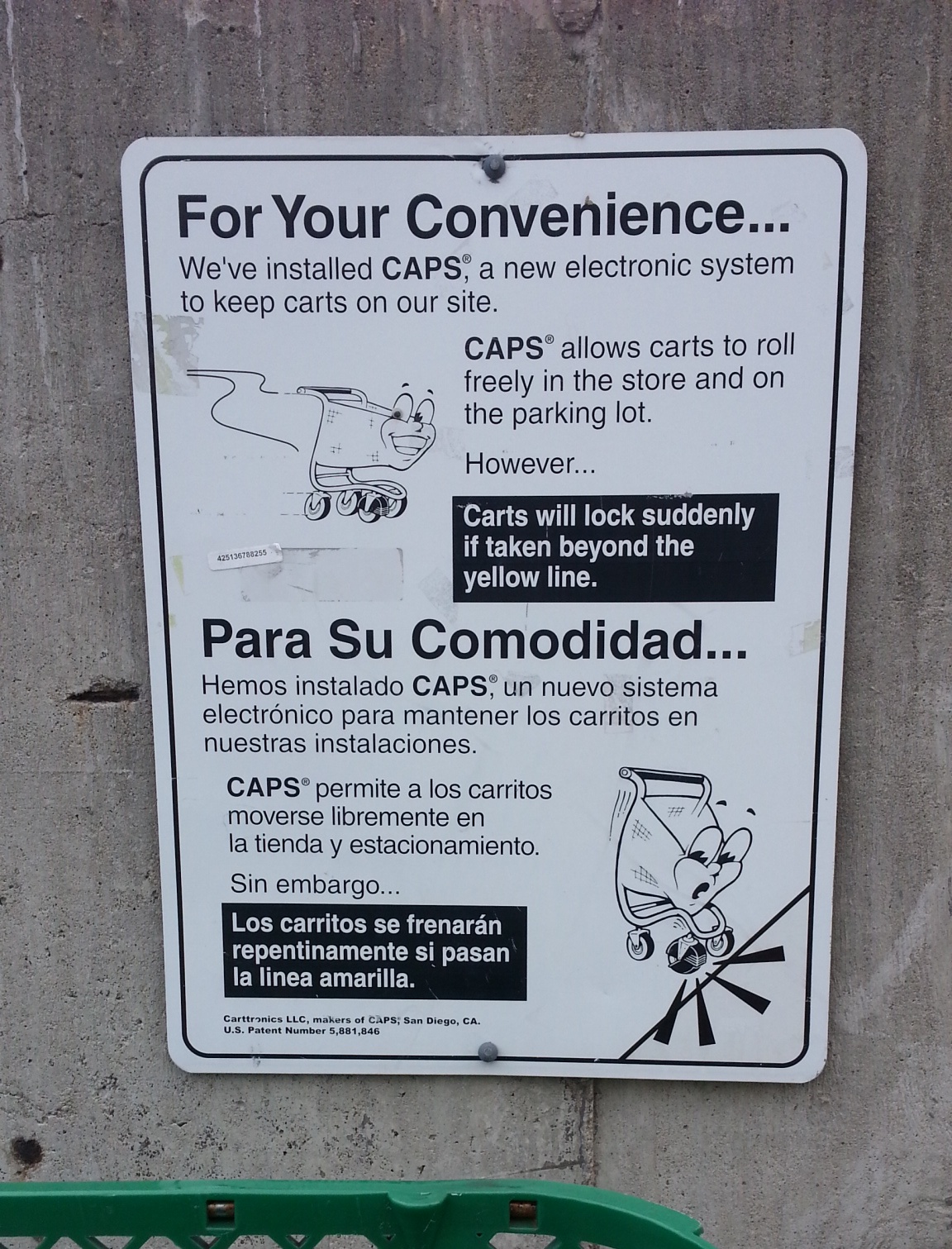
For your convenience…

sign explaining that your shopping cart will lock its wheels if you try to take it too far

No it’s not.

From our local Shaw’s grocery store.

Tweet
Follow me

Categories: cluetrain Tagged with: cluetrain Date: December 2nd, 2012 dw

16 Comments »

August 2, 2012

Three vendors and/or products to love: Computer parts, music, electric toothbrush

I wanted to replace the smashed screen of a white MacBook, and found what seemed like a very good price from Wegener. The new screen arrived very quickly, and was exactly as described. But when I started to strip down the MacBook, I discovered I had ordered the wrong screen. It’s surprisingly easy to do.

So, I sent an email to Wegener and quickly got a reply, followed by a phone call. The support person said they are happy to send me the right screen, for which I have to pay a little more because it’s a more expensive part. They’re sending it even before I return the old one. So far, the experience has been terrific: Quick responses, friendly people, good return policy.

Then they told me that in the carton for the replacement part I’ll find a postage paid mailing label. I reminded them that the problem was entirely my fault, and thus there’s no reason for them to pay for shipping. Yikes, that’s some good customer service! (I went ahead and returned the first screen on my own dime.)

It’s amazing how powerful an experience it is to be treated like a human being by a business.


HumbleBundle is a fantastic way to sell indie games and music. You name your own price, you can divvy it up among the creators and among charities, and today I got a message that they’ve added more songs for free for anyone who purchased the most recent bundle.

Yo, Humbles, I already bought the product. You don’t have to entice me any more. On the other hand: You’ve made me love you even more, and you’ve helped some musicians spread their music just a little wider.


I thought it had been 6 months since my last dental check up. Since I now routinely multiply any past intervals by two, I figured, correctly, that it’s really been a year. Usually, the hygienist has to put on waders and go at me with a pickaxe and a trowel. This was the first time in my life that a dental hygienist has marveled at my teeth. Gums are strong. No tartar, except for a little around a couple of teeth. Some healing of a couple of “pockets.”

There’s been one major variable that I know of: I switched from a Braun electric toothbrush to a Philips SoniCare.Why? Because the Internet told me to. I believe that the correlation is not accidental (see what I did there?), but of course it is just one data point.

Tweet
Follow me

Categories: business, cluetrain Tagged with: business • cluetrain Date: August 2nd, 2012 dw

2 Comments »

July 21, 2012

Doc Searls: WSJ centerfold!

Actually, it’s more like Doc Searls: Wall Street Journal Cover Boy!

It’s a testament to Doc and also a hopeful sign of the times that the WSJ today features on its weekend cover a story by Doc about the theme of his new book, The Intention Economy. The title of the piece is “The Customer as a God,” a headline Doc didn’t write and isn’t entirely comfortable with. But the piece is strong. And getting it on the cover of WSJ is like getting a story about VRM on the cover of CRM Magazine. Which Doc also did.

A sample:

big business continues to believe that a free market is one in which customers get to choose their captors. Choosing among AT&T, Sprint, T-Mobile and Verizon for your new smartphone is like choosing where you’d like to live under house arrest. It’s why marketers still talk about customers as “targets” they can “acquire,” “control,” “manage” and “lock in,” as if they were cattle. And it’s why big business thinks that the best way to get personal with customers on the Internet is with “big data,” gathered by placing tracking files in people’s browsers and smartphone apps without their knowledge—so they can be stalked wherever they go, with their “experiences” on commercial websites “personalized” for them.

It is not yet clear to the perpetrators of this practice that it is actually insane…

Congrats, Doc.


The headline brings to mind the most embarrassing headline I ever found one of my articles placed under. The article was about the need for human leeway in decisions about what constitutes copyright infringement. The title Wired supplied without my knowledge (that’s how magazines work) was: “Copy protection is a crime against humanity.” I can see the pun they intended, but taken at face values, it implies I think copy protection is on a par with genocide. I of course don’t even think copy protection is a crime.

And, yes, I am aware that the title for this post is also guilty of wild overstatement. I’m assuming — no offense, Doc — that even casual readers will understand that it’s hyperbole for humorous effect. Haha.

Tweet
Follow me

Categories: cluetrain Tagged with: cluetrain • doc searls • headlines • vrm • wsj Date: July 21st, 2012 dw

2 Comments »

June 29, 2012

[aspen][2b2k] Ideo’s Tim Brown

Tim Brown of Ideo is opening his Aspen Ideas Festival talk with a slide presentation called “From Newton to Design”. He says he’s early in thinking it through.

He points to a problem in how we’ve thought about design, trained designers, and have practiced design. The great thing about designing simple products is that you can know almost everything about them: who made them, who they’re for, how they were produced, etc. But as products get more complicated, it gets harder even for a team of designers to really understand what’s going on. They get so complicated that there are lots of places design can fail.

When we go out to urban planning , that becomes even more obvious, he says. He shows Union Sq. when it was designed and how wildly NYC has grown around it. Or, at the Courtyard Marriott chain, every element of the user’s experience has been thought through. He shows a script that specifies every interaction. But you can’t anticipate everything. E.g., JetBlue is one of the best designed customer experiences and even they got it wrong a couple of winters ago.

What’s going on? It’s all about complexity. Henri Poincaré in the 19th century tried to solve the three body problem that had been set by the French govt as an open source competition. HP couldn’t solve it. It sounds like a simple problem, but it’s very hard. [BTW, there’s a fascinating history of three French aristocrats hand-computing the movement of Halley’s Comet, which depended on calculating the gravitational influences of multiple bodies. Can’t find the ref at the moment]

Our basic ideas about design have been based on Newton, says Tim. Design assumes the ability to predict the future based on the present. We need to think more like Darwin: design as an evolutionary process. Design is more about emergence, never finished.

He presents a few principles of Darwinian design that he’s been exploring.

1. Design behaviors, not objects — the behaviors that come from our interactions with objects. If you’ve traveled on the high speed trains in Europe, there are signs urging men to be more accurate when peeing. But at Schiphol Airport, they print a fly at the right spot in the urinal; men became 80% more accurate. That’s designing behavior; the actual object doesn’t matter.

2. Design for information flow. Nicholas Christakis has looked at how networks affect behavior. Tesco uses its loyalty card — which cost them 20% of their margins — to increase sales.

3. Faster iteration = faster evolution. Viruses evolve faster than we do because they iterate faster than we do. E.g., State Farm tried out a new idea how to build relationships with the new generation. They built one storefront for this, and learned from it. “Launch to learn.”

4. Use selective emergence. This intrigues him, alathough he doesn’t know how useful it will be in design. Rather than random mutations, you choose what might be interesting and design things that get us there through many iterations. I.e., genetic algorithms. E.g., the Strandbeest walks along beaches with a hip joint unlike any in nature because the artist used genetic algorithms.

5. Take an experimental approach. I.e., testing hypotheses. Cf. Eric Ries, the Lean Startup (build, measure, learn). E.g., Ideo.org has been working on sanitation in Ghana. Where you can’t dig septic pits, Ideo has been experimenting with low cost receptacle toilets (with bio-digesters). But people didn’t want to pay for the service. So, they gave some to families and went away for three days. All the families changed their minds and said they are willing to pay for the service (which is provided by a local franchise).

6. Focus on simple rules. This comes from emergence theory. E.g., complex bird flocking patterns are based on simple rules. [Canonical example: Termite mounds.] E.g., Bi-Rite stores in SF uses simple rules: If an employee is within 10′ of a customer, you look the customer in the eye. If within 4′, you talk with them. This creates a wonderful service experience.

7. Design is never done. E.g., World of Warcraft is constantly being designed by its players.

8. The power of purpose. This creates the self-governance these complex environments succeed. Arab Spring and Occupy Wall Street are examples. Companies are experimenting with new ways of thinking about their business and products. E.g., Patagonia tells you not to buy its products because it also wants to preserve the environment.

The prototypical design artefact is a blue print. Once you created the blue print, the design was done. It was the instruction set for someone to make it. That’s how we think about design: finish and done. What replaces it: Code. It might be DNA (and Tim has people researching this), but more often it’s programming code. It’s an instruction set that can continue to evolve.

Now James Fallows [swoon] interviews him.

JF: You embody your principles. The rules are differen from a prior version. [ACK! Crash. Missed about 2 minutes]

TB: We’ve just finished designing the prototype experience for the new health care exchanges. It will affect how people choose which health care insurance to choose. Today it’s done with paper. Under the new health care laws, lots of people will get to make these choices. We worked with the CA Healthcare Foundation to prototype the user experience. What are the key pieces are parts? How can we keep the choices reasonably simple? Then each state will use this a platform to develop their own.

JF: And the govt had the wit to come to you to do this?

TB: The CA Health Care Foundation…

JF: What are the barriers? Does it cost more to do it your way?

TB: It’s often less costly. Most often they don’t have a good understanding of what their customers go through. When a health care org comes to us, relatively frequently we find out that a senior exec had to go through the health care experience. It’s true of all organizations. We don’t ask the right questions. The urgency to change is not there, and the resistance to change is always huge.

JF: Has the TSA come to you?

TB: Yes, but … well, we learned a lot. In the previous admin, we worked with them to find areas of change. Although going through the scanners has to improve, a lot of it has to do with the behavior of the people. They looked at a training program that was intended to take away some of the rule-based system they used. The more rules you apply, the less sensitive the system is. You need to give the people in that system much more independence to make judgments.

JF: Who do you hire?

TB: We look for a wide range of people. Many disciplines. We look for deep skills, and for empathy. It’s hard to solve problems for others without that. Also, most of what we do is too complex for individuals, so we work in teams, and thus people need an enthusiasm for empathy.

JF: Any unusual interview techniques?

TB: We put people into a situation in which they’re practicing design. E.g., intern program. Also, competitions. And we use Open Ideo as a way of seeing how people work.

JF: Beyond the toilet, what else are you doing for “design for poverty.”

TB: I got excited when I saw the opportunities for design in some social design work. At Open Ideo we’re working on clean water, early ed programs, etc. Ideo.org is a non-profit org. We want it to be sustainable and scalable so we look for external funding for it.

JF: How do you approach environmental sustainability?

TB: We try to build that into every project. Every project affects the environment. We try to bring sustainable thinking around systems, materials, energy flows, etc.

JF: What projects are you proudest of?

TB: The work we do in health care, including with Kaiser Permanente. Also, consumer-facing, post-crash financial services. PNC digital wallet. “Keep the change.” Etc. This is not an area where design has had much to do.

JF:

TB: For physical objects, it peaked maybe 20-30 years ago (with Apple as an exception). But we’re in ascendance for behavior-based designed. We get 25,000 apps a year for 100 openings. We’re a 600-person company. Etsy, Kickstarter, sw designed better than ever before…great things are happening. Soon if not already the number of digital designers will be greater than all other designers combined.

Q & A

Q: Your principles are so close to Buckminister Fuller’s [says the guy from the Fuller institute]. But the boundary between social and evolutionary systems is illusory.

TB: Yes, Fuller figured this out a long time ago. We’re perhaps resurrecting ideas, as every generation does. Design has operated as a priesthood for too long. When I started, I was only interested in how beautiful something is. That’s so much simpler. Opening design up to many more will convince us all that we’re all part of this big design ecosystem and have a responsibility to be thoughtful about the contributions we’re making to the world around us. I hope professional designers learn to enable that, more than controlling it. The B School at Stanford is introducing non-designers to design, which is great.

Q: What can we do to simplify the rules?

TB: The unstated bit of my thesis is that you still have to stop and design something. We develop an idea, perhaps more through iteration. That process doesn’t change. For rebuilding a complex system, maybe big data will help us to see patterns that allow us to understand what we’re designing’s complex effects…but I don’t think we’re there yet. We should be thinking about the hooks we’re building in. I’m big into APIs that allow other people to build with what you’ve built.

Q: Is it training or DNA that determines a good employee for you?

TB: Both. We hire people straight out of grad school because they’re moldable. We hire older people, but it’s harder for them to adapt. I don’t have much control as CEO. The future of all businesses is to have cultures that are a s self-governing as possible. That’s much more resilient and agile than cultures built on inflexible rule sets.

Q: I chair a land conservancy. We create parks in urban areas. Does Ideo have much experience in designing to create behaviors that will get people to use parks? What’s your view of the state of park design?

TB: We don’t have a lot of expertise in designing anything because we like designing everything. The High Line and the West Side park in NYC are remarkable examples. Projects like that show that parks can be remarkable assets to the city. We’re working with High Line on the third phase of that project. NYC’s life expectancy has gone up 3 yrs. Two explanations: People are closer to health facilities, and people walk more.

Q: What are the logistics of running a decentralized org? Mentoring? Sharing a vision?

TB: Purpose creates a sense of direction, so we talk about why the heck we’re doing what we’re doing. We think we should measure everything we do based on the impact it has on the word. We’ve done an occasionally decent job of mentoring; that can be a problem with a decentralized org. It’s a tension. Most of our employees probably want more mentoring, but we also want autonomy. We are not big believers in warehousing knowledge. Designers hate reusing other people’s ideas. It’s much better to have knowledge systems that inspire people to think in new ways. So we’re a storytelling culture. It’s a bit of an obsession of ours. If you do a piece of work, your job is to have some stories to tell about it. That’s more effective than big reports that live in a database somewhere.

(JF calls for all remaining questions)

Q: My group works with at-risk youth. Education is increasingly standards based, but your work is collaborative.

Q: How do you look at chaos? People in open markets are open and affectionate. In corporate controlled spaces, people shut down.

Q: Does form drive function or vice versa?

Q: Apple is a closed system. Google wants more control. Open vs. controlled systems?

TB: 1. University ed is not always the best way to teach entrepreneurship. Apprenticeships are interesting. 2. Great markets are vibrant, but not chaotic. I take clients to the Ferry building to point out all the interrelated pieces that make that such a great experience. It’s not top down, but you can see the patterns and use them as inspiration. 3. Form follow function? Hard to kick that notion because I believe in beautiful engineering, but most things we’re designing today have hundreds of functions, so you can’t get a single form for it. 4. I love closed systems but I think they’re inevitably part of an open system. IOS is part of an open system of everything else that I do with it. We need both. [At last! Something I disagree with! Sort of! :)]

[Fantastic. I’ve been a huge fan of Ideo’s work, and Ideo’s organizational ethos, and Tim Brown, for a long time. So I felt particularly narcissistic as I heard this talk through Cluetrain and Too Big to Know lenses. Substitute “knowledge” for “design” and you get a lot of the ideas in 2b2k. To hear them coming from Tim Brown, who is a personal idol of mine, was a self-centered thrill.]

Tweet
Follow me

Categories: business, cluetrain, culture, liveblog, too big to know Tagged with: 2b2k • aspenideas • cluetrain • design • innovation • liveblog Date: June 29th, 2012 dw

7 Comments »

June 28, 2012

[aspen] Amanda Michel and Matt Thompson on how the media have changed recently

Amanda Michel, who I know from her time at the Berkman Center, is being interviewed by Matt Thompson. She’s pretty amazing: Howard Dean campaign, Huffpo’s Off the Bus, Pro Publica, and now social media at The Guardian. She’s talking with Matt Thompson from NPR.

NOTE: Live-blogging. Getting things wrong. Missing points. Omitting key information. Introducing artificial choppiness. Over-emphasizing small matters. Paraphrasing badly. Not running a spellpchecker. Mangling other people’s ideas and words. You are warned, people.

She says that the Off the Bus effort now strikes her as surprisingly structured and profesionalized. For a year and a half, they recruited citizen journalists. Of the 12,000 of the people who participated, only 14% wanted to write articles on their own. The formalized approach Off the Bus took has been adopted by sites that invite readers to contribute their photos, their thoughts, etc.

The biggest shift, she says, is how much the campaigns rely upon data. E.g., how did Romney think he could win Iowa with just a few offices? The people who worked for him had identified die-hard supporters, who were asked to call other supporters, who were also then asked to call. In 2004, we the people were making media constantly. Now the engines driving the campaign are largely under the hood. So, if you’re reporting on campaigns today, you’re doing email analysis to understand the candidates’ strategies

Matt: It’s amazing how much media people now have woven into their days. A study shows that people are now spending 700 mins a day on media. Media is now a layer on top of people’s everyday experience. We looked at how a persistent story — a storm damaging a town — has been told throughout history. The single thing that stood out: We’ve gone from medium as an appointment you keep to media as a constant texture that both succors and buffets you.

Amanda: That’s why in 2008 we used a formalized approach — asking reporters to sign up and giving them assignments — and now people know if they go to a campaign event, they’ll be asked to post photos and twist.

Amanda: How has the shift between media and people changed?

Matt: We used to broadcast. We used to send out msgs. Now people use their mobile devices to talk with one another. We sit in this space, right alongside them. For us at NPR, that position is sweet. Radio is intimate. People can now carry us with them. That intimacy has created a drastically new dynamic for us.

Amanda: At Pro Publica, we worked on “explainers,” explaining questions people have. Readers told us they were particularly useful. I’m interested in how we can hold those in power accountable. We did the “stimulus spotcheck” to see how the economic stimulus money was being used. We asked our readers if we could tell what was going on. I asked readers to help us identify sites. Readers checked 550 sites around the country — 4.5% of construction sites aroiund the country — and we found that that gusher of work was further down the pipeline.

After making multiple phone calls, readers would sometimes say, “Journalism is hard,” which helps them understand the value of journalism.

The big challenge for media institutions is to keep their eye on the ball. The ubiquity of media can give you the false confidence that you’re seeing all there is. You’re checking Twitter, but many stories are much more difficult to find, and there are many people who don’t have a voice.

Amanda: Matt, what do you see coming?

Matt: I try to work through with the journalists the idea that we’re moving from stories toward streams. Humans have told one another stories forever, and will do so. But stories with beginnings, middles, and ends, are being augmented by the constant stream of info. Andy Carvin is constantly tracking events in the Middle East over Twitter. It’s a very different experience — no beginning, middle, end. Twitter gives you a sense of the texture of the lives of the people you follow. “We’re encountering the end of endings,” said Paul Ford. At NPR we’re trying to pull back to tell a longer story, a quest.

Amanda: There is this real need to see the context. Other trends: We’re going to be making sense of the world through the visual. We’re moving from the written word toward the image. At The Guardian, we think about how to bring people along in an ongoing process. How do you tether together items in the stream?

[Great session. My fave so far. But I’m a pretty big fan of both of these people.]

Tweet
Follow me

Categories: cluetrain, liveblog, media, social media Tagged with: aspen • aspenfuture • cluetrain • journalism • liveblog • npr Date: June 28th, 2012 dw

2 Comments »

[aspen] The new professionalism

I’m at the Aspen Ideas Festival, at a panel on how professionalism has changed.

NOTE: Live-blogging. Getting things wrong. Missing points. Omitting key information. Introducing artificial choppiness. Over-emphasizing small matters. Paraphrasing badly. Not running a spellpchecker. Mangling other people’s ideas and words. You are warned, people.

Reid Hoffman (chair of LinkedIn) says the concept of the professional has changed. It used to be something you got intensive training for, and then moved from apprentice to master within your chosen field. Now it means constantly learning, and adapting to changes in tech and business.

Deirdre Stanley is general counsel at Thomson Reuters (host of this panel). She says that professionalism used to mean meeting peer standards. Now she thinks about professionalism in terms of project ownership, problem solving, a defined end goal, and it’s left to your discretion how to reach that goal.

Susan Peters says GE thinks of professionals as problem solvers. They have 160,000 professionals around the world. It’s about how you do the problem solving. Do leaders create cultures, or do cultures create leaders, she asks.

Mark Penn, the pollster, says that professionals are the new middle class. 85% of Americans say they’re middle class. 54% say they’re professionals. This is the new backbone of the economy. We don’t recognize it enough. There’s not enough talk about making the professional sector as big, vibrate, and cutting edge as possible.

Moderator Heidi Moore says that professionalism is not seen as soulless and oppressed as in Dilbert and Office Space.

Reid: It’s called work because you wouldn’t do it if you weren’t paid for it. The key question: Tech is transforming industry, and tech requires new sets of skills. How do we invest in ourselves and our society? Purpose is an important element, but it’s also how you maintain a competitive edge in the skill set.

Mark: Many professionals don’t want to retire. 25% in an AARP poll said that they don’t want to retire because they like working.

Heidi: Because they feel like they’re working for themselves?

Susan: A cohort is drawn to mission-based work. And it’s the environment in which you’re doing it: the people you work with, the management structure, are you enabled to be a problem solver. At GE last summer we took 21 people from around the globe and had them spend time together, and tell us what you think GE needs to be like: who, where, how. They came up with 250 ideas E.g., a career navigation tool.

Deirdre: Not every company has the luxury to do that. Law students are not getting jobs. And of course not just law students. People have to learn new skills.

Heidi: What does the new professional look like? What should we be doing to manage our careers?

Reid: Think of yourself as the business of yourself. My skillset? How do I invest in myself? What’s your individual product market fit.

Mark: You need education and knowledge. And we need to prepare people for independent problem solving, which is what professionals do.

Deirdre: The proliferation of info affects professionals. 20 yrs ago, your doctor told you what’s wrong with you. Now, you google your symptoms and go to the doctor.

Susan: The organization has to do some forward thinking in helping people become problem solvers. People need to never stop evolving.

Reid: To be a professional, you have to take responsibility for your own evolution. That doesn’t mean the society and business shouldn’t provide the tools and environment to enable that. In Silicon Valley, there’s a lot of discussion about what people seeing about how companies are working; individuals need to do that also

Mark: Prof orgs needs to having training tracks, mentoring. Problem solving is best taught through mentorship. But it’s also about their social environment.

Heidi: Working at home?

Mark: The better the collaborative tools, the better the quality of work.

Reid: Startups are working on this. E.g., LiquidSpace, etc. You do have to have some high bandwidth in-person interactions. It’s going to be ablend.

Deirdre: Tech is accelerating this virtual environment, and also putting increased pressure on the professional. The ability to master the tools may change the profile of the professional. Also, the ability to work with many different sorts of people matters. And, yes, you need some in-person team-building.

Susan: It’s not the old demographic. It’s about the work space, about tech, and about connectedness. The old corporate structure, patterned on the military, is antiquated.

Reid: If you don’t find risk, risk finds you. This is because tech drives globalization. People say they want meaning and stability from their work. Adaptability is the new stability. You accomplish that by being able to take intelligent risks. That’s what entrepreneurs do well, which is why it’s important to become the entrepreneur of your own life. You can’t manage risk to zero. By learning how to be adaptive is how you manage risk in a modern professional career.

Deirdre: When you sit in a corporation, you see some areas growing and some not. If you’re an employee, you want to be in the growing part or in the group figuring out the strategy for the other areas.

Mark: 75% of voters have some college. 26% of two-income households make over $100K. The new prof class is much more pro-environment, much more socially tolerant. We currently have two professionals running for president.

Heidi: Yet all they talk about manufacturing jobs.

Mark: That’s because Ohio is a swing state. But we don’t have enough people to fill all the professional jobs. So why isn’t that the central focus of our economy?

Susan: We do need manufacturing in this country. The professionals in GE are helping to make those manufacturing jobs as advanced as possible. Our aircraft factories are very flat: an hourly worker can stop an assembly line. No foremen. The professional work class comes up with the ideas that brings the next product to be manufactured. GE is big enough that we can experiment. Eg., we’ve given some of our most senior people by giving them events outside of GE for 2-3 days. We send them to Silicon Valley, etc., to be out of their own context. Our research into 21st leaders shows that the people who make the best decisions are the ones with the best context — not just knowledge, but contacts wide in the world.

Heidi: I wake up early every morning and check Spanish bond deals. You have to be thinking about what’s happening around the world.

Reid: Use your network. In Silicon Valley we are constantly talking about “Have you seen…?”

Deirdre: There’s so much info that there may not always be the opportunity to step back and make informed decisions.

Reid: The books I read are the ones strongly recommended by my network.

Susan: Think about reflection. It’s an under leveraged aspect of what has to happen.

Q: You’ve been talking about changes individuals needs to make as professionals. I just spoke with student journalists all of whom are being taught very traditional ways of building a career. How do our higher ed institutions have to change.

Reid: Massively. Ivory towers worked better when there was less change in the world. Also, the dividing line between education and work is going the way of the dodo. You’re in permanent beta.

Mark: American professionals are pretty successful. We’re doing something right. Our system produces people who are the leading edge of change. I think we need more cultural change. Is it education or values that matters?

Heidi: Can we get a work ethic in a free-er culture?

Susan: The community does a great job with that. We’re getting peer evaluations: Who added the most value.

Heidi: Reverse mentoring?

Reid: For me the network is the mentor

Deirdre: At Thomson Reuters especially in diversity training we use reverse mentoring.

Susan: We do reverse mentoring, typically in the tech space.

Q: Many people are unprepared to be entrepreneurs. Shouldn’t public ed teach the basics of entrepreneurship?

Reid: Can it be taught? You can at least give people a grasp of the concepts.

Mark: It’s an important point. In the polls, American youth are becoming less entrepreneurial. They’re more interested in becoming professionals. Arab youth and Vietnamese are hotbeds of entrepreneurship.

Q: The future seems to take more time than we think. In the lifetimes of people here, what will professionalism look like?

Reid: The future is sooner and stranger than you think. I do think we’ll see more free agency; more network thinking, but orgs thinking about networks across boundaries; employment contracts will maintain relationships.

Susan: Some people will get very far very fast. It depends on the person and the product. You don’t want your aircraft engine to be totally freewheeling. Orgs will get more horizontal. People will have to become better all the time or they won’t make it; otherwise they’ll be selected out by their peers or mgt structure. You can’t be what you were.

Mark: We’re bad at predicting the future because we don’t understand the present. But AI will be important.

Heidi: Wall Street’s inability to adapt these days is like Mad Men: People who have an ideal of life they don’t want to change.

[me] Reid’s answers have generally been about being a good professional by using the Net. We have an idea of what a professional looks like in the real world. What does a professional look like on the Net?

Reid: There won’t really be a distinction between professionalism on the net and in life. About ten yrs ago, people said everyone would be blogging, but not everyone has those skills. Having a presence and an identity, being able to find info, to operate through these networks (public and private) will be an essential tool set to be able to operate effectively as a professional. E.g., search cna find all sorts of things, e.g., who ar the right people to talk to to figure things out, what should I be reading to figure out what’s going, etc.

Deirdre: Yes. E.g., knowing how to do Big Data.

[One of the unsaid things: To be professional used to imply a down-to-work, efficient attitude. Now we expect and encourage professionals to have the social skills — including a sense of humor — that enables them to succeed in social nets of all sorts.]

Tweet
Follow me

Categories: business, liveblog Tagged with: aspen • cluetrain • professionalism Date: June 28th, 2012 dw

Be the first to comment »

June 2, 2012

Distribution models that work. Are we finally getting it (them) right?

Is it just me, or are we in a period when new distribution models are burgeoning? For example:

1. Kickstarter, of course, but not just for startups trying to kickstart their business. For example, Amanda Palmer joined the Louis CK club a couple of days ago by raising more than a million bucks there for her new album. (She got my $5 :) As AFP has explained, she is able to get this type of support from her fans because she treats her fans honestly, frankly, with respect, and most of all, with trust.

2. At VODO, you can get your indie movie distributed via bittorrent. If it starts taking off, VODO may feature it. VODO also works with sponsors to support you. From my point of view as a user, I torrented “E11,” a movie about rock climbing, for free, or I could have paid $5 to stream it for 10 days with the ability to share the deal with two other people. VODO may be thinking that bittorrenting is scary enough to many people that they’ll prefer to get it the easy way by paying $5. VODO tells you where your money is going (70% goes to the artist), and treats us with respect and trust.

3. I love Humble Bundle as a way of distributing indie games. Periodically the site offers a bundled set of five games for as much as you want to pay. When you check out, you’re given sliders so you can divvy up the amount as you want among the game developers, including sending some or all to two designated charities. If you pay more than the average (currently $7.82), you get a sixth game. Each Bundle is available for two weeks. They’ve sold 331,000 bundles in the past three days, which Mr. Calculator says comes to $2,588,420. All the games are all un-copy-protected and run on PCs and Macs. Buying a Humble Bundle is a great experience. You’re treated with respect. You are trusted. You have an opportunity to do some good by buying these games. And that’s very cool, since usually sites trying to sell you stuff act as if buying that stuff is the most important thing in the world.

4. I’m hardly the first to notice that Steam has what may be the best distribution system around for mass market entertainment. They’re getting users to pay for $60 games that they otherwise might have pirated by making it so easy to buy them, and by seeming to be on the customer’s side. You buy your PC game at their site, download it from them, and start it up from there. They frequently run crazy sales on popular games for a couple of days, and the game makers report that there is enough price elasticity that they make out well. If I were Valve (the owners of Steam), I’d be branching out into the delivery of mainstream movies.

There’s of course much much more going on. But that’s my point: We seem to be figuring out how to manage digital distribution in new and successful ways. The common threads seem to be: Treat your customers with respect. Trust them. Make it easy for them to do what they want to do with the content. Have a sense of perspective about what you’re doing. Let the artists and the fans communicate. Be on your customers’ side.

Put them all together and what do you have? Treat us like people who care about the works we’re buying, the artists who made them, about one another, and about the world beyond the sale.

Tweet
Follow me

Categories: business, cluetrain Tagged with: business • cluetrain • games • video Date: June 2nd, 2012 dw

5 Comments »

May 25, 2012

[mesh] Michael O’Connor Clarke

Yesterday at the Mesh conference I caught the second half of Michael O’Connor Clarke‘s presentation, to a packed house, about how not to use social media for marketing. I’ve known Michael since the Cluetrain days, and it was great to warch him argue against viewing social media as a messaging vehicle.

Michael has long championed understanding the Net as, well, a conversation that needs to be respected. Keeping that conversation as open and vibrant as possible is more important than your business’s tawdry ambitions, he says. (I am not just paraphrasing here, but entirely putting words in his mouth.) If your business wants to engage with it — and not every business has to, he says — then it should be engaged with by actual people, with actual names, actual interests, and actual personalities. Completely transparently, of course.

Great teaching, great examples, plus Michael’s hilarious. [Michael on twitter]

Tweet
Follow me

Categories: cluetrain, marketing, social media Tagged with: cluetrain • marketing • michaelocc • pr • social media Date: May 25th, 2012 dw

5 Comments »

May 23, 2012

Customer support (and collateral PR) at Reddit: How it’s done

A user who goes by the name Loyal2nes (NES = Nintendo gaming platform) had a problem: the game Civilization 4 kept crashing. So s/he posted about it on the game maker’s customer support site. Two days later, a customer support agent, Alexis L, replied that the problem is that Loyal2nes’s device only has 4096mb of RAM, whereas it needs at least 2 gigabytes. Unfortunately, Alexis did not understand that 4096 megabytes is the same as 4 gigabytes. Ooops.

Loyal2nes posted a screencapture of the exchange under a sarcastic headline, and opened up a thread about it at Reddit, where it climbed to the front page.

And the top-voted comment among the 460+ comments is from the Reddit user dahanese. Here’s her response:

Hey Loyal –

I’m Elizabeth Tobey and I’m the head of customer service – first off, I want to apologize because that’s a pretty embarrassing mistake. Secondly, I want to let you know I’m reopening your ticket and escalating it up. Chances are, I won’t get a response from the team who can help test out tonight and we’ll have a bit more back and forth in the coming days to try and troubleshoot the issue, but I promise I won’t tell you 4096MB is under spec and close your ticket.

Let me know if you have more questions now (although we can use the Support system and not reddit if you want!)

-e.

It doesn’t end there, though. Elizabeth stays with the thread as it expands and diverges. She’s frank, funny, and, as the thread continues, makes it clear that she’s not an interloper at Reddit. In fact, she’s been a Redditor (participant) for a while, participating in the threads that interest her. Often those threads are about gaming, but she also comments on ther serendipitous topics that make Reddit so much fun.

So, what’s so right about how Elizabeth handled this?

  • Her reply was frank, helpful, non-defensive, and understood the customer’s point of view

  • She identified herself by name and position

  • She exhibited a genuine interest in the overall thread, not simply in patching up a problem

  • She was speaking for 2K but very clearly also as herself and in her own voice

  • She spoke in a way that did not just serve her employer but, more importantly, served the conversation

  • She was already a member of the community — an enabler for the rest of this list

The only thing that could have made this a better example of how customer support and public relations is changing would be if Elizabeth were not the head of Customer Support but was an empowered customer support rep. But all the other main themes are there. Clear as day.

Tweet
Follow me

Categories: business, marketing Tagged with: cluetrain • customer support • marketing • pr Date: May 23rd, 2012 dw

2 Comments »

« Previous Page | Next Page »


Creative Commons License
This work is licensed under a Creative Commons Attribution-NonCommercial-ShareAlike 3.0 Unported License.
TL;DR: Share this post freely, but attribute it to me (name (David Weinberger) and link to it), and don't use it commercially without my permission.

Joho the Blog uses WordPress blogging software.
Thank you, WordPress!