



logo
EverydayChaos
Everyday Chaos
Too Big to Know
Too Big to Know
Cluetrain 10th Anniversary edition
Cluetrain 10th Anniversary
Everything Is Miscellaneous
Small Pieces cover
Small Pieces Loosely Joined
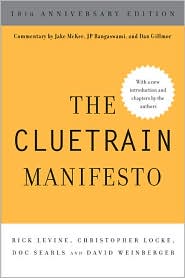
Cluetrain cover
Cluetrain Manifesto
My face
Speaker info
Who am I? (Blog Disclosure Form) Copy this link as RSS address Atom Feed

June 25, 2009

[reboot] Ton Zijlstra on how to facilitate

NOTE: Live-blogging. Getting things wrong. Missing points. Omitting key information. Introducing artificial choppiness. Over-emphasizing small matters. Paraphrasing badly. Not running a spellpchecker. Mangling other people’s ideas and words. You are warned, people.

Ton says the biggest obstacle is one’s own apprehension. He says facilitators cannot give content and participate. Don’t mix and match content and process. Stay in control by letting go. “If you want people to start generating idea, don’t give your own ideas, not even as examples.” “Push everything back into the group.”

Always make the rules clear. When there’s an infraction, don’t assume immediately that it’s out of line. Attract people to the desired behavior.

“Create energy by doing nothing.” Be patient.

Avoid the usual introductory round. Try breaking people into groups of 4-5 where each introduces herself and moves on to the next group.

Worry about the form of work second. First: What is the purpose of the session. Work forms: Open Space, knoweldfe cafe, sticky notes….Find one and then improvise.

Prepare with your ‘client.’

Capture the results, but keep them as close to the work at the session as possible. E.g., photo the flip charts rather than writing up a report. Then “share your shit.” And play.

Audience participation:

Q: How do you handle blabbermouths?
A: You have to get over your hesitancy to step in.

People should remember that not everyone speaks Engish.

The focus on action is good.

Q: [me] Is it appropriate to call on people?
A: Yes, sometimes. I use it to get silent people speaking?

Q:[me] How do you deal with groups ho may feel powerless to speak?
A: you have to know about that ahead of time. You may need to send the managers out, or put them in different subgroups.

Q: What goes on in the mind of facilitators? General energy level in the room?
A: [not Ton] We also think about the space. E.g., we could set the chairs so we’re looking at one another. I do pay attention to the energy in the room.
A: [not Ton] I facilitate smaller groups. I worry about whether they’re happy and attentive.
A: [not Ton] Are people falling into their usual bad habits.

[Lot of conversation. I’m transcribing little of it.]

A: [me] Do you point out the relationships among remarks? E.g., “What you just said enhances/contradicts what so and so said earlier”
A: If it’s more about me bringing my expertise, yes. Otherwise, it gets in the way of the session participants owning the results.

Q: Do you bring into the group what’s being said in the private conversations?
A: Depends.

[Tags: reboot reboot11 rb11 facilitation moderation open_space ]

Tweet
Follow me

Categories: Uncategorized Tagged with: business • conference coverage • facilitation • moderation • open_space • rb11 • reboot • reboot11 Date: June 25th, 2009 dw

1 Comment »

June 15, 2009

How much is the Boston Globe worth?

Ken Doctor says (via Joe Trippi) it’s worth $1:

A buck essentially represents a gentleman’s agreement: I take a liability, headache and a distraction off your hands, says the buyer. I give you the great potential of the Globe brand, a top-25 news web site and improved ability to re-jigger the pieces, thanks to our new contracts and cost-cutting, says the Times.

I think maybe it’s worth $0. But, of course, my financial sense is not very good. So, here’s what I actually mean.

If I were the NY Times, I’d be considering letting the Globe fail entirely, if there’s a way to do that that would wipe the Globe’s debt off the books. Then I’d re-hire some of the columnists and editors, and some of the local reporters (news, sports, business, arts, features, etc.). And I’d announce the new daily Boston insert into the NY Times.

Of course, if the Times can get a buyer willing to pony up substantial cash, and assuming any deal would prevent the Times from hiring current Globe staff, my idea may be quite stupid. Wouldn’t be the first time. [Tags: ]

Tweet
Follow me

Categories: Uncategorized Tagged with: business • everythingIsMiscellaneous • media Date: June 15th, 2009 dw

3 Comments »

June 13, 2009

Microsoft out, Quicken in

Microsoft has announced that as of June 30, it’s no longer going to sell Microsoft Money because the ecology has changed, diminishing the need for products of that sort.

Quicken has announced that as of this summer, it’s going to start selling Quickenan updated version of Quicken for the Mac.

Hmmm.

[Tags: quicken intuit microsoft ]

Tweet
Follow me

Categories: Uncategorized Tagged with: business • intuit • microsoft • quicken Date: June 13th, 2009 dw

1 Comment »

June 12, 2009

Tenth Anniversary of Cluetrain celebration at Berkman

The Berkman Center is putting on a little book launch for the tenth anniversary edition of Cluetrain. Doc and I will be interviewed by the estimable Jonathan Zittrain on the topic “Cluetrain at 10: So How’s Utopia Working Out for Ya?” at 6pm, Tuesday, June 16, at Austin East at Harvard Law [map.

If you can’t make it, or if you’ll only show up if there’s pizza (there isn’t), it’s being webcast.

BTW, the tenth anniversary edition has the complete original text (available here for free), as well as new chapters by each of the four authors, plus an intro to the intro by me, plus articles by Dan Gillmor, Jake McGee, and J.P. Rangaswami.

[Tags: cluetrain ]

Tweet
Follow me

Categories: Uncategorized Tagged with: business • cluetrain • digital culture • marketing Date: June 12th, 2009 dw

1 Comment »

June 11, 2009

[newmedia] Measuring social media’s effects

NOTE: Live-blogging. Getting things wrong. Missing points. Omitting key information. Introducing artificial choppiness. Over-emphasizing small matters. Paraphrasing badly. Not running a spellpchecker. Mangling other people’s ideas and words. You are warned, people.

Q: How do you define social media at Whirlpool?
Brian Synder: It has to be defined separately for each area, and we tie it back to business objectives. We track share of voice and favorability. On customer service, we do interesting text mining.
Lee Aase (Mayo Clinic): We use the free tools that are available. “The need for measurement varies inversely with the amount of money you spend on it.” We use the measurement tools to prove the value of what we’re doing.

Q: Your biggest challenge?
Marcel Lebrun (Radian6): We only measure if there’s a practical purpose. Social media are now multi-purpose. We use social media for every possible purpose. So, it’s disrupting everything in the enterprise that has to do with reaching out to customers. But those different practices have different business goals and thus different needs for measurement.

Q: Where it’s going?
Marcel: In the past six months, we’ve gone from explaining what social media is, to businesses understanding that their brand is the sum of all the conversations about it.

[Missed some. Sorry]

Q: How do you measure influencers for a brand?
Marcel: We integrate a bunch of digital breadcrumbs and social metrics. We measure things like how often a person talks about a subject, how much comments, how many unique comments, inbound links, which ones of those are also talking about that topic. Influence is very topic-centric. You sometimes want to see total reach, and sometimes you just want to find the topic geeks.

Q: How do you determine sentiment?
Brian: Synergy1 has humans reading the posts. The Tensity program automates this.
Lee: We eyeball it. And we’re looking for the really positive ones so we can spread the word and engage.
Brian: We look to engage by actually talking about product issues. E.g., an unhappy customer was tweeting about a product arriving damaged three times. We talked with him and redesigned the packaging based on his suggestions. We’ve taught some of our customer care phone folks how to engage via social media.
Marcel: The bulk of brands are at the listen stage. But Dell has a full blogger outreach team, focused on different kinds of users. The measure quantitatively and qualitatively (e.g., stories).

Marcel: The fastest way to get a new feature into a product is to tweet it. The developers get excited. They like being in touch.

[Tags: nms09 marketing twitter pr social_media cluetrain ]

Tweet
Follow me

Categories: Uncategorized Tagged with: business • cluetrain • conference coverage • marketing • nms09 • pr • social networks • social_media • twitter Date: June 11th, 2009 dw

1 Comment »

[newmedia] New media in a regulated industry (health)

NOTE: Live-blogging. Getting things wrong. Missing points. Omitting key information. Introducing artificial choppiness. Over-emphasizing small matters. Paraphrasing badly. Not running a spellpchecker. Mangling other people’s ideas and words. You are warned, people.

Marc Monseau (Johnson & Johnson): 50% of people change their behavior based on the medical advice they read on line. And most people are looking for info from other people like themselves. But that info isn’t always accurate. That means that the healthcare industry has an obligation to get out into the online world to present accurate info. We have lots of information, and we are companies of relationships: We have close relations with physician groups, patient groups, advocacy groups, gov’t organizations. We can tap into those resources of information and relations. E.g., we have an ADD product. The best info patients receive often come from other parents. at ADHD Moms at Facebook, there’s info, but also the possibility of linking to other patients. We set it up, but it’s unbranded.

Virginia Cox (Consumer Healthcare Products Association) gives an example: Teens getting high on cough medicine. There were 200 videos on YouTube about how to get high that way. So, we used social media to build awareness among mothers. We were completely transparent about who we are. Another example: We recruited five moms because people want to hear from other people like them. We put it on Gather and then on Facebook. We wanted to have them talking. It meant giving up control over what they’re saying.

Earl Whipple (AstraZeneca) says that while you want to provide accurate information, you don’t want to encroach on the physician-client relationship. You also have to be mindful of gov’t regulations, of course. He also notes that the search results are more often coming from bloggers than from sites of credentialed providers. The most controversial posts get pulled up first, frequently, and many people assume that those are the most reliable. Therefore, the question isn’t what’s the risk of engaging in the new social media space; the question is what’s the risk of not engaging.

Q: How are things changing? How authentic can you be?
Earl: The concept of spokespeople is now laughable. People want to hear directly from the content area expert.
Marc: You can be authentic while talking about highly regulated products by being transparent about what you can talk about and what you can’t. People understand we’re under limitations. And we can at least direct the traffic to the right place.

Q: Info across a global world?
Earl: When we put out information, we include who the information is intended for. It’s an unbounded environment.

Q: What is it that you can’t tell people because of regs?
Marc: The FDA limits what pharmas can say about approved products. If people notice a new use for a product, you have to go back to the script and say what’s on the product label. It doesn’t prevent you from engaging. But you can’t get into a detailed conversation about unapproved uses. And if you come across someone who’s had a problem with the product, you have to report that back.
Virginia: There are strict regulations around advertising. Companies have to be careful about what counts as advertising.
Earl: There are many unanswered issues. E.g., if you’re in a genuine dialog and someone brings up an unapproved use, what exactly is your responsibility?

Q: How do you monitor the Five Moms site, for example?
Virginia: We don’t have to monitor it for content. The Moms respond on their own. But we are required to monitor it for adverse reports, etc.

Q: What should all students know about social media and health if their in the communications field?
Virginia:


From the Five Moms Site:

Tips to monitor your kids online.

* Make sure that your children are never online without your permission.
* Be clear with your kids about your rules on Internet use at home and outside of the home.
* Place your computer in an area of the house where you can easily supervise their Internet activity.
* Ask your children about who they talk to and what activities they do online.
* Use parental filters to block access to questionable sites.
* Build an open and trusting relationship with your kids about their online use.

The last point is an unintentional punchline. [Tags: nms09 pr marketing health_care pharmaceuticals social_media social_netowrking cluetrain ]

Tweet
Follow me

Categories: Uncategorized Tagged with: business • cluetrain • conference coverage • marketing • nms09 • pharmaceuticals • pr Date: June 11th, 2009 dw

1 Comment »

[newmedia] Global perspectives

For this session, the panelists are videoconferenced in: Michael Netzley (Singapore Mgt Univ), Marshall Manson (Edelman London), and Wolfgang Lünenbürger-Reidenbach (Edelman Social Media Europe).

As we wait for some technical glitches to get ironed out, we hear from an audience member just back from Russia who talks about the amazing speeds of Moscow’s 4G network. He points out, however, that outside of Moscow, Russia’s network is “19th century.”

MM points to the rise of Facebook and Twitter across Europe. He also notes the importance of social media in the expenses scandal in the UK. WLR points out that the rise in Facebook is in local languages. There is no pan-European public there.

MN from Singapore says that there are 2,000 languages spoken in Asia. “Localization continues to be important.” In Asia, mobile is more important than elsewhere. He also points to the Chinese control of the Net, based on the value of “social harmony.”

Q: Will we see competitors to FB and Twitter in local markets, or will they achieve global dominance?
MM: Translation is going to become much less of a problem over time.
MN: Local remain critical.
WLR: We’ll see more, not less, focus on the local. Hyper local.

Q: Singapore is trying to get young people to get married. Are they using social media in this campaign?
MN: Hong Kong is ahead of Singapore in adopting social media. But in the past 6 months, the Singapore gov’t has been jumping in. The ministries are leading the way. For the past 50 years, media have played primarily a nation-building role. Very top-down. Not independent. But these msgs don’t do well online. The gov’t is slowly learning this. They’re trying to learn how to give more trust to their citizens.

MM: We don’t have to teach the younger generation how to use social media. We do need to change how we teach them to write. The old styles are not useful in conversational media.
WLR: Students use micromessaging.

[Tags: pr marketing global ]

Tweet
Follow me

Categories: Uncategorized Tagged with: business • global • marketing • pr • social networks Date: June 11th, 2009 dw

2 Comments »

June 10, 2009

[2b2k] Chapter 4 – inappropriately concrete?

Chapter 3 left readers with a problem without resolution. If facts don’t provide as firm a bedrock as we’d thought, then are we left to believe whatever we want? Is there no hope? [Spoiler: No, we’re not free to believe whatever we want.]

Because Chapter 3 was pretty abstract, I want to be sure to address its question in some concrete ways. So, Chapter 4 opens with a brief scene-setter that says that we all love diversity, but when there’s too much, we can’t get anything done. I’m now at the beginning of a section that will give maybe four general rules for “scoping” diversity so that a group has enough internal difference to be smarter than the smartest individual, but not so much that they can’t get past bickering. I plan on following that with a more abstract section that asks whether the Net is making us more open or closed to other people’s ideas. At the moment, I like the idea of beginning with the concrete and moving to the abstract, in large part because I think the abstract question is pretty much impossible to answer.

I can’t tell yet if the chapter structure is going to work. There is so much to say about this topic. And I have a concern that the reader is not expecting the book to take this turn. But I won’t be able to tell that until I have enough distance on the prior chapters to be able to read them with some degree of freshness.

Tweet
Follow me

Categories: too big to know Tagged with: 2b2k • broadcast • business • conference coverage • echo chambers • knowledge • marketing • media • newmedia • news • pr Date: June 10th, 2009 dw

9 Comments »

June 8, 2009

Social media are jazz

Jeneane’s got a great post for businesses that think they’re playing well in the social media sandbox. She asks: You’re playing, but are you playing jazz?

[Tags: social_media marketing cluetrain business web_2.0 ]

Tweet
Follow me

Categories: Uncategorized Tagged with: business • cluetrain • digital culture • marketing • social_media • web 2.0 Date: June 8th, 2009 dw

Be the first to comment »

June 2, 2009

Why did E Ink sell?

E Ink has sold itself to Prime View International, a large Taiwanese display manufacturer, and I don’t understand why.

Now, it’s not surprising I don’t understand why. I have no info about E Ink’s financial state other than this article by Robert Weisman in the Boston Globe, and in any case I’m not a great financial guy (and I have the bank statements to prove it). So, my surprise may well be due to nothing but ignorance. Nevertheless, here’s why I was taken aback by the announcement.
E Ink is on a roll in a market that is about to explode (in the good sense). After ten years of work developing a low-power, highly legible display, it’s got something that works. Thanks to Kindle, it’s proven itself in the mass market and it’s in lots of people’s hands. And the market is about to take off now that we have digital delivery systems, a new generation of hardware, and a huge disruption in the traditional publishing market. So, why would E Ink sell itself?

The price — $215M — seems relatively low for such a hot product. If they need the money to fund R&D or to build manufacturing facilities, surely (= it’s not at all sure) there were other possibilities. Apparently the market crisis made an IPO implausible, although, to tell the truth, I — with my weak financial grasp — am not convinced. Investors are looking for places to invest, and E Ink looks like it’s exactly the sort of company they’d love to back: a proven leader in a market that’s obviously on the verge of explosive growth. It’d be like getting in on the early stage of iPods, only potentially bigger, since everyone who reads eventually will have an e-reader. But, if an IPO was out, why wouldn’t E Ink have preferred other forms of investment, including giving a partnership and equity stake to Prime View?

The most likely explanation by far is that I don’t understand what I’m talking about. Another explanation is that the company and its investors simply wanted to cash in by cashing out; the Globe article suggests this. But, that again raises the question of why they’d want to exit a company with a product in a market that’s about to take off. Perhaps they have reason to think the market is not going to take off , but that seems wrong; note that Google yesterday announced it’s going to enter the online book sales business. Or maybe they have doubts about E Ink technology. Maybe they worry the cost won’t drop fast enough for a commoditized market. Maybe color isn’t on its way fast enough. Maybe they’re worried about the inability (or so I’m presuming) of their tech ever to handle video, since the winning e-reader will eventually be multimedia. Maybe they know about ebooks on the way — Apple iPad or whatever the presumed product will be called — that will make static, black-on-gray pages seem obsolete.

So, I don’t know. But it smells fishy to me…although, as I may have mentioned, my financial sniffer has never been very reliable, and I’ll be happy to be set straight about this.

[Tags: e_ink kindle displays ebooks e-books everything_is_miscellaneous ]

Tweet
Follow me

Categories: Uncategorized Tagged with: business • displays • e-books • ebooks • everythingIsMiscellaneous • everything_is_miscellaneous • e_ink • kindle • tech Date: June 2nd, 2009 dw

12 Comments »

« Previous Page | Next Page »


Creative Commons License
This work is licensed under a Creative Commons Attribution-NonCommercial-ShareAlike 3.0 Unported License.
TL;DR: Share this post freely, but attribute it to me (name (David Weinberger) and link to it), and don't use it commercially without my permission.

Joho the Blog uses WordPress blogging software.
Thank you, WordPress!