


logo
EverydayChaos
Everyday Chaos
Too Big to Know
Too Big to Know
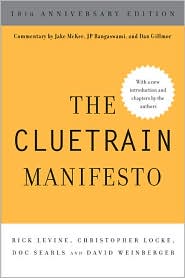
Cluetrain 10th Anniversary edition
Cluetrain 10th Anniversary
Everything Is Miscellaneous
Small Pieces cover
Small Pieces Loosely Joined
Cluetrain cover
Cluetrain Manifesto
My face
Speaker info
Who am I? (Blog Disclosure Form) Copy this link as RSS address Atom Feed

March 30, 2009

[f2c] First panel

At Freedom to Connect, the opening panel, moderated by Joanne Hovis, is on municipal wifi. [Note: Liveblogging. Missing stuff. Typing too fast. Not spellpchecking. No rereading. This is a terribly incomplete and occasionally wrong set of notes.]

Tim Nulty is the former head of Burlington Telecom, and is now the head of a consortium bringing fiber to rural Vermont. He says there are about 45 municipal wifi companies in the US. We pretty much know how to do that. It’s different in rural areas, where the average density is 13 residences per linear mile. About 60% have no broadband. Why should it be harder to replace copper wire with glass the second time around? Why is there this myth that it’s impossible? Because there are incumbents who have a financial interest in saying that it’s impossible because they don’t want to do it [because the margins are lower than they want, which would drive down their overall margins, even while increasing their revenue].

Dirk Van der Woude, program manager for broadband in Amsterdam. They provide boradband as a public service such as garbage collection.

Lev Gonick, founder of One Community, has a million institutional users, via a community network, a 501C3. It has about 4,000 route miles. The governance model is mayor-proof because the infrastructure owns the governance. The goal was not to build-up fiber optics but to enable and transform their communty.

Bill Schrier works on getting Seattle fibered. He says that they’re spending $4B on highway infrastructure, which is 8x what it would cost to bring fiber everywhere.

First Joanne question: Fiber vs. Wireless [which is the topic burning up the backchannel]. Dirk says he pays for fiber at home. Wifi works but is slow, he says. For wifi, you need access points with backhaul that is likely to be fiber.

Bill: What’s the killer app for a network? HDTV. Video teleconferencing.

Tim: Fiber is cheaper and more economic if you intend to be universal. Bringing fiber to his neck of the woods (1,000 sq miles) is $69M. Doing this through wireless, with 2.3 or 2.5gH Wimax, to get close to universality, would be $35M. It costs half as much but brings 1/4 the revenue. The capacity is 1% of what you get with fiber. The right thing economically to do is to put the Wimax on top of the fiber network, at which point it costs $10M, which makes it a great business.

Dirk: In Amsterdam, dwellings are stacked. Getting the fiber to move vertically is a problem.

Mark Cooper: Which comes first, fixed or mobile computing? For connecting the underserved, the killer app isn’t HDTV. It’s connectivity. We want wireless: 1. It gets you further. 2. Mobile computing is a twofer: Mobile computing and basic connectivity that meets the need for connectivity. 3. Mobile computing is future-proof. For this project [stimulus package?] wireless is the right thing to do. 4. Public accountability.

Tim: Rural fiber does not need public money. It can pay its own way. Rural wireless does not pay its own way.

Lev: This is a family dispute. We have a once-in-a-generation opportunity. Let’s move ahead, be pragmatic, etc…

Bill: Wireless and fiber are synergistic, (David I. asks for a show of hands; everyone agrees.)

Q: Fiber is the foundation that supports wireless. Now: Go mesh!

Tim: Mesh is great for thin uses. But for carrying lots of data, it breaks down.

Bob Frankston: We need to change the dynamic. We’re stuck in railroads where you pay for each trip. We need to get to the point where assume connectivity at any speed. The question is the funding model.

Dirk: Cooperate with anyone who wants to cooperate with you, so long as you get the network you want…

Bice Wilson: “Designing the hidden public way,” i.e., the infrastructure of connectivity. There’s a vast network of services that needs connectivity to the entire community.

Lev: That’s what One Community is about.

Bill: In Seattle, that’s where we’re directing our efforts.

Roxanne Googin: Current status…?

Tim: The really important investment is in universal fiber.

Joanne wraps up reminding us of the sense of the room that we want universal connectivity and we want it yesterday. [Gross paraphrase] [Tags: f2c f2c09 wifi broadband muni_wifi fiber connectivity ]

Tweet
Follow me

Categories: Uncategorized Tagged with: broadband • conference coverage • connectivity • digital rights • f2c • f2c09 • fiber • wifi Date: March 30th, 2009 dw

Be the first to comment »

Freedom to Connect stream

I’m at Freedom to Connect, David Isenberg‘s annual conference on building open, fast, dumb networks. If you go to the F2C site, there should be instructions about how to live stream the proceedings. The twitter hashtag is #f2c09. The room’s backchannel is here.

[Tags: f2c f2c09 telcom wifi broadband net_neutrality ]

Tweet
Follow me

Categories: Uncategorized Tagged with: broadband • conference coverage • f2c • f2c09 • net neutrality • telcom • wifi Date: March 30th, 2009 dw

Be the first to comment »

March 18, 2009

Benoit Felten on the economics of unbundling

“Unbundling” means that the companies that run the Internet wires to our homes and businesses also act as wholesalers to others who want to be our ISPs. Benoit Felten of the Yankee Group gave a talk recently arguing that this can be very profitable for all involved. (It also creates competition, which generally is good for us users.)

Scott Cleland disagrees with Benoit.

[Tags: broadband benoit_felten scott_cleland net_neutrality ]

Tweet
Follow me

Categories: Uncategorized Tagged with: broadband • net neutrality • policy Date: March 18th, 2009 dw

1 Comment »

February 18, 2009

Charlie Leadbeater’s problem with Digital Britain

Charlie Leadbeater has posted a paper on why he’s unhappy with the British broadband proposal, Digital Britain. Given Charlie’s way with words, it’s not surprising that it’s a well-done piece, and it makes some essential points: First, you can’t solve problems just by throwing broadband at them, and, second, the Digital Britain proposal takes no account of the Net’s disruptive capabilities. (I’m summarizing to entice you, not to obviate reading it, people!)

[Tags: charlie_leadbeater digital_rights digital_britain broadband ]

Tweet
Follow me

Categories: Uncategorized Tagged with: broadband • digital culture • digital rights • policy Date: February 18th, 2009 dw

2 Comments »

February 1, 2009

Isenberg enacts his freedom to disconnect and Freedom to Connect

David Isenberg, exercising his freedom to disconnect, has posted photos from his trip to Antarctica here, here, and here.

Meanwhile, there’s still time to sign up for David’s Freedom to Connect conference, March 30-31, in Silver Spring MD (a subway ride from DC). It’s a terrific get-together and learning-fest for those who think that pervasive access to an open Internet is important and do-able. It attracts a whole bunch of the do-ers. I try not to miss it.

[Tags: antarctica david_isenberg isen freedom_to_connect net_neutrality broadband ]

Tweet
Follow me

Categories: Uncategorized Tagged with: antarctica • broadband • conference coverage • isen • net neutrality • policy • travel Date: February 1st, 2009 dw

Be the first to comment »

Yochai Benkler on the broadband stimulus

Yochai Benkler, who wrote the seminal book on the new collaborative economics (and of course posted it for free), and is also a Harvard Law professor and holder of the Berkman Chair at the Berkman Center (and is also one of the sweetest people ever) … I got lost in my benkleration, so let’s just start again …

Yochai Benkler has posted at Talking Points Memo his analysis of the Senate and House versions of the stimulus package for broadband. (Thanks for the link to David Isenberg, who provides his own, usual insightful analysis.)

[Tags: yochai_benkler berkman broadband stimulus net_neutrality david_isenberg ]

Tweet
Follow me

Categories: Uncategorized Tagged with: berkman • broadband • digital rights • net neutrality • policy • stimulus Date: February 1st, 2009 dw

1 Comment »

January 15, 2009

Broadband herring

Harold Feld is very happy that the stimulus package includes “only” $6 billion for broadband to underserved areas. He puts it this way:

There’s an old Jewish joke about how a Frenchman, a Pole, and Jew saved Napoleon’s life. Napoleon asks what they want as a reward. The Frenchman says his family were aristocrats before the revolution and he wants his family lands restored. “Granted,” says the Emperor. The Pole says he wants Poland liberated and her pre-partition borders restored. “Granted,” says Napoleon. The Jew says: “I want a real nice piece of herring.”

Napoleon stares, turns in disgust to one of his attendants, and says “get this man a nice piece of herring from the kitchen and then get him out of my sight.”

The Frenchman and the Pole turn to the Jew and laugh “You could have asked for anything! You idiot, that’s the Emperor of France! And you asked for a nice piece of herring!”

“Ha,” answered the Jew. “You think you’re so smart? I’m actually gonna get my herring.”

That’s about how I feel about the broadband stimulus package. Sure, I’d love to have had the feds build fiber out to every home. But I always knew that wouldn’t happen. Worse, I figured that any HUGE pot of money would invariably end up chock full of goodies for incumbents with zippo oversight. ….

But a reasonable set of grant proposals, properly targeted, can do a boatload of good. Consider Mark Cooper’s community hotspot approach, for example, or the work of ongoing projects such as the Mountain Area Information Network in rural North Carolina or the Lawndale Community Wireless Network in Chicago or any of thousands of projects in hundreds of communities working to bridge the gap between connectivity and digital exclusion…

[Tags: harold_feld broadband stimulus herring jewish_jokes ]

Tweet
Follow me

Categories: Uncategorized Tagged with: broadband • herring • net neutrality • policy • stimulus Date: January 15th, 2009 dw

2 Comments »

December 4, 2008

Keeping national broadband useful, usable, and a hotbed of innovation

John Horrigan of Pew Internet & American Life project wonders what their online research says about possible national broadband policies, if we were ever to have one. The essay begins this way:

…America’s middling standing in world rankings on broadband adoption has served as a call to arms for the new administration to develop a national broadband strategy…

The body of research from the Pew Internet Project, dating to 2000, indicates that online Americans might have one more suggestion: Make sure the internet remains a place where users define what it means to be digitally connected.

John points to many-to-many collaboration as the new wave, and refers us to research showing that while 42% of cell phone users use them for something other than making a call, that number is even higher for minority groups. So, a national broadband policy should not only keep the bands open for innovation, but it should cover wireless devices and other devices. And, suggests John, as e-gov services are rolled out, they ought to be held to a very high standard for usability.

“Only connect“? Nah. Connect everyone, with whatever devices they want, and with the freedom to go where they want and invent what they want.

[Tags: broadband generativity net_neutrality pew john_horrigan ]

Tweet
Follow me

Categories: Uncategorized Tagged with: broadband • digital culture • digital rights • egov • generativity • net neutrality • pew Date: December 4th, 2008 dw

1 Comment »

July 30, 2008

Net neutrality everywhere

Matt Stoller reports that every major Democratic candidate for Senate supports Net neutrality. Need I add that Obama’s tech policy is way closer to what we need to save the Internet than what we’ve gotten so far from McCain?

And Tim Wu (the coiner of the phrase “Net neutrality”) has another frame-bender in a NY Times op-ed. He says Americans spend about as much on broadband as on energy, and calls for liberation from the Soviet-style control of spectrum (which he also compares to OPEC) to encourage entrepreneuristic advances.

And now the WSJ has attacked FCC chairman Kevin Martin for supporting Net neutrality. It remains to be seen, however, whether Martin’s ruling against Comcast’s blocking of BitTorrent has any teeth. Poor Kevin! Incoming from all sides.

[Tags: net_neutrality matt_stoller tim_wu broadband ]

Tweet
Follow me

Categories: Uncategorized Tagged with: broadband • net neutrality Date: July 30th, 2008 dw

Be the first to comment »

June 26, 2008

[reboot08] David Isenberg on the end of bandwidth limitations

David Isenberg shows a fiber optic cable with 864 fibers. Each can carry 155 frequencies that each can carry 10 gigabits. That means three of the fibers can carry the entire busy hour traffic of the USA. If everyone on the planet had a phone and was making a call at the same time, that one cable could carry it, and 100 of the fibers would still be dark. [I’m sure I screwed up some of the numbers, perhaps seriously. Sorry. I’m multitasking because I decided this afternoon that my after dinner talk — entirely new — needs slides.] “The answer to the question ‘How many angels can dance on the head of a pin?’, the answer is ‘How many do you want to dance on the head of a pin?’.”

[Tags: reboot08 broadband david_isenberg ]

Tweet
Follow me

Categories: Uncategorized Tagged with: broadband • conference coverage • david_isenberg • reboot08 Date: June 26th, 2008 dw

4 Comments »

« Previous Page | Next Page »


Creative Commons License
This work is licensed under a Creative Commons Attribution-NonCommercial-ShareAlike 3.0 Unported License.
TL;DR: Share this post freely, but attribute it to me (name (David Weinberger) and link to it), and don't use it commercially without my permission.

Joho the Blog uses WordPress blogging software.
Thank you, WordPress!