


logo
EverydayChaos
Everyday Chaos
Too Big to Know
Too Big to Know
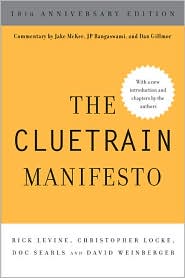
Cluetrain 10th Anniversary edition
Cluetrain 10th Anniversary
Everything Is Miscellaneous
Small Pieces cover
Small Pieces Loosely Joined
Cluetrain cover
Cluetrain Manifesto
My face
Speaker info
Who am I? (Blog Disclosure Form) Copy this link as RSS address Atom Feed

April 9, 2011

Berkman Buzz

The weekly Berkman Buzz:

  • Doc Searls [twitter:dsearls] struggles with how to write about the Net and tune it out at the same time: link

  • Ethan Zuckerman [twitter:ethanz] muses on the Monobloc (those ubiquitous white plastic chairs): link

  • The OpenNet Initiative [twitter:opennet] reviews new Internet controls in Russia: link

  • danah boyd [twitter:zephoria] shares the challenges of doing fieldwork with teenagers: link

  • The Citizen Media Law Project [twitter:citmedialaw] cheers on British Libel Reform: link

  • Weekly Global Voices [twitter:globalvoices] : “Iran: Protests for a Drying Lake”: link

Tweet
Follow me

Categories: berkman Tagged with: berkman Date: April 9th, 2011 dw

1 Comment »

April 2, 2011

Berkman Buzz

The weekly Berkman Buzz:

  • Christian Sandvig [twitter:niftyc] ‘s epic saga through the finer points of Comcast’s customer service comes to an end: link

  • Ethan Zuckerberg [twitter:ethanz] uses Media Cloud to measure the change in media cycles: link

  • Herdict [twitter:herdict] explains how crowdsourcing is being used to monitor Japan’s nuclear crisis: link

  • The Citizen Media Law Project [twitter:citmedialaw] reviews a new memo on smartphone policies in the courtroom: link

  • Weekly Global Voices [twitter:globalvoices] : “Nigeria: What Are Nigerian Bloggers Saying About the 2011 Elections?”: link

Tweet
Follow me

Categories: berkman Tagged with: berkman Date: April 2nd, 2011 dw

Be the first to comment »

March 12, 2011

Berkman Buzz

Weekly Berkman Buzz:

  • Christian Sandvig adds context to “Internet freedom” debates: link

  • Ethan Zuckerman blogs an “informal conversation” with U.S. State Department’s P.J. Crowley: link

  • CMLP asks for help with “Software Best Practices and Open Source Derivative Works”: link

  • Weekly Global Voices: “Cameroon: Netizens React to SMS-to-Tweet Ban”: link

    Tweet
    Follow me

    Categories: berkman Tagged with: berkman Date: March 12th, 2011 dw

    1 Comment »

  • March 5, 2011

    Berkman Buzz

    This weeks Berkman Buzz, as compiled by Rebekah Heacock [twitter:rebekahredux] :

    • Jonathan Zittrain [twitter:zittrain] and Molly Sauter [twitter:oddletters] wonder whether the US will get an Internet kill switch: link

    • Wendy Seltzer [twitter:wseltzer] reviews takedown complaints in the Android marketplace: link

    • Mike Ananny and Taylor Owen argue that despite Twitter, reporters still matter: link

    • Stuart Shieber [twitter:pmphlt] reviews institutional memberships for open-access publishers: link

    • Herdict [twitter:herdict] explains Internet filtering during the Jasmine Revolution: link

    • Weekly Global Voices [twitter:globalvoices] : “Palestine: Demands for a Unified Nation set for March 15”: link

    Tweet
    Follow me

    Categories: berkman Tagged with: berkman Date: March 5th, 2011 dw

    2 Comments »

    March 2, 2011

    Questions from and for the Digital Public Library of America workshop

    I got to attend the Digital Public Library of America‘s first workshop yesterday. It was an amazing experience that left me with the best kind of headache: Too much to think about! Too many possibilities for goodness!

    Mainly because the Chatham House Rule was in effect, I tweeted instead of live-blogged; it’s hard to do a transcript-style live-blog when you’re not allowed to attribute words to people. (The tweet stream was quite lively.) Fortunately, John Palfrey, the head of the steering committee, did some high-value live-blogging, which you can find here: 1 2 3 4.

    The DPLA is more of an intention than a plan. The DPLA is important because the intention is for something fundamentally liberating, the people involved have been thinking about and working on related projects for years, and the institutions carry a great deal of weight. So, if something is going to happen that requires widespread institutional support, this is the group with the best chance. The year of workshops that began yesterday aims at helping to figure out how the intention could become something real.

    So, what is the intention? Something like: To bring the benefits of public libraries to every American. And there is, of course, no consensus even about a statement that broad. For example, the session opened with a discussion of public versus research libraries (with the “versus” thrown into immediate question). And, Terry Fisher at the very end of the day suggested that the DPLA ought to stand for a principle: Knowledge should be free and universally accessible. Throughout the course of the day, many other visions and pragmatic possibilities were raised by the sixty attendees. [Note: I’ve just violated the Chatham Rule by naming Terry, but I’m trusting he won’t mind. Also, I very likely got his principle wrong. It’s what I do.]

    I came out of it invigorated and depressed at the same time. Invigorated: An amazing set of people, very significant national institutions ready to pitch in, an alignment on the value of access to the works of knowledge and culture. Depressed: The !@#$%-ing copyright laws are so draconian and, well, stupid, that it is hard to see how to take advantage of the new ways of connecting to ideas and to one another. As one well-known Internet archivist said, we know how to make works of the 19th and 21st centuries accessible, but the 20th century is pretty much lost: Anything created after 1923 will be in copyright about as long as there’s a Sun to read by, and the gigantic mass of works that are out of print, but the authors are dead or otherwise unreachable, is locked away as firmly as an employee restroom at a Disney theme park.

    So, here are some of the issues we discussed yesterday that I found came home with me. Fortunately, most are not intractable, but all are difficult to resolve and, some, to implement:

    Should the DPLA aggregate content or be a directory? Much of the discussion yesterday focused on the DPLA as an aggregation of e-works. Maybe. But maybe it should be more of a directory. That’s the approach taken by the European online library, Europeana. But being a directory is not as glamorous or useful. And it doesn’t use the combined heft of the participating institutions to drive more favorable licensing terms or legislative changes since it itself is not doing any licensing.

    Who is the user? How generic? Does the DPLA have to provide excellent tools for scholars and researchers, too? (See the next question.)

    Site or ecology? At one extreme, the DPLA could be nothing but a site where you find e-content. At the other extreme, it wouldn’t even have a site but would be an API-based development platform so that others can build sites that are tuned to specific uses and users. I think the room agrees that it has to do both, although people care differently about the functions. It will have to provide a convenient way for users to find ebooks, but I hope that it will have an incredibly robust and detailed API so that someone who wants to build a community-based browse-and-talk environment for scholars of the Late 19th Century French Crueller can. And if I personally had to decide between the DPLA being a site or metadata + protocols + APIs, I’d go with the righthand disjunct in a flash.

    Should the DPLA aim at legislative changes? My sense of the room is that while everyone would like to see copyright heavily amended, DPLA needs to have a strategy for launching while working within existing law.

    Should the DPLA only provide access to materials users can access for free? That meets much of what we expect from public libraries (although many local libraries do charge a little for DVDs), but it fails Terry Fisher’s principle. (I don’t mean to imply that everyone there agreed with Terry, btw.)

    What should the DPLA do to launch quickly and well? The sense of the room was that it’s important that DPLA not get stuck in committee for years, but should launch something quickly. Unfortunately, the easiest stuff to launch with are public domain works, many of which are already widely available. There were some suggestions for other sources of public domain works, such as government documents. But, then the DPLA would look like a specialty library, instead of the first place people turn to when they want an e-book or other such content.

    How to pay for it? There was little talk of business models yesterday, but it was a short day for a big topic. There were occasional suggestions, such as just outright buying e-books (rather than licensing them), in part to meet the library’s traditional role of preserving works as well as providing access to them.

    How important is expert curation? There seemed to be a genuine divide — pretty much undiscussed, possibly because it’s a divisive topic — about the value of curation. A few people suggested quite firmly that expert curation is a core value provided by libraries: you go to the library because you know you can trust what is in it. I personally don’t see that scaling, think there are other ways of meeting the same need, and worry that the promise is itself illusory. This could turn out to be a killer issue. Who determines what gets into the DPLA (if the concept of there being an inside to the DPLA even turns out to make sense)?

    Is the environment stable enough to build a DPLA? Much of the conversation during the workshop assumed that book and journal publishers are going to continue as the mediating centers of the knowledge industry. But, as with music publishers, much of the value of publishers has left the building and now lives on the Net. So, the DPLA may be structuring itself around a model that is just waiting to be disrupted. Which brings me to the final question I left wondering about:

    How disruptive should the DPLA be? No one’s suggesting that the DPLA be a rootin’ tootin’ bay of pirates, ripping works out of the hands of copyright holders and setting them free, all while singing ribald sea shanties. But how disruptive can it be? On the one hand, the DPLA could be a portal to e-works that are safely out of copyright or licensed. That would be useful. But, if the DPLA were to take Terry’s principle as its mission — knowledge ought to be free and universally accessible — the DPLA would worry less about whether it’s doing online what libraries do offline, and would instead start from scratch asking: Given the astounding set of people and institutions assembled around this opportunity, what can we do together to make knowledge as free and universally accessible as possible? Maybe a library is not the best transformative model.

    Of course, given the greed-based, anti-knowledge, culture-killing copyright laws, the fact may be that the DPLA simply cannot be very disruptive. Which brings me right back to my depression. And yet, exhilaration.

    Go figure.

    The DPLA wiki is here.

    Tweet
    Follow me

    Categories: berkman, everythingIsMiscellaneous, experts, libraries, too big to know Tagged with: 2b2k • berkman • copyright • dpla • libraries • metadata Date: March 2nd, 2011 dw

    4 Comments »

    February 26, 2011

    Berkman Buzz

    The weekly Berkman Buzz, as compiled by Rebekah Heacock:

    • DMLcentral explains the rise of Orkut in Brazil

    • Herdict questions Internet filtering at the Wisconsin State Capitol

    • The Citizen Media Law Project explores the “spicy twist” in a recent copyright case

    • Dan Gillmor wonders whether publishers will stand up to Apple’s new subscription model

    • Weekly Global Voices: “Kenya: #KenyaFeb28: Online Call to Nationalism”

    Tweet
    Follow me

    Categories: berkman Tagged with: berkman Date: February 26th, 2011 dw

    2 Comments »

    February 22, 2011

    Eszter Hargittai and Aaron Shaw are giving a Berkman lunchtime talk titled “The Internet Young Adults, and Political Engagement around the 2008 Elections.” It’s a collaborative work between Northwestern U (where Eszter is) and Berkman (where Aaron is). What did the Obama campaign mean for the Internet’s effect on engagement of young people?

    NOTE: Live-blogging. Getting things wrong. Missing points. Omitting key information. Introducing artificial choppiness. Over-emphasizing small matters. Paraphrasing badly. Not running a spellpchecker. Mangling other people’s ideas and words. You are warned, people.

    Research generally summarizes the story of youth’s engagement as a sad one: A downward trend over the past 50 years. Most of the previous research has suggested that the Net is a “weapon of the strong”: those from higher income levels and more social capital tend to make more and better use of the Net. But does the Net impact political engagement directly? Uniformly? What factors and processes matter more than others. There is little agreement on these questions in the literature so far.

    They looked at four outcomes or models: 1. Online political cognitive engagement: How much info-seeking on the Net do you do about politics? 2. Civic engagement: Do you volunteer in the community. 3. Voting. 4. Political action more broadly defined.

    Eszter gathered data from the U of Illinois in Chicago. It’s one of the more racially diverse campuses. She went to the only course required everyone on campus. (There are 86 different sections, so it was a lot of work to gather the data.) It was a paper-pencil survey, not online, because she did not want to worry about who has access to the Net and who is comfortable donig things on line. Of the 1,115 students, the research focused on the 1,000 who were eligible to vote in the 2008 election. About half are first generation college students, 11% African-American, 25% Hispanic. About 60% voted, compared to 62% nationally. Eszter and Aaron are not claiming this is representative of the nation. the controlled for partisanship, political interest, and political knowledge, using “pretty standard” ways of measuring this. She presents the data on the extent of their Net usage; everyone had already been online. [You’ll have to check the study for the actual data. I can’t possibly type that fast!]

    1. Online political cognitive engagement. They looked at whether the kids are reading blogs, commenting on them, involved in online discussions, forwarding info, etc. About 40% visited blogs (etc.) on political topics, and 16% commented on them. Women were less likely to participate. Race and ethnicity and parental education didn’t seem to matter. Political capital (= interest in politics) and your Net skills are positively correlated.

    2. Civic engagement. 81% had engaged in some form, 54% talked to friends or family about current events a few times a week or more, 33% have organized the event of a club or organization. [Again, I can’t keep up with all the data. I’m cherry-picking.] Gender doesn’t matter, but Asian Americans are more engaged, as are those who score higher on parental education, political capital, and online political engagement.

    3. Voting. Race and ethnicity had a positive correlation with voting. Not parental education. Political capital and civic engagement both did. But online political cognitive measures did not. Neither did Net expertise/experience.

    4. Political action, which includes everything from signing a petition to being a paid campaign worker. 65% had signed a petition. 22% had contacted a political official. 14% donated money. If you count any of those, 70% have engaged in political action. No correlation to gender, race/ethnicity, parental education But, there was a positive correlation with political capital, civic engagement, and Internet experiences (particularly the use of social networking sites, and skill).

    Internet mattered for all of the outcomes, except for voting. Net skills seem to have enabled the social networking that is correlated with political action.

    Conclusion: Simply being a Net user is not a direct factor; the relationships seems to be indirect and differential. And were there Obama effects? Only in the political action area, and there it was pretty minor and needs more investigation.

    Q: Suppose you did a longitudinal study…?
    A: That would be interesting. We actually have data on half of them about whether they voted in the gubernatorial election. I’d like to get funding to go back to the students.

    Q: How can you get at what shifts in access have happened that might have spiked with the Obama effect providing an opportunity to engage? E.g., social media make it easier to send around petititions.
    A: It’d be interesting to follow up on what’s going on at social network sites. We only asked if people checked other people’s status and updated their own.

    Q: Net use doesn’t correlate to voting but not to political action?
    A: Voting is a different type of political action. The people who vote tend to look slightly different than the people who engage in other forms of political action.

    Q: How about people from out of state?
    A: Almost all are from within Illinois.

    Q: How active is the Deomcract Club at the U?
    A: Good question.

    Q: Did you look at local elections?
    A: No.

    Q: A study recently showed something like 85% of contributors to Wikipedia were male. Did you see anything similar with online political participation?
    A: I (eszter) have been gathering nuanced data on Wikipedia participation, and it’s unbelievably gendered. Women are participating in political activity less, but the gap is much smaller than at Wikipedia. My research as shown that women contribute less content online [my phraseology — don’t blame Eszter!], even with fan fiction.

    A: [me] Did you break this down by ideology, as well as by partisanship?
    Q: We haven’t broken it out yet.

    A: I would have thought that political engagement and voting would be on the same trajectory, with the same determinants. Do you have a theory about they they’re not?
    A: I do think they’re qualitatively different in American society.

    Q: What data do you wish you had?
    A: We’re proud of this data. We have a ton of it. It’d be good to have more data about Internet engagement/behavior. We also don’t have media consumption data.

    Q: What is more important for a vibrant democracy for these young people, voting or activism?
    A: It’s not an either/or. The literature suggests both are important. Cf. Talking Together. Their data suggests there are lots of people who are talking together.

    [I missed some questions. Sorry. Don’t forget these Tuesday lunch presentations are available online as webcasts.]

    Tweet
    Follow me

    Categories: berkman, egov Tagged with: berkman • edemocracy • egov • online politics • politics Date: February 22nd, 2011 dw

    Be the first to comment »

    February 19, 2011

    Berkman Buzz

    The weekly Berkman Buzz, as compiled by Rebekah Heacock

    • Berkman community members suggest questions for Secretary Clinton in advance of her “Internet freedom” speech: link

    • Ethan Zuckerman posts his suggestion for Secretary Clinton’s entire speech: link

    • Doc Searls is ready for the live web: link

    • Dan Gillmor reviews Apple’s new subscription model: link

    • Weekly Global Voices: “Special Coverage: Bahrain Protests 2011”: link

    Tweet
    Follow me

    Categories: berkman Tagged with: berkman Date: February 19th, 2011 dw

    Be the first to comment »

    February 16, 2011

    In praise of what Secretary Clinton did not say about Wikileaks

    Especially when a prepared talk is being given in the midst of a difficult controversy, most of what matters is in what is not said. For that reason, I think Secretary Clinton’s speech on Net Freedom yesterday was actually quite encouraging about the State Department’s attitude toward Wikileaks. In this I seem to differ with many of my friends and colleagues. (See, for example, this thread from the Berkman mailing list. See also Mathew Ingram. Ethan Zuckerman posts his overall reaction, plus a brilliant draft speech he’d suggested Clinton deliver. Yochai Benkler has posted a draft of a paper [pdf] that — with Yochai’s accustomed astounding command of facts, law, argument, and moral insight — assails the claimed grounds for prosecuting Wikileaks) [Disclosure: I am a Franklin Fellow at the State Dept., attached to the group that works on the internal use of social media. This is a non-paying fellowship, and I feel no obligation to make nice, although I’m human.]

    Secretary Clinton spent a substantial portion of her talk discussing Wikileaks.

    The Internet’s strong culture of transparency derives from its power to make information of all kinds available instantly. But in addition to being a public space, the Internet is also a channel for private conversations. For that to continue, there must be protection for confidential communication online.

    Think of all the ways in which people and organizations rely on confidential communication to do their jobs. Businesses hold confidential conversations when they’re developing new products, to stay ahead of their competitors. Journalists keep the details of some sources confidential, to protect them from retribution.

    And governments also rely on confidential communication—online as well as offline. The existence of connection technologies may make it harder to maintain confidentiality, but it does not change the need for it.

    Government confidentiality has been a topic of debate during the past few months because of Wikileaks. It’s been a false debate in many ways. Fundamentally, the Wikileaks incident began with an act of theft. Government documents were stolen, just the same as if they had been smuggled out in a briefcase.

    Some have suggested that this act was justified, because governments have a responsibility to conduct all of their work out in the open, in the full view of their citizens.

    I disagree. The United States could neither provide for our citizens’ security nor promote the cause of human rights and democracy around the world if we had to make public every step of our most sensitive operations.

    Confidential communication gives our government the opportunity to do work that could not be done otherwise. Consider our work with former Soviet states to secure loose nuclear material. By keeping the details confidential, we make it less likely that terrorists will find the nuclear material and steal it.

    Or consider the content of the documents that Wikileaks made public. Without commenting on the authenticity of any particular documents, we can observe that many of the cables released by Wikileaks relate to human rights work carried out around the world. Our diplomats closely collaborate with activists, journalists, and citizens to challenge the misdeeds of oppressive governments. It’s dangerous work. By publishing the diplomatic cables, Wikileaks exposed people to even greater risk.

    For operations like these, confidentiality is essential, especially in the Internet age, when dangerous information can be sent around the world with the click of a keystroke.

    Of course, governments also have a duty to be transparent. We govern with the consent of the people, and that consent must be informed to be meaningful. So we must be judicious about when we close off our work to the public and review our standards frequently to make sure they are rigorous. In the United States, we have laws to ensure that the government makes its work open to the people. The Obama Administration has also launched unprecedented initiatives to put government data online, encourage citizen participation, and generally increase the openness of government.

    The U.S. government’s ability to protect America — to secure the liberties of our people — and to support the rights and freedoms of others around the world depends on maintaining a balance between what’s public and what should remain out of the public domain. The scale will always be tipped in favor of openness. But tipping the scale over completely serves no one’s interests—and the public’s least of all.

    Let me be clear. I said that we would have denounced Wikileaks if it had been executed by smuggling papers in a briefcase. The fact that Wikileaks used the Internet is not the reason we criticized it. Wikileaks does not challenge our commitment to Internet freedom.

    One final word on this matter. There were reports in the days following the leak that the U.S. government intervened to coerce private companies to deny service to Wikileaks. This is not the case. Some politicians and pundits publicly called for companies to dissociate from Wikileaks, while others criticized them for doing so. Public officials are part of our country’s public debates, but there is a line between expressing views and coercing conduct. But any business decisions that private companies may have taken to enforce their own policies regarding Wikileaks was not at the direction or the suggestion of the Obama Administration.

    Now, one way to read this is to imagine what you wish Clinton had said, or what you would have said if given the opportunity. That certainly has its uses. But it’s essentially a daydream, for it acts as if high-visibility political speeches occur outside of political consequences and negotiations. (Ethan’s imagining, noted above, was within a pragmatic context, attempting to provide a vision for the talk.) If instead we take this speech as the result of a political struggle, then we have to hear not just the daydream, but the nightmare: Forces within the government must have been urging Clinton to take a hard line against Wikileaks and to use Wikileaks as a justification for constraining the Internet. When you consider all that Clinton does not say about Wikileaks, this speech is actually, in my view, quite encouraging. Indeed, in saying that “It’s been a false debate in many ways,” she does not narrow the criticism to the media’s participation; we are left to assume that she is also scolding elements of the government.

    You say “Pshaw!” to the idea that this is a pretty enlightened speech? I understand that reaction, since this address is coming from a government that has reacted overall quite poorly to the Wikileaks leaks. (See especially Yochai Benkler’s comments in the Berkman thread and his comprehensive article.)( But that’s exactly why we ought to view the speech as a sign of hope that at least some elements of the government are catching on to what the Net is about, what it’s for, and what it can and cannot do. (“What the Net can and cannot do” is, from my point of view, pretty much the theme of the entire speech, which by itself is encouraging.)

    Here’s an example of what I mean by reading the speech in light of what it does not say. Secretary Clinton does say that the Wikileaks incident “began with an act of theft.” But, she is careful not to say that Wikileaks was the thief. Instead, she refers to Wikileaks as making the documents public, as releasing them, and as publishing them. You can imagine the pressure on her to characterize Wikileaks as the source of the documents — as the thief — rather than as the recipient and publisher of them. (She does slip in an ambiguous phrase: “we would have denounced Wikileaks if it had been executed by smuggling papers in a briefcase.”)

    Overall, I read the Wikileaks section of the speech as a refusal to blame the Internet, and as a refusal to issue threats against Wikileaks (and against the next Wikileaks-like site). True, Secretary Clinton “condemns” the leaks, but given the range of options for a Secretary of State, what else would you expect? That she would condone the indiscriminate leaking of confidential information? It’s confidential. Of course she’s going to condemn leaks, and in no uncertain terms.

    The question is what follows from that condemnation. What followed were not threats against Wikileaks, not a clamping down on State Department security to ensure that “this never happens again,”not a retreat from Clinton’s emphasis on building a “need to share culture” within State, and not support for new policies that would put “reasonable” controls on the Internet to “ensure” that such “illegal acts” never recur, for “a free Internet does not mean a lawless Internet.” (All items in quotes are phrases I’ve made up but that I can imagine some in the government insisting be inserted.) The only statement about policies to address such leaks says that the Obama Administration did not “coerce” private companies to act to shut down (or shut off) Wikileaks; the clear implication is that the government should not engage in such coercion.

    Now, we can imagine our own preferred words coming out of Secretary Clinton’s mouth, and we certainly can and should compare her statements with the actual behavior of State and the government overall. There was room for her to have gone further; I would have liked it better if she had, as per Yochai’s suggestion, acknowledged that State initially over-reacted in some chilling ways. But, in the context of the political debate, I think Secretary Clinton’s remarks on Wikileaks are encouraging, and her explicit rejection of limiting Internet freedom because sometimes leaks happen is hopeful.

    Tweet
    Follow me

    Categories: berkman, censorship, policy Tagged with: berkman • egov • hillary clinton • open gov • state department • transparency • wikileaks Date: February 16th, 2011 dw

    1 Comment »

    February 12, 2011

    Berkman Buzz

    The weekly Berkman Buzz, as compiled by Rebekah Heacock:

    • Ethan Zuckerman [twitter:ethanz] explores media coverage (and the lack thereof) of the protests in Tunisia, Egypt, and Gabon link

    • The Citizen Media Law Project and the Cyberlaw Clinic First Circuit support the right to make cellphone recordings of police link

    • Dan Gillmor [twitter:dangillmor] argues that the Huffington Post should pay its bloggers link

    • Joseph Reagle analyzes Wikipedia’s gender gap across countries link

    • Weekly Global Voices: “Ghana: Want a new constitution? Text 1992”:
      link

    Tweet
    Follow me

    Categories: berkman Tagged with: berkman Date: February 12th, 2011 dw

    11 Comments »

    « Previous Page | Next Page »


    Creative Commons License
    This work is licensed under a Creative Commons Attribution-NonCommercial-ShareAlike 3.0 Unported License.
    TL;DR: Share this post freely, but attribute it to me (name (David Weinberger) and link to it), and don't use it commercially without my permission.

    Joho the Blog uses WordPress blogging software.
    Thank you, WordPress!