


logo
EverydayChaos
Everyday Chaos
Too Big to Know
Too Big to Know
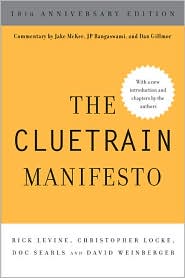
Cluetrain 10th Anniversary edition
Cluetrain 10th Anniversary
Everything Is Miscellaneous
Small Pieces cover
Small Pieces Loosely Joined
Cluetrain cover
Cluetrain Manifesto
My face
Speaker info
Who am I? (Blog Disclosure Form) Copy this link as RSS address Atom Feed

March 16, 2007

Salim Ismail joins Yahoo’s Brickhouse

Salim Ismail, a founder of PubSub and then of Confabb.com has joined Flickr’s Caterina Fake running Yahoo’s Brickhouse, a semi-autonomous unit that’s supposed to innovate, innovate, innovate. (You can read about it in the blog of Bradley Horowitz, Salim’s new boss, among other places.)

Salim is going to stay at Confabb as chairman. (Disclosure: I’m on Confabb’s board of advisors.) But clearly his focus will be on Brickhouse, the type of fun enterprise companies like Yahoo are very smart to start up. And Salim is a great choice for it. (Brickhouse is behind Yahoo Pipes.) [Tags: salim_ismail yahoo confabb brickhouse business caterina_fake pubsub]

Tweet
Follow me

Categories: Uncategorized Tagged with: uncat Date: March 16th, 2007 dw

1 Comment »

March 12, 2007

FWIW, my email is down

As of about 4pm (EDT), I have not been receiving mail sent to self evident.com. I am receiving mail at dweinberger gmail.com, however.

Almost certainly this is because of an upgrade to my server performed by my host. I should have it back sometime tomorrow (Tues.). Until then, please use my gmail account. Thanks.

(Note to spammers: The best way to reach me is by sending mail to me up your own butts. Thank you.)


My email should now (= Tues., 8:30am) be working. The mail that wasn’t delivered should be delivered over the next 24 hours. Please go back to using self evident.com.

Sorry for any inconvenience. (And thanks to my host for fixing this the instant I reported it.)

Tweet
Follow me

Categories: Uncategorized Tagged with: uncat Date: March 12th, 2007 dw

3 Comments »

March 8, 2007

From sticky eyeballs to sticky content

I’ve been thinking about USA Today’s admirable conversationalizing of its site. I don’t think it will do what they want, although I’d be happy to be wrong (which means I must be happy most of them time).

The problem is that the best newspaper is the meta-newspaper, the one that pulls together articles from every conceivable source, from USA Today to the India Times to Aunt Margie’s blog. Why would I go to one of the sources as my news home when I can pull them all to me? Sure, I’ll go to read an article linked to in one of the aggregation sites, but that’s not what USAToday.com is after. Against their wishes, their content is coming unstuck…which is the best way to get my “eyeballs” to come to their site.

It may be that one of the news sources can reinvent itself as the best damn news aggregation site, but it’s not probable since they’re likely to prefer their own content. The site will have to compete with the very best aggregators around, although the newspaper’s brand and market presence and trustworthiness does count for something. We’ll see how it turns out.

(I still think the USAToday site needs to provide a thumbs down option as well as a thumbs up button. Don’t they know we readers want our revenge?) [Tags: usatoday media newspapers journalism marketing everyth everything_is_miscellaneous ]

Tweet
Follow me

Categories: Uncategorized Tagged with: uncat Date: March 8th, 2007 dw

Be the first to comment »

March 7, 2007

Make the big bucks with Global Voices

Global Voices is seeking a full-time Outreach Director to coordinate efforts in promoting blogging, podcasting, videocasting, photoblogging and other forms of citizen media throughout the world. If you’re interested in leading an exciting new focus of Global Voices’ mission to both amplify and spread the power of self-publishing, check out Ethan Zuckerman’s full description of the position.

[Tags: gv globalvoices]

Tweet
Follow me

Categories: Uncategorized Tagged with: uncat Date: March 7th, 2007 dw

Be the first to comment »

February 24, 2007

Who’s happy, where and why?

Ethan Zuckerman has a great post analyzing data about which parts of the world are happy and why. It’s statisticalicious. [Tags: ethan_zuckerman happiness]

Tweet
Follow me

Categories: Uncategorized Tagged with: uncat Date: February 24th, 2007 dw

Be the first to comment »

February 14, 2007

CANCELLATION of Web of Ideas: Can the Internet Save Democracy?

The weather is iffy. Very iffy. I’m worried about the freezing rain making the streets unusable. So, I’m cancelling the Web of Ideas scheduled for tonight. Sorry! We’ll reschedule it soon.

Tweet
Follow me

Categories: Uncategorized Tagged with: uncat Date: February 14th, 2007 dw

Be the first to comment »

February 13, 2007

Introducing the book

An hilarious medieval YouTube showing the introduction of the book… [Tags: comedy humor video technology books libraries newbies rtfm ]

Tweet
Follow me

Categories: Uncategorized Tagged with: uncat Date: February 13th, 2007 dw

2 Comments »

February 10, 2007

FastForward video interviews

Here’s a list of the interviews I did at the Fast Forward user conference, along with the little blurbs describing them. I’ve appended an occasional editorial comment. Most are around 5 minutes, although a few run considerably longer. (I’m writing this in an airport and will probably get things wrong. Darn that haste!)

Chris Anderson, editor-in-chief of Wired and author of The Long Tail talks about when taxonomies, text search and tagging works, and how this applies to a magazine site. And what about tagging’s own long tail? [Tagalicious!]

John Battelle, the author of the best book on Google, says that search should be a conversation with your customers. And it won’t occur only by typing into a text box.

Jeanette Borzo of the Economist Intelligence Unit talks about her survey of 400 executives that showed that even though they’re unclear about what Web 2.0 means, they’re planning on using it to increase revenues and drive down costs. [Quite amusing survey results.]

Matthew Brown, a senior analyst at Forrester Research, talks about the future in which search is ubiquitous but also frequently less visible.

Susan Feldman, an analyst with IDC, gives an advance peak at a study she’s going to be announcing tomorrow that upsets expectations about how people find sites…and opens a possibility for “long tail” advertising. [I think I forced a “clarification” on her that’s actually misleading. From talking with people afterwards, the two types of “queries” she’s talking about probably are ones made at search sites, and ones made using the search services of particular sites, e.g., searching for a book at Google or Amazon. I thought by the second type of query she meant people typing a URL directly into the address bar of a Web site. Sorry!]

Carl Frappaolo of the Delphi Group explains why we should think of search not in terms of finding so much as in terms of teaching.

Stephen Gallagher, Senior Director at Accenture, says that business intelligence is the main factor high performance companies have in common. Bottom-up, “messy” data (in Tim O’Reilly’s phrase) is only a “nice to have.”

Kathleen Gilroy, who’s also doing video blogs at the conference, answers her own question, “How has search changed her life?” If you want to know, just ask her husband.

Joyce Haas, search product manager at WebMD, talks about the use of social software in her company, the resistance to it, and the transformative effect it has. [WebMD’s willingness to let its employees talk this frankly says a lot about WebMD.]

Dorothea Herrey of Dow Jones Consumer Media Group, Director of Franchise Development and Partnership (a subsidiary of the Long Titles Divisional Department :) talks about how Dow Jones organizes itself in the multi-dimensional world of the Web, where the dimensions include content, brands, devices, markets, interests….

Bill Inmon of Inmon Data Systems says that at last we’re able to combine structured and unstructured search, so that (for example) a search for a customer will find transaction records in the database and emails the customer may have exchanged with customer support.

Dan Keldsen of the Delphi Group talks about the intersection of full text search and tagging.

John Markus Lervik, founder and CEO of Fast, talks about who is a bigger competitor, Oracle or Google [a question I totally stole from blogger Joe McKendrick], and the ways in which Fast internally is a Web 2.0 company…wikis and blogs, emerging bottom-up.

Lydia Loizides, a former VP of technology and emerging media at IPC.

Andrew McAfee, creator of the Enterprise 2.0, talks about what Knowledge Management 2.0 looks like…and whether it will arrive top-down, bottom-up or both.

Tom Mandel of ConnectBeam, a social software company, explains why tags are like poetry. [And the extent to which poetry and tagging are expressions of the individual. And why rhyming adds meaning.]

Jim McGee of the Huron Consulting Group, and DiamondHead founder, talks about the need for businesses to allow employees time to think, and the extent to which thinking can be done in the social public of blogs.

Tim O’Reilly, creator of the Web 2.0 meme, says that organizations have been slow to understand how “network effects” can benefit their business if applied internally as well as externally. As customers add to what the company knows, should that added-value information be made accessible outside of the company? [Tim emphasizes the need for internal sharing and notes that that sharing externally may not always make business sense.]

Hadley Reynolds, VP of Fast’s Center of Search Innovation, discusses the implications of the fact that in enabling sites to provide us with highly relevant results, we may trade-off some of our privacy.

James Robertson of Step Two Designs explains why “search sucks,” and how it can be kept simple and made more effective if the implementers do more work up front. [Plus, there’s the great Prawn vs. PrOn confusion…]

MIT’s Michael Schrage explains why getting highly relevant results from a search can actually inhibit the iterative process by which we discover and learn. [Is this the first use of the term “post-relevant results”?]

Euan Semple, formerly the knowledge management guru at the BBC and now an independent consultant, says that he thinks search is overrated. He trusts more the answers given to him by his social network. [Did the leave in the part where I find out that Euan, whom I’ve counted as a friend for years, pronounces his name “You-ann,” not “Eee-an”? How embarrassing!]

Sandeep Swadia, head of Search Business Consulting for Fast, talks about the intersection of customer needs for search and the evolving media business model.

David Watson, VP of Product Design and Development for Digital Media at Disney/ABC, talks about the role of user-generated metadata in guiding people toward his company’s content. Look for looser licensing of news content before creative content. [This is a Disney guy who understands that an importnat measure of control has slipped from producers to the audience.]

Zia Zaman, SVP of Strategic Marketing at Fast, talks about search as the visible surface of deep business processes, and what this means for Fast as a partner. [Tags: ff07 fastforward web2.0 videos interviews search everything_is_miscellaneous]

Tweet
Follow me

Categories: Uncategorized Tagged with: uncat Date: February 10th, 2007 dw

5 Comments »

January 31, 2007

Small Pieces for Kids in Dutch

Marcel de Ruiter (of ShapingThoughts) has translated the kids’ version of Small Pieces Loosely Joined into Dutch. There are now versions in French, Norwegian, Italian (link is broken….working on it) and Portuguese, which makes me inordinately happy. I know doing a kid’s version is an odd idea, but I’m really glad I did it… [Tags: small_pieces_loosely_joined]

Tweet
Follow me

Categories: Uncategorized Tagged with: uncat Date: January 31st, 2007 dw

6 Comments »

Folksonomies vs. Taxonomies

In talking with Lee Rainie of Pew (see previous post), I realized that I don’t have a good answer to an obvious question: What are some good examples of how folksonomies have improved taxonomies? In fact, with my poor powers of recall (and given how imprecise I am, I would make a terrible search engine), I can’t even think of good examples of sites that present a standard-style taxonomy and a tag cloud. I know they’re there. I’m pretty sure I’ve blogged about them. I may even have been married to one during a brief period in the ’70s. But I’m blanking on them… [Tags: folksonomy tagging taxonomy]

Tweet
Follow me

Categories: Uncategorized Tagged with: uncat Date: January 31st, 2007 dw

9 Comments »

« Previous Page | Next Page »


Creative Commons License
This work is licensed under a Creative Commons Attribution-NonCommercial-ShareAlike 3.0 Unported License.
TL;DR: Share this post freely, but attribute it to me (name (David Weinberger) and link to it), and don't use it commercially without my permission.

Joho the Blog uses WordPress blogging software.
Thank you, WordPress!