


logo
EverydayChaos
Everyday Chaos
Too Big to Know
Too Big to Know
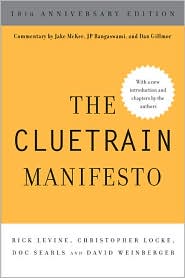
Cluetrain 10th Anniversary edition
Cluetrain 10th Anniversary
Everything Is Miscellaneous
Small Pieces cover
Small Pieces Loosely Joined
Cluetrain cover
Cluetrain Manifesto
My face
Speaker info
Who am I? (Blog Disclosure Form) Copy this link as RSS address Atom Feed

May 19, 2008

The worst director in the world?

The NY Times has an interesting article about Uwe Boll, whom many consider to be the worst director working. I’ve only seen BloodRayne, which is laughably cliched and wildly incompetent. The top half of the graduating class of Emerson College (whose commencement is today … good luck, kids!) has to be better at the basic story-telling techniques than Boll is.

Still, it’s hard to call Boll the worst director in the world when this guy is still making movies. Have you seen Alexander?

[Tags: movies uwe_boll oliver_stone ]

Tweet
Follow me

Categories: Uncategorized Tagged with: movies • uncat Date: May 19th, 2008 dw

3 Comments »

May 15, 2008

[b@10] Charlie Nesson

Charlie Nesson begins by saying that the morning had a negative cast to it. It was about fear. But he was uplifted when Yochai and Jimbo got to what Wikipedia is and could be. [Live blogging. Full of errors and omissions. Posted unedited and unspellchecked.]

He asks the general counsel of Viacom what he does in the course of a day. Mike: Viacom is an entertainment company, but it’s diverse, from cable TV to Internet. It has 140 channels around the world (ComedyCentral, MTV, etc.), video games His day consists of planning, managing, and dealing with surprises.

Charlie asks Esther Dyson what she does during the day. “I’m a court jester.” She swims every morning. She’s retired. So she does what she likes, including sitting on boards, giving advice, writing, giving talks, working with “do-good” groups trying to foster democracy in emerging markets.

Reed Hundt, former FCC chairman, says he’s on 7 boards, kibbitzes on politics.

Charlie says that he speaks for Eon, Dean of Cyberspace, and she has some questions. Wikipedia is the instantiation of the building of the knowledge commons. Why didn’t it come out of a university?

Esther: It came from neither the university nor government because they have rules and process. They don’t welcome strangers. Wikipedia is just a rule set. And, btw, you should check out barcode wikipedia. The topics are products with barcodes. [Ah, the power of unique identifiers!]

Charlie says to Mike of Viacom that Harvard is in a sense a public media company. We sit on a huge archive of material, most of which is copyrighted. The permission system is mired in transaction costs. So, we can’t use our treasure unless we pay a huge amount in time and money to free it up. So, it sits there. You too site on a huge pile ofassets. You’re looking at the system from the other side.

Mike: The system that creates those books depends on an economic incentive.

Charlie: Suppose we had the network infrastructure but no copyright. If we had to make a new system, can we agree that we would not choose the existing system?

Mike: Yes. We would have created something with many different features. You should be allowed to decide how to make your works available. But disrupting those expectations undermines people’s willingness to make works.

Charlie: The Net is a true inflection point. It changes defaults. It starts you from an open space, and you create private spaces within it. That means that the answer to Mike’s argument should be: Yes, except things have changed. We should be in a hurry to change.

Mike: There are tons of examples of those changes. E.g., the record companies have given YouTube site licenses.

Esther: If you’re really going to start over, there’s a principle that if someone creates something, they ought to control its distribution. But there are lots of business models and varieties of contracts.

Reed: Here are some facts that might be true. Over the past 20 yrs, if you look at all content, the price of the hardware in that network has continuously declined. The price of sw has stayed flat. So, the predominant value of the Net is now software. That inhibits the take-up rate in poorer economies. Linux is a response to that.

Esther: The price of the sw isn’t the inhibitor. They’re happy to use stolen sw.

Mike: There are a lot of new, efficient licenses that have developed, including blanket licenses designed to reduce the transaction costs. And we’ve developed ways to get our content out everywhere. And getting clearances are a pain in the butt for Viacom, too.

Charlie asks if we should worry about what JZ has pointed to, the locking down of devices.

Reed says that what happened to the music industry will happen to “elite universities.” You can tell by the fact that universities don’t spend a lot on IT that they don’t know how to accomplish their mission in the new world. E.g., bring Western knowledge to China.

Charlie says that the open access movement wants to bring all knowledge to everyone everywhere.

Esther: Education is about more than making info available.

Charlie: We should be able to make education that is interesting to people around the world. But can you do that with Verizon in charge of the connection and the cellphones?

Reed: In most countries, it’s a state-owned company and has nothing to do with education. We now know that within 15 yrs virtually everyone will have a Net connection, and most will be a wireless connection. Universities need to get ahead of this parade or they won’t be a significant part of how people learn.

Esther: In India, she saw the multimouse, so you can stick a single usb device into a port, and it connects to 8 mice, each with its own cursor. Eight students at a time. That’s MSFT investing in emerging markets. She tells a story about S. Africa to make the point that we shouldn’t be looking for government solutions. We need open markets.

Q: (David Marglin) How do we welcome strangers? How do we beat our swords into plowshares?
Charlie: Harvard has gone open access. That’s news. Other universities notice. Elsevier notices.

Q: You’ve addressed how you broadcast your ideas. But that’s easy. Paris Hilton does that. Harder: How do you listen to all the people who have ideas? How about if Harvard could listen to all those people. And how about getting the science dept to talk with the art dept?

Q: If there were no copyright, we’d have a digital library of Alexandria. Copyright is about providing incentives, not about lowering transaction costs, etc.

Mike: The library wouldn’t exist if people didn’t have incentives. It’d be great if al content had metadata so rights could be cleared automatically, lowering transaction costs. [So there we have the two visions: A system of perfect control to lower transaction costs, and a commons. Me, I want the commons. [Tags: berkman berkmanat10 ]

Tweet
Follow me

Categories: Uncategorized Tagged with: berkman • berkmanat10 • uncat Date: May 15th, 2008 dw

4 Comments »

[b@10] Berkman Center becomes a Harvard center

Dean Kagan has just announced that the Berkman Center, which had been part of Harvard Law, is now an interdisciplinary center, part of Harvard University overall.

This is not only quite an honor. It also will embed the Center even more directly in the full range of Harvard’s discourse.

[Tags: berkman berkmanat10 ]

Tweet
Follow me

Categories: Uncategorized Tagged with: berkman • berkmanat10 • uncat Date: May 15th, 2008 dw

1 Comment »

May 13, 2008

Publius is publicus!

The Berkman Center’s Publius Project is now live. There you’ll find essays on the Internet’s “constitutional moments,” even though most of those moments do not involve a written constitution … which makes the topic all the more interesting. (My contribution, on tacit governance, is here.)

[Tags: publius governance ]

Tweet
Follow me

Categories: Uncategorized Tagged with: governance • publius • uncat Date: May 13th, 2008 dw

Be the first to comment »

May 6, 2008

Flypaper

Flyp, an online mag, is in beta but it’s already gorgeous.

[Tags: flyp ]

Tweet
Follow me

Categories: Uncategorized Tagged with: flyp • uncat Date: May 6th, 2008 dw

1 Comment »

April 26, 2008

Complex interests, detailed interests

BoingBoing points to some wonderful comments by Vint Cerf in an interview in Esquire, including:

The closer you look at something, the more complex it seems to be.

So true. And also quite different from one of the founding ideas of Western culture. For the ancient Greeks, beneath the apparent complexity there had to be a simple order, or else knowledge wasn’t possible.

You have to wonder about the role our current technology has played in our moving from the Greeks to Vint. (1) We are far better able to externalize ideas now, so that we can know more than we could when memory was confined to what fit in our skulls and could be written down by hand. (2) Our technology now lets us put things together far more complexly than the physical world does; reality is designed to keep things apart (to be something is to not be something else, said Aristotle), while the Web is designed to link things together. (3) Our technology connects us in socially complex ways, enabling us to understand things together.

And it’s not just that things become more complex the closer you look. They also become more interesting. Everything is interesting if looked at closely enough. I take that as one of the lessons of the Net. [Tags: vint_cerf philosophy ]

Tweet
Follow me

Categories: Uncategorized Tagged with: philosophy • uncat Date: April 26th, 2008 dw

1 Comment »

April 18, 2008

How important is the Web?

Amazingly, the course I’ve been co-teaching with John Palfrey, called The Web Difference, ends on Tuesday. The question the course poses is, unsurprisingly: Is the Web very different from what came before, a little different, or not different? More important, in what ways? The class has looked at a number of different domains and dimensions. (A now outdated version of the syllabus is here.)

John and I haven’t talked about what to do on the last day, but I’m tempted to raise the question of the Web’s difference by asking the class how epochal they think the Web is. Is it different enough and important enough to call this the Age of the Web? (For purposes of this discussion, I’m not distinguishing between the Web and the Internet. If you’d rather substitute “Internet,” I won’t argue. And, yes, I do know the difference.)

Since that’s still pretty vague, suppose we were to ask whether the Web is as big a deal — in terms of defining an epoch — as genetic manipulation. TV. The telephone. Anesthetics. CB radio. The printing press. Paperback books. Bronze. Steam engines. Commercial aviation. Electric keyboards. The computer. Ball point pens. Johnny Depp.

Personally, I think it’s roughly on the order of the printing press. But I also believe that Wikipedia is our Gutenberg Bible… no, not in terms of credibility or spiritual depth, but as the artifact that shows the importance of the new technology. I suspect and hope many of the students in our class thoroughly disagree… [Tags: webdiff ]

Tweet
Follow me

Categories: Uncategorized Tagged with: uncat • webdiff Date: April 18th, 2008 dw

10 Comments »

My Heart Will Go On Fragging

I will understand if you don’t think this is funny, but I do:


TF2 Karaoke: My Heart Will Go On from FLOOR MASTER on Vimeo.

It comes via Bradsucks. It’s a karaoke version of Celine Dion’s “My Heart Will Go On,” as performed by some guys playing Team Fortress 2. [Tags: karaoke team_fortress ]

Tweet
Follow me

Categories: Uncategorized Tagged with: karaoke • uncat Date: April 18th, 2008 dw

2 Comments »

April 16, 2008

The politics of playing cards

Thanks to my relentless ego-surfing, um, I mean my participating in the ongoing conversation that is the Web, I came across a rough draft of a course paper by Devin Dadigan about the racism and sexism implicit in playing cards, — which, apparently are ordered the way they have been since the 14th century. Kings beat queens, and, the black queen is an especially disastrous card in several games.

At first I thought Devin’s hypothesis about race was problematic, because I thought clubs are sometimes taken as the highest suit, even though Devin says that black cards represent labor and slaves. (That link seems incontestable in America where “spade” has been a demeaning — and occasionally hip — term for African-Americans.) Wikipedia, however, says that when suits are ranked, clubs sometimes come first because the ranking is done alphabetically. Ah, the hidden power of alphabetization! Why, it even cures racism!

Fascinating fact: According to the paper, the ascent of the ace as the highest card “was hastened in the late 18th century by the French Revolution, where games began being played ‘ace high’ as a symbol of lower classes rising in power above the royalty.”

[Tags: cards games history devin_dadigan ]

Tweet
Follow me

Categories: Uncategorized Tagged with: cards • devin_dadigan • games • history • uncat Date: April 16th, 2008 dw

9 Comments »

April 14, 2008

Emergent politics: Was Steven Johnson right?

As the 2004 Dean campaign crashed, Steven Johnson wrote one of the more provocative and insightful analyses of why it failed despite all the enthusiasm behind it. In the piece, Steve refines the notion of “emergence” he had popularized in his terrific book of the same name: There’s emergence that clusters and emergence that copes. Clustering is exemplified by slime mold, which creates a crowd without any top-down control. Coping is exemplified by termite nests which result from a bottom-up regulatory regime which is able to adapt. The Dean campaign, under this analysis, clustered people and money but was unable to cope when things started to go badly.

Steve ends the piece this way:

I suspect that such a system may well be fundamentally incompatible with the necessary structure of a national political campaign, at least for the foreseeable future. Emergent systems that excel at coping do so out of truly local information; they take their random walks through their neighborhoods and record patterns in what they find. National campaigns, on the other hand, work at a macro scale, and they are necessarily wedded to the broadcast amplifications of the national media. Whatever local disturbances or opportunities they discover are quickly uploaded to the world of network TV and satellite feeds, where they undergo all sorts of distortions. And national campaigns, by definition, have to have leaders, at least in the form of the politicians themselves…

Is there an emergent politics capable of a more subtle form of self-regulation? If there is, I think it will first take shape, not as a political campaign, but as a more local, day-to-day affair: more polis than politics.

Was Steve right? (Just to be clear: I’m not asking about Steve, of whom I am a giggling fanboy, but about the state of politics.) [Tags: politics steven_johnson emergence everything_is_miscellaneous ]

Tweet
Follow me

Categories: Uncategorized Tagged with: emergence • politics • uncat Date: April 14th, 2008 dw

5 Comments »

« Previous Page | Next Page »


Creative Commons License
This work is licensed under a Creative Commons Attribution-NonCommercial-ShareAlike 3.0 Unported License.
TL;DR: Share this post freely, but attribute it to me (name (David Weinberger) and link to it), and don't use it commercially without my permission.

Joho the Blog uses WordPress blogging software.
Thank you, WordPress!