

logo
EverydayChaos
Everyday Chaos
Too Big to Know
Too Big to Know
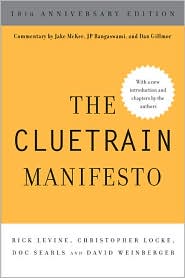
Cluetrain 10th Anniversary edition
Cluetrain 10th Anniversary
Everything Is Miscellaneous
Small Pieces cover
Small Pieces Loosely Joined
Cluetrain cover
Cluetrain Manifesto
My face
Speaker info
Who am I? (Blog Disclosure Form) Copy this link as RSS address Atom Feed

November 15, 2006

(Shhhh. A fun day…)

I’m in NYC to talk with my publishers about their plans for marketing my book. That’s this afternoon. This morning, i’m going to be a guest participant in a grad seminar Steve Johnson teaches. (Note to self: Buy a copy of The Ghost Map so Steve can sign it…and so I can read it. I am a huge Steve Johnson fan.) So, I’ve been looking forward to today…

…Except now I’ve caught the attention of the unswerving god of Irony. Oh mighty swinger of the axe of overturned expectations, enforcer of whim, doer of random acts of randomness, gleeful splasher of cold water and placer of banana peels, oh pants ripper, invincible reminder of one’s inconsequence, interrupter of plans, thruster of the lance that finds all smugness, please forgive thy servant’s moment of happy anticipation. [Tags: steve_johnson i_am_but_a_worm do_not_smite]

Tweet
Follow me

Categories: Uncategorized Tagged with: uncat Date: November 15th, 2006 dw

3 Comments »

November 12, 2006

Dumb question of the week

I’m installing a power supply for my PC. It has a large fan on what is either the top or bottom. Do I install it with the fan facing up or facing down? I tried turning it on and couldn’t really tell if it’s an intake or outflow fan—there was very little breeze coming out of it, so I’m guessing it’s an intake.

(FWIW, our electrical poltergeists seem to have moved back in after a couple of years of vacationing elsewhere. In the past two weeks, my motherboard, amplifier, computer backup system and basement light fixture have all failed.)

Tweet
Follow me

Categories: Uncategorized Tagged with: uncat Date: November 12th, 2006 dw

5 Comments »

November 6, 2006

A Web of Ideas discussion, with Paul Graham: Taste and the Aesthetics of Design

I’m going to talk with Paul Graham as part of the intermittent Web of Ideas series at the Berkman Center this Wednesday evening at 7pm. You’re invited. And we serve pizza.

Paul Graham is a software guru, entrepreneur, essayist and painter. Inhis essay, “Taste for Makers,” Paul argues that successful design, from math to software to painting, relies on the same aesthetic principles. Taste is therefore not a matter of subjectively appreciating fine works but is a required capability for creating great software. But is taste as timeless as Paul suggests? Do the design principles Paul points to result from aesthetic or functional characteristics? And why should we think that the visual and the programmatic, the artistic and the functional, the physical and the virtual might all be beautiful in similar ways?

I’ll interview Paul for a while and then it will be open discussion. Paul is deeply knowledgeable and thoughtful, so this ought to be fun. (Note: The Berkman Center moved around the corner this year. It’s now at 23 Everett St in Cambridge. [map]) [Tags: berkman paul_graham web_of_ideas]

Tweet
Follow me

Categories: Uncategorized Tagged with: uncat Date: November 6th, 2006 dw

7 Comments »

November 1, 2006

O’Reilly’s miscellaneousness

From a Publishers Weekly:

Safari Books Online, a California-based company that provides business and technology reference resources [O’Reilly media + Pearson Technology Group- dw], has launched Short Cuts, a series of brief works about emerging technologies not yet worthy of book-length treatment. The service, which complements the company’s Rough Cuts program allowing readers to offer feedback on manuscripts not yet completed (PW Daily, Mar. 13 ), will be included in the subscription to Safari’s online reference service. That service grants access to more than 4,000 titles by leading technology and business publishers. According to Safari’s v-p of marketing, Debra Woods, the Short Cuts program is part of a larger move by the company to bring more of its content online. “The introduction of Short Cuts builds on an emerging trend here at Safari Books Online to move our service beyond books…. [We are] embracing new formats like Short Cuts and Rough Cuts-products custom designed for the online medium.”

[Tags: everything_is_miscellaneous oreilly safaribooks textbooks publishing media ]

Tweet
Follow me

Categories: Uncategorized Tagged with: uncat Date: November 1st, 2006 dw

2 Comments »

October 28, 2006

How could I be so stupid?

I’ve spent the past couple of days going through the copy edit of Everything Is Miscellaneous. The copy editor, Christopher O’Connell, has done an incredible job. Not only has he corrected every bad comma, transformed every errant “that” into “which” and vice versa, and capped every uncapped capitalized word, but he’s also unearthed an embarrassing number of factual and thoughtual errors that would have mortified me if they’d seen print. I am impressed with the number of ways I’ve managed to go wrong, even though I was rather careful (or so I thought) when taking notes. I misspelled names, don’t know whether 350 BCE is in the third or fourth century BCE, and am wrong about the citizenship of some important historical personages. (What, Napoleon wasn’t Irish???)

It is a usefully humbling experience for which I’m very grateful.

Tweet
Follow me

Categories: Uncategorized Tagged with: uncat Date: October 28th, 2006 dw

3 Comments »

October 17, 2006

Zittrain on One Laptop Per Child

Seb Schmoller’s blog has an excellent write-up by Steve Ryan of the Berkman Center’s Jonathan Zittrain (also of Oxford) talking about what to put on the One Laptop Per Child laptops. Quite typically, JZ ranged wider, deeper and funnier than anyone could reasonably expect of a fellow human being. [Tags: jonathan_zittrain berkman olpc]

Tweet
Follow me

Categories: Uncategorized Tagged with: uncat Date: October 17th, 2006 dw

1 Comment »

October 10, 2006

[berkman] Dan Burk on Open Source science

Dan Burk from U of Minnesota Law School is talking about open source science. [As always, I’m paraphrasing at best.]

He notes some strands of open sourciness. 1. Open Source Genomics saw a clash of the scientific and hacking cultures. 2. Open Source patenting wonders if what worked for sw could work for biotech licensing. 3. Cyberinfrastructure (= e-science), i.e., use of networks to do collaborative science, enables transborder collaboration.

Dan looks at scientific norms as proposed by Merton: Communalism, universalism, independence, organized skepticism and originality. Not that science always achieves this ideals, he says. But if you follow these norms, you get scientific reward, including the respect of one’s peers. in the 1980s, Rebecca Isenberg, among others, pointed to the “intellectual property” system as providing another set of rewards: Money. But that can require secrecy and exclusion, which works against the reputational reward. Patents at least require disclosing what you’ve learned, as opposed to trade secrets. The Human Genome Project in the ’90s started patenting snippets of DNA. They agreed to “Bermuda” rules, making info public within 24 hours.

The new cyberinfrastructure that enables e-science is Internet- and grid-enabled. People share the info through collaboratories (virtual environments). But whose patent law applies to something discovered in a virtual world? The US assigns inventorship based on where you’re located, which is hard to apply. An agreement beforehand would help. Open Source licensing might be a model.

There are two justifications for Open Source coding: It’s practical because it flushes out bugs, and it’s moral. To keep it from being captured, licenses travel with the code with norms that are similar to the scientific norms: Communal, reputational rewards, no forking, leadership, and licensing strategies. Can bio-med sciences adopt this licensing scheme? A couple have tried: the Haplotype Mapping project uses OS-style licenses. The BIOS project makes physical tools (enzymes) and requires you to contribute back to the system any improvements of the tools you make, although you can patent what you make with the tools. The Science Commons uses OS-style licenses for literature.

Dan points to unsettled issues about patents that could be a problem for open science. There’s patent pooling, reverse “reach through” licenses and reverse “grant backs.” Are some of these licenses intended to discourage patents, which the US would consider a bad thing?

There are also cultural impediments, he says. “Science has a much more structured set of institutions than Open Source generally does.” There are universities, funding agencies and labs who have interests in what gets developed. There are also systemic differences: Peer review, publication, scientific societies.

Q: Say more about the patent misuse question
A: A patent gives someone exclusive rights in order to promote progress, to have an incentive, to recoup the investment. The assumption is that that’s good. It will spur science. If you license your patents in a bad way—charge for a license beyond the term of the patent, e.g.—your patent gets curbed. If an OS license says that you can’t patent anything you discover with it, you’re using your patent to discourage patents and it might count as a misuse. SCO said OS discourages the development of “intellectual property.” That argument didn’t go anywhere, but it’s still lurking there. Robin Feldman has a good paper on this. She thinks these licenses could be pro-competitive.

One of the strategies is to forbid patents of developments within the area of the original patent but allow patents for developments outside of that area.

Q: Is there a fundamental difference between the innovations that should be promoted by OS and those promoted by patents and the proprietary?

A: We don’t know but that may be the case. One of the things to worry about is whether open approaches are self-sustaining. The examples in Yochai Benkler’s The Wealth of Networks are of people funded by their business or university.

Q: (me) Assuming we’re going to have both OS and proprietary science, how do the ambiguities get resolved?
A: We’ve had both systems for a long time: Patents and reputational reward. Now they’ve intersected. Generally they accommodate each other. Biomed scientists are figuring out that if they want the reputational reward they have to do X, if they want the patent they have have to do Y. If you view OS as an extension of that (and remember, he says, that the hacker mentality comes out of universities, just as reputational science does), it seems to be working. OS has been around for a while and we really don’t have any cases, outside of a case in the Netherlands last year. OS licenses seem to be enforceable. We may not get decisions quickly. For one thing, business cares about making money, not so much about “intellectual property” for its own sake. There aren’t that many “IP” cases and it may be the same in this area. Also, typically you don’t get a lot of action in the “IP” area until there’s a lot of money at stake. So far, there isn’t. There will be, though. Patent litigation costs $5-10M, so something worthwhile has to be at stake.

Q: Joseph Stiglitz (sp) has shown that prizes work well as incentives.
A: It’s interesting but contested work. In some situations it may well work, in many it won’t, and we’ll have to figure out those situations are. This was Alexander Hamilton’s approach. He liked the French idea of having a system of prizes instead of patents.

Q: How is the scientific culture changing?
A: There seems to be a gender difference in how scientists group. The big divide is between academic and commercial researchers. To get scientists out of academic into commerce, employers have had to provide some of the openness they’re used to in the academy. But the more a commercial scientist wants to join an online group or a collaboratory, there’s more risk of trade secret leakage.

In conversation, Dan recommends a site about an upcoming conference on cyberinfrastructure.

[Tags: science open_science open_source dan_burk berkman patents]

Tweet
Follow me

Categories: Uncategorized Tagged with: uncat Date: October 10th, 2006 dw

3 Comments »

October 5, 2006

Steven Levy on One Web Day and Net neutrality

Steven pens a terrific column for Newsweek on One Web Day — appropriately dark for such a sunny topic. [Tags: OneWebDay Net_neutrality steven_levy susan_crawford]

Tweet
Follow me

Categories: Uncategorized Tagged with: uncat Date: October 5th, 2006 dw

Be the first to comment »

September 22, 2006

Sacramento plans 12,000 sq mile wifi net

According to Esme Vos at MuniWireless.com, Sacramento plans on covering nine counties, 30 municipalities, 3 million people and 12,000 square miles with wifi. It will provide communications for organizations involved in emergency relief, public safety and national security. [Tags: wifi esme_vos sacramento]

Tweet
Follow me

Categories: Uncategorized Tagged with: uncat Date: September 22nd, 2006 dw

1 Comment »

September 20, 2006

Global Voices on the Thai coup

Got yer citizen journalism right here. [Tags: global_voices gv thailand]

Tweet
Follow me

Categories: Uncategorized Tagged with: uncat Date: September 20th, 2006 dw

1 Comment »

« Previous Page | Next Page »


Creative Commons License
This work is licensed under a Creative Commons Attribution-NonCommercial-ShareAlike 3.0 Unported License.
TL;DR: Share this post freely, but attribute it to me (name (David Weinberger) and link to it), and don't use it commercially without my permission.

Joho the Blog uses WordPress blogging software.
Thank you, WordPress!