


logo
EverydayChaos
Everyday Chaos
Too Big to Know
Too Big to Know
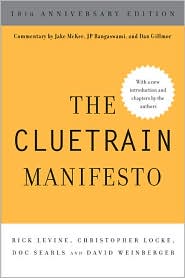
Cluetrain 10th Anniversary edition
Cluetrain 10th Anniversary
Everything Is Miscellaneous
Small Pieces cover
Small Pieces Loosely Joined
Cluetrain cover
Cluetrain Manifesto
My face
Speaker info
Who am I? (Blog Disclosure Form) Copy this link as RSS address Atom Feed

October 10, 2011

Erik Martin on what makes Reddit special

Erik Martin, the general manager of Reddit, explains what’s so special about the discussion site. I’m particularly interested in the nature of authority on the site, and its introduction of new journalistic rhetorical forms.

Tweet
Follow me

Categories: journalism, media, social media, too big to know Tagged with: 2b2k • journalism • media • reddit • social media Date: October 10th, 2011 dw

2 Comments »

September 28, 2011

The coffee-shopping of everything

David Strom at ReadWriteWeb notes a trend at hotels to re-jigger lobbies as social spaces in which you can plug in your laptop and hang out, instead of sitting in your disinfected Rectangle of Solitude.

I’d give it a try, especially if free or cheap coffee were involved. I think I might enjoy the company, although if someone actually tried to talk with me, I’d undoubtedly give him the stink eye so I could get back to work. Hey, just because I want to be near other human beings doesn’t mean I want to be your friend.

So, yes, I would want to achieve that refined balance of social and impersonal that is of increasing importance in today’s ever-more-public world, and that is at the heart of Starbucks’ value proposition.

Tweet
Follow me

Categories: culture, libraries, social media Tagged with: coffeeshops • hotels • libraries • social media • sociality • starbucks Date: September 28th, 2011 dw

5 Comments »

September 26, 2011

Profile Photo

Just for fun:

Profile Photo

JonJGman has updated his profile photo.

JonJGman thinks his profile photo makes him look boring.

JonJGman has put a yellow background in his profile photo.

JonJGman thinks the yellow background makes his skin look waxy, almost cadaverous.

JonJGman has superimposed “Madame Toussault’s” on his background photo so maybe you’ll think he looks waxy because they’ve made a statue of him.

JonJGman has run the spell checker on “Madam Toussault’s.”

JonJGman has changed the background so he’s now standing in front of the Grand Canyon.

JonJGman can’t figure out how to get “Madam Tossaud’s” erased from the sky over the Grand Canyon.

JonJGman has run the spellchecker on “Madam Tossaud’s” and definitely thinks he’s getting closer.

JonJGman has never been to the Grand Canyon and besides it looks like’s standing in front of a photo of the Grand Canyon with the words “Madam Tussauds” mysteriously in the sky, so he’s thinking about going back to his original photo.

JonJGman can’t find his original profile photo.

JonJGman has accidentally deleted his Trash folder.

JonJGman has downloaded a copy of his Waxy Dead Person Standing in Front of a Picture of the Grand Canyon with “Madame Tussault’s” Still Misspelled in the Skies photo.

JonJGman has decided to brighten his teeth in his profile photo.

JonJGman now has a bright pink, waxy nose in his profile photo.

JonJGman wishes to inform his friends that it’s only due to an incompetent attempt to darken the bright tip of his waxy nose that he now looks like suffers from stage 3 leprosy.

JonJGman has accidentally uploaded a photo of Anthony Weiner’s tumescent underpants that he honestly didn’t even know that he had, as his profile photo.

JonJGman’s new profile photo is Default Avatar #23.

JonJGman randomly chose Default Avatar #23 without realizing that it depicts a pink kitty that is at best age-inappropriate and, as a replacement for the Weiner Party in His Pants photo, is actually pretty creepy.

JonJGman wishes to apologize to his friends for not realizing that they were being notified about every step in this personal odyssey.

JonJGman has now changed his name to JakeTheBear325 and hopes to begin again fresh.

JakeTheBear325 has changed his profile photo.

Tweet
Follow me

Categories: humor, social media Tagged with: humor • profiles • social media Date: September 26th, 2011 dw

6 Comments »

August 13, 2011

Reddit and community journalism

I’ve come to love Reddit. What started as a better Digg (and is yet another happy outcome of the remarkable Y Combinator) has turned into a way of sharing and interrogating news. Reddit as it stands is not the future of news. It is, however, a hope for news.

As at other sites, at Reddit readers post items they find interesting. Some come from the media, but many are home-made ideas, photos, drawings, videos, etc. You can vote them up or down, resulting in a list ordered by collective interests. Each is followed by threaded conversations, and those comments are also voted up or down.

It’s not clear why Reddit works so well, but it does. The comments in particular are often fiercely insightful or funny, turning into collective, laugh-out-loud riffs. Perhaps it helps that the ethos — the norm — is that comments are short. Half-tweets. You can go on for paragraphs if you want, but you’re unlikely to be up-voted if you do. The brevity of the individual comments can give them a pithiness that paragraphs would blunt, and the rapid threading of responses can quickly puncture inflated ideas or add unexpected perspectives.

But more relevant to the future of news are the rhetorical structures that Reddit has given names to. They’re no more new than Frequently Asked Questions are, but so what? FAQs have become a major new rhetorical form, of unquestioned value, because they got a name. Likewise TIL, IAMA, and AMA are hardly startling in their novelty, but they are pretty amazing in practice.

TIL = Today I Learned. People post an answer to a question you didn’t know you had, or a fact that counters your intuition. They range from the trivial (“TIL that Gilbert Gottfried has a REAL voice.”) to the opposite of the trivial (“TIL there is a US owned Hydrogen bomb that has been missing off the coast of Georga for over 50 years. “)

IAMA = I Am A. AMA = Ask Me Anything. People offer to answer questions about whatever it is that they are. Sometimes they are famous people, but more often they are people in circumstances we’re curious about: a waiter at an upscale restaurant, a woman with something like Elephant Man’s disease, a miner, or this morning’s: “IAmA guy who just saw the final Harry Potter movie without reading/watching any Harry Potter material beforehand. Being morbidly confused, I made up an entire previous plot for the movie to make sense in my had. I will answer your HP Series question based on the made up previous plot in my head AMA.” The invitation to Ask Me Anything typically unfetters the frankest of questions. It helps that Reddit discourages trolling and amidst the geeky cynicism permits honest statements of admiration and compassion.

The topics of IAMA’s are themselves instructive. Many are jokes: “IAmA person who has finished a whole tube of chapstick without losing it. AMA” But many enable us to ask questions that would falter in the face of conventional propriety: “IAmA woman married to a man with Asperger’s Syndrome AMA”. Some open up for inquiry a perspective that we take for granted or that was too outside our normal range of consideration: “IAMA: I was a German child during WWII that was in the Hitler Youth and had my city bombed by the U.S.”

Reddit also lets readers request an IAMA. For example, someone is asking if one of Michelle Bachman’s foster kids would care to engage. Might be interesting, don’t you think?

So, my hypothesis is that IAMA and AMA are an important type of citizen journalism. Call it “community journalism.”

Now, if you’ve clicked through to any of these IAMA’s, you may be disappointed at the level of “journalism” you’ve seen. For example, look at yesterday’s “IAMA police officer who was working during the London Riots. AMA.” Many of the comments are frivolous or off-topic. Most are responses to other comments, and many threads spin out into back-and-forth riffing that can be pretty damn funny. But it’s not exactly “60 Minutes.” So what? This is one way citizen journalism looks. At its best, it asks questions we all want asked, unearths questions we didn’t know we wanted asked, asks them more forthrightly than most American journalists dare, and gets better — more honest — answers than we hear from the mainstream media.

You can also see in the London police officer’s IAMA one of the main ways Reddit constitutes itself as a community: it binds itself together by common cultural references. The more obscure, the tighter the bond. For example, during the IAMA with the police officer in the London riots, someone asks if they’ve caught the guy who knocked over the trash can. This is an unlinked reference to a posting from a few days before of a spoof video of a middle class guy looking around an empty street and then casually knocking over a garbage can. The comments devolve into some silliness about arresting a sea gull for looting. The police officer threads right in:

[police officer] I do assure you we take it very seriously, however. Here, please have a Victim of Crime pack and a crime reference number. We will look into this issue as a matter of priority, and will send you a telegram in six-to-eight-weeks.
permalinkparent

AmbroseChapel
Telegram? Are you that cop who got transported back to the 1970s?

[police officer]
My friends call me Murphy.

derpedatbirth
Lawl, I’m watching RoboCop right now.

This community is both Reddit’s strength as a site, and its greatest weakness as a form of citizen journalism. Reddit illustrates why there are few quotes that simultaneously delight and scare me more than “If the news is important, it will find me.” This was uttered, according to Jane Buckingham (and reported in a 2008 Brian Stelter NY Times article) by a college student in a focus group. In my view, the quote would be more accurate if it read, “If the news is interesting to my social group, it will find me.” What’s interesting to a community is not enough to make us well informed because our community’s interests tend to be parochial and self-reinforcing. This is not so much a limitation of community as a way that communities constitute themselves.

And here’s where I think Reddit offers some hope.

First, it’s important to remember that Reddit is not intending to cover the news, even though its tag line is “The front page of the Internet.” It feels no responsibility to post and upvote a story simply because it is important. Rather, Reddit is a supplement to the news. If something is sufficiently covered by the mainstream — today the stock market went up dramatically, today the Supreme Court decided something — it exactly will not be covered as news at Reddit. Reddit is for what didn’t make it into the mainstream news. So, Reddit does not answer the question: How will we get news when the main stream dries up?

But it does make manifest a phenomenon that should take some of the gloom off our outlook. Take Reddit as a type of internet tabloid. Mainstream tabloids are sensationalistic: They indulge and enflame what are properly thought of as lower urges. But Reddit feeds and stimulates a curiosity about the world. It turns out that a miner —or a person who works at Subway — has a lot to tell us. It turns out that a steely British cop has a sense of humor. It turns out that American planes dropping bombs on a German city did not fly with halos over them. True, there’s a flood of trivial curios and tidbits at Reddit. Nevertheless, from mainstream tabloids you learn that humans are a weak and corrupt species that revels in the misfortunes of others. From Reddit you learn that we are creatures with a wild curiosity, indiscriminate in its fascinations. And you learn that we are a social species that takes little seriously and enjoys the multiplicity of refractions.

But is the curiosity exhibited at Reddit enough? I find this question rocks back and forth. The Reddit community constitutes itself through a set of references that belong to a particular group and that exclude those who just don’t get nods to Robocop. Yet it is a community that reaches for what is beyond its borders. Not far enough, sure. But it’s never far enough. Reddit’s interests are generally headed in the right direction: outward. Those interests often embrace more than what the mainstream has found room for. Still, the interests of any group are always going to reflect that group’s standpoint and self-filters. Reddit’s curiosity is unsystematic, opportunistic, and indiscriminate. You will not find all the news you need there. That’s why I say Reddit offers not a solution to the impeding News Hole, but a hope. The hope is that while communities are based on shared interests and thus are at least somewhat insular, some communities can generate an outward-bound curiosity that delights in the unabashed exploration of what we have taken for granted and in the discovery of that which is outside its same-old boundaries.

But then there is the inevitability triviality of Reddit. Reddit topics, no matter how serious, engender long arcs of wisecracks and silliness. But this too tells us something, this time about the nature of curiosity. One of the mistakes we’ve made in journalism and education is to insist that curiosity is a serious business. Perhaps not. Perhaps curiosity needs a sense of humor.

Tweet
Follow me

Categories: culture, experts, journalism, social media, too big to know Tagged with: 2b2k • citizen journalism • journalism • media • reddit Date: August 13th, 2011 dw

38 Comments »

August 7, 2011

The point of Web 2.0 is its problem

I liked this post by in the Guardian by John Naughton about the future of Web 2.0, and I’m always delighted to be mention in the same paragraph as Paul Graham, but I want to keep insisting that Web 2.0 was not the moment when the Web moved from publishing platform to social platform. One of the main points of Cluetrain (1999) was in fact that the Web from its beginning was thrilling us because it was a social place, a set of conversations, a party.

Now, it is certainly true that with Web 2.0, the Web became more social, easier to socialize in, undeniably social. That’s why Web 2.0 is a useful concept.

My problem is really with the “point” in Web 2 Point Oh, since it can imply a point in time when the Web became social, as if before that the Web was merely a publishing platform. Nah. It’s been social since the moment browsers started appearing.

Tweet
Follow me

Categories: cluetrain, social media Tagged with: cluetrain • social networking • web 2.0 Date: August 7th, 2011 dw

4 Comments »

July 31, 2011

The mystery of Public and Incoming at Google Circles: An Explainer (unless I’m getting it wrong)

I thought I understood Google Circles until I tried explaining it to someone. So, let me see if I have this straight.And if I do, then I have a suggestion for Google Plus: Instead of saying that we post to “Public,” tell us we’re posting “To Followers.” And instead of letting us look at our “Incoming” stream, tell us we’re looking at “From Followers.”

Let’s say I have two circles: Friends and Coworkers. Into Friends I put Fred, Fanny, and Felicia. Into Coworkers I put Carol, Carl, and Cathy.

I now post something to Friends. Assume all members of my Friends circle have put me in one of their own circles. My Friends now see my posts whenever they check the stream from the circle they’ve put me into.

Now, it turns out that my coworker Carol hates my guts and hates hearing from me, so she hasn’t put me in any of her circles. Does she see my posts to my Coworkers circle anyway? If not, then either (a) I have the illusory sense that I’m posting to her when I post to my Coworkers circle, or (b) Carol is seeing my posts even though she does not want me in any of her circles.

Google Plus solves this dilemma through the Incoming stream and the Public circle. By putting Carol into one of my circles, two things happen:

(1) When I check my Coworker stream, I now see what Carol posts to Public. Since Carol doesn’t have me in any of her circles, she doesn’t want me to see what she posts exclusively to those circles. But, if Carol posts to Public, it is visible to anyone who has encircled her…even people like me whom she hates. If Carol didn’t want me to see it, she shouldn’t have posted it to Public. (Think of posting to Public as posting “To Followers.”) [Note about an hour later: Thanks to useful discussion of this post over at G+, I realize I should have added that posting to Public means also that your post has a publicly accessible URL.]

(2) My posts now show up in Carol’s Incoming stream. That stream shows all posts from people who have encircled Carol. If she doesn’t want to see my posts in her Incoming stream, she can mute me. (Think of Incoming as “From Followers.”)

The asymmetry of Circles is their genius, but, just as with Twitter, they lead our mortal brains astray. We think that because we’re posting to a circle, everyone in that circle will receive our post. Not exactly. If they have encircled me, it will show up within that circle’s stream. If they have not encircled me, it will be visible to them in their Incoming stream.

So, if you are an Internet Celebrity who has been encircled by 100,000 people, but who has encircled only ten close friends, your posts to your circle of ten will be visible only to those ten. (If they haven’t encircled you, your posts will show up in their Incoming stream.) If you post to Public, all 100,000 people will see your post within whatever circle they’ve placed you in.

I understand this as I write it. But, wait a second…yeah, it’s gone. :(

Tweet
Follow me

Categories: social media Tagged with: google • google plus • social media Date: July 31st, 2011 dw

7 Comments »

July 16, 2011

The social and the public

It seems to me that what’s new about Circles (and Twitter’s “Follows” structure) is the weird way they mix the social and the public.

Google Circles are unlike a bunch of people sitting around in a circle talking about stuff, because G Circles are asymmetric: That I’m in your Circle does not mean that you’re in mine. So, when I post to my Circle, it has elements of the social (symmetric communication, the possibility of back-and-forth conversation, and the implication of a continuing relationship) but it also has elements of the public (asymmetric communication, more difficulty engaging in a back-and-forth because of scaling issues, and no implication of a continuing relation).

What are prior analogues of this weird intermingling of the social and the public? We could always be social, and we could always be public (to one degree or another). The casual and often unnoticed mingling of the two seems to me to be genuinely new.

(This expands on my comment to Robert Paterson’s post at Google Plus.)

Tweet
Follow me

Categories: culture, social media Tagged with: google • google plus • public • social • social networking • twitter Date: July 16th, 2011 dw

3 Comments »

July 8, 2011

What is Google+ for?

Edward Vielmetti asked on Google Plus “What is Google+ for?” I thought Peter Kaminski‘s response was particularly insightful. (Quoted in full with Pete’s permission.)

The purpose of Google+ is to keep you within the Google web (as opposed to having you outside anybody’s web, or in someone else’s web). Where “web” used to mean the spidered collection of documents and files available via HTTP, but has grown to mean your Digital Life.

Google’s business is to mediate as much of your Digital Life as it can — similar to the way Microsoft’s business in the old days was to mediate as much of your Digital Office as it could (back in the day when Digital Life and Digital Office were nearly equivalent). The monetization model is completely different, of course; but the more of your Digital Life Google can mediate, the more they can monetize, and the more sticky the whole suite is. Google wants to be as ubiquitous as Microsoft used to feel.

(Google and Microsoft have also had altruistic goals of making the world a better place while running their business, but of course that means they have to be successful at business to be successful in their altruistic goals.)

Google has been pretty good at understanding how far Digital Life will reach into Real Life. Want to find out where you are physically and where you’re going? There’s a Google (Maps) for that. Want to watch millions of channels of video? There’s a Google (YouTube) for that. Want to talk to your friends, family and business associates on the phone? There’s a Google (Android, Voice) for that. Etc.

It took them a while to figure out that “socializing with friends” was a big part of regular folks’ Real Life, and then it’s taken them a while to figure out how to make a Google for that. But it looks to me like they got it right with Plus.

Bonus look at the other players in the game:

Apple: understands the idea of a Digital Life, but hampered by its long-term view that Digital Life would be built around digital assets (documents, apps, media), instead of Real Life.

Facebook: has a huge head start on mediating your Digital Life, because it’s built on socializing, which is a big part of regular folks’ Real Life. May or may not figure out there are other parts to it.

Microsoft: mediated most people’s Digital Life for a long time. Parts of it understand that there’s more to Digital Life than Digital Office. But they may die by milking their old cash cow (Innovator’s Dilemma) before succeeding in the new game.

Yahoo: accidentally, subconsciously, understood Digital Life early on. Couldn’t wake up and realize it consciously, gave away the race.

Tweet
Follow me

Categories: social media Tagged with: facebook • google • google plus • sns • social nets Date: July 8th, 2011 dw

12 Comments »

February 14, 2011

The “Twitter doesn’t topple dictators” cliche undone, but leaderless networks don’t stay that way

Jay Rosen has a great post, full of links (because Jay practices what he preaches about transparency) on the popular article that keeps getting written that argues that Twitter does not topple dictators. By the time Jay is done exposing the predictable pattern those bogus articles take, you will not be able to take them seriously ever again. For which we should thank Prof. Rosen.

One extremely fruitful place the conversation can move to is Zeynep Tufecki’s fabulous post on why leaderless networks tend to develop leaders. “Preferential attachment” just tends to have that outcome, as much for political leaders as for bloggers (as per Clay Shirky’s famous “power law” argument). Zeynep writes, for instance:

It is not enough for the network to start out as relatively flat and it is not enough for the current high-influence people to wish it to remain flat, and it is certainly not enough to assume that widespread use of social media will somehow automatically support and sustain flat and diffuse networks.

On the contrary, influence in the online world can actually spontaneously exhibit even sharper all-or-nothing dynamics compared to the offline world, with everything below a certain threshold becoming increasingly weaker while those who first manage to cross the threshold becoming widely popular.

Zeynep’s analysis and presentation are brilliant. I come out of it only wondering if the almost-inevitable clustering around particular nodes is an indicator of leadership, and, if so, how much that itself changes the nature of leadership. That is, the fact that Wael Ghonim and Mohamed El-Baradei are likely to gain many, many Twitter followers, and to loom large in Web link maps makes them important social media personalities. But Ashton Kutcher by that measure is also important. Kutcher (because there is a God who loves us) is not a leader. But Ghonim and El-Baradei are. This seems to me to be a very different sense of leadership, indicating a serious change in the mechanics and semantics of leadership.


[The next day:] Paul Hartzog responds, criticizing Zeynep’s assumptions for presenting “one side of the evolution of networks, i.e. the growth phenomena, without presenting the other side, which are the constraining phenomena, such as carrying capacity.”

Tweet
Follow me

Categories: egov, peace, social media Tagged with: egypt • journalism • leadership • media • twitter Date: February 14th, 2011 dw

7 Comments »

February 11, 2011

Freedom for Egypt: Some tweets, a thought about a future of journalism, and a question about networked leadership

This is such a miraculous day for our sisters and brothers in Egypt. As an American, a father, a Jew, and a fellow human being, I am overwhelmed with happiness for you and what you have so courageously accomplished.


A couple of tweets:

@MOHAMMEDFAS: words of joy will be everywhere only thoes who have oppressed this day will speachless!!

@peterglaser: Heute fängt das 21. Jahrhundert an – nicht am 11. September [The 21st century starts here, not on 9/11]


I learned a lot from Paul Amar’s article that tries to lay out Egypt’s power structure and political landscape. Of course, I cannot evaluate its accuracy. (I heard about it from a tweet by Matthew Stoller.


Andy Carvin [twitter:acarvin] is one of the faces of the future of journalism. He curated and retweeted thousands of tweets, a stream that gave better continuous coverage than was available on any of the broadcast channels. His retweeting of messages from the ground, from other Twitterers, from the mainstream media gave us a Channel of One. Andy’s stream was transparent — he was on the side of the protestors, duh (and, btw, CNN certainly gave up any pretense of objectivity on that score)— and imbued with his personality and his sense of humor.

Sure, Andy’s twitter stream was not a sufficient source of information, but what was? And sure, tweets are only 140 characters long, but they can include links to longer pieces.

Andy became a central part of the media ecology for many of us. While Andy is unique, the role he played is replicable. Smart media companies will be out looking for their own Andy Carvins. Even so, most will get it wrong, because they will assume that being inside a media company helps. I’m not sure that it does, although being paid by a media company certainly must.

(Some people (including me) have made donations to their local NPR stations to support Andy’s efforts. You can donate here. If you do, how about tweeting it with the hashtag #gave4andy so the the motive for your donation will be clear?)

(Later that day: Nieman Lab has an excellent post on the gave4Andy meme.)


A question: We’re going to be arguing forever about the role and importance of social media in the Egyptian revolution, but I want to ask a smaller question: Would the Egyptian Revolution been leaderless without the presence of social media?

I ask this as a genuine question. And I understand that I don’t know how leaderless it was.

Tweet
Follow me

Categories: journalism, peace, social media Tagged with: egypt • journalism • twitter Date: February 11th, 2011 dw

14 Comments »

« Previous Page | Next Page »


Creative Commons License
This work is licensed under a Creative Commons Attribution-NonCommercial-ShareAlike 3.0 Unported License.
TL;DR: Share this post freely, but attribute it to me (name (David Weinberger) and link to it), and don't use it commercially without my permission.

Joho the Blog uses WordPress blogging software.
Thank you, WordPress!