


logo
EverydayChaos
Everyday Chaos
Too Big to Know
Too Big to Know
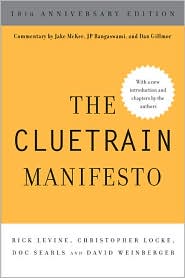
Cluetrain 10th Anniversary edition
Cluetrain 10th Anniversary
Everything Is Miscellaneous
Small Pieces cover
Small Pieces Loosely Joined
Cluetrain cover
Cluetrain Manifesto
My face
Speaker info
Who am I? (Blog Disclosure Form) Copy this link as RSS address Atom Feed

October 31, 2011

The Firefox difference

Sebastian Anthony points to a distinguishing philosophy of Firefox that was not clear to me until I read it. The title is “Firefox is the cloud’s biggest enemy,” which he in the comments admits is not entirely apt. Rather, Firefox wants you to own and control your data; it uses the cloud, but encrypts your data when it does. This is a strong differentiation from Google Chrome and Microsoft IE.

Tweet
Follow me

Categories: policy Tagged with: cloud • firefox • google • microsoft • mozilla • privacy Date: October 31st, 2011 dw

Be the first to comment »

October 18, 2011

[berkman] Yochai Benkler on his new book

Yochai Benkler is giving a talk about his new and wonderful book, The Penguin and the Leviathan. (I interviewed him about it here.)

NOTE: Live-blogging. Getting things wrong. Missing points. Omitting key information. Introducing artificial choppiness. Over-emphasizing small matters. Paraphrasing badly. Not running a spellpchecker. Mangling other people’s ideas and words. You are warned, people.


Yochai begins by pointing to Occupy Wall Street as teaching us much about cooperation and collaboration.


On Oct. 23, 2008, Alan Greenspan acknowledge to Rep. Henry Waxman that his model of the world was wrong. “I made a mistake in presuming that the self interest of organizations…was such that they were best capable of protecting their own shareholders.” We live in a world built around a mistaken model of human motivation, Yochai says. The basic error is not that we are sometimes self-interested, for we are. The mistake is thinking we could build our systems assuming that we are more or less uniformly self-interested. We’ve built systems that try to get incentives right, or that try to get punishment right. But now scientific selfishness has retreated, and we should model our systems on this new knowledge.


In 1968 Gary Becker said that we could model crime by thinking it of a pay-off model: the benefits of the crime vs. the cost of the penalty. So, we get Three Strikes laws. In another domain, the Jenson and Murphy paper on incentive pay for top management assumes that every level of the enterprise will try to shirk and put more in their pockets, so (the theory goes) you should increase the stock options at the top. But that hasn’t worked very well for companies in terms of return to stockholders; you get misalignment from this model. This model is like Becker’s: it’s about getting the incentives and penalties right. Yochai tells of a mother trying to get her three year old into a car by threatening to take five cents off the child’s allowance. “This model penetrates everywhere,” he says.


This intellectual arc is everywhere. Evolutionary biology has moved from group selection to selfish gene through kin altruism and direct reciprocity. Economics also: strong assumptions of self-interest. Political theory, from Downs, to Olson, to Hardin: all assume the inability to come together on a shared set of goals. Management science and organizational sociology: From Taylor to Weber to Schumpeter through Williamson. Although there are counter narratives in each of these fields, selfishness is the dominant model.


And yet on line we see how easily we cooperate. “Things that shouldn’t have worked, have worked.” He draws a 2×2: market based and non-market based vs. decentralized and centralized. In each, there have been huge successes of social production. This is in fact a new solution space.


In each of the aforementioned disciplines, there is now a development of more complex models that take account of cooperation. E.g., evolution: indirect reciprocity; cooperation emerges much more easily in the new models. Economics: shift to experimental and modeling away from self-interest, and the development of neuroeconomics. Political: Eleanor Ostrom on the commons. Management science: Work on team production and networks; high commitment, high-performance organizations.


The core insight of all of these fields is that the model of uniform self-interest is inadequate. Then there’s debate.

Yochai compares Dawkins in The Selfish Gene (1976) and Martin Nowak (2006). Dawkins says we are born selfish. Nowak says: “Perhaps the most remarkable aspect of evolution is its ability to generate cooperation in a competitive world.” It’s an old debate, Yochai says, citing Kropotkin vs. Spencer vs. Boaz vs. Margaret Mead. The debate is now swinging toward Kropotkin, e.g., neural research that shows empathy via brain scans: a partner’s brain lights up in the same way when s/he sees the other person undergoing pain. He points to the effect of oxytocin on trust, and for the first time in Berkman history makes a reference to monogamous voles.


Why does this matter, Yochai asks. He refers to an experiment by Lee Ross et al. Take a standard Prisoner’s dilemma. All predictions say that everyone should defect. Take the same game and give it to American students, Israeli fighter pilots, etc., and told them either “You’re going to play the Community Game” or “The Wall Street Game.” The former 70% opened cooperatively and kept cooperating through the 7 rounds. The latter opened at 30% cooperative. The 30% in the Community Game represent a significant segment that has to be dealt with in a cooperative system. But there’s a big middle that will one or the other depending on what they understand their context to be. So, concludes Yochai, it’s important to design systems that lets the middle understand the system as cooperative.


So, we move from tough on crime to community policing. That changes all sorts of systems, including technical, organizational, institutional, and social. Community policing has been widely adopted because it’s generally successful. We see that we have success with actual practices that depend not on reward and punishment and monitoring, but on coperation. We’re finding out about this online, but it’s not happening just online.


Yochai says that he’s just at the beginning of an investigation about this. There’s a limit to how much we can get out of evolution, he says. It’s hard to design systems on the basis of evolution. Instead, we see a lot of work across many different systems.


But we still want to know: Won’t money help? The answer is what’s called “crowding out.” We care about material interests, but we also care about fairness. We have emotional needs. We have social motivations. What if these interests don’t align? The Titmuss-Arrow debate 1970/1 about the motivations for donating blood. A 2008 study (Mellstrom and Johannsesson) paid people money to give blood. When you allow them to give the money away, it increased the number of people who gave blood. Adding money can suppress an activity more than it increases it. That’s crowding out. It’s not uniform in the population. Designing systems is much harder than coming up with a material reward that appeals to people’s self-interest. We do not have full answers here


Think of cooperative human systems in three vectors. 1. Conceptual: from rationality as univeral self-interest to diversity of motivations. 2. Design: Cooperative human systems designed on behaviorally realistic, evidence-based design. Politics: We cannot separate out incentives from fairness, ethics, empathy, solidarity.

Yochai points to a number of factors, but focuses on fairness: of outcomes, of intentions, and of processes.


Outcomes: What counts as fair is different in different cultures, especially when you move outside of market economies. In market societies, 50:50 is the norm for fairness. Once it gets to 30:70, people will walk away. But you can change that if you change the framing, e.g., “You got lucky.” But there is no single theory of justice. Yochai looks at a study of the cement trucking industry. It turns out that there are large pay disparities. They also differ in what they say they pay for: performance, or equally time. They don’t always do what they say, though. But when you look at real performance measures, you have fewer accident and out of service events if the company is accurate in what it says, no matter what it says.


We don’t have an agreed upon theory of justice, he says. This explains the 99% vs. 53% debate around the Occupy Wall Street. This is a debate over basic moral commitments without which a system cannot function. There is no way to resolve it either through neutral principles or by efficiency arguments.


Intentions also matter to fairness. When you Where bad intentions excluded (e.g., it was just a roll of the dice), then there’s much less negative reciprocity.


Processes: Tyler (2003) showed that procedural justice correlated with internalized compliance. Yochai points to the militarization of the police as they deal with the OWS. The image projected to the crowd is one of lack of regard for process. He compares this to a massive demonstration of Israel in which the police stood a good distance away, and a different relationship was fostered.


We can see a revival of the “sharing nicely” idea we teach our children. In science. In business. Science is beginning to push back against the assumption of selfishness. It turns out that we aren’t universally self-interested. Different people respond differently, and each person responds differently in different contexts.


We need a new field of cooperative human systems design that accounts for the diversity of motivation, and that takes seriously the issue of “crowding out”: adding incentives can result in worse outcomes.


And, Yochai concludes, we need a renewed view of our shared humanity.


Q: Fascinating. But: The passage from evolution to the social sciences has long been discredited. Also, it’s too simple to say that the solution to the banking problem is that we need more cooperation. The banks are supported by a set of interests bigger than that.
A: You say sociobiology has been discredited. That’s true of the early to mid 1980s but is no longer a good description. The social sciences and anthro have been moving to evolutionary models. Economics too. What was in the 1980s was resolved, now, especially in the social sciences, is unresolved. Second, sure, bankers self-select and control the system. The real answer is that it’s a lot of work. When you have a system optimized for money, and money is the social signal, it self-selects for people driven by that. We need long-term interventions to increase cooperation. E.g., the person who can work with Open Source at, say, IBM, is different than the person who can work her/his way up a hierarchy; the company therefore has to train itself to value those who cooperate.


Q: I just went through MIT’s tutorial that instructed me how my ideas would be licensed. I said that maybe there should information in your office about how to contribute more openly. How do systematize open, collaborative forms across the entire educational system?
A: Lots of people in this room are working on this problem in different ways. We fight, we argue, we persuade. Look at university open access publication. We use our power within the hierarchy of universities to raise a flag and to say we can do it a new way. That allows the next person to use us as an example. After I released Wealth of Networks for free on the Web, I got emails from all sorts of people wanting to know how to negotiate that deal for themselves. Universities should be easy.


Q: What are the burning policy implications of this shift in the way we rule the world? What would you change first?
A: I should note that I don’t address that in the book. We need an assessment of community policing and the big board [?] approach. The basic question is whether we continue to build a society based on maximizing total group, or one that trades off some growth for a more equitable distribution of outcomes. The point is much broader than open access, patent, copyright, etc. The deregulatory governance model is based on an erroneous model of interests. But all of my work is done on the micro level, not the level of organizations. But we know that the idea that musicians need the payoffs afforded by infinite copyright is false; we have empirically data about that. So there are places where the relation between the micro interests and institutional interventions is tight. But I don’t talk about that much in the book.


Q: I’ve looked at pay inequality in Japan and the US. The last thing that matters to the level of compliance with regulations is the gap between CEO and workers. The deterrents are very effective in the US, explaining [couldn’t hear it]. Compliance is much better in the US because the penalties are effective deterrents.
A: First, once you’re talking about the behavior of an organization, we don’t have the same kind of data on what happens within a corporate decision. When people see themselves as agents, there can be conflicts between the individual and the organization. For that you need external enforcement.
Q: Jail time makes a huge difference.
A: Then how do you explain the findings that amount of tax options predicts probability of tax fraud. Same baseline enforcement, but whether you had stock options predicts tax fraud. Adding money and punishment certainly has an effect on behavior. But it depends on whether that intervention has better effects than other interventions. But we only have a little bit of data.


Q: If a high school principal came to you who serves many interests and types of people, how could your ideas influence her or him?
A: My mother founded two schools and a volunteer organization. The lessons are relatively straightforward: Higher degrees of authority and trust, structure with clearly set goals, teamwork, less hierarchical distance between students and teachers, less high-stress testing.

Tweet
Follow me

Categories: berkman, philosophy, policy, science, social media Tagged with: benkler • berkman • book • collaboration • cooperation Date: October 18th, 2011 dw

2 Comments »

July 10, 2011

Elliot Noss — an Internet good guy, and my friend — finds additional significance in ICANN’s June decision to open up new dot-whatever names to anyone willing to pay a very hefty price:

Tweet
Follow me

Categories: peace, policy Tagged with: governance • icann Date: July 10th, 2011 dw

1 Comment »

March 1, 2011

Spectrum is abundant

Elliot Noss, CEO of Tucows, has adopted a quirky and admirable approach to submitting filings to official bodies looking for comments on policies. Rather than writing the traditional legalistic brief, he has been commissioning pieces more readable by the non-lawyerly. I wrote an essay for him on copyright, and he’s just submitted and posted a second one by me on spectrum policy. [Disclosure: 1. Elliot is my friend. 2. He offered to pay me for writing this.]

Tweet
Follow me

Categories: policy Tagged with: fcc • open spectrum • spectrum Date: March 1st, 2011 dw

Be the first to comment »

February 18, 2011

National Broadband Map: What the incumbents hath failed to wrought (wring?)

The National Broadband Map is now available. We had wanted to bask in the sunlight provided by the incumbent access providers, but instead we just got freckles. Want to laugh like a broken-hearted clown? View only the places that have fiber to the home.

The map was controversial from its inception, since it at least initially was relying on data coming from parties interested in exaggerating the extent of coverage. (I interviewed Steve Rosenberg at the FCC about his agencies contribution to it, in November 2009.) It does not link to its sources. It did not list my access provider (RCN) as available where I live. Also, the map is very clunky to manipulate. (Hint: Turn off all overlays until you zoom into where you want to see.) (Harold Feld provides a balanced perspective.)

Now want to cry like a generation watching its future slip away? The Republicans seem set on throwing The Master Switch to turn the Internet into a corporate content delivery system. Let your Senators know that you want the Internet to remain the engine of innovation and a public square for free speech.

Tweet
Follow me

Categories: net neutrality, policy Tagged with: broadband • broadbandstrategyweek • fcc • net neutrality • ntia Date: February 18th, 2011 dw

1 Comment »

February 16, 2011

In praise of what Secretary Clinton did not say about Wikileaks

Especially when a prepared talk is being given in the midst of a difficult controversy, most of what matters is in what is not said. For that reason, I think Secretary Clinton’s speech on Net Freedom yesterday was actually quite encouraging about the State Department’s attitude toward Wikileaks. In this I seem to differ with many of my friends and colleagues. (See, for example, this thread from the Berkman mailing list. See also Mathew Ingram. Ethan Zuckerman posts his overall reaction, plus a brilliant draft speech he’d suggested Clinton deliver. Yochai Benkler has posted a draft of a paper [pdf] that — with Yochai’s accustomed astounding command of facts, law, argument, and moral insight — assails the claimed grounds for prosecuting Wikileaks) [Disclosure: I am a Franklin Fellow at the State Dept., attached to the group that works on the internal use of social media. This is a non-paying fellowship, and I feel no obligation to make nice, although I’m human.]

Secretary Clinton spent a substantial portion of her talk discussing Wikileaks.

The Internet’s strong culture of transparency derives from its power to make information of all kinds available instantly. But in addition to being a public space, the Internet is also a channel for private conversations. For that to continue, there must be protection for confidential communication online.

Think of all the ways in which people and organizations rely on confidential communication to do their jobs. Businesses hold confidential conversations when they’re developing new products, to stay ahead of their competitors. Journalists keep the details of some sources confidential, to protect them from retribution.

And governments also rely on confidential communication—online as well as offline. The existence of connection technologies may make it harder to maintain confidentiality, but it does not change the need for it.

Government confidentiality has been a topic of debate during the past few months because of Wikileaks. It’s been a false debate in many ways. Fundamentally, the Wikileaks incident began with an act of theft. Government documents were stolen, just the same as if they had been smuggled out in a briefcase.

Some have suggested that this act was justified, because governments have a responsibility to conduct all of their work out in the open, in the full view of their citizens.

I disagree. The United States could neither provide for our citizens’ security nor promote the cause of human rights and democracy around the world if we had to make public every step of our most sensitive operations.

Confidential communication gives our government the opportunity to do work that could not be done otherwise. Consider our work with former Soviet states to secure loose nuclear material. By keeping the details confidential, we make it less likely that terrorists will find the nuclear material and steal it.

Or consider the content of the documents that Wikileaks made public. Without commenting on the authenticity of any particular documents, we can observe that many of the cables released by Wikileaks relate to human rights work carried out around the world. Our diplomats closely collaborate with activists, journalists, and citizens to challenge the misdeeds of oppressive governments. It’s dangerous work. By publishing the diplomatic cables, Wikileaks exposed people to even greater risk.

For operations like these, confidentiality is essential, especially in the Internet age, when dangerous information can be sent around the world with the click of a keystroke.

Of course, governments also have a duty to be transparent. We govern with the consent of the people, and that consent must be informed to be meaningful. So we must be judicious about when we close off our work to the public and review our standards frequently to make sure they are rigorous. In the United States, we have laws to ensure that the government makes its work open to the people. The Obama Administration has also launched unprecedented initiatives to put government data online, encourage citizen participation, and generally increase the openness of government.

The U.S. government’s ability to protect America — to secure the liberties of our people — and to support the rights and freedoms of others around the world depends on maintaining a balance between what’s public and what should remain out of the public domain. The scale will always be tipped in favor of openness. But tipping the scale over completely serves no one’s interests—and the public’s least of all.

Let me be clear. I said that we would have denounced Wikileaks if it had been executed by smuggling papers in a briefcase. The fact that Wikileaks used the Internet is not the reason we criticized it. Wikileaks does not challenge our commitment to Internet freedom.

One final word on this matter. There were reports in the days following the leak that the U.S. government intervened to coerce private companies to deny service to Wikileaks. This is not the case. Some politicians and pundits publicly called for companies to dissociate from Wikileaks, while others criticized them for doing so. Public officials are part of our country’s public debates, but there is a line between expressing views and coercing conduct. But any business decisions that private companies may have taken to enforce their own policies regarding Wikileaks was not at the direction or the suggestion of the Obama Administration.

Now, one way to read this is to imagine what you wish Clinton had said, or what you would have said if given the opportunity. That certainly has its uses. But it’s essentially a daydream, for it acts as if high-visibility political speeches occur outside of political consequences and negotiations. (Ethan’s imagining, noted above, was within a pragmatic context, attempting to provide a vision for the talk.) If instead we take this speech as the result of a political struggle, then we have to hear not just the daydream, but the nightmare: Forces within the government must have been urging Clinton to take a hard line against Wikileaks and to use Wikileaks as a justification for constraining the Internet. When you consider all that Clinton does not say about Wikileaks, this speech is actually, in my view, quite encouraging. Indeed, in saying that “It’s been a false debate in many ways,” she does not narrow the criticism to the media’s participation; we are left to assume that she is also scolding elements of the government.

You say “Pshaw!” to the idea that this is a pretty enlightened speech? I understand that reaction, since this address is coming from a government that has reacted overall quite poorly to the Wikileaks leaks. (See especially Yochai Benkler’s comments in the Berkman thread and his comprehensive article.)( But that’s exactly why we ought to view the speech as a sign of hope that at least some elements of the government are catching on to what the Net is about, what it’s for, and what it can and cannot do. (“What the Net can and cannot do” is, from my point of view, pretty much the theme of the entire speech, which by itself is encouraging.)

Here’s an example of what I mean by reading the speech in light of what it does not say. Secretary Clinton does say that the Wikileaks incident “began with an act of theft.” But, she is careful not to say that Wikileaks was the thief. Instead, she refers to Wikileaks as making the documents public, as releasing them, and as publishing them. You can imagine the pressure on her to characterize Wikileaks as the source of the documents — as the thief — rather than as the recipient and publisher of them. (She does slip in an ambiguous phrase: “we would have denounced Wikileaks if it had been executed by smuggling papers in a briefcase.”)

Overall, I read the Wikileaks section of the speech as a refusal to blame the Internet, and as a refusal to issue threats against Wikileaks (and against the next Wikileaks-like site). True, Secretary Clinton “condemns” the leaks, but given the range of options for a Secretary of State, what else would you expect? That she would condone the indiscriminate leaking of confidential information? It’s confidential. Of course she’s going to condemn leaks, and in no uncertain terms.

The question is what follows from that condemnation. What followed were not threats against Wikileaks, not a clamping down on State Department security to ensure that “this never happens again,”not a retreat from Clinton’s emphasis on building a “need to share culture” within State, and not support for new policies that would put “reasonable” controls on the Internet to “ensure” that such “illegal acts” never recur, for “a free Internet does not mean a lawless Internet.” (All items in quotes are phrases I’ve made up but that I can imagine some in the government insisting be inserted.) The only statement about policies to address such leaks says that the Obama Administration did not “coerce” private companies to act to shut down (or shut off) Wikileaks; the clear implication is that the government should not engage in such coercion.

Now, we can imagine our own preferred words coming out of Secretary Clinton’s mouth, and we certainly can and should compare her statements with the actual behavior of State and the government overall. There was room for her to have gone further; I would have liked it better if she had, as per Yochai’s suggestion, acknowledged that State initially over-reacted in some chilling ways. But, in the context of the political debate, I think Secretary Clinton’s remarks on Wikileaks are encouraging, and her explicit rejection of limiting Internet freedom because sometimes leaks happen is hopeful.

Tweet
Follow me

Categories: berkman, censorship, policy Tagged with: berkman • egov • hillary clinton • open gov • state department • transparency • wikileaks Date: February 16th, 2011 dw

1 Comment »

December 8, 2010

Standing with the Net

Life is complex, but sometimes it comes down to taking sides.

I don’t mean about Wikileaks. As Micah Sifry [twitter: mlsif] has tweeted, “I don’t know if I’m pro-Wikileaks, but I know I’m anti-anti-Wikileaks.”

Me, too. Especially when the full power of government and commerce is unleashed against it. Wikileaks embodies transitional ambiguity in several intersecting, crucial social processes normally handled unambiguously by traditional institutions. So, ambivalence is a proper response, and, arguably the only proper response. (For contrast, see the right-wing American Enterprise Institute’s reaction, by Mark Thiessen.)

I know I’m anti-anti-Wikileaks not because I know I like Wikileaks (although I do lean that way). It’s not Wikileaks that has summoned the wrath of the incumbents. It’s the Internet. The incumbents have now woken up to the Net’s nature, and are deploying every weapon they can find against it, including siccing Interpol on Julian Assange for incidents of what were reportedly consensual sex. (You’ve probably already read Naomi Wolf’s scathing, hilarious response.) [Later that day: Wolf’s casual assertions are likely wrong. The charges are more serious than what I said.] As Milton Mueller writes at the Internet Governance Project:

Whatever one’s opinion about the wisdom, responsibility and ethical justification of the revelations, it has shown that there is a new countervailing force in the world that the militarists and diplomats don’t know how to control yet. This is, on the whole, a good thing. It is true that the disclosure power Wikileaks invoked can be abused. It can do real damage. But in relative terms, it is far more benign that the power it is being used against in this case and its legitimacy resides more in public opinion than anything else. The hysteria generated by foreign policy hawks polarizes the world around the internet and its capabilities and shows that, all too often, those who claim to be defenders of freedom are its worst enemies.

Denizens of the Net are choosing sides. To my dismay, Amazon and eBay’s PayPal have decided that they are on the Net but not of the Net. When it comes down to it, they have decided they don’t really care for the Internet all that much, except as a low-friction cash register. How we would have rejoiced if Amazon and eBay had stood up to those who want to stop the flow of information that they don’t like. Instead they folded.

Amazon’s capitulation is especially disappointing. It has so benefited from its enlightened ideas about trust and openness. Yet, because karma does occasionally get itself out of bed in the morning, they will pay: What business is going to trust its data to Amazon’s cloud, knowing that one phone call from Senator McScrooge is enough to get Amazon to inspect or destroy its data?

I have my leanings, but I am ambivalent about everything in the past fifteen year’s messy cultural, societal transition. But my ambivalence shows up in how to navigate on the unambivalent ground on which I stand. I stand with the Net.

Tweet
Follow me

Categories: censorship, media, policy Tagged with: wikileaks Date: December 8th, 2010 dw

19 Comments »

« Previous Page


Creative Commons License
This work is licensed under a Creative Commons Attribution-NonCommercial-ShareAlike 3.0 Unported License.
TL;DR: Share this post freely, but attribute it to me (name (David Weinberger) and link to it), and don't use it commercially without my permission.

Joho the Blog uses WordPress blogging software.
Thank you, WordPress!