logo
EverydayChaos
Everyday Chaos
Too Big to Know
Too Big to Know
Cluetrain 10th Anniversary edition
Cluetrain 10th Anniversary
Everything Is Miscellaneous
Small Pieces cover
Small Pieces Loosely Joined
Cluetrain cover
Cluetrain Manifesto
My face
Speaker info
Who am I? (Blog Disclosure Form) Copy this link as RSS address Atom Feed

September 11, 2011

With a little twist of Heidegger

I’m giving a talk in Berlin in a week. My hosts want me to talk about the evolution of media, but suggested that I might want to weave some Heidegger in, which is not a request you often get. It’s a brief talk, but what I’ve written talks about four pairs, all based on Shannon’s original drawing of signal moving through a channel. 1. The medium and bits as idealized abstractions. 2. The medium and messages: How McLuhan reacts against information theory’s idea of a medium, and the sense in which on the Internet we are the medium. 3. Medium and communication: Why we think of communication as something that occurs through a medium, rather than as a way in which we share the world. 4. Medium and noise: Why the world appears, in its most brutal facticity, in Shannon’s diagram as noise, and how the richness of the Web (which consists of connections intentionally made) is in fact signal that taken together can be noise. (I know I am not using these terms rigorously.)

At the end, I’ll summarize the four contrasts:

Bits without character vs. A world that always shows itself as something

The medium as a vacuum vs. We are the medium that moves messages because we care about them

Communication as the reproduction of a representation in the listener’s head vs. Turning to a shared world together

World as noise vs. Links as a context of connection

Not by coincidence, each of these is a major Heideggerian theme: Being-as or meaning, care, truth. and world.

And if it’s not obvious, I do not think that Heidegger’s writings on technology have anything much to do with the Internet. He was criticizing the technology of the 1950s that scared him: mainframes and broadcast. He probably would have hated the Net also, but he was a snobby little fascist prick.
Tweet
Follow me

Categories: culture, infohistory, media, philosophy Tagged with: communications • heidegger • media • shannon Date: September 11th, 2011 dw

7 Comments »

September 3, 2011

[2b2k] Re-reading myselves

When I run into someone who wants to talk with me about something I’ve written in a book, they quite naturally assume that I am more expert about what I’ve written than they are. But it’s almost certainly the case that they’re more familiar with it than I am because they’ve read it far more recently than I have. I, like most writers, don’t sit around re-reading myself. I therefore find myself having to ask the person to remind me of what I’ve said. Really, I said that?

But, over the past twenty-four hours, I’ve re-read myself in three different modes.

I’ve been wrapped up in a Library Innovation Lab project that we submitted to the Digital Public Library of America on Thursday night, with 1.5 hours to spare before the midnight deadline. Our little team worked incredibly hard all summer long, and what we submitted we think is pretty spectacular as a vision, a prototype of innovative features, and in its core, work-horse functionality. (That’s why I’ve done so little blogging this sumer.)

So, the first example of re-reading is editing a bunch of explanatory Web pages — a FAQ, a non-tech explanation of some hardcore tech, a guided tour, etc. — that I wrote for our DPLA project. In this mode, I feel little connection to what I’ve written; I’m trying to edit it purely from the reader’s point of view, as if someone else had written it. Of course, I am oblivious to many of the drafts’ most important shortcomings because I’m reading them through the same glasses I had on when I wrote them. Things make sense to me that would not to readers who have the good fortune not to be me. Nevertheless, it’s just a carpentry job, trying to sand down edges and make the pieces fit. It’s the wood that matters, not whoever the carpenter happened to be.

In the second mode, I re-read something I wrote a long time ago. Someone on the Heidegger mailing list I audit asked for articles on Heidegger’s concept of the “world” in Being and Time and in The Origin of the Artwork. I remembered that I had written something about that a couple of careers ago. So, I did a search and found “Earth, World and the Fourfold” in the 1984 edition of Tulane Studies in Philosophy. (It’s locked up nice and tight so, no, you can’t read it even if you want to. Yeah, this is a completely optimal system of scholarship we’ve built for ourselves. [sarcasm]) I used my privileged access via my university and re-read it. It’s a fully weird experience. I remember so little of the content of the article and am so disassociated from the academic (or more exactly, the pathetic pretender to the same) I was that it was like reading a message from a former self. Actually, it wasn’t like that. It was that exactly.

I actually enjoyed reading the article. For one thing, unsurprisingly, I agreed with its general outlook and approach. It argues that Heidegger’s shifting use of “world,” especially with regard to that which he contrasts it with, expresses his struggle to deal with the danger that phenomenology will turn reality into a mere appearance. How can phenomenology account for that which shows itself to us as being beyond the mere showing? That is, how do we understand and acknowledge the fact that the earth shows itself to us as that which was here before us and will outlast us?

Since this was the topic of my doctoral dissertation and has remained a topic of great interest to me — it runs throughout all my books, including Too Big to Know — it’s not startling that I found Previous Me’s article interesting. And yet, Present Me persistently asked two sorts of distancing questions.

First, granting that the question itself is interesting, why was this guy (Previous Me) so wrapped up in Heidegger’s way of grappling with it? To get to Heidegger’s answers (such as they are) you have to wade through a thicket wrapped in profound scholarship wrapped in arrogantly awful writing. Now, Present Me remembers the personal history that led Previous Me to Heidegger: an identity crisis (as we used to call it) that manifested itself intellectually, that could not be addressed by pre-Heideggerian traditional philosophy (because that tradition of philosophy caused the intellectual conundrum in the first place). But outside of that personal history, why Heidegger? So, the article reads to Present Me as a wrestling match within a bubble invisible to Previous Me.

Second, my internal editor was present throughout: Damn, that was an inelegant phrase! Wait, this paragraph needs a transition! What the hell did that sentence mean? Jeez, this guy sounds pretentious here!

So, reading something of mine from the distant past was a tolerable and even interesting experience because PreviousMe was distant enough.

Third, I am this weekend reading the page proofs of Too Big to Know. At this point in the manufacturing process known as “writing a book,” I am allowed only to make the most minor of edits. If a change causes lines on the page to shift to a new page, there can be consequences expensive to my publisher. So, I’m reading looking for bad commas and “its” instead of “it’s”, all of which should have been (and so far have been) picked up by Christine Arden, the superb copy-editor who went through my book during the previous pass. But, I also am reading it looking for infelicities I can fix — maybe change an “a” to “the” or some such. This requires reading not just for punctuation but also for rhythm and meaning. In other words, I simultaneously have to read the book as if I were a reader, not just an editor. And that is a disconcerting, embarrassing, frustrating process. There are things about the book that pleasantly surprise me — Where did I come up with that excellent example! — but fundamentally I am focused on it critically. Worse, this is PresentMe seeing how PresentMe presents himself to the world. I am in a narcissistic bubble of self-loathing.

Which is too bad since this is the taste being left by what is very likely to be the last time I read Too Big to Know.

(My publisher would probably like me to note that the book is possibly quite good, and the people who have read it so far seem enthusiastic. But, how the hell would I know before you tell me?)

Tweet
Follow me

Categories: culture, philosophy, too big to know Tagged with: 2b2k • dpla • heidegger • writing Date: September 3rd, 2011 dw

7 Comments »

June 25, 2011

Interesting reading abounds

Ever since I ended my paper-based relationship with the Boston Globe, I’ve done my breakfast reading in front of a monitor on our kitchen table. Today, I spent a little longer, and read some excellent articles:

  • Stephen Metcalf writes about Robert Nozick’s legitimizing effect on Libertarianism, and the philosophical weakness of the case he made for it. I have not heard anyone else make Metcalf’s critique of the Wilt Chamberlain argument (so far as I recall).

  • In Scientific American, John Horgan defends Stephen Jay Gould from the charge that his brilliant example of personal bias affecting scientific outcomes was itself based on Gould’s own biases. It’s actually a weak defense, with Horgan instead defending a related point SJG was making: “Maybe Gould was wrong that Morton misrepresented his data, but he was absolutely right that biological determinism was and continues to be a dangerous pseudoscientific ideology.” By coincidence, a couple of days ago I came across my old copy of an anthology titled “The Sociobiology Debate” that was compiled in 1978 when the idea that evolution shape ours our social behavior was not just controversial, but to many of us (including me) seemed quite threatening: it implied a lack of free will (which I no longer care about) and it was sometimes used to give a sheen of inevitability to the most conservative and even oppressive of social behaviors. Unfortunately, Horgan’s argument against sociobiology consists of the following single paragraph:

    “Biological determinism is a blight on science. It implies that the way things are is the way they must be. We have less choice in how we live our lives than we think we do. This position is wrong, both empirically and morally. If you doubt me on this point, read [Gould’s] Mismeasure [of Man], which, even discounting the chapter on Morton, abounds in evidence of how science can become an instrument of malignant ideologies.”

  • Also in Slate, I disagree so sharply with Jack Shafer’s criticism of Jose Antonio Vargas that I think I must be missing something obvious. Jose is the former Washington Post and Huffington Post journalist (and Pulitzer-prize winner, by the way) who came out as an undocumented immigrant in an article in tomorrow’s NY Times Magazine. Shafer declares himself to be an “immigration dove”: “I believe in open borders and detest our current laws and their enforcement.” If you hate the law’s enforcement, how can you also get in a snit about someone who lies to evade that enforcement? Or perhaps it’s only journalists who shouldn’t lie to their employers about their immigration status because there needs to be a special bond of trust between the editor and the journalist. So, which jobs does Shafer think do not require trust? Or is this just journalism dealing with its self-esteem issues again? Jose didn’t lie about his credentials, and he didn’t lie in his stories. He lied about the thing the bad laws Shafer “detests” made him lie about, just as forty years ago he likely would have had to lie about his sexual preferences. If Shafer thinks Jose’s admission makes him unreliable, then go through his work and find where this lack of reliablity manifests itself. If it doesn’t, then salute Jose for his honesty and courage. (Disclosure: Although I haven’t talked with him in a year or two, I count Jose as a friend, beginning in his pre-Pulitzer WaPo days. He has struck me as an honest, open-minded, and impassioned inquirer. I like him a lot.)

Tweet
Follow me

Categories: culture, journalism, media, philosophy, politics, science Tagged with: jose anotion vargas • libertarianism • nozick • philosophy • science • sociobiology • stepohen jay gould Date: June 25th, 2011 dw

3 Comments »

June 8, 2011

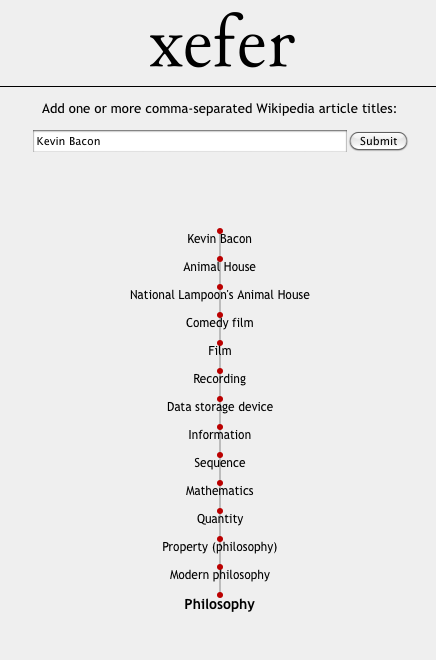
Six degress of philosophy

In what is certainly the coolest proof that philosophy is the Queen of the Sciences, and also the Duke and all of the in-laws, xefer shows the relation of any Wikipedia topic to its “Philosophy” article. (Hat tip to Hal Roberts.)

Kevin Bacon to Philosophy

Tweet
Follow me

Categories: humor, philosophy Tagged with: kevin bacon • philosophy • wikipedia Date: June 8th, 2011 dw

1 Comment »

May 30, 2011

The titles of philosophy

Philosophers Carnival at Philosophy, etc. points to philosophical posts from around the Web over the past three months. Many of them weigh in on age old questions about the continuity of consciousness, whether objective morality is possible without Heaven and Hell, and whether time travel is possible.

But I was especially struck by the online sites and journals where the articles were posted:

  • What Blag?

  • Gavagai!

  • Only a Game

  • Yeah, Ok

  • Horseless Telegraph

  • The Partially Examined Life

  • Huenemanniac

This is a far cry from titles such as the Review of Metaphysics and Journal of Medieval and Early Modern Studies typical of the printed output of the old school. (Browse a list here.) The new titles seem to mock the academy, even though many of the papers would be at home in its traditional publications. But slowly the wrapped will take on the properties of the wrapper…

Tweet
Follow me

Categories: philosophy, too big to know Tagged with: 2b2k • philosophy Date: May 30th, 2011 dw

Be the first to comment »

March 13, 2011

Former philosophy majors

Here’s a list of famous people who started out as philosophy majors.

You can take this either as evidence of the utility of majoring in philosophy, or as evidence that if you want to succeed, you should flee from your background as a philosophy major.

Tweet
Follow me

Categories: philosophy Tagged with: philosophy Date: March 13th, 2011 dw

3 Comments »

« Previous Page


Creative Commons License
This work is licensed under a Creative Commons Attribution-NonCommercial-ShareAlike 3.0 Unported License.
TL;DR: Share this post freely, but attribute it to me (name (David Weinberger) and link to it), and don't use it commercially without my permission.

Joho the Blog uses WordPress blogging software.
Thank you, WordPress!